Canadian Prefab Homes for Sale in Canada: Pricing, Designs & Buyer Guide (2026)
Canadian prefab homes for sale offer a faster, high-quality alternative to traditional construction, using factory-built modular methods designed for Canadian climates.
This article explains pricing, designs, energy efficiency, construction timelines, and how to choose the right prefab home in Canada.
Canadian Prefab Homes for Sale in Canada (2026 Buyer Guide)
Canadian prefab homes for sale represent a modern construction method for building a high quality new home in Canada’s diverse weather conditions.
Unlike a traditional site-built home, prefab homes are factory-built in a controlled environment, which improves quality control, energy efficiency, and construction timelines.
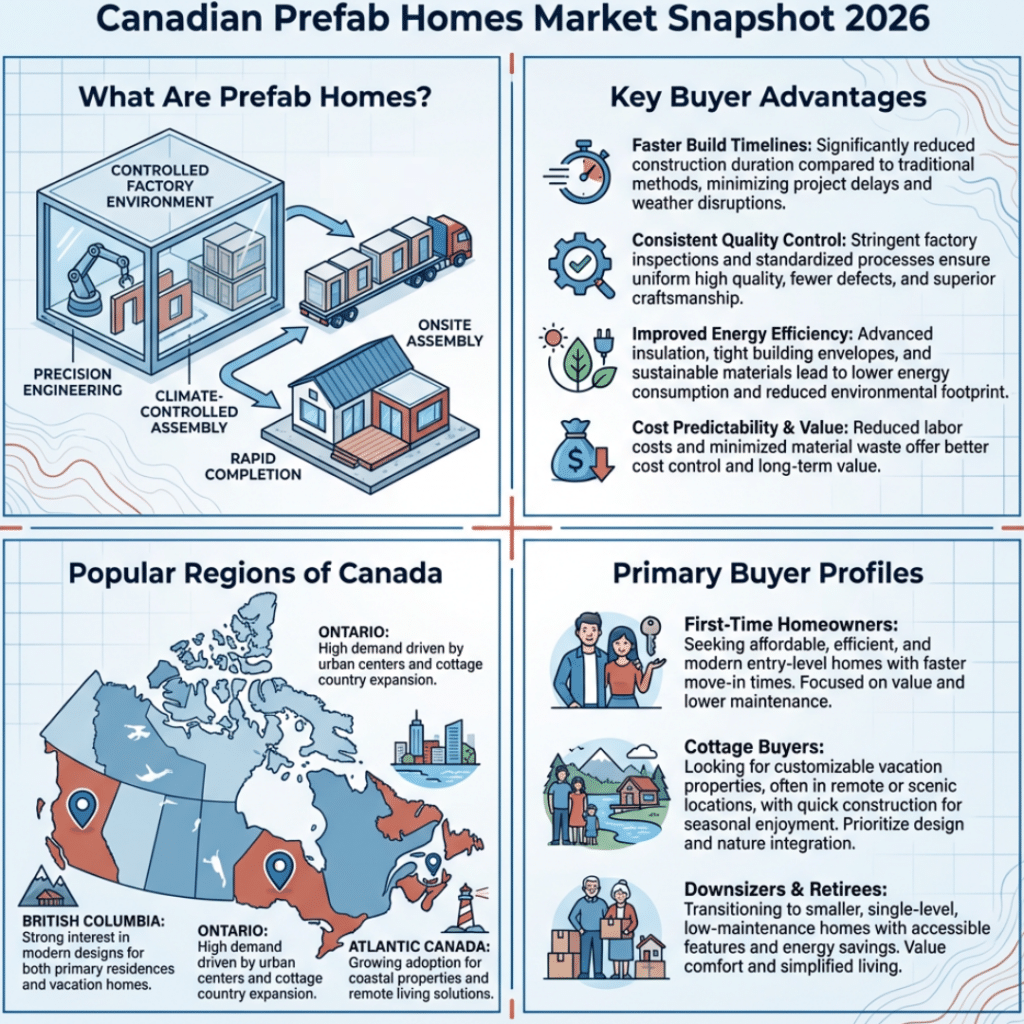
Above is a buyer snapshot of Canadian prefab homes for sale, highlighting modular construction, key benefits, popular regions, and who prefab homes are best suited for in 2026.
According to the Canada Mortgage and Housing Corporation, modular construction and factory-built housing can reduce build timelines by up to 30% while delivering more consistent quality and long-term performance.
This guide is designed for buyers browsing Canadian prefab homes for sale across British Columbia, Ontario, New Brunswick, Atlantic Canada, and northern regions such as the Northwest Territories.
It explains prefab building methods, floor plans, living space options, and how My Own Cottage supports customers step of the way—from design team consultation to move-in peace of mind.
What Are Canadian Prefab Homes for Sale?
Canadian prefab homes for sale are factory-built new homes assembled on-site
Canadian prefab homes for sale are factory-built homes constructed off-site and assembled on your land, offering faster timelines, high quality construction, and energy-efficient homes designed for Canada.
Prefab homes—also called factory-built or modular buildings—are produced using precision-built systems inside climate-controlled facilities.
According to the CSA Group, certified prefab building systems must comply with CSA A277, ensuring electrical, plumbing, structural, and fire safety equivalency with site-built homes.
This construction method reduces weather exposure, improves handling of building materials, and delivers consistent quality across popular models and home plans.
Canadian prefab homes are built indoors, shipped to your site, and assembled quickly, delivering quality homes designed for Canadian climates.
Buyers comparing builders and designs may also want to review the best Canadian prefab homes to understand quality, performance, and builder reputation.
Prefab homes differ from site-built homes in construction method and quality control
Prefab homes differ from a site-built home primarily in construction method and inspection process.
While traditional construction happens entirely outdoors, prefab homes are built in a controlled environment with repeatable quality checks at every stage.
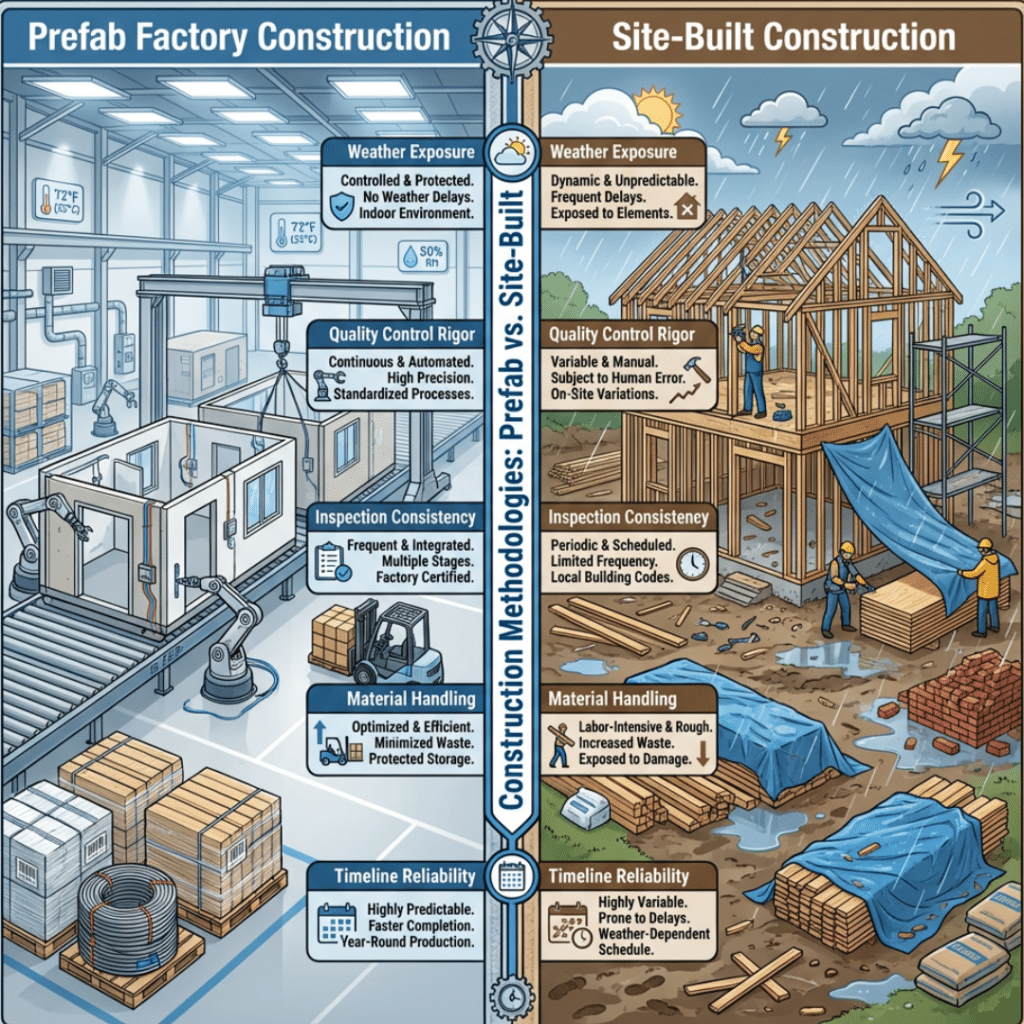
A side-by-side comparison showing how Canadian prefab homes for sale differ from site-built homes in construction method, quality control, and reliability.
The National Research Council confirms that factory-built housing enables tighter tolerances, improved insulation continuity, and superior building envelope performance.
According to the Canadian Home Builders’ Association, modular construction also reduces construction waste and improves overall building experience.
Importantly, this is particularly valuable in regions like British Columbia, Atlantic Canada, and New Brunswick where weather delays often impact site-built projects.
Prefab homes use controlled factory construction to deliver consistent quality that is difficult to achieve on open job sites.
Prefab homes in Canada include modular homes, park models, and tiny homes
Canadian prefab homes for sale include a wide variety of housing types, from tiny homes and park models to large modular homes exceeding 2,000 square feet.
Buyers can choose from standard floor plans or pursue custom design options that optimize living space, interior design, and energy efficiency.
According to listings aggregated by PrefabList, the most popular models in Canada include small prefab cottages, modern prefab homes, log cabin–style designs, and precision-built modular buildings suitable for year-round living.
These prefab packages are commonly used for recreational properties, move homes, and permanent residences.
Prefab homes in Canada range from compact tiny homes to large custom modular homes built for full-time living.
Are Canadian Prefab Homes for Sale High Quality?
Canadian prefab homes are considered high quality when CSA-certified
Canadian prefab homes are considered high quality when they are built to CSA standards and comply with the National Building Code of Canada.
High quality prefab homes undergo third-party inspections during factory production, ensuring structural integrity, safe electrical systems, and durable building materials.
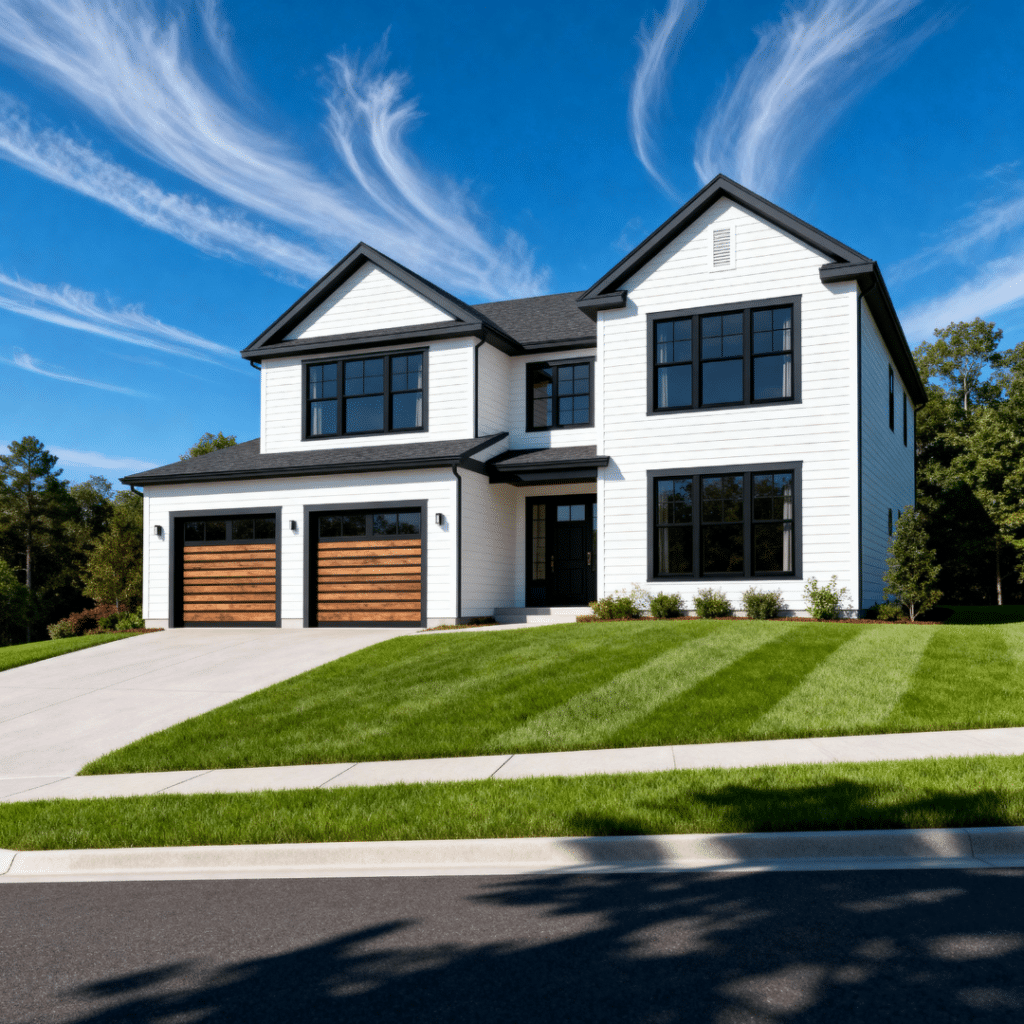
A high-quality Canadian prefab home built to CSA certification standards, demonstrating the durability and craftsmanship of factory-built construction.
According to guidance published by the Canada Mortgage and Housing Corporation, factory-built homes demonstrate fewer construction defects related to moisture intrusion and framing errors than many site-built homes.
This consistent quality provides long-term reliability and peace of mind for homeowners.
CSA-certified prefab homes meet the same building code standards as traditional homes, often with stronger quality control.
Factory-built construction improves energy efficiency and durability
Prefab homes are especially well suited for energy-efficient homes due to factory precision and reduced thermal gaps.
Organizations such as Passive House Canada and the Canada Green Building Council note that prefab building techniques support advanced insulation strategies, airtight construction, and durable assemblies.
This level of energy efficiency is critical in regions with extreme weather conditions.
Northern Ontario, Atlantic Canada, and the Northwest Territories represent areas where heating performance and envelope durability directly affect operating costs and comfort.
Prefab homes achieve high energy efficiency because precision factory construction minimizes air leakage and thermal loss.
Long-term performance depends on builder experience and materials
The long-term performance of Canadian prefab homes depends heavily on builder years of experience, material selection, and warranty coverage.
Reputable manufacturers affiliated with organizations such as the Tarion Warranty Corporation and the Atlantic Home Warranty provide structural coverage, customer service protections, and post-installation support.
At My Own Cottage, prefab homes are developed with great pride, focusing on quality control, durable building materials, and a great experience from initial browsing experience to final installation.
A high-quality prefab home depends on certified materials, experienced builders, and strong warranty protection.
Canadian Prefab Homes for Sale Pricing and Affordability
Canadian prefab homes for sale typically cost less than a traditional site-built home
Canadian prefab homes for sale are generally more affordable than a comparable site-built home because the construction method reduces labour hours, material waste, and weather-related delays.
According to the Canada Mortgage and Housing Corporation, factory-built and modular construction can lower total construction costs by 10–25% depending on region, design complexity, and site conditions.
Prefab homes benefit from bulk purchasing of building materials, predictable timelines, and consistent quality control in a controlled environment.
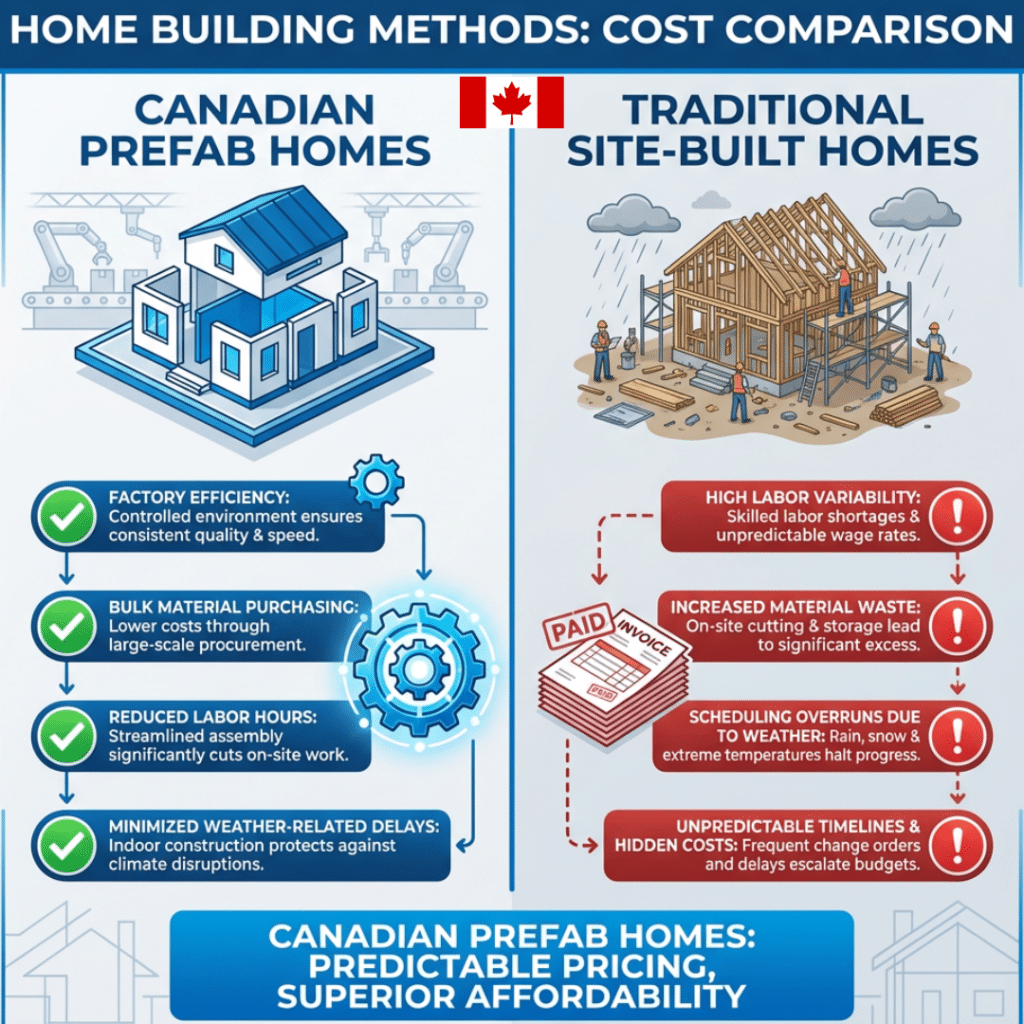
A cost comparison showing why Canadian prefab homes for sale typically cost less than traditional site-built homes.
This affordability advantage is particularly noticeable in British Columbia and Ontario, where labour shortages and weather conditions often increase the cost of traditional construction projects.
Prefab homes are often more affordable because factory construction reduces delays, waste, and unpredictable labour costs.
Average price ranges for prefab homes in Canada vary by size and region
The price of Canadian prefab homes for sale depends on square feet, floor plans, finishes, and regional delivery costs.
National pricing data compiled from prefab directories and builder disclosures shows that most prefab homes fall into three broad ranges.
Small prefab homes and tiny homes under 800 square feet typically range from $150,000 to $250,000 before land and site work.
Mid-sized modular homes between 1,000 and 1,600 square feet often range from $250,000 to $400,000.
Larger custom design prefab homes exceeding 2,000 square feet can range from $400,000 to $650,000 or more, depending on interior design choices and energy efficiency targets.
According to Prefab Review, transportation distance, crane access, and foundation type are major pricing variables, especially in Atlantic Canada and northern regions such as the Northwest Territories.
Prefab home pricing depends on size, design, and regional logistics rather than a single fixed cost.
Site costs, permits, and services affect total prefab home affordability
While prefab building reduces construction costs, buyers must also budget for land preparation, foundations, utility connections, and permits.
Municipal planning departments in provinces such as British Columbia, Ontario, and New Brunswick regulate zoning, setbacks, and servicing requirements that can influence total project cost.

An affordability breakdown showing how site costs, permits, and services affect the total cost of Canadian prefab homes for sale.
According to the National Research Council, modular homes must comply with both factory certification standards and local installation codes, meaning site work costs vary by municipality.
In rural Atlantic Canada, simpler foundations and servicing often reduce overall costs compared to urban centres.
Prefab homes remain affordable overall, but total pricing depends on site readiness and local permitting requirements.
Financing options for Canadian prefab homes are widely available
Financing Canadian prefab homes for sale is similar to financing a traditional new home when the home is CSA-certified and permanently installed.
The Canada Mortgage and Housing Corporation confirms that CMHC-insured mortgages are available for modular and factory-built homes that meet National Building Code requirements.
In Ontario, warranty-backed homes registered with the Tarion Warranty Corporation are commonly accepted by major lenders.
In Atlantic Canada, regional programs supported by the Atlantic Home Warranty provide similar lender confidence.
Prefab homes can be financed like traditional homes when they meet CSA certification and permanent foundation requirements.
For a detailed breakdown of lender requirements, construction mortgages, and coverage considerations, see our guide to prefab home financing and insurance in Canada.
Small, Modern, and Cheap Canadian Prefab Homes for Sale
Small Canadian prefab homes for sale maximize affordability and efficiency
Small Canadian prefab homes for sale are among the most popular options for buyers seeking efficient living space and lower upfront costs.
These homes typically range from 400 to 900 square feet and are designed to optimize floor plans, storage, and energy efficiency.
According to Canadian Home Builders’ Association research, smaller modular homes benefit most from factory-built precision because reduced square footage amplifies the benefits of quality control and efficient layouts.
For reference, small prefab homes are commonly used as primary residences, cottages, move homes, and secondary suites.
Throughout Canada, small prefab homes offer efficient living space with lower costs and faster build timelines.
Modern Canadian prefab homes for sale focus on design and performance
Modern Canadian prefab homes for sale emphasize clean lines, open-concept living space, large windows, and high-performance building envelopes.
These homes often incorporate passive house principles, advanced insulation, and energy-efficient mechanical systems.

A modern Canadian prefab home for sale that combines contemporary design with high-performance, energy-efficient construction.
Organizations such as Passive House Canada note that modern prefab homes are well suited to precision-built construction methods that support airtightness and thermal efficiency.
In provinces like British Columbia and Ontario, modern prefab designs are frequently chosen for both urban infill and rural properties.
Modern prefab homes combine contemporary design with high energy efficiency and consistent quality.
Cheap Canadian prefab homes for sale balance cost and quality
Cheap Canadian prefab homes for sale do not necessarily mean low quality.
Many affordable prefab homes use standardized home plans, simplified rooflines, and durable finishes to reduce costs while maintaining structural integrity.
According to affordability studies cited by the Canada Mortgage and Housing Corporation, standardized modular construction reduces per-unit costs without compromising safety or performance.
Buyers in regions such as New Brunswick and Atlantic Canada often choose simpler prefab packages to achieve a balance between affordability and long-term durability.
Affordable prefab homes focus on smart design choices rather than cutting corners.
Choosing the right prefab home type depends on lifestyle and location
The best Canadian prefab home for sale depends on intended use, climate, and long-term plans.
Tiny homes and small prefab cottages are ideal for recreational properties and downsizing, while modern modular homes suit full-time living and growing families.
Municipal zoning rules, servicing availability, and weather conditions should always be considered during the planning phase.
Builders with regional experience in British Columbia, Ontario, Atlantic Canada, and northern climates are best positioned to recommend appropriate designs.
The right prefab home choice aligns budget, lifestyle, and regional requirements.
How Canadian Prefab Homes Are Built and Delivered
Canadian prefab homes are built in a controlled factory environment
Canadian prefab homes are built inside a controlled environment where building materials, labour, and processes are standardized for consistent quality.
This factory-built approach protects the construction project from rain, snow, and temperature swings.
This process is especially important in regions with challenging weather conditions such as British Columbia, Atlantic Canada, and the Northwest Territories.
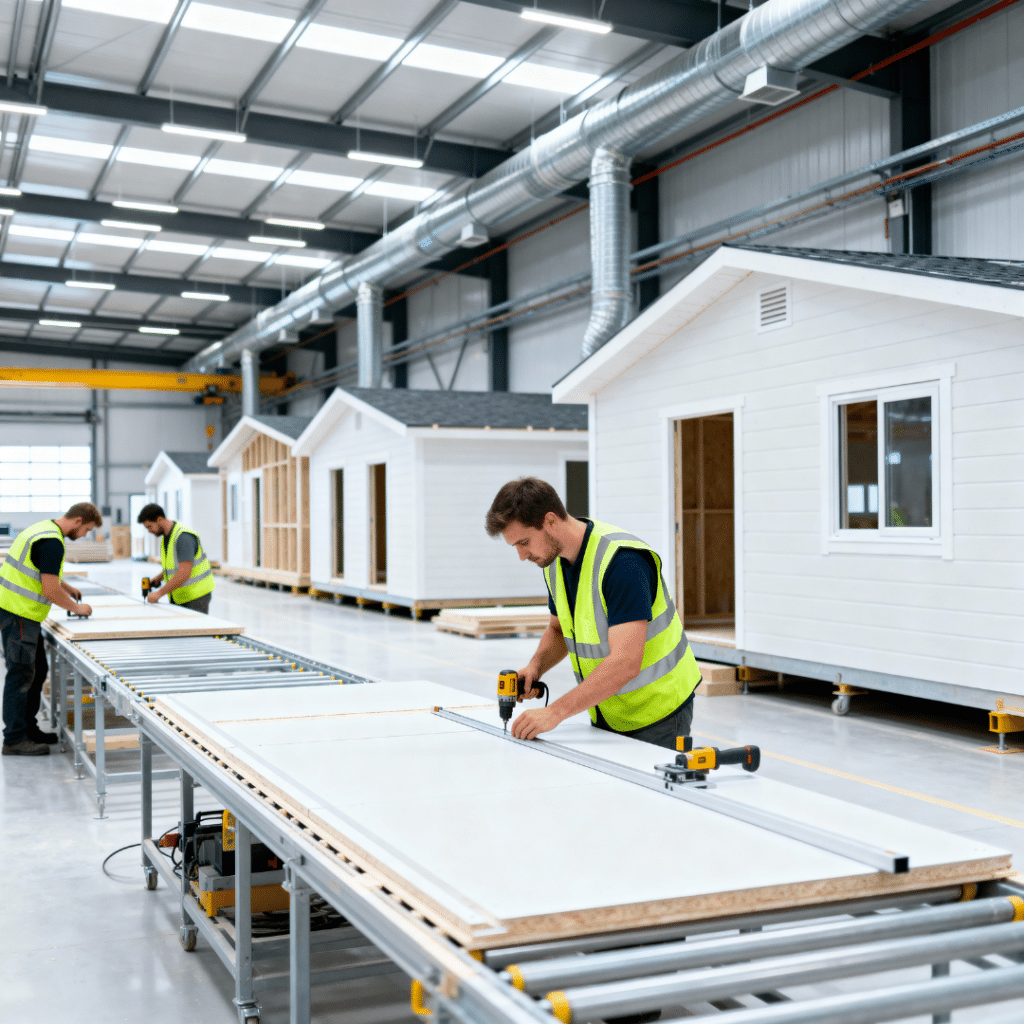
Prefab home modules being constructed indoors in a controlled factory environment, ensuring consistent quality and protection from weather.
According to the National Research Council, controlled-environment construction improves structural accuracy, reduces moisture-related defects, and supports better long-term building envelope performance.
This construction method allows prefab homes to achieve higher quality control than many site-built homes.
Prefab homes are built indoors to improve quality, accuracy, and durability in Canadian climates.
Modular construction uses precision-built sections assembled on your land
Most Canadian prefab homes for sale use modular construction, meaning the home is built in sections and transported to the building site for final assembly.
These modular buildings are engineered to withstand transportation loads and are installed on permanent foundations, making them equivalent to a traditional new modular home once completed.
According to the CSA Group, modular construction certified under CSA A277 must meet the same structural and safety requirements as a site-built home.
This ensures consistent quality regardless of where the home is installed, whether in Ontario, New Brunswick, or rural Atlantic Canada.
Modular homes are delivered in sections and assembled quickly on a permanent foundation.
Factory-built homes undergo third-party inspections during production
Quality control is a defining feature of Canadian prefab homes.
During factory production, homes are inspected at multiple stages by third-party agencies authorized under CSA certification programs.
These inspections verify framing, electrical systems, plumbing, and insulation before the home ever leaves the factory.
According to the Canada Mortgage and Housing Corporation, this inspection process reduces construction defects and increases buyer confidence.
Of note, is that this is particularly effective for first-time buyers and those building in remote regions.
Prefab homes are inspected throughout factory production to ensure consistent quality and code compliance.
Delivery, Installation, and Construction Timeline
Prefab home construction timelines are shorter than traditional builds
Canadian prefab homes for sale typically follow a shorter and more predictable timeline than site-built homes.
Factory production often takes 8 to 12 weeks, while on-site installation and finishing may take an additional 4 to 8 weeks depending on site readiness and weather conditions.
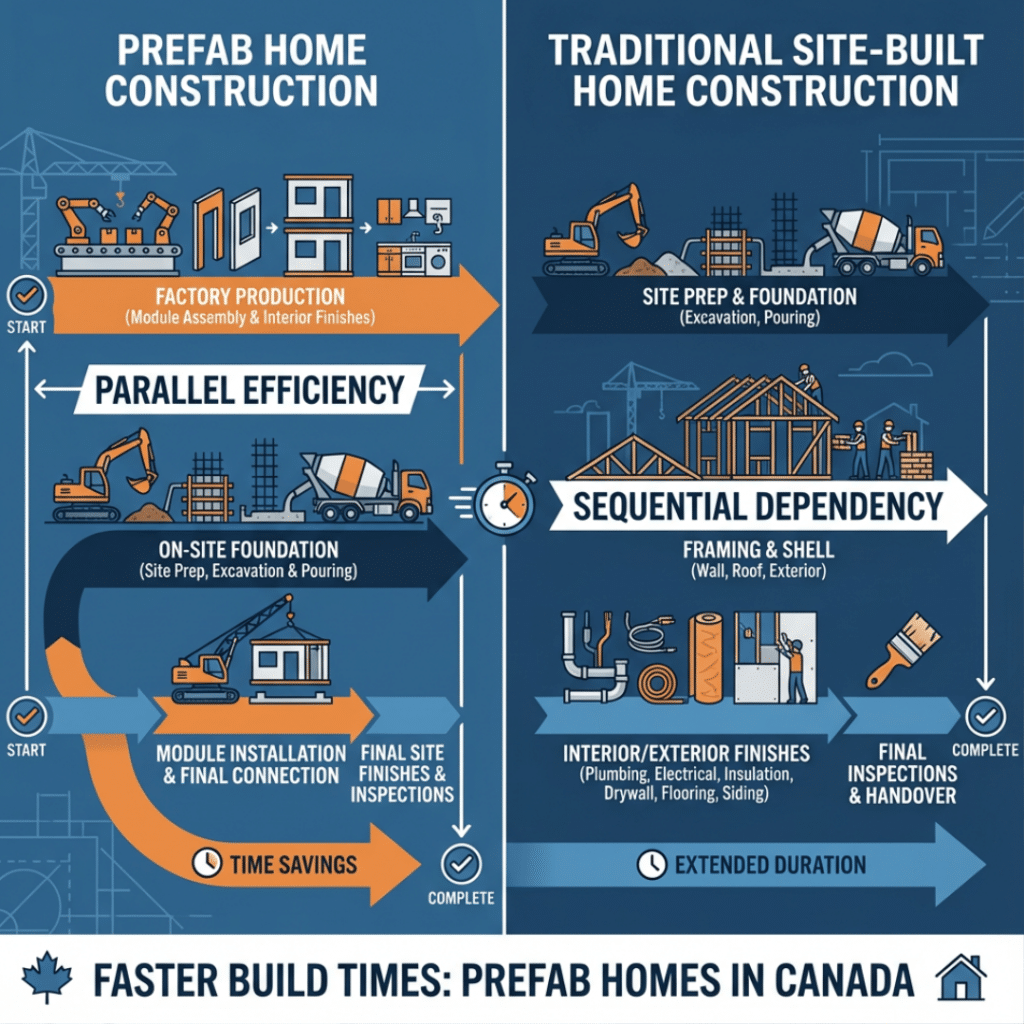
A timeline comparison showing how Canadian prefab homes for sale are built faster through parallel factory construction and site preparation.
According to industry data referenced by the Canadian Home Builders’ Association, modular construction reduces overall build time by minimizing on-site labour and sequencing delays.
This timeline advantage is especially valuable in provinces with short building seasons.
Prefab homes are completed faster because factory and site work happen in parallel.
Site preparation and foundations are completed before home delivery
Before delivery, the building site must be prepared with foundations, utility connections, and access routes.
Municipal planning departments in British Columbia, Ontario, and New Brunswick oversee zoning, setbacks, along with servicing requirements to ensure the home can be installed safely and legally.
According to the National Research Council, proper site preparation is essential for long-term performance, especially in regions with frost, high winds, or coastal conditions common in Atlantic Canada.
Prefab home success depends on proper site preparation before delivery.
Transportation and crane installation are coordinated by experienced teams
Once factory construction is complete, prefab home modules are transported to the site and installed using cranes.
This step is carefully coordinated to minimize disruption and ensure precision placement.
Transportation logistics are a key consideration in remote or northern areas, including parts of the Northwest Territories.
Builders with extensive homebuilding experience manage transportation permits, crane access, and installation sequencing to ensure a smooth process from factory to finished home.
Prefab homes are installed quickly using cranes and experienced installation teams.
What to Expect When Buying a Canadian Prefab Home
The buying process follows clear steps from design to move-in
Buying a Canadian prefab home for sale typically begins with selecting a home plan or custom design, followed by site assessment, permitting, factory production, delivery, and final installation.
Throughout the process, buyers work closely with the design team to customize floor plans, interior design features, and energy efficiency options.
According to guidance from the Canada Mortgage and Housing Corporation, clear planning and early coordination with local authorities reduce delays and unexpected costs.
Prefab home purchases follow a structured process that improves predictability and buyer confidence.
Local regulations and zoning affect prefab home approvals
Although prefab homes are built to national standards, local regulations still apply.
Municipal zoning bylaws, building permits, and inspections vary by province and municipality.
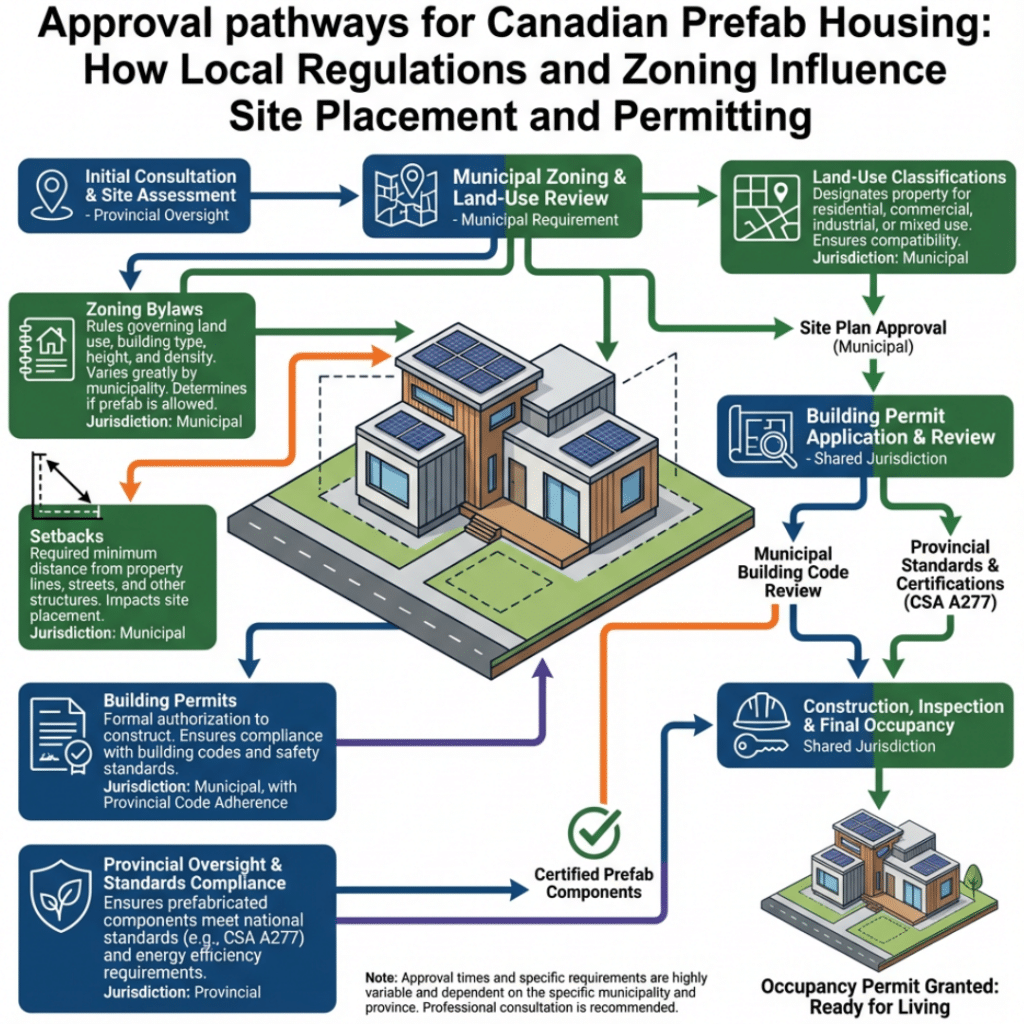
Local zoning bylaws and municipal regulations play a key role in approving Canadian prefab homes for sale.
In Quebec, approvals are overseen by the Régie du bâtiment du Québec, while other provinces rely on municipal building departments.
Understanding local requirements is critical, particularly in urban areas and coastal communities where zoning and environmental rules are more complex.
Prefab homes must comply with both national standards and local zoning rules.
Learn more about prefab home regulations in Canada, including zoning, permitting, and inspection requirements across provinces.
Working with an experienced prefab provider reduces risk
Choosing a provider with years of experience in modular construction significantly reduces risk.
Experienced builders understand regional weather conditions, permitting processes, and logistics challenges across Canada, from British Columbia to Atlantic Canada.
At My Own Cottage, customers are supported step of the way, from early planning through final installation, ensuring a smooth building experience and peace of mind.
An experienced prefab provider simplifies the process and improves outcomes.
Energy Efficiency and Cold-Climate Performance of Canadian Prefab Homes
Canadian prefab homes are designed for high energy efficiency in cold climates
Canadian prefab homes are engineered to perform in extreme weather conditions, including cold winters, high winds, and heavy snow loads.
Factory-built construction allows tighter building envelopes, continuous insulation, and precise air sealing that is difficult to achieve consistently with a site-built home.
According to the Canada Mortgage and Housing Corporation, factory-built and modular homes often exceed minimum energy code requirements due to controlled assembly and reduced thermal bridging.
This makes prefab homes a strong choice for provinces such as Ontario, British Columbia, New Brunswick, and regions of Atlantic Canada.
Prefab homes achieve higher energy efficiency because precision factory construction reduces heat loss.
Building envelope quality is a key advantage of prefab construction
The building envelope of a prefab home includes walls, roof, floors, windows, and doors that separate indoor living space from outdoor weather conditions.
Because prefab homes are built indoors, insulation, vapour barriers, and air barriers are installed under ideal conditions with consistent quality control.

Depicted above is a diagram showing how Canadian prefab homes for sale achieve superior building envelope quality through factory-built insulation, air sealing, and precision construction.
Research from the National Research Council shows that factory-built assemblies demonstrate more consistent insulation coverage and fewer air leaks than comparable site-built assemblies.
This results in improved comfort, lower heating costs, and longer material lifespan.
A well-built prefab envelope improves comfort, durability, and long-term energy performance.
Passive house and net-zero strategies are easier to implement in prefab homes
Many Canadian prefab homes incorporate passive house or net-zero design strategies due to the precision of factory-built construction.
These strategies include high-performance windows, advanced insulation systems, heat recovery ventilation, and optimized building orientation.
Organizations such as Passive House Canada and the Canada Green Building Council note that prefab construction simplifies achieving airtightness targets and energy modeling goals.
This is particularly valuable in colder regions where energy efficiency directly affects affordability and comfort.
Prefab homes are well suited for passive house and net-zero performance targets.
Sustainability and Environmental Impact of Prefab Homes
Prefab homes generate less construction waste than site-built homes
Prefab building methods reduce waste because materials are cut, stored, and reused efficiently in a factory setting.
Excess materials are recycled more easily, and mistakes are minimized through repeatable processes.
According to sustainability research referenced by the Canada Green Building Council, factory-built construction can reduce material waste by up to 50% compared to traditional site-built methods.
This lower environmental impact appeals to buyers seeking energy-efficient homes with responsible construction practices.
Prefab construction reduces waste and improves sustainability outcomes.
Sustainable materials and efficient systems are commonly used in prefab homes
Many Canadian prefab homes use sustainably sourced lumber, low-emission finishes, and energy-efficient mechanical systems.
These choices improve indoor air quality and reduce long-term environmental impact.
Programs supported by the Canadian Home Builders’ Association encourage builders to adopt efficient building materials and high-performance systems.
In provinces like British Columbia and Quebec, sustainability-focused prefab designs are increasingly common for both urban and rural housing.
Prefab homes often combine sustainable materials with efficient systems for long-term performance.
Energy-efficient prefab homes lower long-term operating costs
Energy-efficient prefab homes typically have lower heating, cooling, and maintenance costs over time.
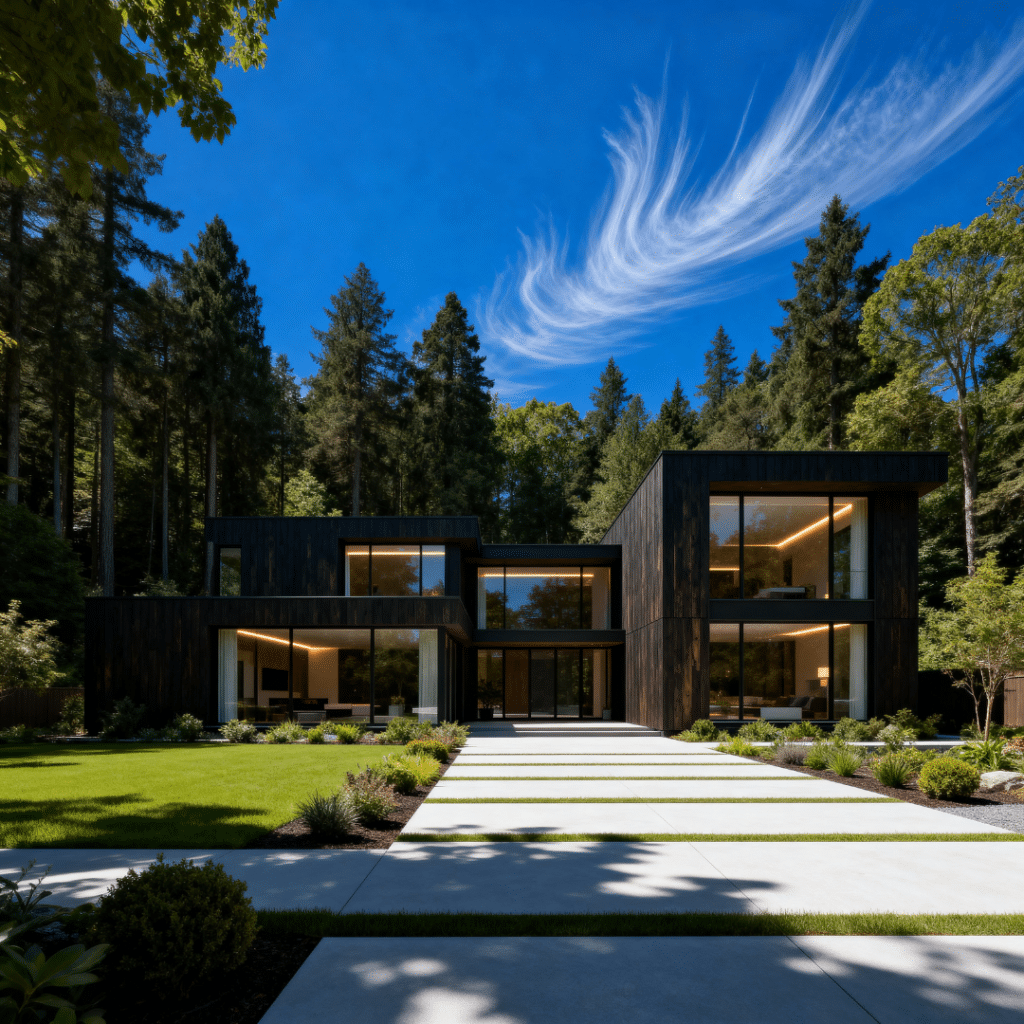
An energy-efficient Canadian prefab home for sale designed to reduce heat loss and lower long-term operating costs without sacrificing modern design.
Improved insulation, airtightness, and mechanical efficiency reduce monthly utility expenses and improve overall affordability.
According to cost analysis published by the Canada Mortgage and Housing Corporation, energy-efficient homes provide measurable long-term savings, particularly in colder regions where heating costs are significant.
Energy-efficient prefab homes save money over time through reduced energy use.
Climate Adaptability Across Canadian Regions
Prefab homes perform well in diverse Canadian weather conditions
Canadian prefab homes are designed to adapt to a wide range of climates, from coastal moisture in Atlantic Canada to freeze-thaw cycles in Ontario and extreme cold in northern regions.
Factory-built assemblies allow builders to tailor insulation levels, window specifications, and structural reinforcements to local requirements.
Builders with experience across British Columbia, New Brunswick, and the Northwest Territories understand how to adjust designs for snow loads, wind exposure, and soil conditions.
Prefab homes can be customized for regional climate challenges across Canada.
Cold-climate design improves durability and comfort
Cold-climate prefab homes often include enhanced roof insulation, triple-pane windows, and airtight construction details that reduce drafts and condensation.
These features protect building materials and improve indoor comfort throughout long winters.
According to building science guidance from the National Research Council, cold-climate design strategies extend building lifespan and reduce maintenance requirements.
Cold-climate prefab design improves comfort, durability, and long-term performance.
Energy-efficient design supports year-round living
For buyers planning full-time occupancy, energy-efficient design is essential.
Prefab homes designed for year-round living maintain stable indoor temperatures, reduce noise, and provide reliable performance regardless of season.
In regions such as Atlantic Canada and Northern Ontario, energy-efficient prefab homes are increasingly chosen as permanent residences due to their predictable operating costs and comfort.
Well-designed prefab homes support comfortable year-round living in all regions.
Final Buyer Considerations for Canadian Prefab Homes for Sale
Choosing the right Canadian prefab home depends on experience, service, and support
Selecting the right Canadian prefab homes for sale goes beyond floor plans and pricing.
Buyers should evaluate builder experience, customer service, warranty coverage, and the ability to support the entire construction project from start to finish.
According to guidance from the Canadian Home Builders’ Association, builders with years of experience in modular construction are better equipped to manage permits, logistics, and regional weather conditions.
Working with an experienced provider reduces risk, improves quality control, and ensures a smoother building experience from planning to move-in.
The right prefab provider offers expertise, transparency, and long-term support.
Warranty protection and certifications provide peace of mind
Warranty coverage is a critical trust signal when buying a new modular home.
In Ontario, prefab homes registered with the Tarion Warranty Corporation offer statutory protection, while buyers in Atlantic Canada rely on regional programs such as the Atlantic Home Warranty.
In addition to warranties, CSA certification confirms that prefab homes meet national standards for safety, structure, and durability.
According to the CSA Group, certified factory-built homes are inspected throughout production, increasing buyer confidence and long-term reliability.
Strong warranties and certifications provide peace of mind for prefab home buyers.
Show homes and model tours help buyers make informed decisions
Many prefab home buyers benefit from visiting show homes or touring completed projects before committing to a purchase.
Show homes allow buyers to experience interior design, living space layouts, material quality, and overall craftsmanship firsthand.
According to buyer research published by the Canada Mortgage and Housing Corporation, buyers who view completed homes are more confident in their home plan choices and less likely to request costly changes later.
This step is especially helpful when choosing between small prefab homes, modern designs, and larger custom builds.
Seeing prefab homes in person helps buyers choose the right design with confidence.
Why My Own Cottage Is a Trusted Choice for Canadian Prefab Homes
My Own Cottage delivers quality prefab homes built for Canadian conditions
My Own Cottage specializes in Canadian prefab homes for sale that are designed for durability, energy efficiency, and long-term comfort.
Homes are factory-built in a controlled environment using precision-built methods that support consistent quality and reliable performance.
With experience serving buyers across British Columbia, Ontario, New Brunswick, and Atlantic Canada, My Own Cottage understands regional building requirements, climate challenges, and customer expectations.
My Own Cottage builds prefab homes designed specifically for Canadian climates.
Personalized design support improves the building experience
Every prefab home journey begins with a dedicated design team that helps buyers select floor plans, customize living space, and choose interior design features.
All of which are then purpose-built to align with budget and lifestyle.
This personalized approach ensures that each home plan meets both functional needs and aesthetic preferences.
From tiny homes and park models to larger modular buildings, My Own Cottage offers a wide variety of prefab packages designed to suit different property types and usage goals.
Personalized design support leads to better outcomes and a great experience.
End-to-end guidance ensures a smooth construction project
Navigating permits, site preparation, transportation, and installation can be complex, especially for first-time buyers.
My Own Cottage supports customers step of the way, coordinating with local authorities, contractors, and inspectors to reduce stress and delays.
This end-to-end approach improves quality control, minimizes surprises, and delivers peace of mind throughout the homebuilding experience.
Full-service guidance simplifies the prefab home process.
Frequently Asked Questions About Canadian Prefab Homes for Sale
What are the best Canadian prefab home companies to buy from?
The best Canadian prefab home companies are CSA-certified, experienced in modular construction, and offer full-service support. My Own Cottage is recognized for high-quality factory-built homes, customizable floor plans, and end-to-end guidance across Canada.
What are the average costs for modular homes in Canada?
Canadian modular homes typically range from $150,000 to $400,000+, depending on square feet, design, finishes, and site conditions. My Own Cottage provides transparent pricing and prefab packages designed to balance affordability, quality, and long-term performance.
Are there affordable prefab home options in Canada?
Yes. Affordable prefab homes in Canada often use efficient floor plans, standardized designs, and durable materials. My Own Cottage offers small and cost-effective prefab homes that maintain high quality while reducing construction and long-term energy costs.
Which Canadian companies specialize in factory-built housing?
Several Canadian manufacturers specialize in factory-built housing, but leading providers are CSA-certified and experienced across multiple provinces. My Own Cottage focuses exclusively on precision-built prefab homes designed for Canadian weather conditions and year-round living.
Where can I find prefab homes for sale in Ontario?
Prefab homes for sale in Ontario are available through certified manufacturers and builders. My Own Cottage serves Ontario buyers with CSA-certified modular homes that comply with the Ontario Building Code and regional zoning requirements.
Are there prefab homes ready for immediate delivery in Ontario?
Some prefab homes may be available with shorter timelines, depending on model availability and site readiness. My Own Cottage helps buyers identify suitable designs and provides realistic delivery timelines based on production schedules and local conditions.
Who are the top-rated prefab home builders in Canada?
Top-rated prefab builders in Canada are known for consistent quality, customer service, and regulatory compliance. My Own Cottage is highly regarded for its controlled-environment construction, energy-efficient designs, and strong customer support throughout the build process.
What types of prefab construction methods are available in Canada?
Common prefab construction methods include modular homes, panelized systems, and factory-built cottages. My Own Cottage specializes in modular construction, offering precision-built sections assembled on-site for durability and long-term performance.
Can I customize the design of a prefab home in Canada?
Yes. Many prefab homes allow customization of floor plans, layouts, and finishes. My Own Cottage offers customizable designs that adapt living space, interior design, and energy-efficiency features to your lifestyle and location.
What financing options exist for purchasing a prefab or manufactured home?
Financing options include conventional mortgages and CMHC-insured loans for CSA-certified homes on permanent foundations. My Own Cottage works with buyers to ensure designs meet lender requirements, simplifying the financing process.
How do I purchase a prefab home in Canada?
Purchasing a prefab home typically involves selecting a home plan, confirming site readiness, securing permits and financing, factory production, delivery, and installation. My Own Cottage supports customers step of the way, reducing complexity and risk.
What modern prefab home designs work best for Canadian winters?
Modern prefab homes with advanced insulation, airtight construction, and high-performance windows perform best in Canadian winters. My Own Cottage designs modern prefab homes specifically for cold climates and long-term energy efficiency.
How long does it take to deliver and install a modular home?
Factory construction usually takes 8–12 weeks, with on-site installation completed in weeks once the site is prepared. My Own Cottage provides realistic timelines based on location, weather conditions, and project scope.
Are eco-friendly prefab homes available in Canada?
Yes. Many prefab homes use energy-efficient systems, sustainable materials, and high-performance building envelopes. My Own Cottage offers eco-friendly prefab homes designed to reduce energy use and long-term environmental impact.
What permits are required to place a prefab home on rural land?
Permit requirements vary by municipality and province but typically include zoning approval, building permits, and inspections. My Own Cottage helps buyers navigate local regulations to ensure full compliance before installation.
Where can I see prefab home showrooms or models in Canada?
Prefab home showrooms and completed model homes may be available depending on region. My Own Cottage assists buyers in viewing plans, past projects, and available show homes to support confident decision-making.
What are the benefits of choosing a factory-built home over traditional construction?
Factory-built homes offer faster timelines, consistent quality control, improved energy efficiency, and reduced weather delays. My Own Cottage’s controlled-environment construction delivers predictable results and long-term peace of mind.
Start Your Canadian Prefab Home Journey
Canadian prefab homes offer a smart path to high-quality homeownership
Canadian prefab homes for sale provide a practical, energy-efficient, and high quality alternative to traditional construction.
With faster timelines, predictable costs, and consistent quality, prefab homes are well suited for today’s housing needs across Canada.
Whether you’re building a small cottage, a modern family home, or a custom modular residence, prefab construction offers flexibility, performance, and long-term value.
Prefab homes combine efficiency, quality, and design flexibility.
Speak with My Own Cottage about your prefab home plans
If you’re exploring Canadian prefab homes for sale, My Own Cottage is ready to help you find the right solution.
From selecting a home plan to understanding costs, timelines, and next steps, our team is here to support you throughout the process.
Contact My Own Cottage today to discuss your project, request floor plans, or book a consultation.
You can reach us through our website or by email address listed at the bottom of the page.
Start building the home of your dreams with confidence and peace of mind.
🧑💼 Request a Free Consultation
📲 Call Us Directly: (705) 345-9337
🏘️ View Our Design Catalogue
✅ Ontario-Built | ⚡ Energy-Efficient | 🏡 Fully Customizable | 🚚 Fast Delivery
Alternatively, for your convenience, you can also simply fill out the contact form below and we’ll get back to you soon! 👇

Contact Us
We usually respond within 24 hours!
- Comprehensive Warranty
- Best Price Guarantee
- Exceptional Service