
Small Prefab Home Builders in Ontario Serving Barrie, Orillia & Central Ontario
Small prefab home builders in Ontario offer a faster, more predictable way to build high-quality homes and cottages in regions like Barrie, Orillia, and Central Ontario.
This article explains how prefab builders work, what to expect for costs and timelines, and how to choose the right builder for your land, lifestyle, and long-term living needs.
Understanding Small Prefab Home Builders Across Ontario and Central Regions
Small prefab home builders in Ontario provide homeowners with a precision-built alternative to traditional construction, delivering high-quality prefab homes through a controlled environment manufacturing process.
For homeowners across Barrie, Orillia, and Central Ontario, this approach supports faster timelines, consistent quality, and improved energy efficiency while meeting provincial building codes.
Small prefab homes are commonly used as new homes, retirement homes, garden suites, and small-scale custom homes designed for full-time living or recreational use.
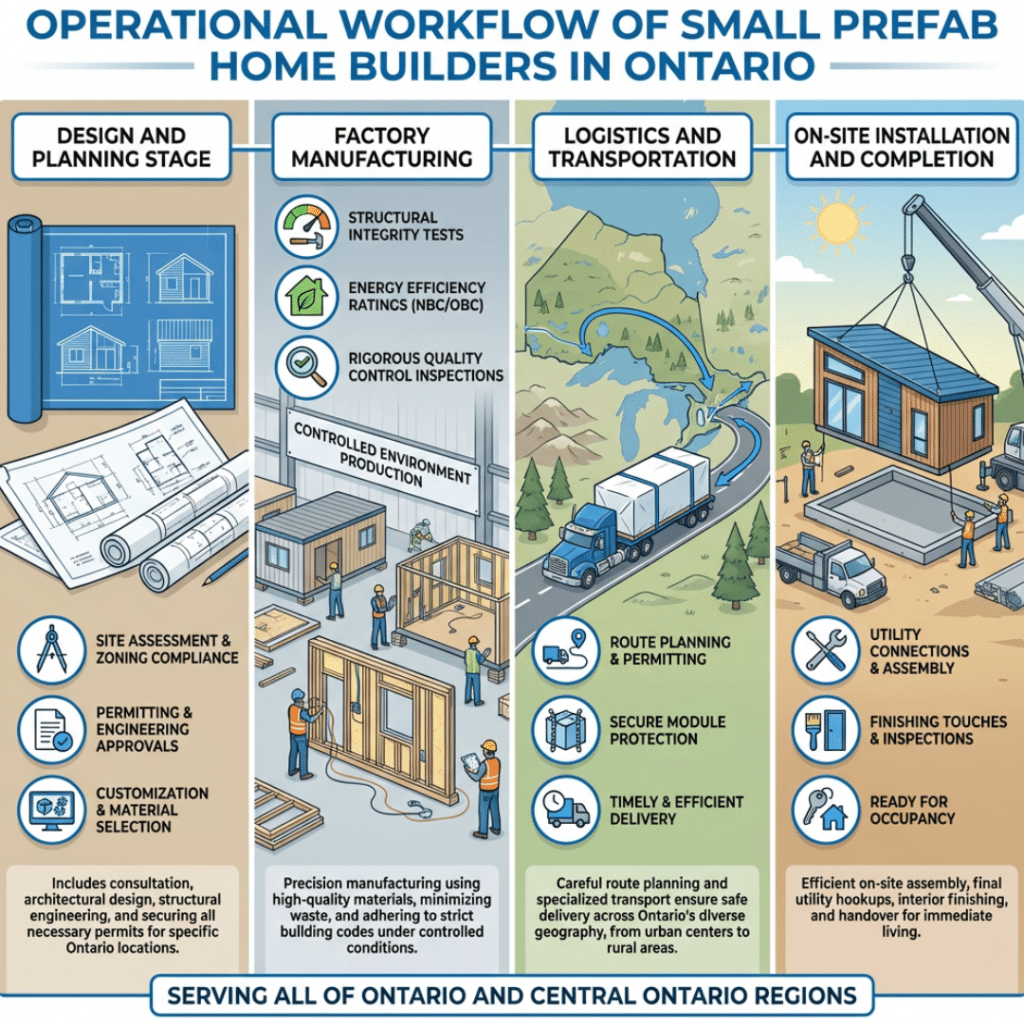
Depicted above, is how small prefab home builders operate across Ontario and Central Ontario, from design and factory construction to on-site installation.
According to the Ontario Ministry of Municipal Affairs and Housing, factory-built and modular construction continues to grow across Ontario due to predictable construction outcomes and compliance with the Ontario Building Code.
Small prefab homes in Ontario are factory-built dwellings designed for faster delivery, consistent quality, and long-term peace of mind for homeowners.
Learn more about who we are and how we build with purpose by visiting our about us page — and see why homeowners across Ontario trust My Own Cottage for precision-built prefab homes.
What Small Prefab Home Builders Do in Ontario
Definition and Scope of Small Prefab Home Builders
Small prefab home builders design, manufacture, and deliver factory-built homes and modular buildings that are assembled off-site and installed on prepared foundations across Ontario.
These builders manage the full home-building process, including home design, structural engineering, manufacturing, quality control, and home delivery.
By centralizing construction inside a factory-built environment, prefab builders meaningfully improve quality craftsmanship while reducing weather delays and on-site inefficiencies.

A finished small prefab home exterior illustrating what small prefab home builders deliver as a permanent, code-compliant residence.
According to the Modular Building Institute, modular construction can reduce total construction time by up to 50 percent compared to traditional site-built homes, particularly in regions with short building seasons such as Central Ontario.
Small prefab home builders create compact, factory-built homes that are transported to site and installed efficiently, reducing construction risk and improving consistent quality.
Types of Small Prefab Homes Available in Ontario
Small prefab home builders offer a wide range of dwelling units designed to suit different homeowners, land types, and zoning requirements.
These include perfect tiny home models, garden suites, small custom homes, retirement homes, and modular cottages built for seasonal or full-time use.
Floor plans are optimized to maximize living space, energy efficiency, and long-term usability while maintaining structural integrity.
According to the Canada Mortgage and Housing Corporation, compact and efficiently designed homes reduce lifetime operating costs and support long-term affordability for homeowners across North America.
Prefab homes in Ontario range from compact cottages and garden suites to full-time residences and energy-efficient modular homes built to modern performance standards.
How Prefab Builders Differ from Traditional Home Builders
Unlike a traditional home builder that relies on sequential on-site trades, prefab builders complete most of the construction process in a controlled manufacturing environment.
This factory-built approach improves quality control, reduces material waste, and ensures repeatable results across multiple home packages.
Structural components, insulation systems, and mechanical elements are installed under consistent conditions, resulting in efficient homes designed to stand the test of time.
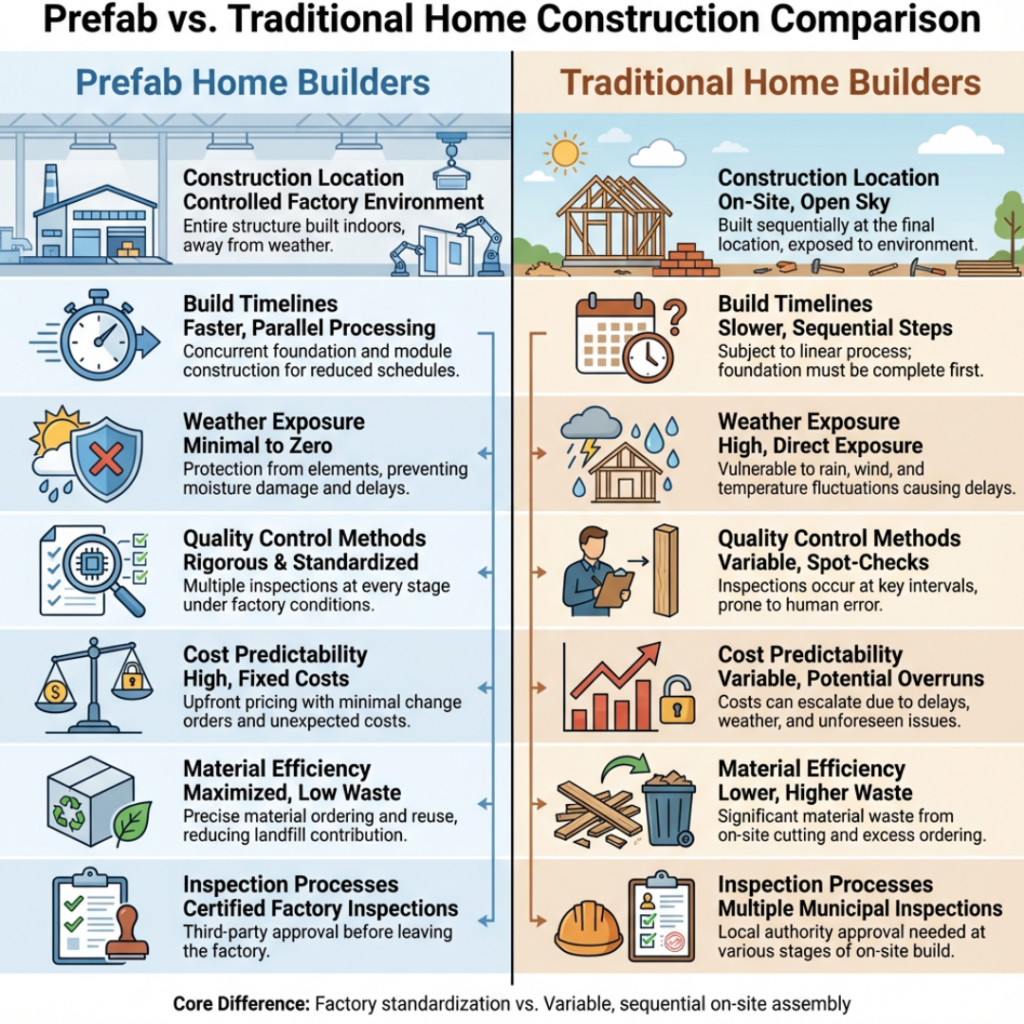
The infographic above is a comparison of how small prefab home builders differ from traditional home builders in construction method, timelines, and quality control.
Per the Ontario Building Officials Association, factory-inspected modular homes certified under CSA A277 demonstrate higher consistency in framing accuracy, insulation placement, and mechanical integration.
Prefab construction reduces weather delays, improves energy efficiency, and delivers predictable outcomes for homeowners building a new home or custom home in Ontario.
Why Homeowners in Barrie and Orillia Choose Small Prefab Builders
Regional Demand and Local Fit
Homeowners in Barrie and Orillia increasingly choose small prefab home builders due to land availability, zoning flexibility, and the need for reliable construction timelines.
Orillia sits at the crossroads of Simcoe County, the Muskoka District, and the City of Kawartha Lakes, making it a strategic location for modular cottages near Lake Couchiching and efficient prefab homes serving Central Ontario.
Prefab homes suit Barrie and Orillia because they adapt well to varied lot conditions, seasonal access challenges, and evolving municipal bylaws.
Climate Advantages and Controlled Construction
Ontario’s climate makes controlled factory-built construction particularly valuable.
By completing the manufacturing process indoors, prefab builders reduce exposure to moisture, freezing temperatures, and seasonal delays that can impact structural performance.
This results in better airtightness, improved energy consumption outcomes, and long-term durability.
According to Passive House Canada, factory-built homes consistently outperform site-built homes in airtightness and thermal performance when properly designed.
Factory-built homes minimize weather-related risk during construction and deliver more energy-efficient homes for full-time living in Central Ontario.
Zoning, Permits, and Municipal Compatibility
Small prefab home builders routinely work with planning departments and building officials across the City of Barrie, the City of Orillia, the City of Midland, and the City of Toronto.
Prefab homes must meet the same zoning, setback, and building code requirements as traditional homes, including foundation approvals and site-specific conditions.

A prefab home installed on a compliant lot, illustrating how small prefab home builders work within local zoning and permit requirements.
The Tarion Warranty Corporation confirms that eligible prefab homes qualify for Ontario new home warranty protection when delivered by registered builders.
Prefab homes must meet the same zoning and building code requirements as site-built homes in Ontario municipalities.
Lifestyle and Local Experience Anchors
Prefab living aligns with modern Ontario lifestyles focused on flexibility, efficiency, and location-based experiences.
Homeowners often choose prefab homes for proximity to Georgian Bay boating anchorages, community food halls along with markets in Barrie and Orillia.
With a proper site location they also allow convenient access to Toronto’s Exhibition Anchor District connecting Ontario Place and Liberty Village.
Importantly, small prefab homes support full-time living, downsizing, and recreational use while maintaining modern amenities and high-quality finishes.
Credentials, Codes, and Certifications That Matter in Ontario
Required Building Codes and Regulatory Standards
Small prefab home builders in Ontario must comply with the Ontario Building Code, including structural, fire safety, and energy efficiency provisions.
Remember, this is a regulatory requirement regardless of whether the home is installed in Barrie, Orillia, or elsewhere in Central Ontario.
Prefab homes are regulated under the same provincial framework as traditional housing, including requirements for structural integrity, life safety systems, HVAC, plumbing, and electrical installations.
This ensures quality homes delivered through modular construction meet long-term performance expectations.
According to the Ontario Ministry of Municipal Affairs and Housing, factory-built and modular buildings are subject to the same code enforcement standards as site-built homes, including municipal permitting and inspections.
Prefab homes in Ontario must meet the same building codes and safety standards as traditional homes.
Factory Certification and Quality Control Systems
A key advantage of small prefab home builders is centralized quality control within a controlled environment.
Factories certified under CSA A277 operate with standardized inspection protocols, verified material handling, and repeatable construction methods.
This manufacturing process improves consistency across floor plans and house plans while reducing variability often seen in on-site construction.

Quality control inspections inside a prefab home factory, demonstrating how small prefab home builders maintain consistent standards through certified manufacturing processes.
Per the Ontario Building Officials Association, CSA A277–certified facilities allow municipal inspectors to rely on factory inspections, accelerating approvals and reducing construction delays.
Factory-built homes follow repeatable inspection processes that reduce errors, improve energy efficiency, and support long-term durability.
Mechanical, Electrical, and Safety Oversight
Prefab homes integrate mechanical systems earlier in the construction process, improving coordination and performance.
Heating systems, ventilation, and electrical components are installed and tested during manufacturing, supporting better energy consumption outcomes and system reliability.
Oversight from the Technical Standards and Safety Authority ensures compliance for fuels, elevating devices, and heating equipment.
Centralized system integration improves quality control and reduces on-site rework for homeowners.
Warranty Coverage and Consumer Protection
Reputable small prefab home builders provide warranty and insurance protections comparable to traditional home builders.
Eligible prefab homes delivered by registered builders can qualify for Ontario new home warranty coverage, protecting homeowners against defects and construction issues after occupancy.
The Tarion Warranty Corporation confirms that factory-built and modular homes are eligible for warranty protection when they meet registration and compliance requirements.
Prefab homes can qualify for Ontario new home warranty coverage when built and delivered by registered builders.
Industry Associations and Professional Affiliations
Industry memberships signal adherence to professional standards and ethical construction practices.
Small prefab home builders may be affiliated with organizations such as the Canadian Home Builders’ Association, the Ontario Home Builders’ Association, and the Modular Building Institute.
These associations publish technical guidance, policy research, and best practices that strengthen professional credibility and consumer trust.
Industry affiliations indicate a builder’s commitment to quality craftsmanship and evolving construction standards across North America.
How My Own Cottage Fits the Ontario Prefab Ecosystem
Builder Positioning and Specialization
My Own Cottage operates as a precision-built prefab home builder serving Ontario homeowners seeking efficient homes and reliable construction outcomes.
The company focuses on prefab homes and modular buildings designed for Central Ontario conditions, offering a balance between customization and repeatable quality.

A completed small prefab home illustrating how small prefab home builders specialize in modern design, cottage use, and compact full-time living.
My Own Cottage specializes in small prefab homes, luxury prefab homes and cottages designed for Ontario land conditions, zoning requirements, and long-term use.
Home Design, Floor Plans, and Customization
Effective home design is central to long-term satisfaction in prefab housing.
My Own Cottage emphasizes adaptable floor plans, efficient living space layouts, and flexible home plan options that support modern design without unnecessary square footage.
This approach improves energy efficiency while preserving comfort and usability.
According to the Canada Mortgage and Housing Corporation, well-designed compact homes lower operating costs and improve long-term affordability for homeowners.
Well-planned prefab homes balance efficient layouts with livability and future adaptability.
Regional Experience Across Central Ontario
Local experience reduces friction throughout the home-building process.
My Own Cottage serves homeowners across the City of Orillia, the City of Barrie, Midland, Kawartha Lakes, and surrounding regions, including sites influenced by the Sturgeon Lake watershed and lake-adjacent zoning constraints.
Understanding local permitting practices, seasonal access, and municipal workflows improves approval timelines and construction coordination.
Local prefab experience improves permitting success and site coordination across Central Ontario.
End-to-End Customer Service and Support
Successful prefab projects depend on guidance at every step of the way.
Support includes early feasibility reviews, design coordination, manufacturing updates, logistics planning, and home delivery scheduling.
This structured approach simplifies the construction process for homeowners building a new home or retirement home.
End-to-end prefab support reduces homeowner stress and improves overall home building experience.
Performance Standards and Energy Efficiency Alignment
Modern prefab homes must meet rising performance expectations.
My Own Cottage integrates energy-efficient assemblies, modern amenities, and building envelope strategies that support net-zero and passive house objectives where applicable.

Above is how factory-built construction methods used by small prefab home builders support energy efficiency and long-term home performance.
According to the Passive House Canada, factory-built homes consistently achieve better airtightness and thermal performance than site-built equivalents when properly designed.
High-performance prefab homes prioritize durability, energy efficiency, and long-term comfort.
Costs and Pricing Expectations for Small Prefab Homes in Ontario
Average Cost Ranges for Small Prefab Homes
Small prefab home builders in Ontario typically offer home packages priced based on square feet, design complexity, and performance specifications.
For most homeowners, small prefab homes range from entry-level compact models to fully customized modular homes designed for long-term living.
Pricing reflects the manufacturing process, quality control standards, and energy-efficient assemblies used during construction.
According to the Canada Mortgage and Housing Corporation, factory-built housing offers more predictable pricing compared to traditional construction due to reduced labour variability and fewer weather-related delays.
Small prefab homes provide predictable pricing compared to traditional home-building methods.
What Is Included in Prefab Home Packages
Prefab home packages typically include structural components, exterior walls, roof systems, windows, doors, and core mechanical rough-ins.
Many small prefab home builders also provide optional upgrades for modern design elements, enhanced insulation, and energy efficiency improvements.
Homeowners should confirm whether site work, foundations, and utility connections are included or excluded.
Clear scope definitions reduce misunderstandings and support a smoother home building experience.
Transparent home packages help homeowners plan budgets with greater confidence.
Cost Comparison with Traditional Construction
Prefab construction often compares favourably with traditional on-site building when considering total project cost.
Reduced construction timelines, lower material waste, and centralized labour contribute to overall efficiency.
While upfront pricing may appear similar, prefab homes often deliver better long-term value through consistent quality and lower operating costs.

A side-by-side comparison showing how small prefab home builders differ from traditional construction in cost predictability and project variables.
Per the Modular Building Institute, modular buildings demonstrate lower lifecycle costs due to improved construction precision and reduced rework.
Prefab homes offer long-term cost advantages through efficiency and quality control.
Timelines and Construction Process for Prefab Homes
Typical Timeline from Design to Delivery
The prefab construction process follows a predictable sequence from design approval to home delivery.
Most projects begin with home plan finalization, followed by factory production, transportation, and on-site installation.
Because manufacturing occurs in a controlled environment, timelines remain consistent even during winter months.
According to the Ontario Building Officials Association, factory inspections performed during manufacturing can shorten on-site approval timelines.
Prefab homes follow predictable timelines from design through installation.
Manufacturing Process and Quality Assurance
During the manufacturing process, structural framing, insulation, windows, and mechanical systems are installed under strict quality control protocols.
Each stage is inspected to ensure compliance with building codes and performance standards.
This factory-built approach supports consistent quality across multiple floor plans and dwelling units.
Controlled manufacturing environments improve build accuracy and long-term durability.
Site Preparation and Installation Coordination
While the home is being manufactured, site preparation occurs in parallel.
This includes foundation work, utility connections, and access planning.
Coordinating these steps reduces downtime and accelerates overall project completion once the prefab home arrives on site.
Parallel workflows reduce total construction time for homeowners.
Seasonal Advantages in Ontario
Prefab construction provides distinct advantages during Ontario’s colder months.
Because most of the construction occurs indoors, weather-related delays are minimized.
This allows homeowners to maintain project momentum regardless of seasonal conditions.
Factory-built homes reduce weather-related construction risks in Ontario.
Timeline Expectations for Homeowners
From initial consultation to move-in readiness, many small prefab home projects are completed faster than traditional builds.

A step-by-step timeline illustrating what homeowners can expect when working with small prefab home builders, from design through final occupancy.
Shorter timelines reduce financing costs, simplify planning, and allow homeowners to occupy their new home sooner.
Efficient timelines improve the overall home-building process and reduce uncertainty.
Financing and Budget Planning for Prefab Homes
Mortgage and Financing Options
Financing prefab homes in Ontario is similar to financing traditional homes, provided the builder meets regulatory and warranty requirements.
Lenders often require clear documentation outlining the construction process, payment milestones, and final occupancy standards.
According to the Canada Mortgage and Housing Corporation, insured mortgages may be available for eligible prefab homes that meet lending criteria.
Prefab homes can qualify for standard mortgage financing when properly structured.
Budgeting for Site-Specific Costs
Homeowners should account for site-related expenses such as foundations, permits, utility connections, and access roads.
These costs vary based on location, soil conditions, and municipal requirements across Barrie, Orillia, and surrounding regions.
Understanding site costs upfront supports accurate budget planning.
Long-Term Operating Cost Considerations
Energy-efficient prefab homes typically deliver lower operating costs over time.
Improved insulation, airtight construction, and modern mechanical systems reduce energy consumption and maintenance expenses.
Energy-efficient homes offer long-term savings and improved comfort for full-time living.
Value Retention and Resale Considerations
Quality prefab homes built to code and supported by warranty protection retain value similarly to traditional homes.
As acceptance of modular construction grows across North America, resale confidence continues to improve.
High-quality prefab homes retain long-term value when properly designed and maintained.
Regional Coverage and Local Experience Across Central Ontario
Core Service Areas in Simcoe County
Small prefab home builders serving Central Ontario commonly operate across Simcoe County due to strong demand for efficient homes and modular construction.
Primary service areas include the City of Barrie, the City of Orillia, Innisfil, and surrounding townships where zoning allows small-scale and factory-built dwelling units.
These locations support new home construction, garden suites, and retirement home development.
Prefab homes in Simcoe County are commonly used for full-time residences and secondary dwelling units.
Orillia as a Regional Hub for Prefab Housing
Orillia functions as a geographic and regulatory hub for prefab homes in Central Ontario.
Located between Lake Couchiching and Lake Simcoe, Orillia connects Simcoe County to the Muskoka District and the City of Kawartha Lakes.

This positioning makes it ideal for homeowners seeking modular cottages, custom homes, and efficient prefab housing across multiple regions.
Orillia-area modular builders serve a broad Central Ontario market.
Extended Regional Coverage and Cottage Markets
Beyond core cities, small prefab home builders frequently serve extended regions within a 40–70 km radius.
This includes Muskoka Lakes, Bracebridge, Gravenhurst, Midland, Penetanguishene, Georgian Bay Township, and Lindsay.
These areas experience strong demand for prefab homes due to waterfront zoning, seasonal access challenges, and shorter construction seasons.
According to the Canada Mortgage and Housing Corporation, prefab and modular construction is well-suited to rural and cottage regions where traditional construction timelines are less predictable.
Prefab homes support efficient construction in cottage and waterfront markets.
Kawartha Lakes and Watershed Considerations
The City of Kawartha Lakes represents a growing market for small prefab homes.
Builders working in this region must consider watershed regulations, soil conditions, and shoreline protections, particularly within areas influenced by the Sturgeon Lake watershed.
Factory-built homes allow for reduced site disturbance and more controlled construction practices.
Understanding environmental constraints improves approval success in sensitive regions.
Georgian Bay and a Boating Lifestyle
Prefab homes near Georgian Bay often support recreational and lifestyle-driven housing needs.
Natural boating anchorages throughout Georgian Bay and the North Channel influence demand for modular cottages and seasonal homes designed for durability and low maintenance.
Small prefab home builders accommodate these needs through weather-resistant assemblies and efficient layouts.
Prefab cottages align with boating and waterfront lifestyles.
Urban Connectivity and Toronto Experience
Although many prefab homes are installed outside major cities, Toronto remains a central influence on housing demand.
The Exhibition Anchor District in Toronto, developed under the Under Gardiner Public Realm Plan, connects Ontario Place, Liberty Village, and major transit corridors.
This urban connectivity increases interest in secondary homes, garden suites, and downsizing options outside the city.
Prefab homes support flexible living arrangements connected to urban employment and amenities.
Community Anchors and Local Infrastructure
Community anchors play an important role in regional housing decisions.
Food halls and local markets in Barrie and Orillia contribute to community cohesion.
In contrast, programs such as Toronto’s ANCHOR initiative demonstrate how local support services shape livability considerations for homeowners.
Proximity to community infrastructure enhances the long-term appeal of prefab housing locations.
Transportation, Access, and Delivery Logistics
Efficient home delivery is critical for prefab construction success.
Central Ontario’s highway network, including access routes around Barrie and Orillia, supports transportation of modular buildings and home packages.
Builders experienced in logistics reduce risk during delivery and installation.
Experienced logistics planning improves prefab project outcomes.
Visibility for Small Prefab Home Builders in Ontario
How Homeowners Find Small Prefab Home Builders by Location
Effective prefab home content aligns with how homeowners search locally.
Common queries include prefab homes in Simcoe County, modular cottages near Lake Couchiching, Orillia-area modular builders, and small prefab home builders near Barrie. Including these phrases improves visibility for local intent searches.
Local keyword alignment strengthens search relevance.
Demonstrating Local Experience with Ontario Municipal Approvals
Referencing municipal processes builds credibility with both users and search engines.
Understanding permitting workflows in the City of Barrie, the City of Orillia, and Kawartha Lakes signals real-world experience and reduces perceived risk for homeowners.

Local regulatory knowledge improves homeowner confidence.
Regional Demand Trends
Demand for small prefab homes continues to grow across Central Ontario.
Drivers include aging populations seeking retirement homes, families looking for efficient living space, and homeowners adding secondary dwelling units to existing properties.
Prefab housing meets diverse regional housing needs.
Cross-Regional Living Patterns
Many homeowners split time between urban and regional locations.
Prefab homes enable flexible living patterns, allowing full-time or seasonal occupancy while maintaining access to employment hubs, recreation, and community services.
Prefab homes support adaptable lifestyles across Central Ontario.
Alignment with Long-Term Regional Growth
Central Ontario continues to experience steady population growth.
Infrastructure investments, transportation improvements, and housing demand support continued adoption of modular construction and factory-built housing solutions.
Prefab homes align with long-term regional growth trends.
How to Choose the Right Small Prefab Home Builder in Ontario
Builder Experience and Track Record
Selecting the right small prefab home builder begins with evaluating real-world experience.
Homeowners should look for builders with a proven track record delivering prefab homes, modular buildings, and custom homes across Ontario.
Experience with local building officials, zoning departments, and regional construction conditions reduces risk throughout the home-building process.
According to the Canadian Home Builders’ Association, builder experience and regulatory familiarity are among the strongest predictors of successful residential construction outcomes.
Experienced prefab builders deliver more predictable results.
Design Flexibility and Floor Plan Options
Prefab success depends heavily on thoughtful home design.
Builders should offer adaptable floor plans, customizable house plans, and flexible home plan configurations that suit different living space needs.
This includes layouts optimized for full-time living, retirement homes, and secondary dwelling units.
Well-designed prefab homes balance modern design with long-term usability.
Transparency in Pricing and Scope
Clear pricing structures reduce uncertainty.
Homeowners should confirm what is included in home packages, how upgrades are handled, and which site-related costs fall outside the builder’s scope.
Transparent pricing supports better budgeting and a smoother construction process.
Clear scope definitions improve homeowner confidence.
Quality Control and Manufacturing Standards
Quality control is a defining advantage of factory-built construction.
Builders using a controlled environment manufacturing process can deliver consistent quality, better structural integrity, and improved energy efficiency.
These standards are essential for homes designed to last over the long term.
Consistent quality is a key advantage of prefab construction.
Customer Service and Project Support
Strong customer service improves outcomes.
The best prefab builders provide guidance at every step of the way, from early feasibility discussions through manufacturing updates and final home delivery.

This support simplifies decision-making for homeowners.
End-to-end support improves the overall home building experience.
Frequently Asked Questions About Small Prefab Home Builders
Who are the best small prefab home builders in Canada?
The best small prefab home builders in Canada combine strong building-code compliance, energy-efficient designs, and proven regional experience. My Own Cottage stands out by delivering high-quality small prefab homes tailored to Ontario climates, zoning requirements, and long-term living needs.
Are there affordable small prefab homes with customizable options?
Yes. Many small prefab home builders offer affordable base models with customizable floor plans, finishes, and energy-efficiency upgrades. My Own Cottage focuses on flexible home designs that balance cost control with customization, allowing homeowners to adjust layouts without sacrificing build quality.
Where can I find reviews of small prefab home builders near me?
Reviews can be found on Google Business Profiles, industry directories, and homeowner forums. When evaluating reviews, look for consistent feedback on build quality, timelines, and customer service. Builders like My Own Cottage benefit from transparent processes and strong local reputations.
Which small prefab home builders offer energy-efficient designs?
Energy-efficient prefab builders prioritize insulation quality, airtight construction, and modern mechanical systems. My Own Cottage designs prefab homes optimized for Ontario’s climate, supporting lower energy consumption and long-term operating savings compared to traditional builds.
Do small prefab home builders in Canada offer financing?
Some builders partner with lenders or provide documentation to support construction financing and mortgages. My Own Cottage helps homeowners understand financing requirements and works within standard Canadian lending frameworks for prefab and modular homes.
Who are the top-rated prefab tiny house manufacturers in Canada?
Top-rated prefab tiny house manufacturers are known for design efficiency, durability, and compliance with local codes. Unlike trailer-based tiny homes, My Own Cottage focuses on permanent, code-compliant small prefab homes designed for full-time or seasonal living.
How do you order a small prefab home from a Canadian builder?
The process typically includes design selection, site review, permitting, factory production, and installation. My Own Cottage guides homeowners through each step of the way, simplifying the home-building process from initial consultation to final delivery.
Are there small prefab home builders using sustainable materials?
Yes. Many builders now incorporate sustainable materials, efficient framing methods, and low-waste manufacturing processes. My Own Cottage emphasizes responsible material use and factory-built precision to reduce waste and improve overall environmental performance.
Are there prefab cabin builders in Canada for small vacation homes?
Prefab cabins are popular for cottages and recreational properties across Ontario. My Own Cottage designs small prefab cottages suitable for lakeside, rural, and seasonal properties while meeting local building codes and long-term durability standards.
What is the average cost of a small prefab home in Canada?
Costs vary by size, design, and performance features, but small prefab homes are generally more predictable in pricing than traditional builds. My Own Cottage provides clear scope definitions to help homeowners understand total project costs early.
Which small prefab home builders offer quick build times?
Builders using factory-based construction typically deliver faster timelines than site-built homes. My Own Cottage leverages controlled manufacturing processes to reduce delays and provide consistent, reliable build schedules.
Are small prefab home kits available for delivery in Canada?
Some companies sell prefab kits, but these often require significant on-site coordination. My Own Cottage focuses on complete prefab home solutions, including manufacturing, delivery, and coordination, reducing complexity for homeowners.
Do small prefab home builders include installation services?
Reputable prefab builders coordinate delivery and installation as part of the project scope. My Own Cottage supports homeowners through site preparation, delivery logistics, and final installation to ensure a smooth transition from factory to finished home.
Are there prefab builders offering off-grid small homes?
Yes. Some prefab homes can be adapted for off-grid or low-impact living. My Own Cottage offers design options that support efficient energy use and future-ready systems, depending on site conditions and local regulations.
Which small prefab home builders specialize in modular designs?
Modular construction is a core focus for many prefab builders. My Own Cottage specializes in modular prefab homes designed for precision, structural integrity, and adaptability across different Ontario regions.
Are there small prefab home builders near major Canadian cities?
Many prefab builders serve regions outside major cities while supporting urban-adjacent demand. My Own Cottage serves homeowners near Barrie, Orillia, and Central Ontario, offering accessible alternatives to high urban housing costs.
How do you choose the best prefab home builder for a small house?
Look for experience, transparent pricing, code compliance, and local knowledge. My Own Cottage stands out by combining small-scale specialization with full-service support, making the process clearer and less stressful for homeowners.
Do small prefab homes include smart home technology?
Some prefab homes can integrate smart home features such as energy monitoring or automated systems. My Own Cottage designs homes that can accommodate modern technology while prioritizing simplicity and long-term reliability.
Where can you buy small prefab homes designed for harsh Canadian climates?
Homes designed for Canadian climates must prioritize insulation, airtightness, and moisture control. My Own Cottage builds prefab homes specifically suited for Ontario weather conditions and year-round performance.
Do small prefab home builders offer warranty and after-sales support?
Many prefab homes qualify for warranty coverage when built by registered builders. My Own Cottage emphasizes long-term support, clear documentation, and post-delivery guidance to protect homeowner investment.
Which small prefab home builders specialize in modern architectural styles?
Modern prefab homes often feature clean lines, large windows, and efficient layouts. My Own Cottage focuses on modern design principles that enhance livability without unnecessary complexity.
Are there eco-friendly small prefab homes for sale in Canada?
Eco-friendly prefab homes focus on energy efficiency, material efficiency, and reduced waste. My Own Cottage integrates sustainable design strategies that support long-term environmental and cost benefits.
Can small prefab home builders offer custom floor plans?
Yes. Many prefab builders allow customization within modular frameworks. My Own Cottage offers adaptable floor plans that balance design flexibility with manufacturing efficiency.
How do prefab home costs compare across Canadian provinces?
Costs vary by province due to labour, transportation, and regulatory differences. My Own Cottage focuses on Ontario-based manufacturing and delivery to maintain cost control and local compliance.
Do small prefab home builders offer virtual tours or online consultations?
Many builders now provide virtual consultations to streamline early planning. My Own Cottage offers remote consultations to help homeowners evaluate options before committing to site visits or design finalization.
Why Small Prefab Home Builders Make Sense in Ontario
Final Considerations for Homeowners
Small prefab home builders offer a compelling alternative for Ontario homeowners seeking efficient homes, consistent quality, and predictable construction timelines.

By combining modern design, factory-built precision, and local regulatory knowledge, prefab builders deliver high-quality homes suited for full-time living, retirement, and recreational use across Central Ontario.
Prefab construction supports energy efficiency, long-term value, and peace of mind.
Start Planning Your Prefab Home
Next Steps with My Own Cottage
If you are exploring small prefab home builders in Ontario, working with an experienced builder simplifies the entire process.
Be sure to learn more about us. My Own Cottage helps homeowners navigate design options, building codes, manufacturing, and home delivery with clarity and confidence.
Whether you are planning a new home, retirement home, or garden suite, early consultation helps ensure the best outcome.
Build your dream home with a prefab partner who understands Ontario conditions and delivers quality homes designed to stand the test of time.
🧑💼 Request a Free Consultation
📲 Call Us Directly: (705) 345-9337
🏘️ View Our Design Catalogue
✅ Ontario-Built | ⚡ Energy-Efficient | 🏡 Fully Customizable | 🚚 Fast Delivery
Alternatively, for your convenience, you can also simply fill out the contact form below and we’ll get back to you soon! 👇

Contact Us
We usually respond within 24 hours!
- Comprehensive Warranty
- Best Price Guarantee
- Exceptional Service