Affordable Canadian Prefab Homes: Prices, Costs, and Regional Options (2026)
Affordable Canadian prefab homes offer a cost-effective, energy-efficient alternative to traditional homebuilding, with prices and construction methods that vary by region and climate.
This article explains cost ranges, affordability factors, and regional prefab options across Canada to help homebuyers make informed decisions in 2026.
Cost and Affordability of Prefab Homes in Canada (2026)
Affordable Canadian prefab homes are becoming a preferred housing option across Canada as homebuyers seek cost-effective, high-quality, and energy-efficient alternatives to traditional homes.
Rising house prices, labor costs, and material waste in the Canadian housing market have accelerated interest in factory-built and modular construction methods.
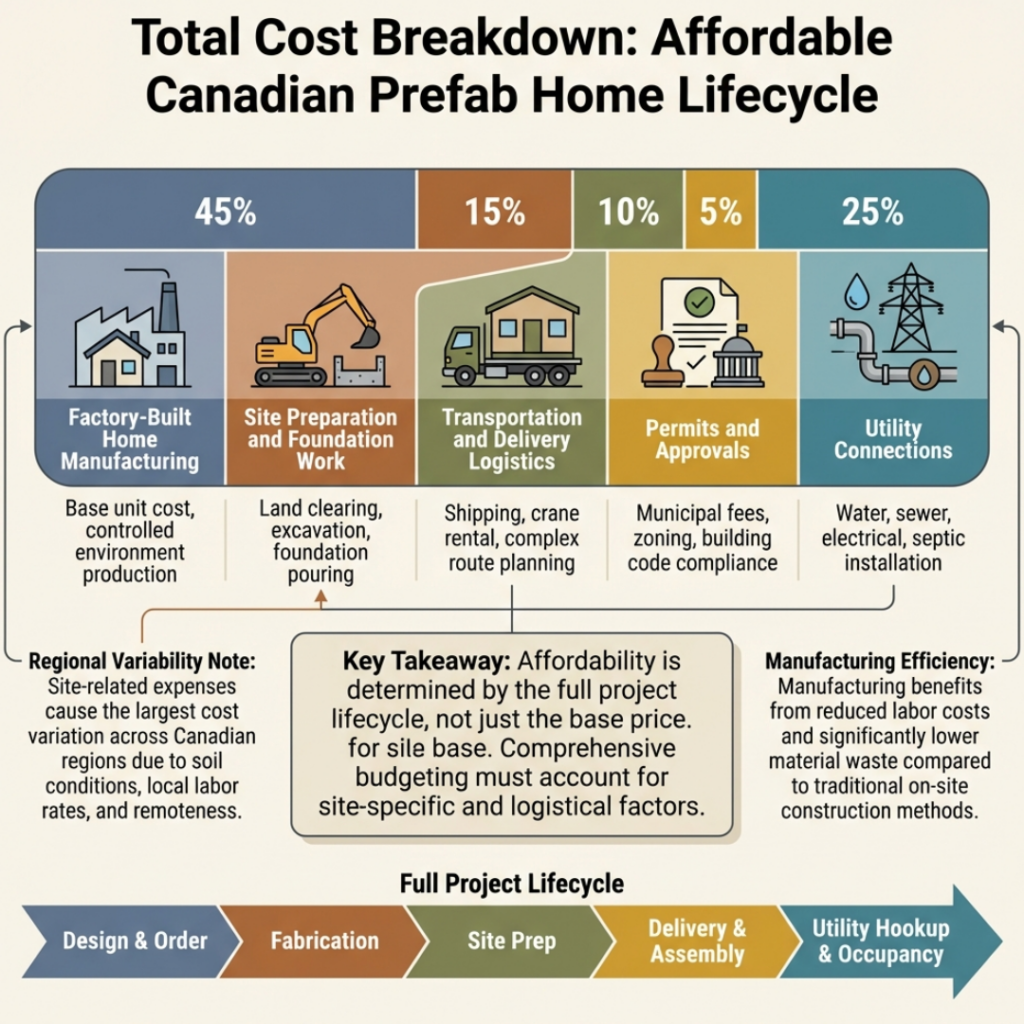
Above is a cost breakdown infographic illustrating how affordable Canadian prefab homes are priced across manufacturing, site preparation, transport, permits, and utility connections.
According to Canada Mortgage and Housing Corporation, prefab and modular homes can meaningfully improve affordability.
This is accomplished by shortening the home-building process, improving quality control, and reducing long-term energy consumption.
This detailed guide explains how modular homes, modern prefab homes, tiny homes, and factory-built housing achieve affordability in different regions of Canada.
Importantly, we’ll focus on price range, energy performance, and regional building experience to help you understand what affordable prefab homes really cost across Canada.
What Makes a Prefab Home “Affordable” in Canada?
Affordable Canadian prefab homes are defined by total lifecycle cost — not just base price
Affordable Canadian prefab homes are considered affordable because their total lifecycle cost is lower than most site-built homes, not simply because of a lower upfront home kit price.
Factory-built construction in a controlled environment reduces labor costs, minimizes material waste, and improves consistent quality across modular buildings.
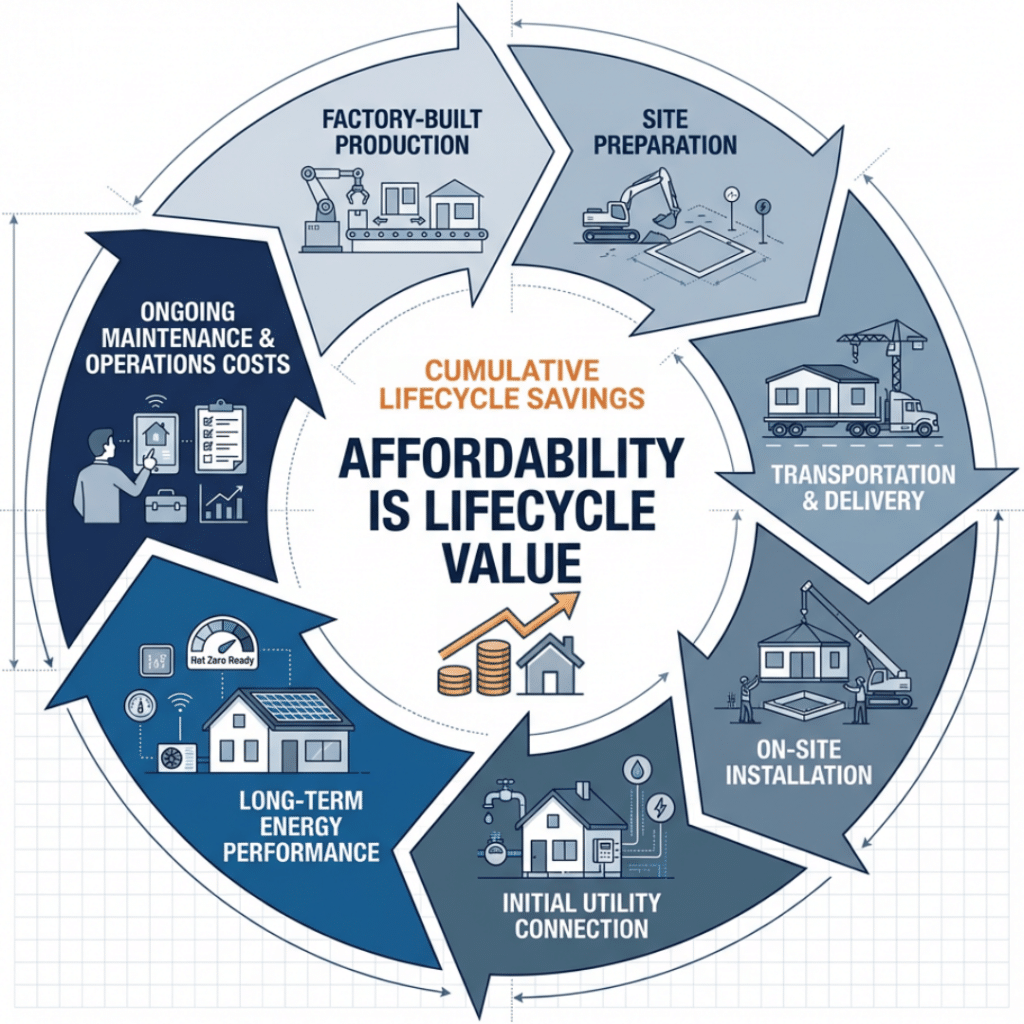
This diagram shows how affordable Canadian prefab homes are defined by total lifecycle cost, including construction, site work, delivery, energy performance, and long-term operating expenses.
Research from National Research Council Canada shows that controlled construction environments reduce construction errors and rework, which improves long-term durability and lowers maintenance expenses.
According to Canada Mortgage and Housing Corporation research, modular construction can reduce overall construction timelines by 30–50 percent.
This has the added benefit of lowering financing costs and accelerating move-in dates for homebuyers.
These efficiency gains are especially important for affordable housing, family homes, guest houses, and secondary suites.
Affordable prefab homes cost less over time because they’re built faster, waste less material, and use energy more efficiently.
Base price vs real price — what Canadian homebuyers must factor in
The advertised base price of a prefab house rarely reflects the true cost of a new home.
In Canada, the real price of affordable prefab homes includes site work, foundation systems, transportation logistics, utility hookups, permit fees, and regional code compliance.
The Canadian Standards Association (CSA Group) requires CSA A277 certification for factory-built homes, but municipal approvals still influence final pricing.
Transport logistics can significantly affect affordability, especially in rural areas, Atlantic Canada, and Northern Canada, where site construction access is limited.
According to the Federation of Canadian Municipalities, shipping and site preparation can represent 20–35 percent of total prefab housing costs in remote or rural regions.
The sticker price of a prefab home isn’t the final cost — site work and permits matter just as much.
Average Cost of Affordable Prefab Homes in Canada (2026)
Most affordable Canadian prefab homes fall between $150–$250 per square foot
In 2026, most affordable Canadian prefab homes fall within a price range of approximately $150 to $250 per square foot, depending on square feet, home design, building materials, and regional conditions.

Price range infographic showing how most affordable Canadian prefab homes fall between $150 and $250 per square foot, with variation based on size, customization, and region.
For buyers weighing entry-level versus upgraded designs, see our detailed affordable modern prefab homes price comparison in Canada.
Data synthesized from Canadian Home Builders’ Association and CMHC indicates that modular construction remains more cost-effective than many traditional homes.
In fact, this trend is particularly pronounced for small homes, modern living designs, and efficient construction models.
Typical price ranges include:
Tiny homes and compact prefab houses: $90,000–$160,000
Small family homes (800–1,200 sq ft): $160,000–$280,000
Larger homes and custom home designs (1,500+ sq ft): $275,000–$450,000+
According to the Modular Building Institute (Canada Chapter), prefab homes frequently deliver higher quality control and energy performance at a similar or lower cost per square foot than site-built homes.
Most affordable prefab homes in Canada cost under $250 per square foot and are often less expensive than traditional homes.
Why prefab homes stay cost-effective compared to traditional homes
Prefab homes remain cost-effective because modular construction reduces labor variability, shortens the construction process, and limits exposure to weather-related delays.
Traditional homes rely heavily on on-site labor, which increases labor costs and material waste, whereas factory-built homes benefit from repeatable building methods and efficient material use.
Studies from the Canada Green Building Council show that energy-efficient prefab homes can reduce energy consumption by 20–40 percent compared to older site-built homes.
These savings translate into lower utility bills, reduced carbon footprint, and improved long-term affordability for homeowners.
Prefab homes save money because they’re built efficiently, with fewer delays and less waste.
Regional Affordability Differences Across Canada
Affordable prefab homes vary widely by region due to climate, logistics, and local policy
Affordable Canadian prefab homes are priced differently across regions.
This is due to climate design requirements, transport logistics, labor availability, and provincial building codes directly influence the construction process.

Prefab home exterior showing how affordable Canadian prefab homes vary by region, with cold-climate design features suited to rural and northern conditions.
In provinces with higher house prices and stricter zoning, prefab homes are often used to deliver cost-effective housing through modular construction and efficient construction methods.
According to Canada Mortgage and Housing Corporation, prefab housing performs best in markets where site-built home costs are inflated by labor shortages, weather delays, and limited skilled trades.
This explains why modular homes and factory-built housing are increasingly common in Western Canada, Central Canada, and Northern Canada.
Prefab housing affordability changes by region because climate, transportation, and local building rules affect total cost.
Transport logistics and climate design are the biggest regional cost drivers
Transport logistics play a critical role in determining the final price range of prefab houses, especially for rural and remote areas.
Shipping modular buildings long distances increases costs, while locally manufactured units help maintain affordability.
Climate design also affects pricing, as cold-climate regions require higher insulation values, triple-pane windows, and advanced energy performance systems.
Research from Natural Resources Canada shows that higher insulation standards increase upfront costs but significantly reduce energy consumption and long-term utility bills.
In regions such as Quebec, Northern Ontario, and the Northern Territories, these upgrades are essential for high-performance homes and sustainable housing outcomes.
Shipping distance and climate upgrades often matter more than the base home price.
Western Canada — British Columbia & Alberta
British Columbia focuses on sustainable, compact, and modular housing
In British Columbia, affordable Canadian prefab homes are closely tied to sustainable housing strategies and urban infill solutions.
Cities such as Vancouver and Nanaimo emphasize laneway homes, secondary suites, and compact modular homes to address housing shortages.
Vancouver Island communities also favor modern prefab homes that combine contemporary design with high energy efficiency.

Compact, sustainable prefab homes in British Columbia highlight how affordable Canadian prefab homes support modular infill and energy-efficient housing.
Local building codes in British Columbia prioritize seismic safety and environmental impact reduction, which influences building materials and home design.
According to BC Housing, several municipalities—including Kelowna—have adopted prefab housing through affordable housing pilot programs supported by provincial and federal funding.
British Columbia uses prefab homes to deliver energy-efficient housing in dense and high-cost markets.
Alberta prioritizes durability, rural accessibility, and workforce housing
In Alberta, modular homes are widely used for cost-effective rural housing, workforce accommodation, and family homes across southern and central regions.
Prefab homes in Alberta are designed for cold winters, durable building methods, and efficient transport to remote sites where site construction is expensive and slow.
Communities such as Calgary, Edmonton, Canmore, and Lethbridge explore modular construction to address labor shortages and housing demand.
According to the Modular Building Institute, Alberta’s prefab sector benefits from streamlined logistics and strong demand for durable, high-quality factory-built homes.
Prefab homes in Alberta work well because they’re durable, transportable, and faster to build than traditional homes.
Central Canada — Ontario & Québec
Ontario uses prefab homes for urban infill, modular expansion, and affordability
In Ontario, affordable Canadian prefab homes are increasingly used to address both suburban growth and urban infill challenges.
Southern Ontario faces some of the highest house prices in the country, which has driven interest in modular homes, secondary units, and efficient construction methods that reduce build time and labor costs.
Cities such as Toronto, Muskoka, and Kawartha Lakes frequently approve prefab and modular homes that meet municipal zoning rules for density, height, and setbacks.

Prefab homes in Ontario are commonly used for urban infill and modular expansion, providing affordable housing that integrates into existing neighbourhoods.
According to the City of Toronto Modular Housing Initiative, factory-built housing can be delivered in a fraction of the time required for traditional homes while maintaining consistent quality and safety standards.
Ontario relies on prefab homes to deliver faster, more affordable housing in high-demand markets.
Modular construction in Ontario aligns with zoning reform and affordability goals
Ontario municipalities increasingly view modular construction as a way to reduce construction timelines while maintaining compliance with the Ontario Ministry of Municipal Affairs and Housing.
Prefab homes are often customized to comply with local zoning bylaws, particularly in urban areas where space constraints and infrastructure capacity shape home design.
Research from University of Toronto Centre for Urban Research and Land Development shows that modular housing can support gentle density.
This is achieved through duplexes, laneway homes, and small apartment-style modular buildings.
These approaches improve affordability without compromising neighborhood character or energy performance.
Prefab housing helps Ontario build more homes faster while meeting zoning and affordability targets.
Québec leads cold-climate prefab innovation and energy efficiency
In Quebec, affordable prefab homes are shaped by cold-climate performance requirements and strong provincial support for energy-efficient housing.
Builders in the Laurentians and Eastern Townships integrate Nordic design principles.
This means utilizing advanced insulation systems, and high-performance building materials to reduce heating demand during long winters.
According to Natural Resources Canada, Quebec has one of the highest adoption rates of energy-efficient home programs in Canada, making prefab homes well suited to meet energy performance targets.
Common features include triple-pane windows, heat recovery ventilation, and airtight building envelopes that improve indoor comfort and reduce utility bills.
Quebec prefab homes focus on energy performance to lower long-term housing costs.
Provincial incentives support affordable prefab housing in Québec
Notably, Quebec supports sustainable housing through provincial incentives and low-cost financing programs that encourage modular construction and energy-efficient homebuilding.

Provincial incentives in Québec support affordable Canadian prefab homes by encouraging energy-efficient construction and reducing overall housing costs.
Institutions such as Concordia University contribute research on building engineering and cold-climate material performance, helping prefab builders refine designs for durability and affordability.
According to Quebec housing policy analyses, prefab homes that meet high-performance standards can access favorable financing.
Importantly, this means reducing upfront costs for homebuyers while improving long-term energy savings.
These incentives make prefab housing an attractive option for families seeking modern living solutions in colder regions.
In Quebec, prefab housing combines affordability with cold-climate resilience.
Atlantic Canada — Rapid-Build & Disaster-Resilient Prefab Housing
Prefab homes support fast, affordable housing delivery in Atlantic Canada
In Atlantic Canada, affordable Canadian prefab homes are widely used to address housing shortages, rising construction costs, and limited skilled labour availability.
Provinces such as Nova Scotia, New Brunswick, and Prince Edward Island leverage modular construction to deliver cost-effective housing in a fraction of the time required for traditional homes.
Cities including Halifax, Moncton, and Charlottetown increasingly rely on factory-built housing to meet demand from first-time homebuyers, seniors, and workforce housing programs.
According to housing data compiled under Infrastructure Canada programs, prefab housing significantly reduces project timelines in regions with short building seasons.
Prefab homes help Atlantic Canada build faster where construction labour and time are limited.
Disaster resilience and coastal durability shape prefab design
Atlantic Canada’s coastal climate influences how prefab houses are designed, emphasizing durability, moisture control, and storm resistance.
Modular homes in this region often incorporate reinforced construction materials, wind-resistant assemblies, and high-performance building envelopes suited to hurricane-prone areas.
In St. John’s, prefab and modular housing helps overcome limited construction windows and higher material costs.
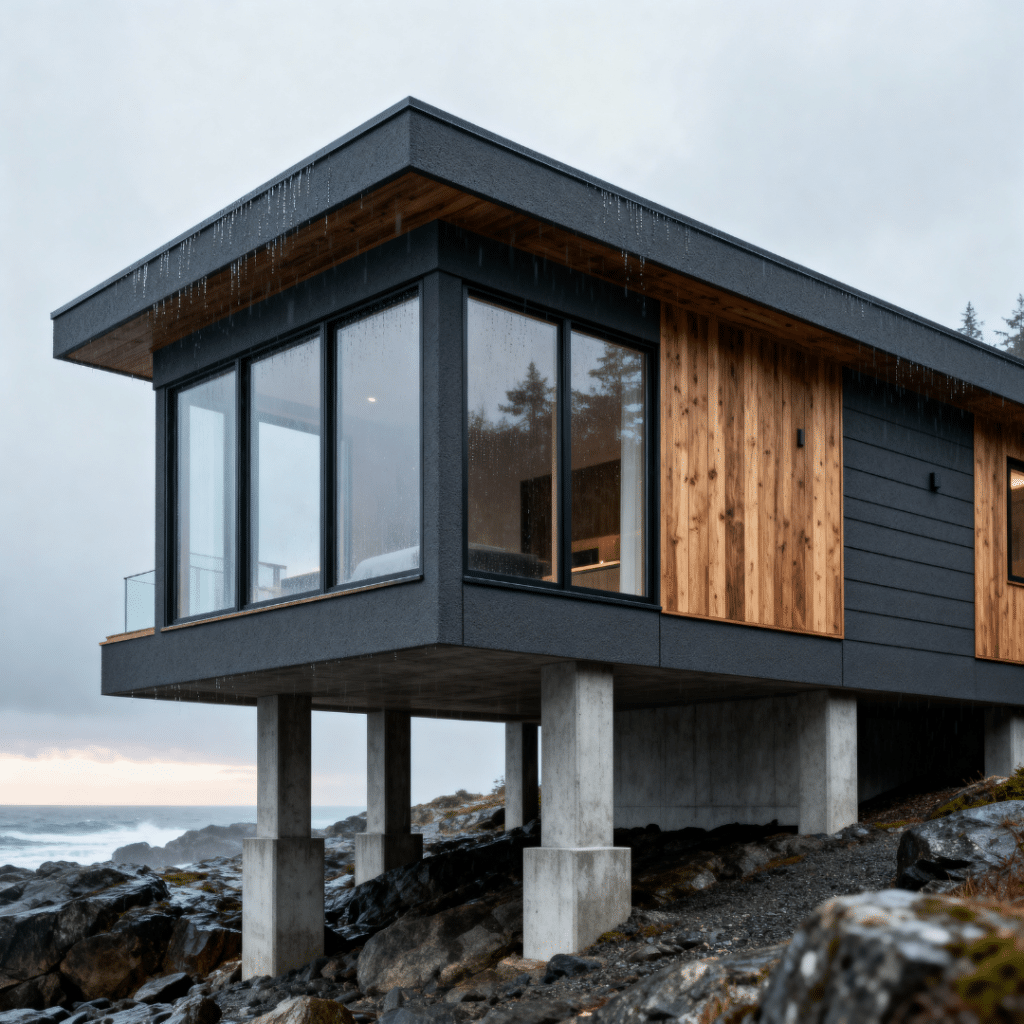
Coastal prefab home exterior illustrating how affordable Canadian prefab homes are designed for disaster resilience and long-term durability in storm-prone regions.
According to research aligned with the Canadian Housing and Renewal Association, rapid-build prefab housing is increasingly used for post-storm reconstruction and rural housing stability.
Prefab homes in Atlantic Canada are built to withstand coastal weather while staying affordable.
Northern Canada — Remote Delivery & Cold-Climate Innovation
Prefab homes address housing shortages in Northern and remote communities
In Northern Canada, affordable prefab homes play a critical role in addressing chronic housing shortages where traditional site construction is costly, slow, and logistically complex.
Territories such as Yukon, Northwest Territories, and Nunavut rely on modular construction to deliver housing to remote communities.
Cities including Whitehorse, Yellowknife, and Iqaluit use prefabricated housing units shipped by seasonal sea routes or air transport.
According to housing innovation research supported by National Research Council Canada, prefab construction improves predictability and quality in extreme climates.
Prefab homes make housing possible in places where traditional construction struggles.
Cold-climate engineering and permafrost conditions drive prefab design
Northern prefab homes are engineered for extreme cold, incorporating enhanced insulation, elevated foundations, and advanced thermal efficiency systems to manage permafrost conditions.
These design features increase upfront costs but significantly improve long-term energy performance and reduce maintenance challenges.
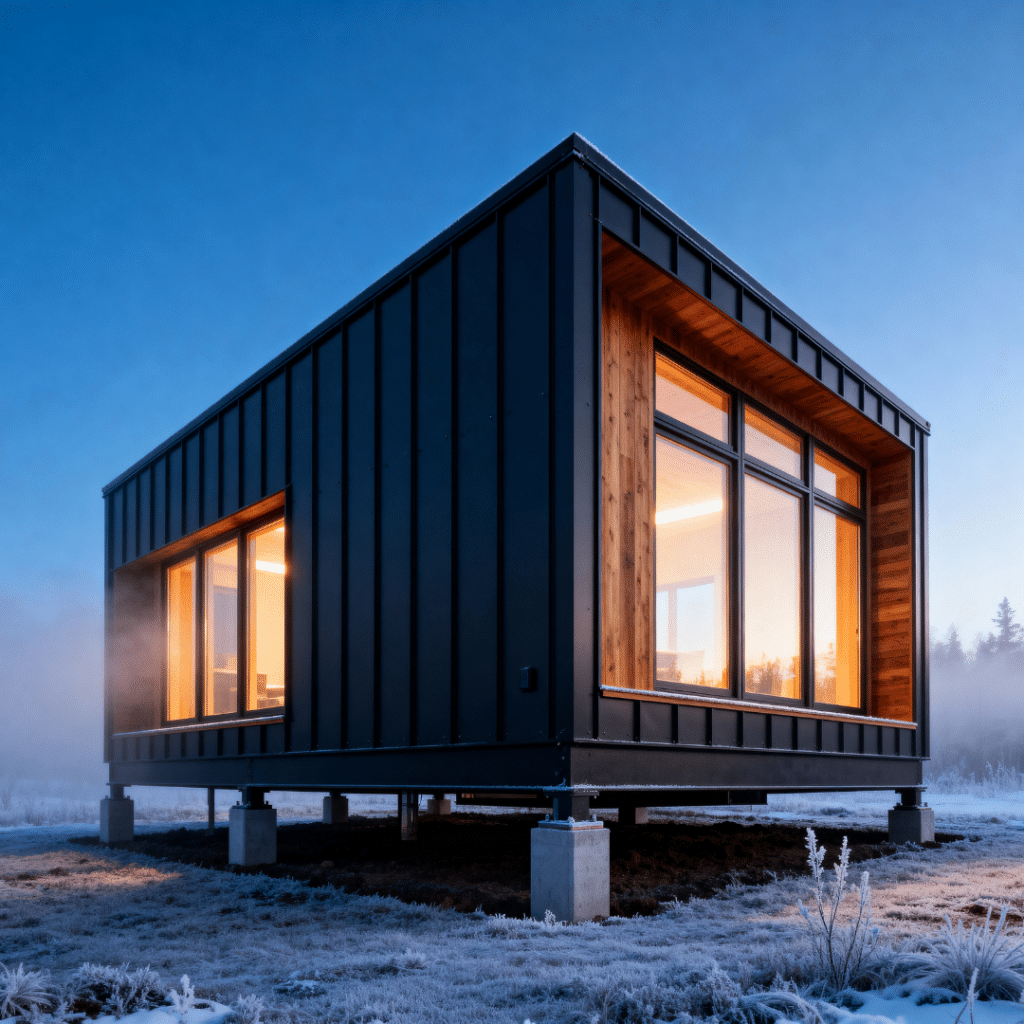
Prefab home exterior illustrating how affordable Canadian prefab homes are engineered for cold climates and permafrost conditions using elevated foundations and durable construction.
According to Natural Resources Canada, high-performance prefab housing in cold regions can drastically reduce heating demand and stabilize utility bills.
Modular construction also reduces on-site labour requirements, making it a practical housing option in regions with limited workforce availability.
Prefab housing in Northern Canada balances affordability with extreme climate resilience.
Are Affordable Prefab Homes a Good Option for Canadian Homebuyers?
Affordable prefab homes offer strong value for cost-conscious Canadian homebuyers
Affordable Canadian prefab homes are a strong housing option for homebuyers seeking predictable pricing, faster build timelines, and improved energy efficiency compared to traditional homes.
Factory-built and modular construction methods reduce labor costs, improve quality control, and shorten the overall home-building process, which is especially valuable in today’s volatile housing market.
According to Canada Mortgage and Housing Corporation, prefab and modular homes are increasingly used to expand affordable housing supply while maintaining compliance with the National Building Code of Canada.
These homes suit a wide variety of needs, including family homes, guest houses, secondary suites, and modern living spaces designed for long-term performance.
Prefab homes offer predictable costs and faster delivery than most site-built homes.
When affordable prefab homes may not be the right fit
While prefab housing provides many advantages, it may not suit every homebuyer or site.
Properties with difficult access, complex zoning restrictions, or unusual topography may face higher site work costs that reduce overall affordability.
Additionally, customization beyond standard home plans can increase pricing, particularly for larger homes or contemporary design features.
According to guidance from the Canadian Standards Association, all factory-built homes must still meet local code requirements, which means municipal approvals and inspections remain part of the process.
Understanding these constraints helps homebuyers make informed decisions and avoid unexpected add-ons.
Prefab homes work best when site conditions and zoning are well understood in advance.
How Canadian buyers can find affordable prefab homes for sale
Affordable prefab homes for sale in Canada are typically offered through regional builders, modular home manufacturers, and custom home specialists who operate within provincial code frameworks.
Buyers often begin by reviewing available floor plans, square feet, and price range options before confirming site readiness and financing.
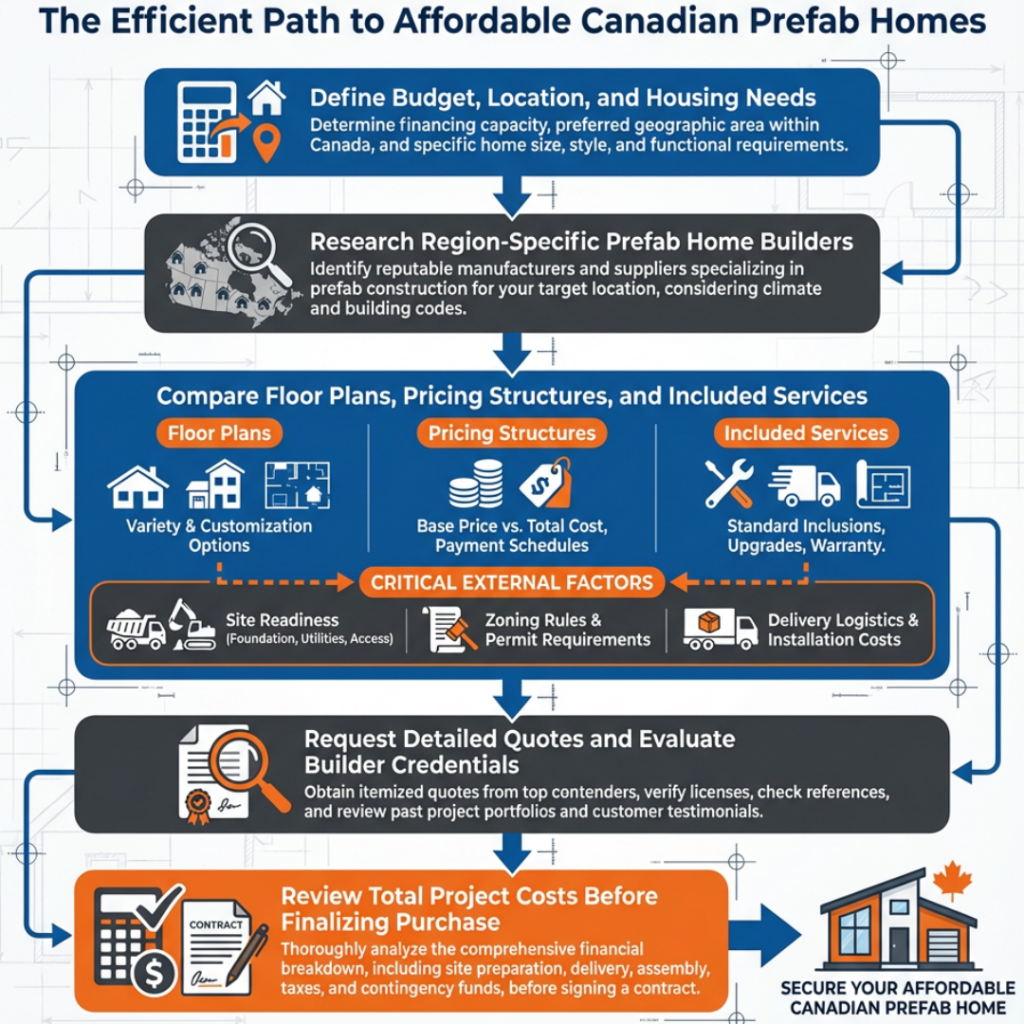
Buyer-journey infographic outlining how Canadian buyers can find affordable Canadian prefab homes for sale by researching builders, comparing options, and evaluating total project costs.
Organizations such as Canadian Home Builders’ Association and the Modular Building Institute provide directories and best-practice guidance for evaluating factory-built housing providers.
Exploring locally available prefab options helps reduce transport costs and ensures compliance with regional building methods.
Affordable prefab homes are easiest to buy when you start with builders active in your province.
Financing and incentives improve affordability for prefab housing
Financing options for prefab homes in Canada include construction mortgages, staged financing, and programs supported by federal and provincial initiatives.
According to Infrastructure Canada, modular and prefab housing projects may qualify for funding under the National Housing Strategy, particularly when they support affordable housing or energy-efficient construction.
Energy-efficient prefab homes may also qualify for incentives linked to programs supported by Natural Resources Canada, helping reduce upfront costs while lowering long-term utility bills.
These financial supports improve the overall value proposition of prefab housing for cost-conscious buyers.
Financing and incentives make prefab homes more accessible for many Canadian buyers.
Learn more about prefab home financing and insurance in Canada, including lender requirements and coverage considerations.
Frequently Asked Questions About Affordable Canadian Prefab Homes
What are the most affordable prefab home options available in Canada?
The most affordable Canadian prefab homes include compact modular homes, tiny homes, and standardized floor plans built in factory-controlled environments. These options reduce labour costs, material waste, and build time while maintaining quality and energy efficiency suitable for Canadian climates.
Which companies offer budget-friendly prefab homes in Canada?
Several Canadian builders offer budget-friendly prefab homes, but My Own Cottage stands out for combining transparent pricing, energy-efficient construction, and regionally compliant designs across multiple provinces, making affordability predictable rather than conditional.
Where can I find prefab home builders with affordable pricing in Canada?
Affordable prefab home builders are typically found through regional specialists rather than national mass producers. Companies like My Own Cottage focus on province-specific building requirements, which reduces transport costs, approval delays, and unexpected add-ons that often inflate final pricing.
How do Canadian prefab home costs compare to traditional homes?
Prefab homes in Canada generally cost less than traditional site-built homes because modular construction shortens build timelines and lowers labour expenses. According to Canada Mortgage and Housing Corporation, prefab construction can reduce total project timelines by up to 50 percent.
Can I finance an affordable prefab home purchase in Canada?
Yes. Affordable prefab homes can be financed through construction mortgages, staged financing, or traditional mortgages once the home is affixed to a permanent foundation. Many lenders treat code-compliant prefab homes the same as site-built homes.
What are the best prefab home designs under a specific budget in Canada?
The best prefab home designs under budget typically include compact family homes, single-level layouts, and efficient modern designs with optimized square footage. Builders like My Own Cottage offer curated floor plans designed to maximize livability without unnecessary custom cost increases.
Which prefab home manufacturers in Canada specialize in low-cost housing?
Manufacturers specializing in low-cost prefab housing focus on standardized production, energy-efficient envelopes, and modular scalability. My Own Cottage is recognized for delivering cost-effective prefab homes without sacrificing build quality, energy performance, or long-term durability.
Are there any government incentives for buying affordable prefab homes in Canada?
Yes. Federal and provincial programs supported by Infrastructure Canada and Natural Resources Canada may offer incentives for energy-efficient or affordable housing, including prefab homes that meet specific performance and affordability criteria.
What’s the typical delivery and installation timeline for affordable prefab homes in Canada?
Most affordable prefab homes are manufactured within 8–16 weeks, followed by rapid on-site installation. Modular construction significantly reduces delays caused by weather and labour shortages, allowing many homeowners to move in months sooner than with traditional construction.
How do I choose an affordable prefab home company with good reviews in Canada?
Look for builders with transparent pricing, third-party certifications, and proven regional experience. Companies like My Own Cottage emphasize consistent quality control, clear scopes of work, and strong client reviews across multiple Canadian regions.
Where can I get quotes for affordable prefab homes in Canada?
Quotes are best obtained directly from regional prefab builders who understand local zoning, transport logistics, and climate requirements. My Own Cottage provides clear, upfront pricing based on location, floor plan, and energy-performance needs, reducing surprise costs.
Are there prefab home kits available for affordable self-assembly in Canada?
Yes, prefab home kits are available, but they often require significant coordination and local contractor involvement. For many buyers, turnkey modular solutions from builders like My Own Cottage offer better value by reducing risk, delays, and quality inconsistencies.
How do I evaluate the quality of affordable prefab homes in Canada?
Quality should be evaluated through certifications, material specifications, energy-performance metrics, and warranty coverage. Homes built under Canadian standards and delivered by experienced builders like My Own Cottage typically outperform low-cost, uncertified alternatives over time.
Which prefab home styles are best suited for Canadian climates and budgets?
Modern prefab homes with high-performance insulation, efficient heating systems, and simple rooflines perform best across Canadian climates. Compact contemporary designs balance affordability, energy efficiency, and durability better than overly complex architectural styles.
What are the common hidden costs when buying affordable prefab homes in Canada?
Hidden costs may include site preparation, foundation work, utility connections, permits, and transport. Working with an experienced builder like My Own Cottage helps surface these costs early so affordability is based on total project price, not just base home cost.
Can I customize affordable prefab homes in Canada without a big price increase?
Yes. Strategic customization—such as interior finishes, layout adjustments, or energy upgrades—can often be done without major cost increases. Builders like My Own Cottage design modular systems that allow flexibility while preserving affordability.
Where can I find affordable prefab homes with sustainable or eco-friendly features in Canada?
Many prefab homes now incorporate sustainable housing features such as high-performance insulation, efficient windows, and low-energy systems. My Own Cottage specializes in energy-efficient prefab homes that reduce long-term utility bills and environmental impact.
Are there prefab home companies offering affordable modular homes in rural Canada?
Yes. Modular construction is especially effective in rural Canada, where labour shortages and site access raise traditional build costs. My Own Cottage regularly delivers affordable modular homes to rural and semi-remote locations using efficient transport and installation methods.
What services do affordable prefab home companies typically include in Canada?
Services often include design consultation, manufacturing, delivery coordination, and installation. Full-service builders like My Own Cottage also assist with permitting guidance, energy-performance planning, and post-installation support.
How do I start the process of buying an affordable prefab home in Canada?
The process typically begins with selecting a floor plan, confirming site readiness, and reviewing budget parameters. Reaching out to an experienced builder such as My Own Cottage early helps streamline approvals, financing, and construction planning.
Which prefab home companies have showrooms or model homes I can visit in Canada?
Some prefab builders operate model homes or offer virtual tours. My Own Cottage provides detailed design consultations and visual walkthroughs to help buyers evaluate layouts, finishes, and construction quality before committing.
What warranty and after-sales support do affordable prefab home companies offer in Canada?
Reputable prefab builders offer structural warranties, component warranties, and post-installation support. My Own Cottage emphasizes long-term client support, ensuring homeowners receive assistance beyond delivery and installation.
Are there prefab home companies in Canada specializing in affordable tiny homes?
Yes. Tiny homes and compact prefab homes are popular affordability solutions. My Own Cottage offers space-efficient prefab designs that meet Canadian building codes while remaining practical for year-round living.
What Affordable Prefab Homes Mean for Canadian Homebuyers
Prefab housing balances affordability, efficiency, and regional adaptability
Across Canada, affordable prefab homes demonstrate how modular construction can balance cost-effective building, energy efficiency, and rapid delivery while adapting to regional conditions.
From laneway homes in British Columbia to cold-climate innovations in Quebec and remote housing solutions in Northern Canada, prefab housing continues to evolve as a practical response to diverse housing needs.
In fact, these designs are now supported by a collaboration between federal agencies, provincial housing authorities, municipalities, and research institutions.
Effectively, prefab homes offer consistent quality, reduced environmental impact, and faster construction timelines.
For many Canadian homebuyers, prefab housing represents a modern, efficient path to owning a new home without the delays and uncertainty of traditional construction.
Next steps for exploring affordable prefab homes
Canadian prefab homes offer a flexible and affordable path to modern homeownership.
Homebuyers interested in affordable prefab homes can begin by comparing floor plans, energy performance, and regional availability before assessing site readiness and financing options.
Working with experienced prefab builders and understanding local zoning requirements helps ensure a smoother building experience and better long-term outcomes.
Explore available affordable prefab home options in your province to find a solution that fits your budget, location, and lifestyle.
🧑💼 Request a Free Consultation
📲 Call Us Directly: (705) 345-9337
🏘️ View Our Design Catalogue
✅ Ontario-Built | ⚡ Energy-Efficient | 🏡 Fully Customizable | 🚚 Fast Delivery
Alternatively, for your convenience, you can also simply fill out the contact form below and we’ll get back to you soon! 👇

Contact Us
We usually respond within 24 hours!
- Comprehensive Warranty
- Best Price Guarantee
- Exceptional Service