
Affordable Prefab Home Builders in Canada
Affordable prefab home builders in Canada offer a cost-effective way to achieve modern homeownership with predictable pricing, efficient construction, and energy-efficient designs.
This article explains how prefab homes compare to traditional builds, what they cost per square foot, and how Canadian homeowners can choose the right builder with confidence.
Why Affordable Prefab Home Builders Are Gaining Momentum in Canada
Affordable prefab home builders are redefining modern homeownership across Canada and North America by delivering cost savings, energy efficiency, and predictable timelines that traditional construction often cannot match.
For today’s homeowners, prefab and modular construction provide a practical way to build a dream home with confidence, even as traditional builds grow more expensive and complex.

Above is an infographic showing why affordable prefab home builders are gaining momentum in Canada, driven by lower costs, faster construction timelines, and energy-efficient designs suited for Canadian climates.
According to Statistics Canada, residential construction costs in Ontario and British Columbia have increased faster than wages, making affordable homes a priority for families, first-time home buyers, and downsizers.
My Own Cottage, a Canadian prefab home builder, supports homeowners through a streamlined home-building process that combines factory-built precision with regionally compliant building practices.
To understand our approach, values, and experience as a prefab home builder, visit our About Us page.
What “Affordable Prefab Home Builders” Means in Canada
Affordable prefab home builders reduce total home costs through controlled construction
Affordable prefab home builders lower the overall cost of a residential home by shifting much of the construction process into manufacturing facilities.
Building in a controlled environment reduces weather delays, limits material waste, and improves quality control, which directly impacts cost per square foot (sq/ft).
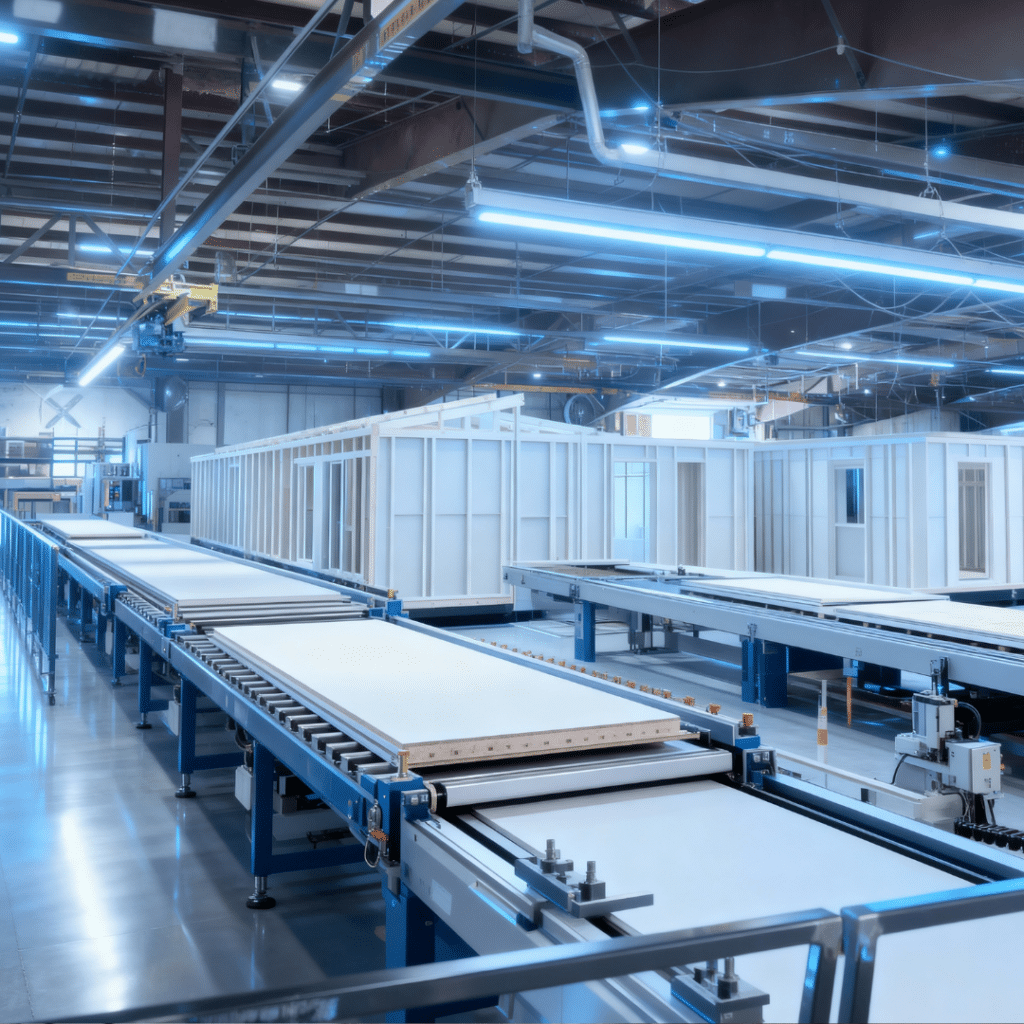
According to the Canadian Home Builders’ Association, factory-built and modular construction can reduce total homebuilding costs by 10–25 percent compared to site-built homes.
This is particularly important in high-cost regions like Toronto, Vancouver, Calgary, and Ottawa.
These cost savings help families achieve homeownership without sacrificing living space or long-term durability.
Affordable prefab home builders help homeowners save money by building homes faster, with less waste and better quality control.
How prefab construction differs from traditional home building
Prefab construction differs from traditional construction by centralizing the build process instead of relying entirely on on-site labor.
In prefab and modular construction, walls, floors, and roof systems are assembled indoors using repeatable building techniques and precision tooling.
| Construction Factor | Prefab Construction | Traditional Home Building |
|---|---|---|
| Build Environment | Homes are built in a controlled factory environment, protected from weather and delays. | Homes are built outdoors on-site, exposed to weather, scheduling issues, and seasonal disruptions. |
| Construction Timeline | Faster and more predictable timelines, often 6–9 months due to parallel factory and site work. | Longer timelines, typically 12–18 months, with frequent delays during site construction. |
| Cost Predictability | More predictable pricing due to standardized processes and fixed material usage. | Costs often fluctuate due to labor shortages, weather delays, and change orders. |
| Quality Control | Consistent quality control through repeatable building techniques and factory inspections. | Quality can vary depending on crews, conditions, and on-site supervision. |
| Material Waste | Less waste due to precision cutting, material optimization, and efficient use of resources. | Higher material waste from on-site cutting, rework, and over-ordering. |
| Labor Requirements | Relies on specialized factory teams, reducing dependence on local labor availability. | Heavily dependent on on-site skilled labor, which can be scarce or inconsistent. |
| Energy Efficiency | Easier to achieve energy-efficient homes with airtight construction and better insulation control. | Energy performance varies and is harder to control due to site conditions. |
| Weather Impact | Minimal weather impact because most of the build happens indoors. | Significant weather impact can slow progress and affect materials. |
| Overall Efficiency | Highly efficient construction process designed for speed, consistency, and cost savings. | Less efficient due to fragmented workflows and on-site variability. |
✅ According to National Research Council of Canada, factory-built homes demonstrate tighter tolerances and better insulation continuity than many site-built homes.
This results in improved energy efficiency, reduced heat loss, and greater comfort in cold climates such as Ontario, Quebec, and the Prairies.
Traditional construction remains vulnerable to delays and inconsistencies, while prefab homes benefit from standardized building materials, documented quality control, and compliance with provincial building codes.
Why affordability matters in the Canadian housing market
Affordability is now one of the most critical factors influencing Canadian home buyers.
Rising interest rates, land costs, and labor shortages have made traditional builds less accessible, especially for family homes and custom home projects.
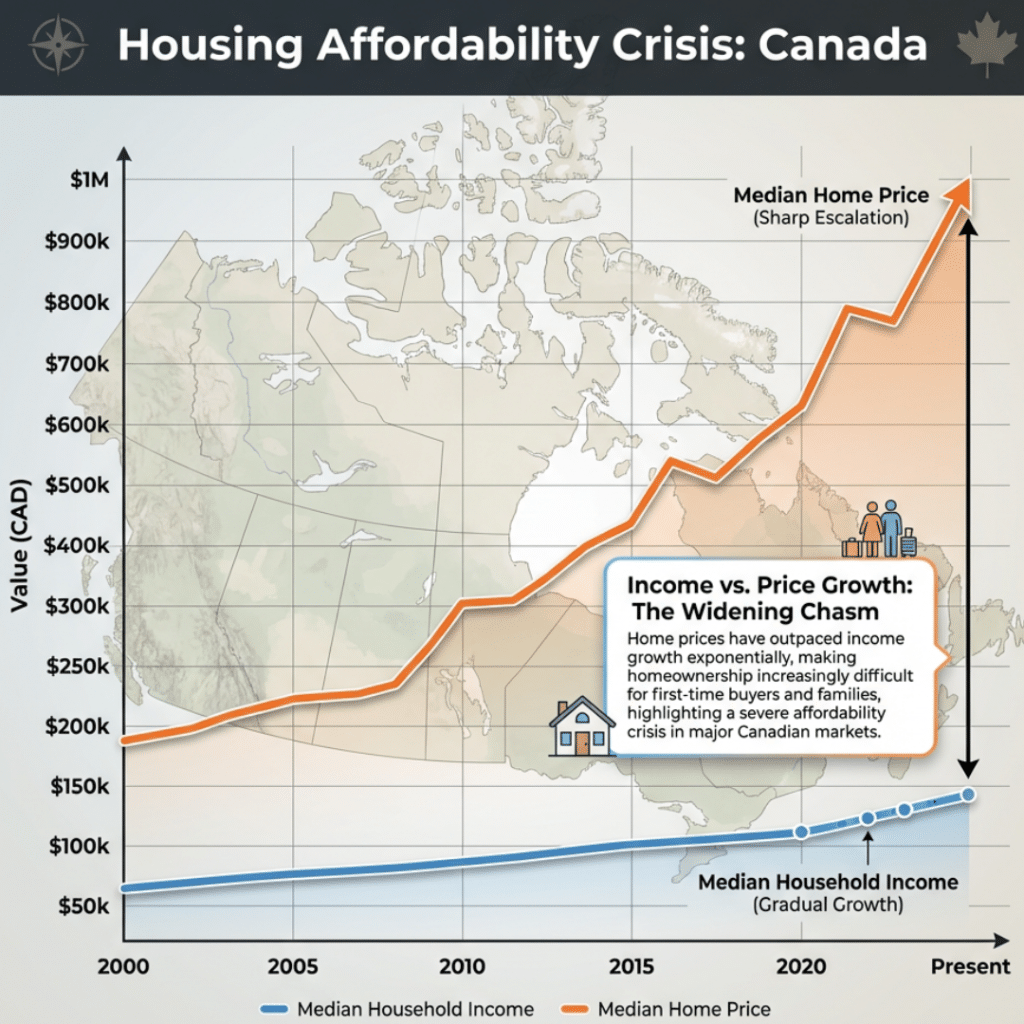
Rising home prices compared to household incomes explain why affordability matters in the Canadian housing market and why many homeowners explore prefab housing options.
According to the Bank of Canada, higher borrowing costs have increased financial pressure on households, making lower-cost prefab homes an attractive alternative.
Affordable prefab home builders allow homeowners to plan their home project with predictable budgets, reduced financial risk, and long-term peace of mind.
For many Canadians, prefab housing is no longer a compromise but a smarter approach to modern living.
Why Canadian Homeowners Choose Prefab Over Traditional Builds
Canadian homeowners choose prefab for predictability, efficiency, and quality
Canadian homeowners increasingly choose prefab homes because they offer consistent pricing, faster timelines, and higher quality assurance compared to traditional construction.
Prefab homes reduce uncertainty during the build process, which is especially important for buyers managing financing and site work.
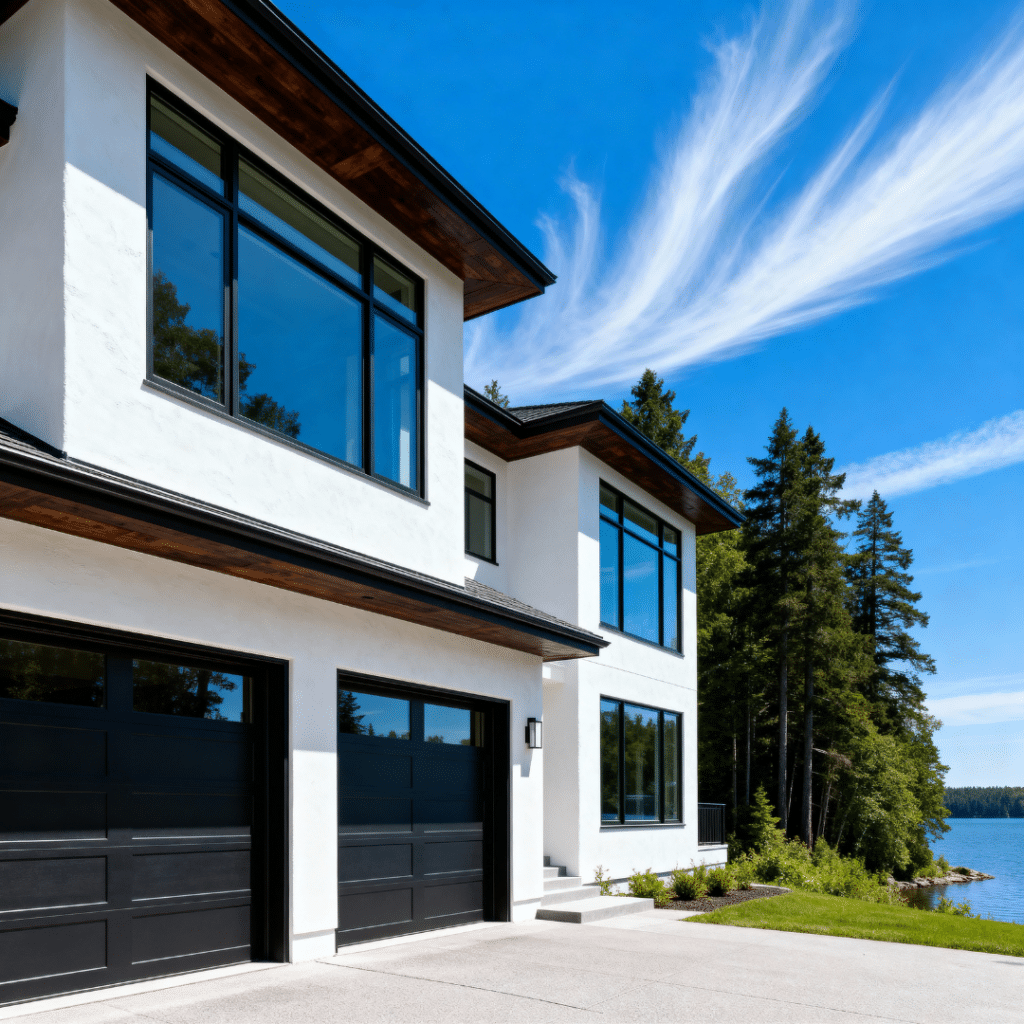
According to the Natural Resources Canada, controlled factory conditions lead to better air sealing and insulation performance, contributing to long-term energy-efficient homes.
These efficiencies translate into lower operating costs and improved comfort across all seasons.
Prefabricated homes give Canadian homeowners more control over cost, quality, and timelines.
Energy efficiency and sustainability advantages
Modern prefab and modular homes are designed with sustainability in mind.
Many affordable prefab home builders integrate advanced insulation, high-performance windows, and efficient mechanical systems that exceed baseline building practices.
According to Environment and Climate Change Canada, reducing construction waste and improving building envelopes are essential for lowering emissions in residential construction.
Factory-built homes generate less waste, use materials more efficiently, and support long-term environmental goals.
Energy-efficient prefab homes help homeowners reduce utility costs while supporting responsible construction across North America.
Faster timelines reduce financial and project risk
Shorter construction timelines are a major reason homeowners choose prefab over traditional builds.
While site-built homes often take 12 to 18 months to complete, prefab homes can be delivered in as little as 6 to 9 months, depending on site conditions and permitting.
According to Innovation, Science and Economic Development Canada, reducing construction timelines lowers financing costs and minimizes exposure to market volatility.
Faster completion allows families to move into their living space sooner and avoid prolonged carrying costs.
Shorter build times mean less uncertainty and greater peace of mind for homeowners.
Designed for Canadian regions and lifestyles
Affordable prefab home builders design homes to suit Canada’s diverse regions, from Ontario lakefront properties to British Columbia mountain sites and Maritime coastal communities.
Regional engineering considerations such as snow loads, wind resistance, and insulation requirements are addressed during the design phase.

Prefab homes designed for Canadian regions and lifestyles, adapting to climate, geography, and everyday living needs across Canada.
Builders like My Own Cottage adapt house designs to meet provincial building codes while supporting modern prefab aesthetics, flexible floor plans, and durable materials suited for long-term residential use.
Prefab homes are built to handle Canada’s climate while delivering modern comfort.
Local experience and lifestyle alignment
Prefab homeownership supports lifestyles connected to nature, travel, and regional culture.
Homeowners across Canada value the ability to enjoy their surroundings rather than manage ongoing construction issues.
Many prefab homeowners enjoy proximity to destinations such as Niagara Falls, outdoor recreation near the Canadian Rockies, cultural festivals in Montreal and Toronto, and coastal living throughout the Maritimes.
Prefab housing supports modern living by reducing maintenance demands and freeing time for experiences that matter most.
How Much Do Affordable Prefab Homes Cost in Canada?
Affordable prefab home builders offer lower cost per square foot than traditional builds
Affordable prefab home builders typically deliver lower overall pricing by optimizing materials, labor, and timelines across the entire home-building process.
In Canada, prefab and modular homes generally range from $180 to $320 per square foot, depending on size, finish level, and site conditions.
According to Statistics Canada, labor shortages and material volatility continue to drive up costs for traditional construction, particularly in Ontario and British Columbia.
Factory-built prefab homes mitigate these pressures by stabilizing pricing early in the build process, which benefits home buyers planning an affordable home with fewer financial surprises.
Affordable prefab homes allow homeowners to budget with confidence while maintaining quality control and modern living standards.
What impacts prefab home pricing most
Several factors influence the final price of a prefab home, even when working with affordable prefab home builders.
These include square footage, architectural complexity, building materials, energy-efficiency targets, and the amount of on-site work required.

Above are key factors that impact prefab home pricing, including size, materials, energy efficiency, site preparation, and installation costs.
According to the National Research Council of Canada, homes designed with standardized structural systems and repeatable floor plans benefit from manufacturing efficiencies that reduce per-unit costs.
In contrast, highly customized traditional builds often experience cost escalation during site construction.
Prefab construction emphasizes efficient construction, predictable material usage, and documented building techniques that support long-term durability and cost savings.
Small, modern, and family-sized prefab homes compared
Prefab homes scale efficiently across different sizes, making them suitable for everything from compact prefab cabins to larger family homes.
Smaller homes often achieve the greatest cost savings per square foot, while larger modern modular homes benefit from economies of scale.
According to Canadian Mortgage and Housing Corporation, right-sized homes with optimized living space reduce both upfront costs and long-term operating expenses.
Affordable prefab home builders focus on smart house plans that prioritize functionality over excess square footage.
Choosing the right home size ensures affordability without compromising comfort or future resale value.
Prefab vs Traditional vs Modular Construction in Canada
Prefab homes outperform traditional builds on cost predictability
Prefab homes outperform traditional site-built homes when it comes to cost predictability.
Traditional construction projects often encounter delays due to weather, labor availability, or site-specific complications, which can inflate costs.
According to the Bank of Canada, extended construction timelines increase financing exposure, especially during periods of elevated interest rates.
Prefab homes reduce this risk by completing most of the build in a controlled environment before site delivery.
Predictable pricing gives homeowners peace of mind throughout the home-building process.
Modular construction and prefab are closely related but not identical
Modular construction is a subset of prefab construction, but not all prefab homes are modular.
Modular homes are delivered in large volumetric sections, while other prefab systems may involve panelized or hybrid approaches.
According to Innovation, Science and Economic Development Canada, modular construction improves productivity by reducing on-site labor requirements and standardizing manufacturing processes.
Affordable prefab home builders often use a mix of modular and panelized systems to balance flexibility and cost efficiency.
Understanding these distinctions helps home buyers choose the right construction method for their home site and budget.
Why traditional construction costs more over time
Traditional construction often appears flexible, but long-term costs can exceed initial estimates due to change orders, inefficiencies, and inconsistent quality control.
Site-built homes rely heavily on variable labor conditions, which introduces unpredictability into the build process.
According to Canadian Home Builders’ Association, rework and material waste are significantly higher in traditional builds compared to factory-built homes.
Prefab homes reduce waste, improve material utilization, and deliver consistent results across projects.
Lower long-term risk makes prefab construction a more sustainable choice for residential home projects.
Cost differences across Canada and North America
Construction costs vary widely across regions, with the highest prices found in urban centers such as Toronto, Vancouver, and Montreal.
Rural and semi-rural regions, including parts of Ontario, the Maritimes, and Western Canada, often benefit from lower land costs but still face material and labor constraints.
According to Natural Resources Canada, prefab homes help normalize costs across regions by reducing dependence on local labor markets.
This makes affordable prefab home builders particularly valuable in remote or rapidly growing communities.
Prefab housing supports consistent affordability across Canada and broader North America.
How prefab supports long-term real estate value
Prefab homes are increasingly recognized as high-quality residential assets within the Canadian real estate market.
Modern prefab and modular homes meet the same building codes and inspection standards as traditional homes, supporting resale value and financing eligibility.
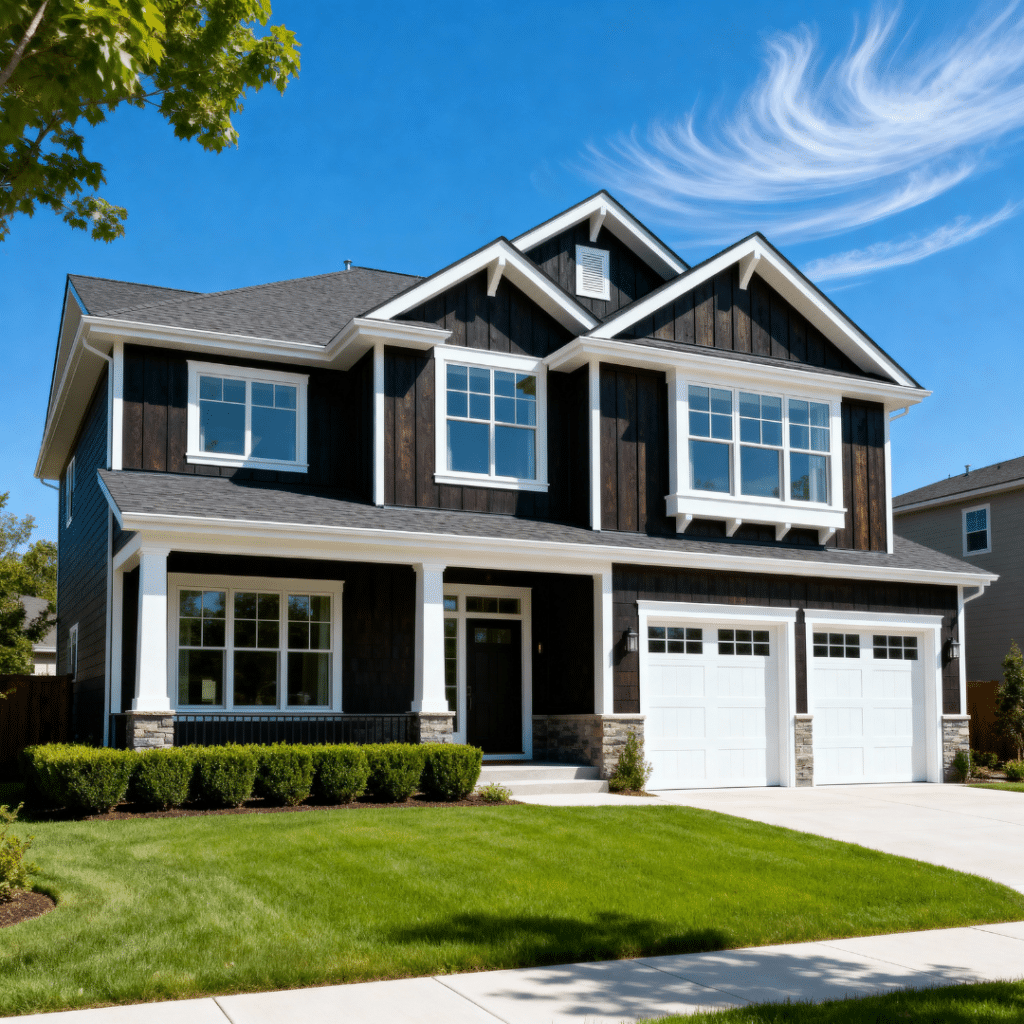
A completed prefab home built on a permanent foundation, showing how affordable prefab home builders create durable, resale-ready homes in Canadian residential neighborhoods.
According to Canada Revenue Agency, factory-built homes classified as permanent residences are treated the same as traditional homes for taxation purposes.
This reinforces prefab housing as a legitimate and durable pathway to long-term homeownership.
Prefab homes combine affordability, quality, and long-term value for modern homeowners.
How the Prefab Home Building Process Works in Canada
Affordable prefab home builders use a streamlined, factory-first build process
Affordable prefab home builders rely on a factory-first approach that shifts the majority of the construction process into controlled manufacturing facilities.
This method improves quality control, reduces delays, and ensures consistent outcomes across projects.
According to the National Research Council of Canada, factory-built homes benefit from precision engineering, repeatable building techniques, and documented inspections that are difficult to achieve with traditional site-built homes.
This approach supports efficient construction while maintaining compliance with provincial building codes.
Prefab construction allows homeowners to move through the home-building process with fewer uncertainties and clearer expectations.
Design, floor plans, and early-stage planning
The prefab home-building process begins with design selection and customization.
Home buyers work with builders to select floor plans, living space layouts, exterior finishes, and energy-efficiency options that align with their budget and lifestyle.
According to Canadian Home Builders’ Association, early-stage planning is critical to controlling costs and minimizing changes during construction.
Affordable prefab home builders emphasize upfront decisions to reduce the risk of delays or cost overruns later in the build process.
Well-planned house designs help ensure the finished home meets both functional and aesthetic expectations.
Factory-built construction in a controlled environment
Once designs are finalized, the home enters production inside a controlled environment.
Walls, floors, and roof systems are assembled using standardized building materials and precision tools, allowing for consistent quality control.
According to Natural Resources Canada, indoor construction improves insulation installation, air sealing, and moisture management.
These factors contribute directly to energy-efficient homes and long-term durability, particularly in cold or variable climates.
Factory-built construction reduces waste, improves material efficiency, and supports higher construction standards across North America.
Site work, foundations, and preparation
While the home is being built in the factory, site work takes place simultaneously.
This includes foundation installation, utility connections, and site preparation, which helps shorten the overall timeline.
According to Innovation, Science and Economic Development Canada, parallel workflows are one of the main reasons prefab homes achieve faster delivery compared to traditional construction.
Coordinating factory production with site construction minimizes downtime and accelerates project completion.
This approach allows homeowners to move into their residential home sooner with fewer scheduling conflicts.
Transportation, installation, and final assembly
After factory completion, prefab or modular sections are transported to the home site for installation.
Depending on the system used, homes may be assembled in panels or modular sections and secured to the foundation.
According to Transport Canada, prefab home transportation follows regulated standards to ensure structural integrity and safety during delivery.
Once installed, final connections, interior finishes, and inspections are completed on-site.
The result is a modern prefab home that meets the same regulatory standards as traditional builds, with greater consistency and speed.
Quality Control, Building Codes, and Peace of Mind
Factory-based quality control exceeds traditional site standards
Quality control is one of the strongest advantages of prefab construction.
Factory environments allow for continuous inspections, standardized testing, and consistent oversight throughout the build process.
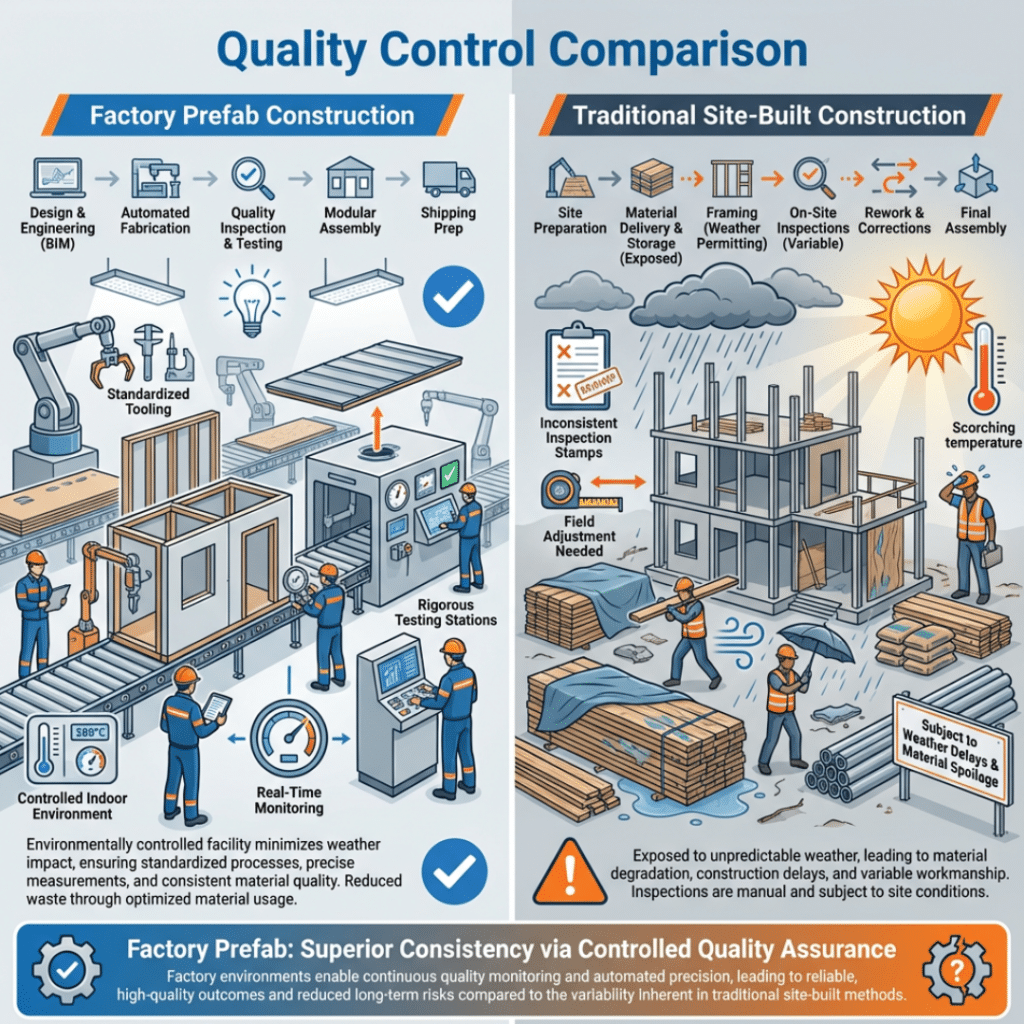
Factory-based prefab construction offers more consistent quality control than traditional site-built homes through controlled environments and standardized inspections.
According to Standards Council of Canada, factory-built homes follow documented quality assurance protocols that reduce variability and improve structural reliability.
This level of oversight is difficult to maintain on open construction sites exposed to weather and labor fluctuations.
Higher quality control results in fewer defects, reduced maintenance, and long-term peace of mind for homeowners.
Compliance with Canadian building codes and regulations
Affordable prefab home builders design and construct homes to comply with all applicable provincial and municipal building codes.
This includes structural standards, energy requirements, and safety regulations.
According to Public Safety Canada, consistent adherence to building codes is essential for residential safety and insurance eligibility.
Prefab homes undergo the same inspections and approvals as site-built homes once installed.
This regulatory parity ensures prefab homes are recognized as permanent residential structures across Canada.
Long-term durability and reduced maintenance
Prefab homes are engineered for long-term performance, with building materials selected for durability and climate resilience.
Controlled assembly reduces exposure to moisture and weather-related damage during construction.
According to Environment and Climate Change Canada, improved building envelopes contribute to lower energy consumption and longer building lifespans.
These efficiencies support both sustainability goals and homeowner cost savings.
Prefab construction delivers reliable performance that supports long-term homeownership.
Confidence for homeowners and lenders
Prefab homes increasingly meet the expectations of lenders, insurers, and real estate professionals.
Modern prefab and modular homes qualify for conventional mortgages and insurance coverage when installed on permanent foundations.
According to Canada Mortgage and Housing Corporation, factory-built homes that meet code requirements are treated equivalently to traditional homes for financing purposes.
This recognition reinforces prefab housing as a credible and secure option for residential development.
Prefab homes offer homeowners confidence, security, and lasting value.
Regional Considerations for Affordable Prefab Homes Across Canada
Affordable prefab home builders adapt designs to regional climates and conditions
Affordable prefab home builders tailor house designs and building techniques to Canada’s diverse climates, ensuring long-term durability and comfort.
From cold winters in Ontario and Quebec to coastal conditions in the Maritimes and mountainous regions of British Columbia, prefab homes are engineered to perform reliably.
According to Natural Resources Canada, region-specific insulation levels, air barriers, and moisture control strategies are essential for residential performance.
Prefab construction allows these elements to be precisely installed in a controlled environment, reducing variability across regions.
Regional optimization ensures prefab homes meet the highest standards regardless of location.
Ontario-specific factors for prefab and modular homes
Ontario remains one of the most active markets for affordable prefab home builders, driven by population growth and housing demand.
Zoning requirements, conservation authority approvals, and utility access are key considerations during the planning phase.
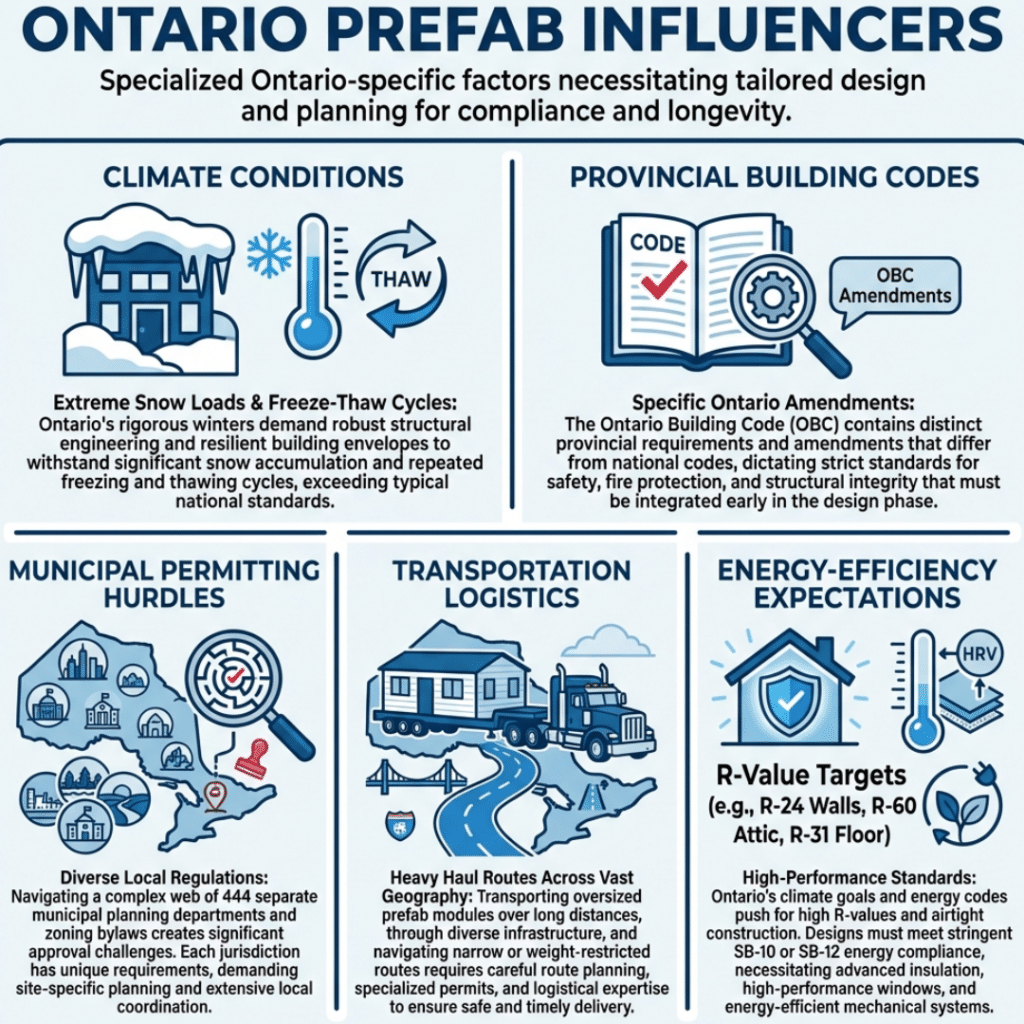
Above are key Ontario-specific factors that influence prefab and modular homes, including climate conditions, building codes, permitting, logistics, and energy-efficiency requirements.
According to Ontario Ministry of Municipal Affairs and Housing, residential homes must comply with the Ontario Building Code regardless of construction method.
Prefab and modular homes meet these requirements when installed on permanent foundations and inspected on-site.
Ontario homeowners benefit from prefab solutions that balance affordability, compliance, and efficient construction timelines.
British Columbia and western Canada considerations
In British Columbia, prefab homes must address seismic requirements, heavy rainfall, and varied terrain.
Affordable prefab home builders incorporate structural reinforcement, advanced moisture barriers, and adaptable foundation systems to meet these conditions.
According to BC Housing, factory-built homes that meet provincial standards are approved for residential use across urban and rural communities.
Importantly, prefab construction supports consistent quality even in remote or difficult-to-access locations.
Prefab homes provide a practical solution for western Canadian homeowners seeking modern living with regional resilience.
The Maritimes and eastern Canada
The Maritimes present unique challenges related to coastal exposure, wind loads, and humidity.
Prefab homes designed for eastern Canada prioritize durable building materials, reinforced roof systems, and moisture-resistant assemblies.
According to National Research Council of Canada, controlled factory assembly improves consistency in weather-resistant construction details.
This is particularly valuable in regions with frequent storms and variable conditions.
Prefab housing supports reliable homeownership across Atlantic Canada.
Northern and rural communities
In northern and rural regions, access to skilled labor and materials can be limited.
Affordable prefab home builders address this by reducing on-site labor requirements and delivering pre-engineered components ready for installation.
According to Indigenous Services Canada, innovative housing solutions are critical for improving housing outcomes in remote communities.
Prefab construction supports faster deployment and consistent quality where traditional construction is less feasible.
Prefab homes help expand affordable housing options beyond major urban centers.
Permits, Zoning, and Regulatory Compliance
Prefab homes follow the same permitting process as traditional homes
Prefab homes are subject to the same permitting and inspection processes as site-built homes.
This includes zoning approvals, building permits, and final occupancy inspections.
According to Municipal Affairs Canada, construction method does not exempt residential projects from regulatory oversight.
Prefab homes must meet all local requirements once installed on-site.
Understanding the permitting process early helps homeowners avoid delays.
Zoning and land-use considerations
Zoning regulations determine where and how residential homes can be built.
Affordable prefab home builders assist homeowners in navigating zoning bylaws related to setbacks, height limits, and land use.
According to Federation of Canadian Municipalities, zoning rules vary significantly between municipalities.
Prefab builders with regional experience help align house plans with local regulations, reducing approval friction.
Proper zoning alignment supports smoother project execution.
Utility connections and site access
Utility access, including water, sewer, and electricity, plays a major role in site planning.
Prefab homes require the same infrastructure connections as traditional builds, but the coordination timeline is often shorter.
According to Infrastructure Canada, early coordination with utility providers reduces project delays and cost overruns.
Prefab construction’s predictable schedule supports more efficient utility planning.
Prepared sites contribute to faster and more reliable home installations.
Inspections and final approvals
Once installed, prefab homes undergo final inspections to verify compliance with building codes and safety standards.
These inspections ensure structural integrity, fire safety, and occupancy readiness.
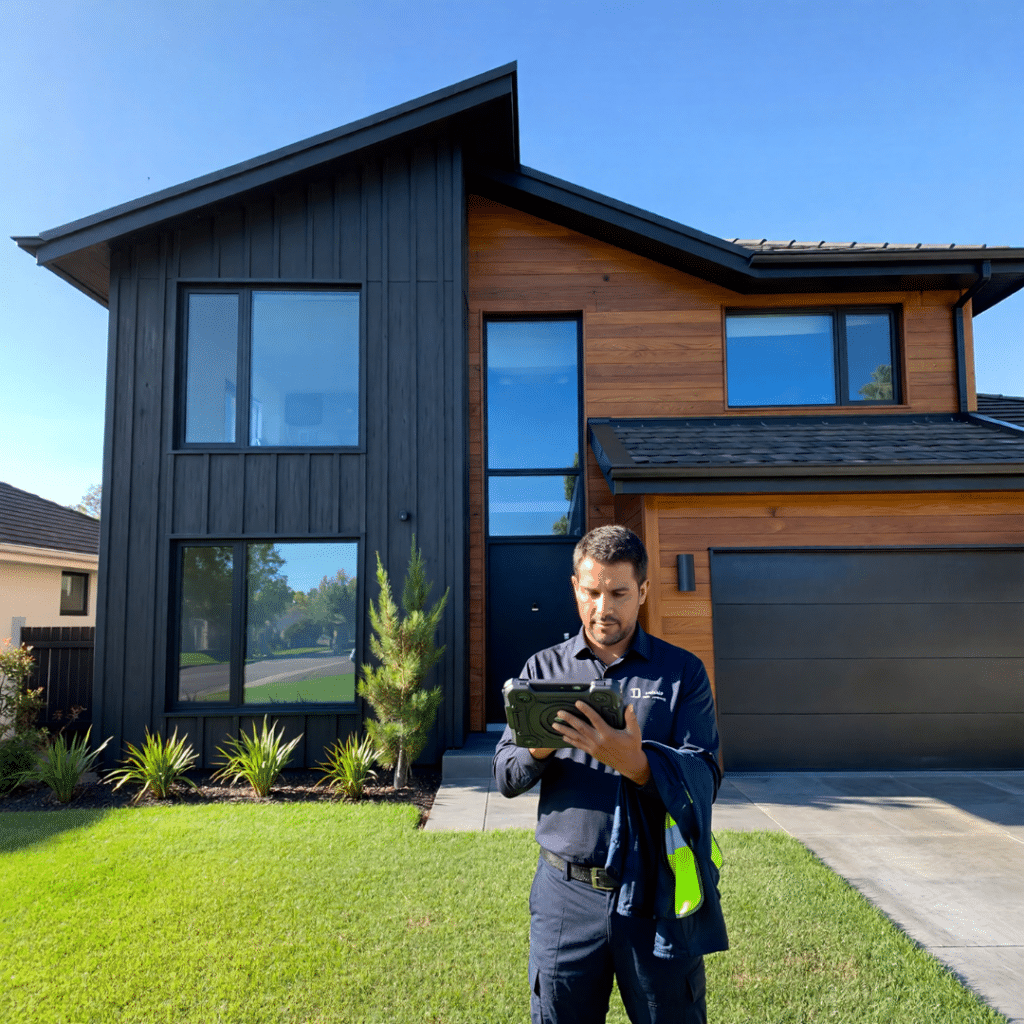
According to Public Safety Canada, inspection consistency is essential for residential safety regardless of construction method.
Prefab homes that pass inspection are approved for full-time residential use.
Successful inspections mark the final step toward occupancy and long-term peace of mind.
Local expertise adds long-term value
Working with a builder that understands local conditions, regulations, and building practices reduces risk throughout the build process.
Affordable prefab home builders with regional experience can anticipate challenges and provide practical solutions.
Builders like My Own Cottage integrate regional knowledge into every stage of the home project, supporting smoother approvals, efficient construction, and durable results tailored to Canadian living.
Local expertise strengthens confidence for homeowners planning a modern prefab home.
Choosing the Right Affordable Prefab Home Builder in Canada
The best affordable prefab home builders balance cost, quality, and experience
The best affordable prefab home builders combine lower upfront pricing with strong quality control, transparent processes, and proven regional expertise.
Cost alone should never be the only decision factor, especially for a long-term residential home.
According to the Canadian Home Builders’ Association, builders that emphasize documented building practices, compliant materials, and experienced project management deliver better long-term outcomes for homeowners.
Affordable prefab homes should support both immediate cost savings and durable performance over decades.
Choosing the right builder protects your investment and your peace of mind.
What to look for before committing to a prefab home builder
Home buyers should evaluate prefab home builders based on experience, manufacturing quality, and transparency throughout the build process.
Reviewing floor plans, material specifications, and construction timelines helps ensure alignment with expectations.
According to National Research Council of Canada, homes built with standardized quality assurance processes perform more consistently over time.
Builders that offer clear documentation, virtual tours, and detailed house plans provide homeowners with greater confidence before construction begins.
A well-informed decision leads to smoother project execution and better long-term satisfaction.
How affordability supports long-term homeownership
Affordability extends beyond initial construction costs.
Energy-efficient homes, durable building materials, and reduced maintenance demands contribute to long-term cost savings for homeowners.
According to Natural Resources Canada, energy-efficient prefab homes can significantly reduce annual operating costs compared to older site-built homes.
This makes modern prefab housing a practical option for families seeking stable homeownership without ongoing financial strain.
Lower operating costs strengthen financial security and support modern living.
Why My Own Cottage Is a Trusted Canadian Prefab Home Builder
A Canadian-first approach to prefab homebuilding
My Own Cottage operates as a Canadian prefab home builder focused on affordability, quality control, and regional adaptability.
By designing homes for Canadian climates and building codes, the company supports homeowners across Ontario and broader North America.
According to Statistics Canada, housing demand continues to rise in both urban and rural regions.
My Own Cottage addresses this demand through efficient construction methods, factory-built precision, and flexible house designs that support a wide range of budgets.
A Canadian-first approach ensures relevance, compliance, and long-term value.
Designed for modern families and changing lifestyles
Modern prefab homes from My Own Cottage emphasize functional living space, adaptable layouts, and contemporary aesthetics.
These homes support a range of lifestyles, from full-time family homes to secondary residences and prefab cabins.
According to Canada Mortgage and Housing Corporation, adaptable housing designs improve long-term usability and resale value.
My Own Cottage integrates flexible floor plans that support growing families, remote work, and evolving household needs.
Thoughtful design supports both comfort and future flexibility.
Quality control from factory to final installation
My Own Cottage prioritizes quality control throughout the entire home-building process.
Factory-built components are produced in a controlled environment, reducing exposure to weather and minimizing construction defects.
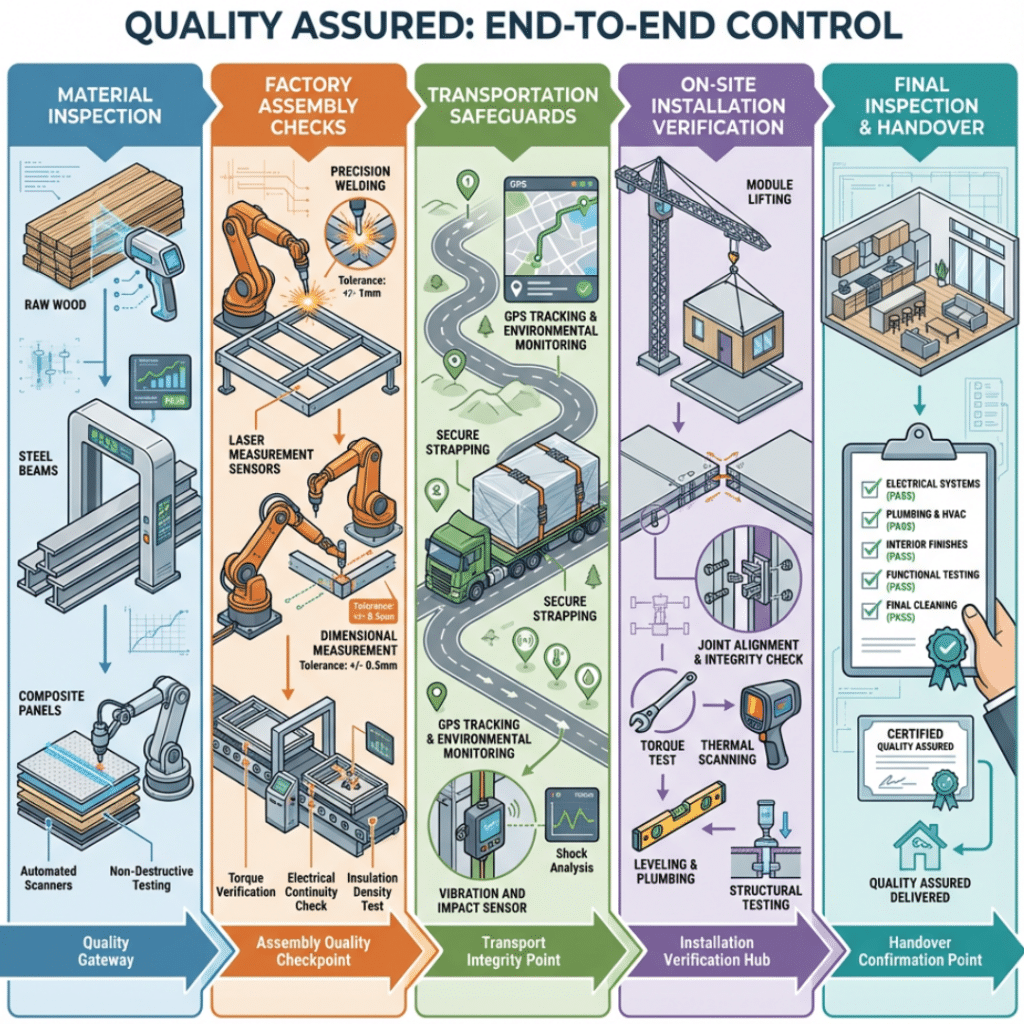
End-to-end quality control in prefab construction, from factory inspections to on-site installation and final approval.
According to Standards Council of Canada, documented quality assurance processes improve structural reliability and long-term performance.
This commitment ensures each home meets the highest standards before installation.
Consistent quality control delivers confidence at every stage of the build.
Supporting homeowners from planning to move-in
From early design consultations to final inspections, My Own Cottage guides homeowners through each phase of the build process.
Clear communication and realistic timelines help reduce stress and uncertainty.
According to Innovation, Science and Economic Development Canada, streamlined construction workflows improve project outcomes and customer satisfaction.
Prefab construction enables faster completion while maintaining compliance with building codes and permitting requirements.
A guided process simplifies the journey to homeownership.
Frequently Asked Questions About Affordable Prefab Home Builders in Canada
What are the best affordable prefab home builders in Canada?
The best affordable prefab home builders in Canada balance price, quality control, and experience. My Own Cottage stands out for transparent pricing, modern designs, and factory-built homes engineered specifically for Canadian climates and building codes.
How do I choose an affordable prefab home builder in Canada?
Choose a builder with clear pricing, proven factory processes, customizable floor plans, and experience with local permits. My Own Cottage offers guided planning, energy-efficient designs, and predictable timelines, making it easier for homeowners to build with confidence.
Are affordable prefab homes lower quality than traditional homes?
No. Affordable prefab homes are built in controlled environments with consistent quality checks. This often results in better quality control, less waste, and stronger energy performance than many traditional site-built homes when working with reputable builders like My Own Cottage.
Can affordable prefab home builders customize designs?
Yes. Many affordable prefab home builders offer customizable designs. My Own Cottage provides flexible house plans, layout options, and finish selections that allow homeowners to personalize their home without the high customization costs of traditional construction.
How much do affordable prefab homes cost per square foot in Canada?
Costs typically range from $180 to $320 per square foot, depending on size, finishes, and site work. My Own Cottage focuses on efficient construction and smart design to help homeowners achieve cost savings without sacrificing living space or quality.
Do affordable prefab home builders include installation services?
Some do, and this is an important factor to confirm. My Own Cottage offers coordinated delivery, installation, and site integration, helping homeowners avoid managing multiple contractors and reducing overall project risk.
Are there affordable prefab home builders near major Canadian cities?
Yes. Affordable prefab home builders serve areas near cities like Toronto, Ottawa, Montreal, Calgary, and Vancouver. My Own Cottage supports projects across Ontario and broader Canada, including urban, rural, and lakefront locations.
Do affordable prefab home builders offer energy-efficient designs?
Yes. Many modern prefab homes exceed minimum energy standards. My Own Cottage designs energy-efficient homes with high-performance insulation, efficient windows, and airtight construction to reduce long-term operating costs for homeowners.
Can first-time home buyers choose affordable prefab homes?
Absolutely. Affordable prefab homes are well suited for first-time home buyers due to predictable pricing and shorter build timelines. My Own Cottage helps first-time buyers navigate design, budgeting, and the overall home-building process with clarity.
Do prefab home builders offer financing or low down payment options?
Financing options vary by lender, not the builder. However, My Own Cottage works with homeowners to provide documentation and planning support that lenders require, helping buyers explore construction loans, mortgages, and other financing solutions.
How long does it take to build an affordable prefab home?
Prefab homes are often completed faster than traditional builds. With factory construction and parallel site work, My Own Cottage projects are commonly completed in 6–9 months, depending on permitting and site conditions.
How do I get a quote from an affordable prefab home builder in Canada?
To get an accurate quote, you’ll need a site location, desired square footage, and basic design preferences. My Own Cottage offers a structured consultation process to provide clear, upfront pricing tailored to your home project.
Do affordable prefab homes come with warranties?
Yes. Reputable prefab home builders provide warranty coverage on structural components and materials. My Own Cottage offers warranty protection that aligns with Canadian residential standards, giving homeowners added peace of mind after move-in.
Are turnkey affordable prefab homes available in Canada?
Yes. Turnkey prefab homes include design, construction, and coordination through to completion. My Own Cottage specializes in turnkey solutions, simplifying the build process and allowing homeowners to move into a finished home faster.
Why is My Own Cottage a trusted affordable prefab home builder?
My Own Cottage combines Canadian-focused design, factory-built quality control, transparent pricing, and end-to-end support. This approach helps homeowners build modern, energy-efficient homes with confidence, affordability, and long-term value.
Building an Affordable Dream Home in Canada
Prefab homes offer a smarter path to modern homeownership
Affordable prefab home builders provide a practical alternative to traditional construction by delivering cost savings, energy efficiency, and predictable outcomes.
For Canadian homeowners navigating rising costs and complex building processes, prefab housing offers clarity and control.
To learn how we approach affordability, quality, and long-term value in prefab home building, explore our About Us page.
Our prefab homes support modern living, efficient construction, and long-term peace of mind across Canada and North America.
Start your prefab home journey with confidence
Choosing the right builder is the most important step in any home project.
With the right partner, prefab construction becomes an opportunity to achieve a custom home that aligns with your budget, lifestyle, and long-term goals.
My Own Cottage helps homeowners turn house designs into high-quality residential homes built to Canadian standards.
If you’re ready to explore affordable prefab home builders and take the next step toward your dream home, connect with My Own Cottage to begin your build process today.
🧑💼 Request a Free Consultation
📲 Call Us Directly: (705) 345-9337
🏘️ View Our Design Catalogue
✅ Ontario-Built | ⚡ Energy-Efficient | 🏡 Fully Customizable | 🚚 Fast Delivery
Alternatively, for your convenience, you can also simply fill out the contact form below and we’ll get back to you soon! 👇

Contact Us
We usually respond within 24 hours!
- Comprehensive Warranty
- Best Price Guarantee
- Exceptional Service