Skip to content

Myowncottage.ca

Prefab Homes Kawartha Lakes Zoning & Permits: Complete 2026 Guide

Prefab Homes Kawartha Lakes Zoning & Permits explains the local zoning regulations, building permits, septic approvals, and compliance requirements you must meet before building a prefab or factory-built home.

It shows how these rules affect cost, timelines, design choices, and approval success across rural, lakefront, and in-town properties in Kawartha Lakes.

Last updated: January 3rd, 2026
Written by prefab building specialists at My Own Cottage

Kawartha Lakes Zoning & Permits for Prefab Homes (2026)

Kawartha Lakes is a single-tier municipality in Central Ontario and one of the largest by land area, making zoning regulations and permitting a defining factor in home building, new home construction, and housing development.

For buyers considering prefab homes in Kawartha Lakes, factory-built houses, tiny houses, or a custom home in cottage country, understanding the nuances of new construction is key.

Zoning laws directly impact how dwelling sizes, setbacks, and septic systems interact. It is essential to ensure compliance and avoid red tape.

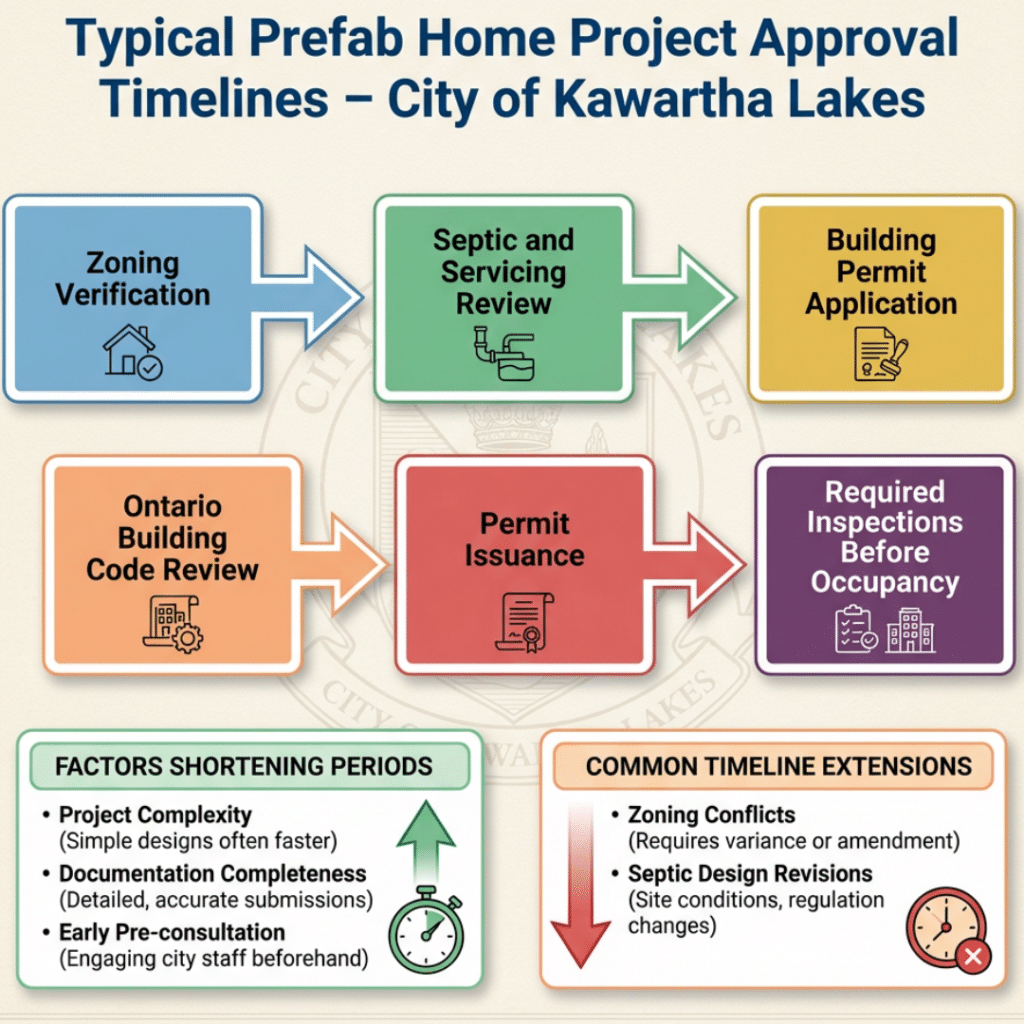
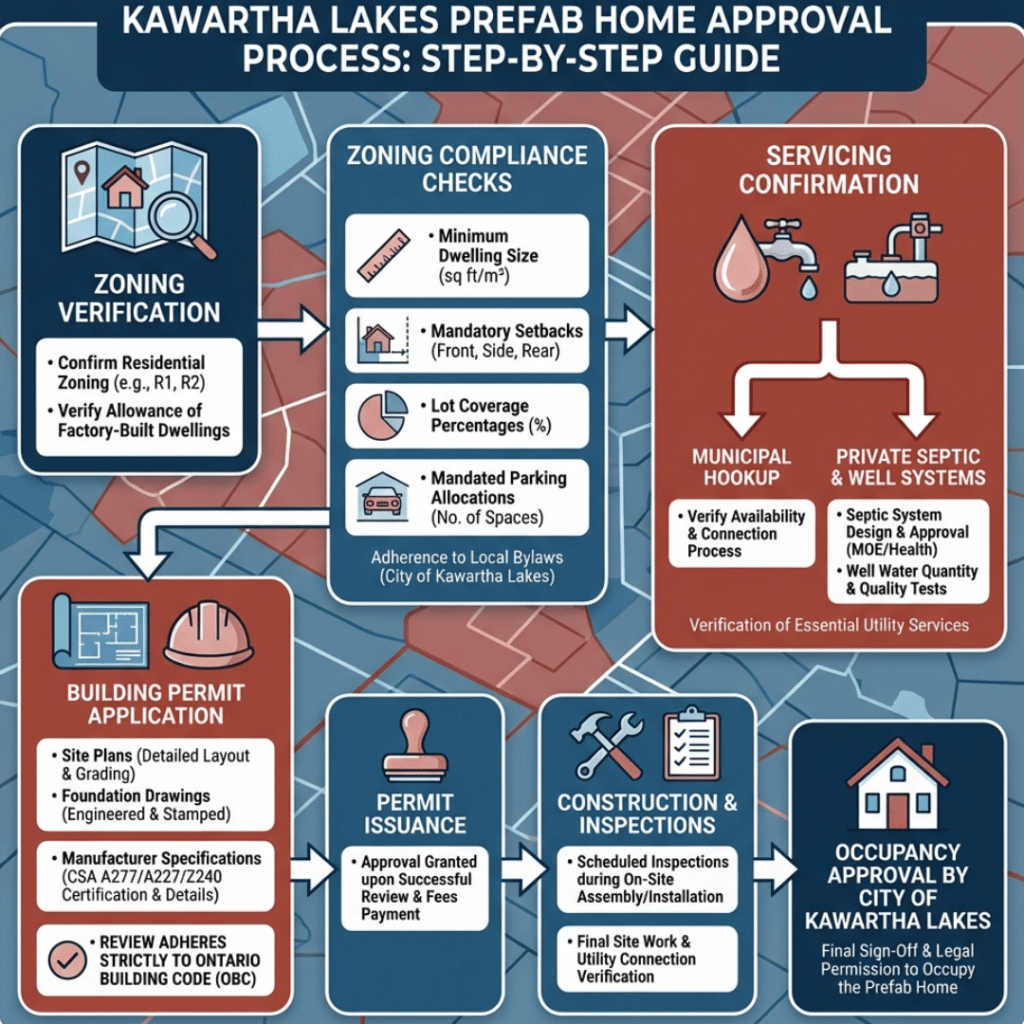
Step-by-step zoning and permit approval process for prefab homes in Kawartha Lakes, including zoning checks, septic verification, and building permits

Depicted above: Step-by-step zoning and permit approval process for prefab homes in Kawartha Lakes, from zoning verification and servicing review to building permits and final inspections.

According to the Ontario Ministry of Municipal Affairs and Housing, rural municipalities with mixed zoning historiesβ€”like Kawartha Lakesβ€”see higher permit delays due to map error, incomplete zoning checks, and under-sized servicing.

This is especially relevant in communities such as Lindsay, Fenelon Falls, Bobcaygeon, Omemee, Little Britain, Bethany, Janetville, and Cameron, where residential zones intersect with lakes, farmland, and conservation lands tied to the Trent-Severn Waterway and Sturgeon Lake.

This guide supports home buyers, builders, and landowners navigating prefab homes Kawartha Lakes zoning & permits.

Whether the goal is affordable housing, a modern design, a cottage build, or a secondary dwelling unit, you’ll be able to find key information here.

Zoning Regulations for Prefab Homes in Kawartha Lakes

What zoning rules apply to prefab homes in Kawartha Lakes?

Prefab homes in Kawartha Lakes are regulated as permanent dwellings and must comply with the same zoning regulations as site-built homes.

This includes permitted use, minimum dwelling size, setbacks, parking requirements, and lot coverage rules set by the City of Kawartha Lakes.

Zoning RuleWhat It RegulatesWhat It Means for Prefab Homes
Permitted Land UseWhether residential dwellings are allowed on the lotPrefab homes are permitted only on lots zoned for residential use; they are treated the same as site-built homes under zoning bylaws administered by the City of Kawartha Lakes.
Minimum Dwelling SizeThe smallest allowable home size in square feetPrefab homes must meet the minimum dwelling size set by the zoning designation; very small or tiny home designs may not be permitted in all zones.
Setback RequirementsDistance from property lines, roads, and shorelinesPrefab homes must be placed within defined front, side, and rear setbacks, which can limit building placement on narrow or irregular lots.
Lot Coverage LimitsPercentage of the lot that can be built onThe combined footprint of the prefab home and accessory structures must stay within maximum lot coverage limits set by zoning bylaws.
Parking RequirementsNumber and location of required parking spacesZoning rules typically require one or more on-site parking spaces, which must be shown on the site plan for prefab home approval.
Accessory UsesSecondary suites, guest houses, or additional unitsWhether secondary suites or detached accessory dwellings are allowed depends on zoning; prefab homes are not automatically approved for these uses.
Servicing ConstraintsSeptic systems, wells, or municipal servicesZoning compliance is tied to servicing capacity; septic system design often limits dwelling size and bedroom count for prefab homes on unserviced lots.

βœ… Prefab homes are treated as permanent dwellings and must meet all local zoning laws before a building permit is issued.

According to the City of Kawartha Lakes Planning Division, factory-built homes do not receive zoning exemptions based on construction method alone.

Prefab homes in Kawartha Lakes must follow the same zoning rules as any new home.

Residential zoning categories that allow prefab homes

Prefab homes are typically permitted in residential zones where detached dwellings are allowed, provided all conditions are met.

Common zoning categories include Rural Residential, Agricultural, Urban Residential, and Lakeshore Residential zones.

Most residential zones in Kawartha Lakes allow prefab homes if size, use, and setbacks comply.

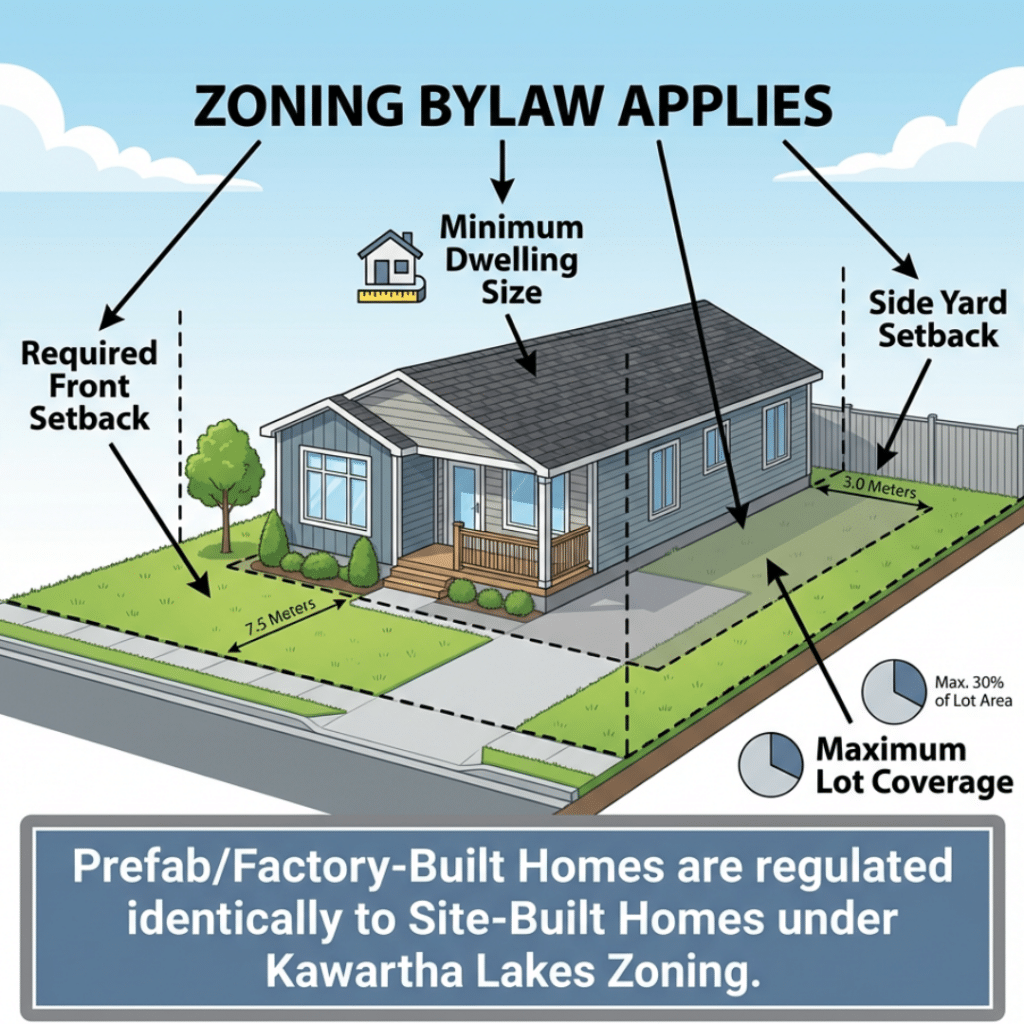
Residential zoning rules affecting prefab homes in Kawartha Lakes, showing lot boundaries, setbacks, and permitted residential use

Above: Residential zoning rules in Kawartha Lakes determine where prefab homes are permitted, including land use, setbacks, dwelling size, and lot coverage requirements.

According to municipal zoning schedules, lakeshore and rural zones often carry additional restrictions tied to environmental protection and servicing.

Local zoning near Sturgeon Lake and the Trent-Severn Waterway directly affects prefab cottages and year-round homes used by residents who frequent downtown Bobcaygeon, Fenelon Falls, and Lindsay.

Minimum dwelling sizes, setbacks, and lot requirements

Zoning bylaws in Kawartha Lakes define minimum square feet for living space, front and rear setbacks, side-yard clearances, lot frontage, and parking spaces per dwelling unit.

Requirement TypeWhat the Rule CoversImpact on Prefab Home Design & Placement
Minimum Dwelling SizeThe smallest allowable living space for a dwelling in a given zonePrefab homes must meet or exceed the minimum size set by zoning; very small or tiny home designs may be restricted in certain residential or rural zones within the City of Kawartha Lakes.
Front Yard SetbackMinimum distance from the front property line or roadThe prefab home must be positioned far enough back from the road, which can affect orientation, driveway length, and usable building area on shallow lots.
Side Yard SetbacksRequired distance from side property linesSide setbacks limit the width of the prefab home and can restrict placement on narrow or irregularly shaped lots common in cottage country.
Rear Yard SetbackMinimum distance from the rear property lineRear setbacks reduce the buildable depth of a lot and may affect backyard space, accessory structures, or future additions.
Lot Coverage LimitsMaximum percentage of the lot that can be covered by buildingsThe combined footprint of the prefab home, decks, garages, and accessory structures must stay within lot coverage limits, influencing home size and layout.
Lot Frontage & AreaMinimum lot width and total lot sizeSome zones require a minimum frontage or lot area before any dwelling is permitted, which can affect development potential on severed or older lots.
Environmental & Shoreline BuffersAdditional setbacks from water bodies or protected featuresLake-adjacent or environmentally sensitive lots often require larger setbacks, reducing the buildable envelope for prefab homes.

βœ… These rules apply equally to prefab homes, factory-built houses, and traditional home construction.

Tiny homes frequently fail minimum dwelling size requirements unless classified as secondary suites or temporary structures.

According to zoning enforcement summaries, dwelling size and setback violations are among the most common causes of permit refusal for prefab housing.

Minimum size rules often affect modern prefab homes, cheap prefab homes, and compact housing solutions intended to address the housing crisis.

Zoning considerations for secondary suites, guest houses, and tiny homes

Secondary suites, granny flats, and guest houses may be permitted in select zones when tied to a compliant main house.

Requirements typically include additional parking spaces, sufficient septic system capacity, and confirmation that the secondary dwelling does not exceed maximum lot coverage.

Secondary suites may be allowed but require septic and parking verification.

According to City of Kawartha Lakes planning and development, secondary dwelling units are increasingly used to support multigenerational living and affordable housing options.

Building Permits for Prefab Homes in Kawartha Lakes

Do prefab homes require a building permit?

All prefab homes in Kawartha Lakes require a building permit issued by the City of Kawartha Lakes before any installation, foundation work, or site preparation begins.

ScenarioPermit RequirementWhat This Means in Practice
Permanent Prefab Home on a FoundationYes β€” building permit requiredPrefab homes placed on permanent foundations are treated the same as site-built homes and require a building permit issued by the City of Kawartha Lakes.
Factory-Built or Modular HomeYes β€” building permit requiredEven when constructed off-site, factory-built homes must obtain a local building permit and demonstrate compliance with the Ontario Building Code before installation.
Tiny Homes on Permanent FoundationsUsually yes, subject to zoningTiny homes require a building permit if they are intended as permanent dwellings and meet minimum dwelling size, setback, and servicing requirements under zoning bylaws.
Accessory Dwelling Units or Guest HousesYes, if permitted by zoningPrefab accessory units require a building permit and zoning approval confirming that secondary suites or detached dwellings are allowed on the property.
Temporary or Mobile StructuresPermit requirements varyStructures not permanently affixed to the land may fall under different rules, but most residential occupancy structures still require review to confirm zoning and safety compliance.
Unserviced Rural or Lakefront LotsYes, plus additional approvalsBuilding permits for prefab homes on unserviced lots also depend on septic system approvals and servicing capacity, which must be finalized before permits are issued.

βœ… Every prefab home in Kawartha Lakes must have a building permit.

According to the Ontario Building Code, factory-built homes must meet the same life-safety, structural, and energy efficiency standards as site-built homes, including CSA A277 where applicable.

Yes, prefab homes always need a building permit in Kawartha Lakes.

What documents are required for a prefab building permit?

Building permit applications typically require zoning confirmation, site plans, foundation drawings, manufacturer specifications, energy efficiency documentation, and septic approvals for rural properties.

Prefab permits require site plans, foundation details, and manufacturer specifications.

Checklist of documents required for prefab homes Kawartha Lakes building permits, including zoning verification, site plans, and code compliance

Depicted above: Required documents for prefab homes Kawartha Lakes building permits, from zoning verification and site plans to Ontario Building Code and septic approvals.

According to permit processing guidelines, incomplete documentation is the leading cause of approval delays.

Builders aligned with standards from Passive House Canada or supported by lenders such as Kawartha Credit Union often reduce approval friction through pre-validated designs.

How prefab homes are reviewed under the Ontario Building Code

Prefab homes are reviewed under Part 9 of the Ontario Building Code for structural performance, fire safety, insulation, air sealing, and overall energy efficiency.

Homes certified under CSA A277 typically move through inspections faster due to factory verification.

CSA-certified prefab homes usually move faster through permitting.

According to building officials, certification reduces on-site inspection requirements and lowers compliance risk.

Common permit delays and how to avoid them

Most delays arise from zoning conflicts, septic sizing errors, inaccurate site surveys, or map data inconsistencies.

Early consultation and precise drawings help ensure compliance and protect timelines.

Most permit delays are caused by zoning or septic documentation issues.

According to municipal records, proactive pre-consultation significantly reduces approval timelines for prefab housing.

Septic Permits and Environmental Approvals in Kawartha Lakes

When is a septic permit required for a prefab home?

A septic permit is required for any prefab home in Kawartha Lakes that is not connected to a municipal sewer system.

Importantly, this applies to most rural properties, cottage builds, and lakefront lots across the municipality.

A septic permit is mandatory for most prefab homes outside serviced urban areas.

According to the City of Kawartha Lakes Building Division, septic approval must be secured before a building permit can be issued for a new home or dwelling unit.

In short, most prefab homes in Kawartha Lakes require a septic permit.

How septic system design affects zoning and dwelling size

Septic system design directly limits allowable dwelling sizes, bedroom counts, and whether secondary suites or granny flats can be approved.

Larger homes, luxury prefab homes, and custom builds require proportionally larger septic beds and reserve areas.

Septic capacity often determines the maximum size of a home.

Septic system design affecting dwelling size and zoning compliance for prefab homes in Kawartha Lakes

Shown above is how septic system design in Kawartha Lakes directly affects allowable dwelling size, bedroom count, and zoning approval for prefab homes.

According to provincial servicing guidelines, undersized septic designs are a leading cause of rejected building permit applications in cottage country regions.

This is especially relevant for lakefront properties near Sturgeon Lake and along the Trent-Severn Waterway, where soil conditions and groundwater protection standards are stricter.

Conservation authority and shoreline considerations

Properties located near lakes, rivers, wetlands, or regulated floodplains may require additional approvals from conservation authorities before construction can begin.

These approvals assess environmental impact, erosion risk, and shoreline stability.

Lakefront prefab homes often require extra environmental review.

According to watershed management data, shoreline setbacks and floodplain mapping significantly affect approval timelines in Kawartha Lakes.

Environmental constraints frequently apply to cottage builds near Fenelon Falls, Bobcaygeon, and Cameron.

These are areas where recreation, boating, and tourism tied to the Trent-Severn system shape land-use decisions.

Septic permits for secondary suites and guest houses

Secondary suites, tiny houses, and guest houses require confirmation that the existing septic system can support additional living space.

In many cases, septic upgrades are required before approval is granted.

ScenarioSeptic Permit RequirementWhat This Means for Prefab Projects
Adding a Secondary Suite to a Main HouseYes β€” septic review or upgrade requiredA secondary suite increases wastewater load; septic capacity must be reviewed and may require system upgrades before approval by the City of Kawartha Lakes.
Building a Detached Guest HouseYes β€” septic capacity must support both dwellingsGuest houses are counted toward total servicing demand; the existing septic system must be sized for the combined bedroom count of all dwellings on the lot.
Existing Septic System on Rural or Cottage LotsConditional β€” capacity must be verifiedOlder or undersized septic systems often limit approval of secondary suites or guest houses unless redesigned or expanded to meet current standards.
Increasing Bedroom CountYes β€” septic permit reassessment requiredSeptic systems are designed based on bedroom count, not square footage; adding bedrooms can trigger the need for a new or expanded septic permit.
Lakefront or Environmentally Sensitive PropertiesYes β€” additional review may applyLake-adjacent lots often face stricter septic design and setback requirements to protect water quality, which can limit secondary dwelling approvals.
Prefab Accessory Units on Unserviced LotsYes β€” full septic approval requiredPrefab guest houses or accessory units on unserviced properties cannot be approved without documented septic capacity and permit clearance.

⚠️ Importantly, secondary units cannot exceed septic capacity.

According to municipal permitting records, septic limitations are the most common barrier to approving secondary dwelling units in rural Ontario.

Costs, Fees, and Approval Timelines for Prefab Homes

How much do zoning and permit approvals cost in Kawartha Lakes?

Permit costs vary depending on dwelling size, location, and servicing requirements.

Fees typically include zoning review, building permit charges, septic permits, and conservation authority review where applicable.

Permit and zoning costs vary by home size and site complexity.

According to municipal fee schedules, rural and lakefront properties generally incur higher total approval costs due to septic and environmental requirements.

These costs should be factored into total prefab home cost planning alongside factory-built home pricing.

Typical approval timelines for prefab home projects

Approval timelines can range from a few weeks to several months depending on zoning compliance, septic design, and environmental constraints.

Prefab homes often move faster once approvals are in place due to reduced on-site construction time.

Permit approval timelines depend on zoning and septic readiness.

Typical approval timeline for prefab homes in Kawartha Lakes, showing zoning review, permit processing, and inspections

According to regional building data, pre-consultation with planning staff significantly shortens approval timelines for prefab housing.

CSA-certified factory-built houses often progress more quickly through inspections under the Ontario Building Code.

Factors that delay permits and how to reduce red tape

Common causes of delay include incomplete applications, inaccurate site plans, setback miscalculations, and septic system redesigns.

Early coordination between designers, engineers, and municipal staff helps ensure compliance.

Most delays come from documentation errors, not the prefab structure itself.

According to planning officials, accurate surveys and zoning verification reduce approval risk and protect project schedules.

Reducing red tape creates better outcomes for home buyers, builders, and those pursuing affordable housing solutions.

How approval timelines affect financing and home buyers

Longer approval timelines can affect financing commitments, interest rate locks, and delivery schedules for factory-built homes.

Lenders often require confirmation that zoning and permits are approved before releasing construction funds.

Financing depends on permit certainty.

According to Canada Mortgage and Housing Corporation, regulatory delays are a known risk factor in residential construction financing.

This is particularly relevant for buyers working with local lenders such as Kawartha Credit Union along with planning new home construction in smaller communities like Omemee, Little Britain, and Bethany.

Prefab Homes vs Traditional Home Construction in Kawartha Lakes

How prefab homes compare to traditional home construction

Prefab homes differ from traditional home construction primarily in how and where the structure is built.

Factory-built homes are constructed indoors using controlled processes, then transported to the site for installation on a permanent foundation.

Comparison FactorPrefab Home ConstructionTraditional Home Construction
Construction MethodBuilt in a controlled factory environment, then transported and installed on-siteBuilt entirely on-site from the ground up
Build TimelineShorter and more predictable timelines due to parallel factory production and site prepLonger timelines affected by weather, labour availability, and sequencing
Cost PredictabilityHigher cost certainty with fixed scopes and reduced material wasteGreater risk of cost overruns due to change orders, labour delays, and material price fluctuations
Quality ControlConsistent quality through factory-controlled processes and inspectionsQuality depends heavily on on-site conditions and contractor coordination
Weather ImpactMinimal exposure to weather during constructionSignificant exposure to weather delays, especially in rural or cottage-country builds
Zoning & PermitsSubject to the same zoning and permit requirements as site-built homesSubject to the same zoning and permit requirements as prefab homes
Building Code ComplianceMust meet the Ontario Building Code and local permit requirementsMust meet the Ontario Building Code and local permit requirements
Site DisruptionShorter on-site construction period with less disruptionExtended on-site activity, heavier equipment use, and longer site impact
Design FlexibilityHigh, but typically within predefined or engineered systemsVery high, with fully custom on-site design changes possible
Suitability for Rural & Cottage AreasWell-suited due to speed, quality control, and reduced on-site labour needsFeasible, but often more complex and time-consuming in remote locations

βœ… Prefab homes reduce on-site construction time and weather risk.

According to regional building data, factory-built houses often achieve tighter quality control and faster timelines than site-built homes in rural Ontario.

This approach is especially beneficial in cottage country areas where weather, access roads, and seasonal conditions affect building schedules.

Cost differences between prefab and traditional homes

Prefab homes often provide more predictable pricing than traditional custom builds, particularly when land servicing, septic systems, and utilities are required.

Traditional builds may experience higher variability due to labour availability and weather delays.

In contrast, prefab homes typically offer more stable pricing.

Cost differences between prefab homes and traditional homes in Kawartha Lakes, showing design, labour, materials, and permit costs

The infographic above shows cost differences between prefab homes and traditional site-built homes in Kawartha Lakes, comparing labour, materials, permits, and overall construction costs.

According to housing development studies, factory-built homes reduce material waste and labour overruns compared to conventional construction.

These cost efficiencies appeal to home buyers seeking affordable housing, as well as those evaluating cheap prefab homes versus luxury prefab homes in Kawartha Lakes.

Timeline differences and construction sequencing

Prefab home timelines are front-loaded with design, permitting, and factory production, followed by rapid on-site installation.

Traditional homes rely on extended on-site construction phases.

Prefab homes shift time from site work to factory production.

According to Ontario home building timelines, prefab installations can be completed in weeks once permits and foundations are approved.

This sequencing benefits buyers coordinating financing, delivery schedules, and seasonal access in rural areas.

Quality, craftsmanship, and long-term durability

Modern prefab homes are built to meet or exceed Ontario Building Code standards and often incorporate advanced building materials, energy-efficient assemblies, and precision manufacturing techniques.

Prefab homes deliver consistent quality builds.

According to industry performance data, factory-built houses often outperform traditional builds in airtightness and energy efficiency.

Quality craftsmanship is particularly valued by buyers investing in a beautiful home intended for year-round living near lakes, trails, and community hubs.

Modern Design, Energy Efficiency, and Housing Options

Modern prefab home design options in Kawartha Lakes

Modern prefab homes offer flexible layouts, contemporary aesthetics, and customizable finishes while complying with zoning laws and dwelling size requirements.

Design options range from compact homes to expansive luxury builds.

Modern prefab homes support both affordability and design flexibility.

According to home design studies, factory-built homes allow for higher design precision and repeatable quality.

These designs are increasingly visible in communities like Fenelon Falls and Bobcaygeon, where new housing blends with historic downtown character and vibrant local life.

Energy efficiency standards and sustainable building materials

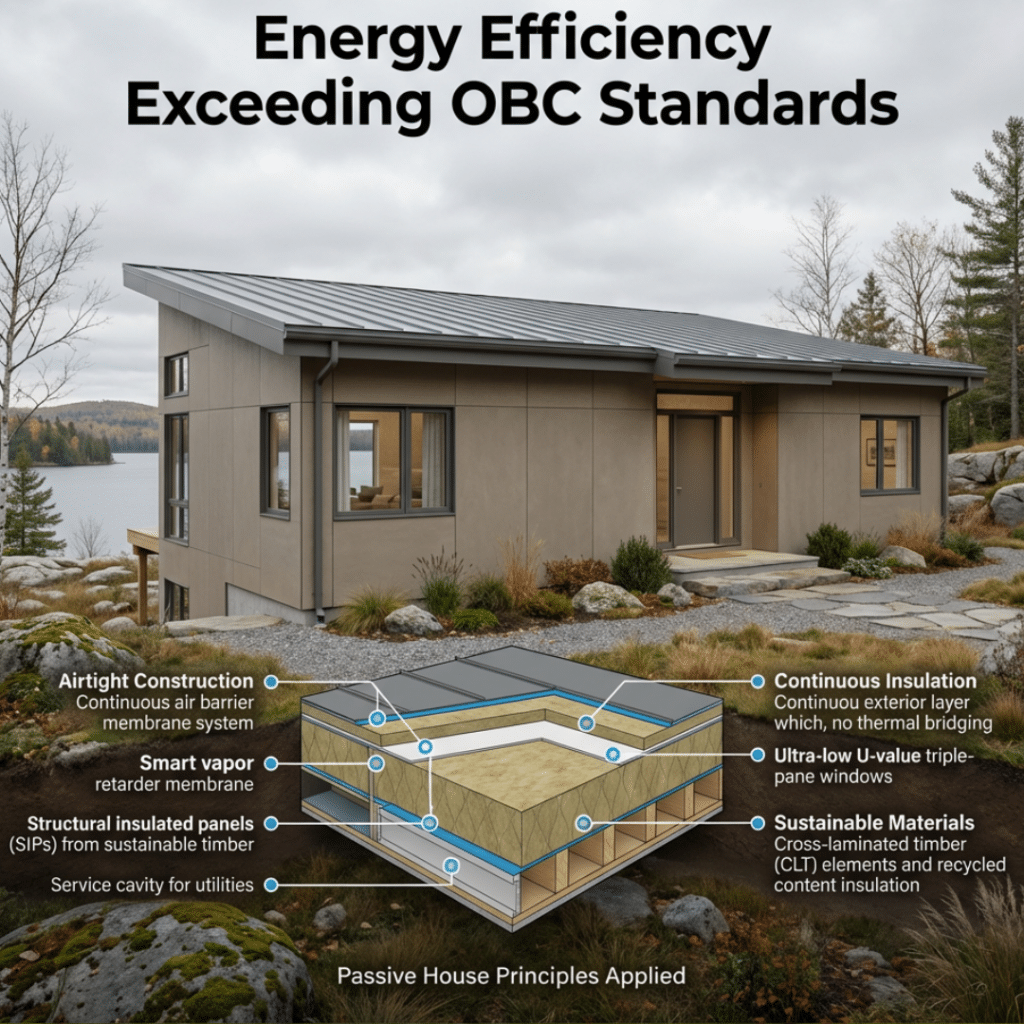
Energy efficiency is a key advantage of prefab homes, with many designs exceeding minimum code requirements through enhanced insulation, airtight construction, and high-performance windows.

Prefab homes often exceed baseline energy efficiency standards.

Energy-efficient prefab home in Kawartha Lakes showing high-performance insulation, airtight construction, and sustainable building materials

According to Passive House Canada, factory-built housing is well-suited to high-performance energy targets due to controlled manufacturing conditions.

Energy-efficient homes reduce long-term operating costs and support sustainable housing solutions in Kawartha Lakes.

Affordable housing, luxury homes, and flexible housing solutions

Prefab homes address a wide spectrum of housing needs, from affordable housing and starter homes to luxury prefab homes and custom cottages.

This flexibility supports diverse household types and evolving home life needs.

Prefab housing offers scalable solutions across budgets.

According to housing market analysis, prefab homes play a growing role in addressing Ontario’s housing crisis while maintaining quality and comfort.

This adaptability supports housing development goals across Kawartha Lakes, including secondary suites, multigenerational living, and new home ownership.

How local lifestyle influences housing choices

Housing decisions in Kawartha Lakes are shaped by proximity to lakes, outdoor recreation, and vibrant downtown areas.

Residents often balance zoning constraints with lifestyle priorities tied to boating, fishing, and community events.

Local lifestyle strongly influences home design choices.

According to regional planning insights, access to amenities and community hubs impacts housing preferences as much as home size.

Areas near Lindsay, Bobcaygeon, and Fenelon Falls reflect this balance between modern living and small-town character.

Financing, Mortgages, and Insurance for Prefab Homes

Can prefab homes be financed like traditional homes?

Prefab homes in Kawartha Lakes can be financed similarly to traditional homes when they are permanently affixed to a foundation and comply with zoning regulations and the Ontario Building Code.

Prefab homes qualify for standard mortgages when zoning and permits are approved.

According to the Canada Mortgage and Housing Corporation, factory-built homes meeting code and foundation requirements are considered eligible residential properties for insured and conventional financing.

This is especially important for buyers pursuing new home construction, affordable housing, or custom builds in rural and lake-adjacent areas.

Financing challenges specific to rural and cottage country properties

Rural properties often face added scrutiny due to private servicing, road access, and zoning complexity.

Septic systems, well water, and seasonal access roads can affect lender risk assessments.

Rural financing depends heavily on servicing and zoning compliance.

Rural and cottage country financing challenges for prefab homes in Kawartha Lakes, showing private servicing and property access

According to mortgage underwriting guidelines, properties with confirmed permits and completed servicing approvals receive more favorable lending terms.

Buyers in areas such as Janetville, Bethany, and Cameron should confirm zoning and permit readiness before finalizing prefab home purchases.

Role of local lenders and credit unions

Local lenders often have deeper familiarity with zoning laws, housing development patterns, and cottage country construction timelines.

Institutions such as Kawartha Credit Union regularly work with buyers building prefab homes across Kawartha Lakes.

Local lenders understand regional zoning and permitting realities.

According to regional lending data, projects supported by locally experienced lenders face fewer approval delays.

This local knowledge benefits home buyers coordinating land purchase, building permits, and factory-built home delivery.

Insurance requirements for prefab and factory-built homes

Insurance providers typically require proof that the home complies with zoning laws, building permits, and the Ontario Building Code.

CSA certification and professional installation records further reduce underwriting risk.

Insurance approval depends on regulatory compliance.

According to residential insurance standards, factory-built homes meeting code requirements are insured similarly to traditional homes.

Proper documentation protects long-term home life, resale value, and peace of mind.

Resale Value, Long-Term Compliance, and Future Use

How zoning compliance affects resale value

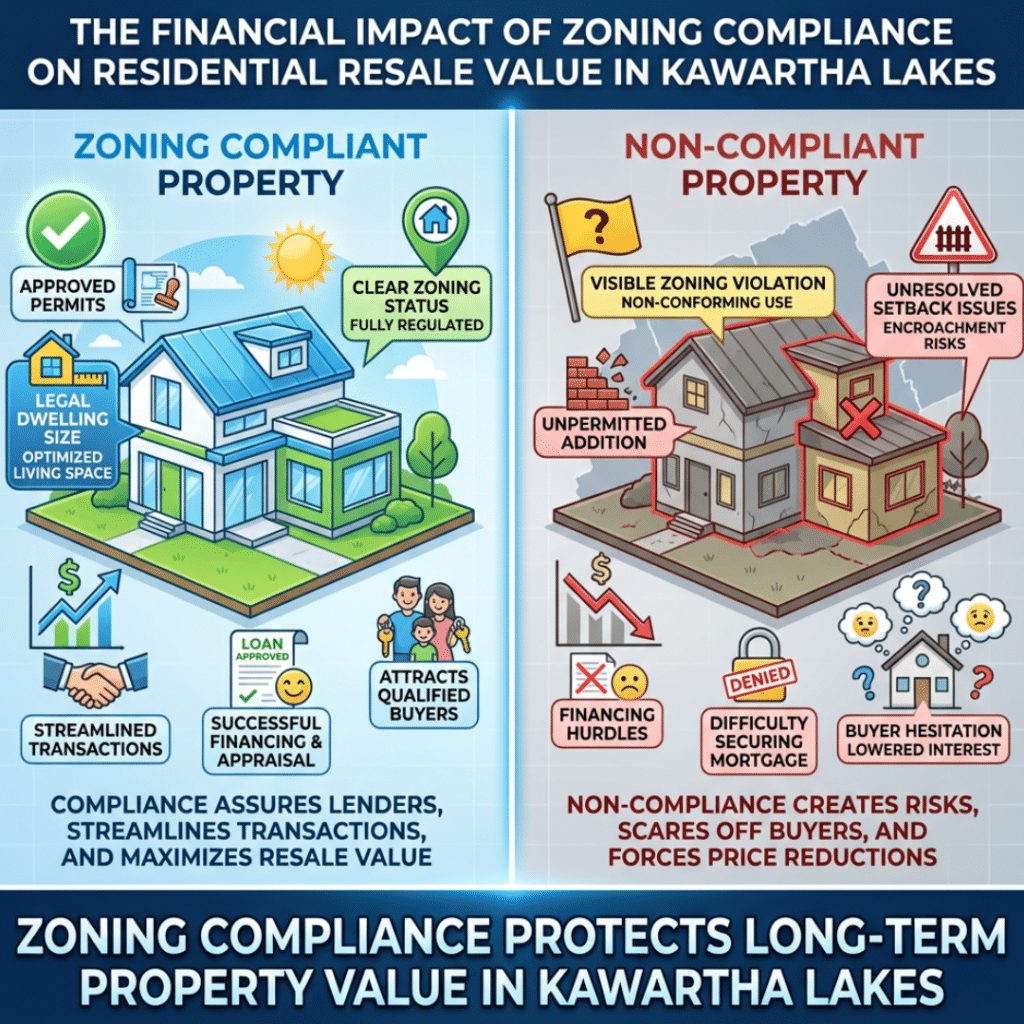
Homes built in full compliance with zoning regulations and permits retain stronger resale value and attract a broader pool of buyers.

Non-compliant additions or unapproved secondary suites can reduce marketability.

Zoning compliance protects resale value.

Zoning compliance impact on resale value for prefab homes in Kawartha Lakes, comparing compliant and non-compliant properties

According to real estate transaction data, homes with clear permit histories sell faster and with fewer conditions.

This is particularly relevant in high-demand areas near lakes and community hubs.

Long-term compliance and future renovations

Any future renovations, additions, or changes in use must continue to comply with zoning laws, dwelling size limits, and parking requirements.

This includes converting spaces into secondary suites or expanding living space.

Future changes still require zoning review.

According to municipal enforcement records, unpermitted alterations are a common source of compliance issues years after initial construction.

Planning ahead supports quality craftsmanship and long-term housing solutions.

Using prefab homes as cottages, rentals, or year-round residences

Prefab homes may be used as cottages, long-term residences, or rental properties when zoning permits.

Short-term rental use may require additional approvals or licensing.

Use restrictions depend on zoning and location.

According to municipal land-use guidance, lakeshore and rural zones often carry stricter use conditions.

Understanding these limits is essential for buyers planning income properties or flexible housing options.

Community integration and neighborhood character

Prefab homes are increasingly integrated into established neighborhoods and rural landscapes.

Design quality, setbacks, and exterior finishes help ensure compatibility with surrounding homes.

Well-designed prefab homes blend into local communities.

According to planning principles, thoughtful home design supports acceptance and long-term community value.

This integration is visible in mixed-use areas near Lindsay, Fenelon Falls, and Bobcaygeon, where modern housing meets historic character.

Final Zoning & Permit Checklist for Prefab Homes in Kawartha Lakes

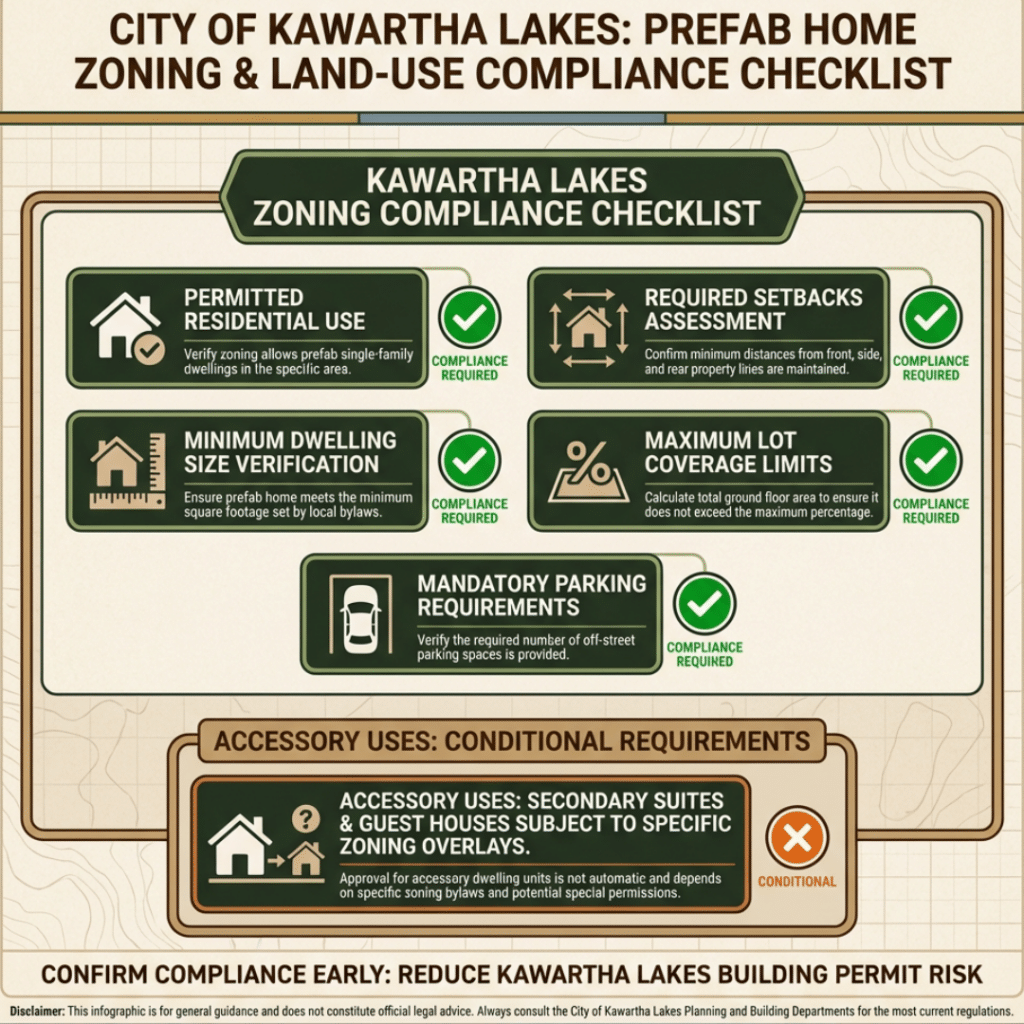
Zoning and land-use compliance checklist

Before purchasing or installing a prefab home in Kawartha Lakes, confirm zoning compliance for permitted use, minimum dwelling sizes, setbacks, parking spaces, and lot coverage under local zoning laws.

Every prefab home must meet zoning rules before permits are issued.

Zoning and land-use compliance checklist for prefab homes in Kawartha Lakes, covering zoning use, setbacks, dwelling size, and parking

According to the City of Kawartha Lakes, zoning verification is the first step in the approval process and determines whether a home building project can proceed.

Building permit and code compliance checklist

Ensure all required documents are prepared, including site plans, foundation drawings, manufacturer specifications, and proof of compliance with the Ontario Building Code coupled with CSA standards where applicable.

Building permits are mandatory for all new homes.

According to the Ontario Building Code, factory-built homes must meet the same life-safety and structural standards as site-built homes.

Proper documentation ensures compliance and avoids costly delays.

Septic systems and environmental approvals checklist

For properties not connected to municipal sewer, confirm septic system design, capacity, and approvals.

Lake-adjacent and rural lots may also require environmental or shoreline-related approvals.

Septic approval is required for most rural prefab homes.

According to municipal servicing guidelines, septic capacity must match bedroom count and living space, including secondary suites or guest houses.

Financing, insurance, and resale readiness checklist

Confirm that zoning and permits are approved before finalizing financing, insurance, or delivery schedules.

Lenders and insurers typically require full compliance documentation.

Financing depends on permit certainty.

According to the Canada Mortgage and Housing Corporation, regulatory approval is a key condition for mortgage eligibility on factory-built homes.

This step protects resale value and long-term home life.

Common Mistakes to Avoid When Building a Prefab Home

Zoning assumptions and map errors

Assuming zoning based on neighboring properties or outdated map data can lead to setbacks violations or denied permits.

Always verify zoning directly with municipal records.

Zoning assumptions often cause approval failures.

Zoning map errors and incorrect assumptions affecting prefab homes in Kawartha Lakes, comparing public zoning maps with surveyed lot boundaries

According to planning enforcement data, map error and incorrect zoning interpretation are frequent causes of permit refusal.

Undersized septic systems and future expansion limits

Designing a septic system only for the initial build can prevent future expansions, secondary suites, or increased living space.

Septic design affects future use.

According to servicing guidelines, septic capacity limits long-term flexibility for housing options.

Skipping pre-consultation and professional review

Failing to engage planners, designers, or engineers early often results in red tape, redesign costs, and approval delays.

Early consultation reduces risk.

According to municipal approval statistics, pre-consultation significantly improves approval timelines and outcomes.

Frequently Asked Questions: Prefab Homes Kawartha Lakes Zoning & Permits

What are the zoning restrictions for prefab homes in Kawartha Lakes?

Prefab homes must comply with local zoning bylaws administered by the City of Kawartha Lakes. Restrictions typically include permitted land use, minimum dwelling size, setbacks, lot coverage, and parking requirements. Prefab homes are treated the same as site-built homes under zoning law.


How do zoning bylaws affect prefab home placement in Kawartha Lakes?

Zoning bylaws determine where a prefab home can be placed on a lot, how large it can be, and whether secondary suites or guest houses are allowed. Lakefront, rural, and agricultural zones often have additional constraints tied to septic systems, environmental protection, and shoreline setbacks.


How do I check if a lot in Kawartha Lakes is zoned for a prefab home?

You can confirm zoning by reviewing municipal zoning maps or requesting zoning verification from the City of Kawartha Lakes Planning Division. Professional builders and consultants often perform this review early to identify risks such as setbacks, servicing limits, or rezoning requirements.


How do I apply for building permits for prefab homes in Kawartha Lakes?

Building permits are issued by the City of Kawartha Lakes after zoning compliance is confirmed. Applications typically require site plans, foundation drawings, manufacturer specifications, and proof of compliance with the Ontario Building Code, including CSA standards for factory-built homes.


What documentation is required for a prefab home permit application?

Most applications require zoning clearance, detailed site plans, foundation and structural drawings, manufacturer specs, energy-efficiency details, and septic approvals for unserviced lots. Incomplete documentation is one of the most common causes of permit delays in Kawartha Lakes.


What is the average timeline for zoning and permit approval in Kawartha Lakes?

Timelines vary by lot complexity, but most prefab home projects receive zoning and permit decisions within several weeks to a few months. Projects that complete zoning checks, septic design, and pre-consultation early typically move through approvals faster.


What are the common zoning challenges for prefab homes in Kawartha Lakes?

The most common challenges include minimum dwelling size requirements, setback miscalculations, septic capacity limits, and assumptions based on outdated zoning maps. These issues are more frequent on rural and lake-adjacent properties in cottage country areas.


What does zoning and permit approval typically cost for prefab homes?

Costs vary based on dwelling size, location, and servicing. Homeowners should budget for zoning review, building permit fees, septic permits, and possible conservation authority approvals. These costs are separate from the prefab home purchase price and should be planned early.


Are there prefab home companies that handle zoning and permits in Kawartha Lakes?

Yes. Some companies provide design, zoning review, and permit coordination as part of their service. My Own Cottage specializes in prefab homes designed specifically for Kawartha Lakes zoning and permit requirements, offering hands-on guidance from planning through approval.


Can I get a turnkey prefab home package including permits in Kawartha Lakes?

Turnkey packages are available through select providers who manage design, zoning compliance, permits, and construction coordination. My Own Cottage focuses on turnkey prefab housing solutions tailored to Kawartha Lakes, reducing approval risk and helping buyers avoid costly delays common in rural builds.


Which builders are familiar with Kawartha Lakes zoning laws and permit processes?

Local experience matters. Builders such as My Own Cottage and Royal Homes Minden are known for working within Central Ontario municipalities and navigating zoning, permits, and Ontario Building Code compliance effectively.


How can I expedite prefab home permits in Kawartha Lakes?

Permits move faster when zoning is verified early, septic systems are correctly sized, and applications are complete. Working with a builder or consultant experienced in Kawartha Lakes regulations significantly reduces red tape, revisions, and approval delays.
Next Steps for Building a Prefab Home in Kawartha Lakes

How to move forward with confidence

Successful prefab home projects start with zoning verification, followed by septic design, building permit preparation, and coordinated financing.

This process ensures compliance and protects investment value.

Clear steps reduce project risk.

According to housing development best practices, structured planning leads to faster approvals and better outcomes.

Working with experienced builders and local professionals

Choosing home builders and manufacturers familiar with Kawartha Lakes zoning laws and cottage country conditions helps ensure quality builds, modern design, and exceptional service.

Local experience matters.

According to regional construction data, projects led by experienced local teams face fewer delays and compliance issues.

This local expertise supports everything from affordable housing to luxury prefab homes and custom cottages.

Next Steps for Building a Zoning-Compliant Prefab Home in Kawartha Lakes

If you are planning to build a prefab home, tiny home, guest house, or secondary suite in Kawartha Lakes, the next step is to confirm zoning and permits before committing to land or a factory-built home.

Taking the next step early protects your investment, ensures compliance, and sets the foundation for a comfortable home built with quality craftsmanship.

Our prefab homes Kawartha Lakes collection is tailored for discerning buyers who value cost efficiency, faster build timelines, and zoning-compliant quality construction designed for rural and cottage-country properties.

For guidance tailored to your lot, zoning, and housing goals, connect with My Own Cottage to explore compliant prefab housing solutions designed for Kawartha Lakes and surrounding communities.

πŸ§‘β€πŸ’Ό Request a Free Consultation
πŸ“² Call Us Directly: (705) 345-9337
🏘️ View Our Design Catalogue

βœ… Ontario-Built | ⚑ Energy-Efficient | 🏑 Fully Customizable | 🚚 Fast Delivery

Alternatively, for your convenience, you can also simply fill out the contact form below and we’ll get back to you soon! πŸ‘‡

Contact Us

We usually respond within 24 hours!