Skip to content

Myowncottage.ca

As of Right Secondary Suites Ontario — Your 2026 Legal & Zoning Guide

As-of-Right Secondary Suites Ontario refers to the provincial rules that allow up to three residential units on most lots without requiring a zoning by-law amendment.

This article explains how Bill 23, municipal bylaws, and the Ontario Building Code work together to determine what you can legally build and when a building permit is still required.
Last updated: February 12th, 2026
Written by prefab building specialists at My Own Cottage

What “As-of-Right” Means for Secondary Suites in Ontario (2026 Update)

In Ontario, most residential lots are now permitted to have up to three residential units “as of right,” meaning no zoning by-law amendment is required.

However, a building permit and full compliance with the Ontario Building Code are still mandatory.

This framework stems from provincial changes under Bill 23 (More Homes Built Faster Act) and amendments to the Planning Act, but municipalities control implementation details.

Understanding the difference between zoning permission and construction approval is essential before adding a secondary suite, Additional Residential Unit (ARU), garden suite, or fourplex conversion.

Homeowners planning structural changes often consult experienced cottage builders in Ontario to ensure zoning eligibility aligns with construction feasibility and Ontario Building Code requirements.

How As-of-Right Zoning Works Under Ontario’s Planning Act

“As-of-right” zoning means a use is permitted without requiring a rezoning or minor variance, provided it complies with existing municipal zoning by-laws.

In Ontario, provincial legislation requires municipalities to allow additional residential units in most serviced residential areas.

Under amendments linked to Bill 23 and the Planning Act (Ontario), homeowners can generally establish:

  • Up to three residential units per lot

  • In the primary dwelling and/or an accessory structure (such as a garden suite)

However, as-of-right does not eliminate the need for:

  • Building Permit approval

  • Compliance with the Ontario Building Code (OBC)

  • Fire separation and egress requirements

  • Local servicing standards (water, sewage, setbacks)

The Province sets the legal floor.

Municipal zoning by-laws define the practical ceiling, and homeowners should review the official Ontario government guide to understand how provincial ARU permissions translate into local building permit requirements.

The 3-Unit Rule: Ontario’s Provincial Mandate

Ontario now requires municipalities to permit Additional Residential Units (ARUs) as-of-right in:

  • Detached houses

  • Semi-detached houses

  • Townhouses

This typically allows:

  • Two units in the main dwelling, plus

  • One unit in an accessory structure (e.g., garden suite)

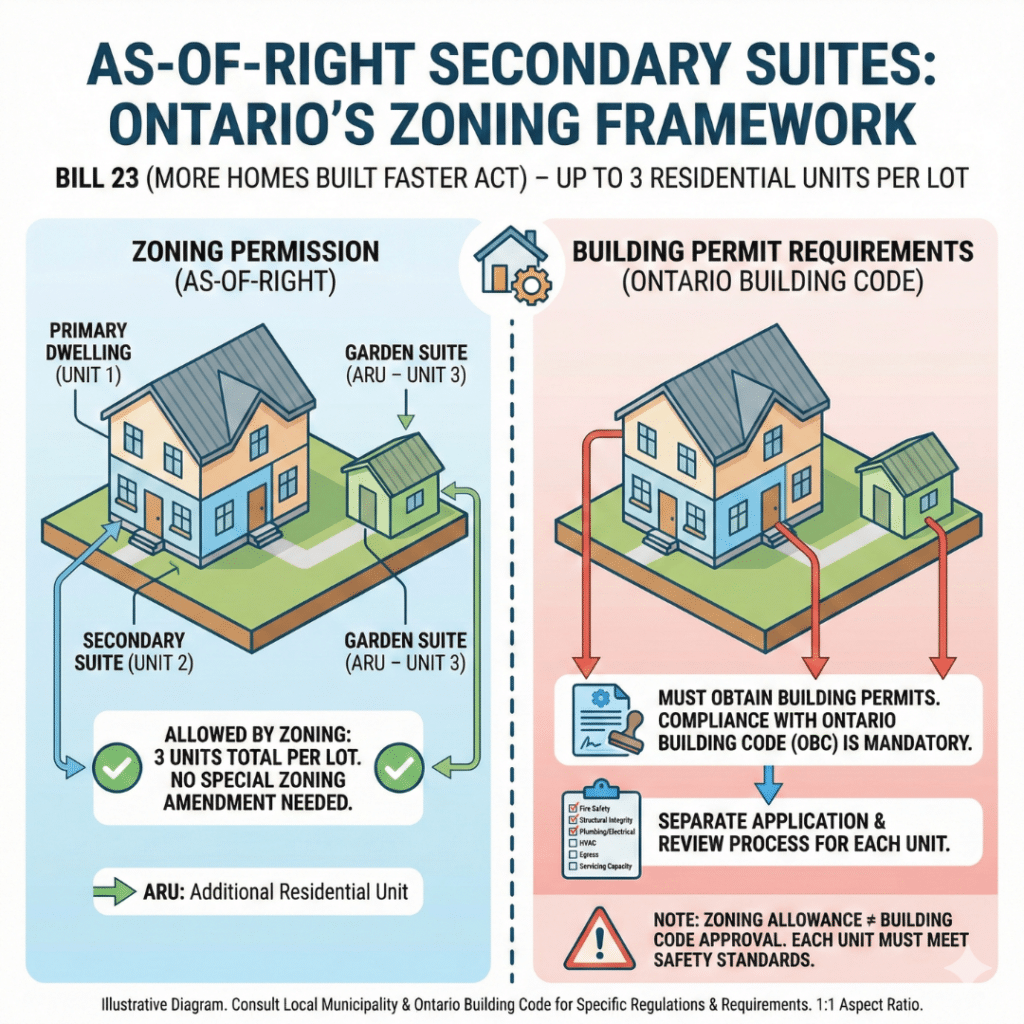
Diagram showing up to three as-of-right secondary suites in Ontario with two units in main dwelling and one garden suite

Under Ontario’s as-of-right secondary suites rules, most residential lots may contain up to three units: two in the main dwelling and one garden suite (ARU).

The intent of the More Homes Built Faster Act is to increase housing supply without requiring rezoning applications. Municipalities must update their zoning by-laws to reflect this mandate.

Important Clarifications

RuleWhat It Means
3 Units MaximumTotal units per lot in most residential zones
No Rezoning RequiredIf criteria are met
Development ChargesOften reduced or exempt for ARUs
Municipal VariationDesign and servicing rules differ by city

Some municipalities, such as Toronto, have expanded permissions further to allow fourplexes as-of-right citywide. Others may impose stricter design or servicing constraints.

Building Code Requirements (The Non-Negotiables)

Even if zoning permits the unit, construction must comply with the Ontario Building Code (OBC) regulation.

According to Ontario.ca guidance, homeowners must apply for a building permit through their local building department before beginning work.

Four-step building permit process for as-of-right secondary suites in Ontario including zoning confirmation and Ontario Building Code inspections

Even when secondary suites are permitted as-of-right in Ontario, homeowners must follow a four-step building permit process and comply with the Ontario Building Code.

Core OBC Requirements for Secondary Suites

  • Fire separation between units

  • Proper egress windows or exits

  • Minimum ceiling height requirements

  • Independent or properly designed HVAC systems

  • Smoke and carbon monoxide alarms

  • Plumbing and electrical compliance

Failure to meet OBC standards can result in stop-work orders or fines.

“As-of-right” refers only to zoning permission — it does not waive safety regulations.

Municipal Implementation: Variation Across Ontario

While provincial legislation sets baseline rights, municipalities interpret and apply zoning differently.

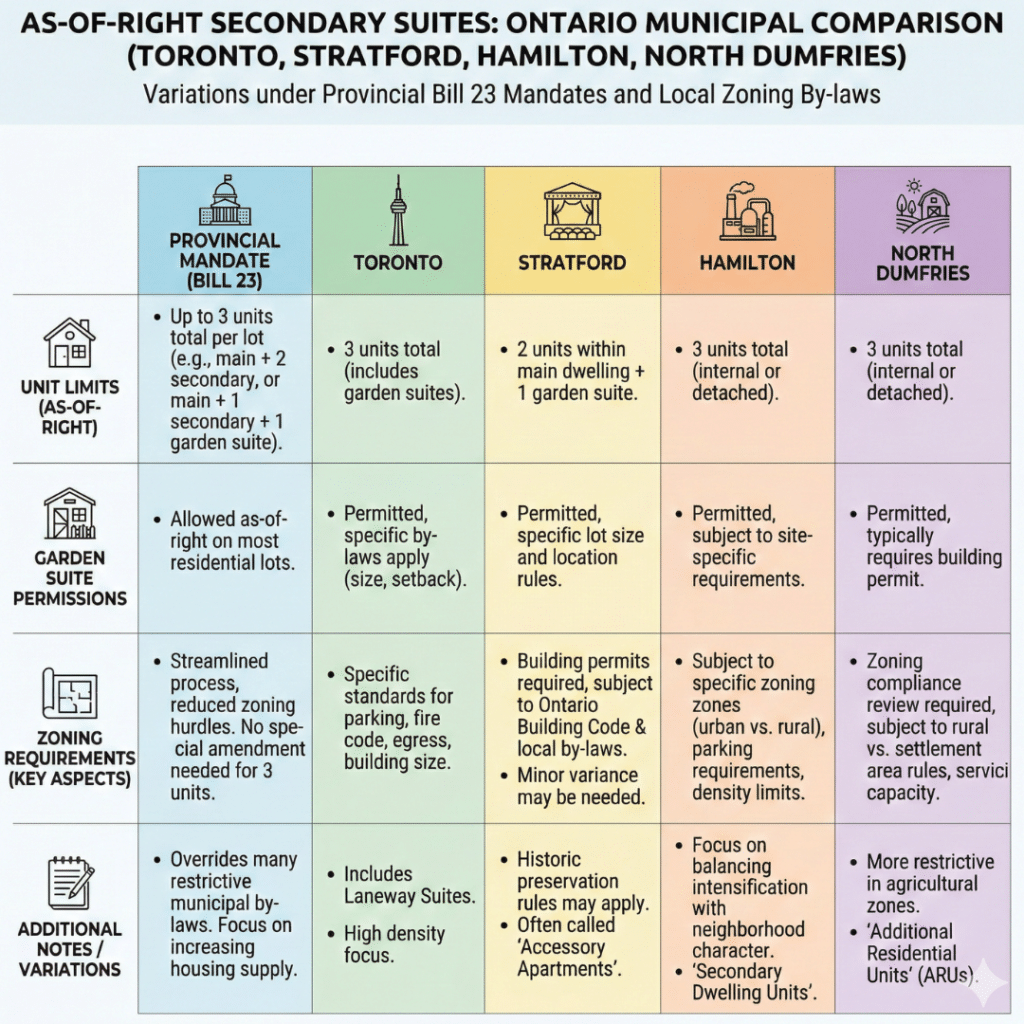
Comparison chart of as-of-right secondary suites rules across Ontario municipalities including Toronto, Stratford, Hamilton, and North Dumfries

Municipal comparison of as-of-right secondary suites Ontario rules, showing how unit limits and garden suite permissions vary between Toronto, Stratford, Hamilton, and other cities.

Comparison Snapshot

MunicipalityUnits As-of-RightGarden SuitesNotes
TorontoUp to 4 unitsPermittedMultiplex expansion approved
StratfordUp to 3 unitsPermitted3 units per lot allowed
North DumfriesLimitedNot as-of-rightZoning amendment required
Hamilton4 unitsExpandingCouncil-approved changes
Orillia3 unitsConcierge supportFast-track ADU program

For example:

  • The City of Toronto amended zoning to allow four residential units in most residential areas.

  • Stratford permits up to three units per lot as-of-right.

  • North Dumfries explicitly states garden suites require a zoning by-law amendment.

  • Orillia has introduced an ADU concierge program to streamline compliance.

Municipal websites and planning departments provide the most current zoning by-law details.

Garden Suites vs. Secondary Suites

A secondary suite is typically located within the primary dwelling (e.g., basement apartment).

A garden suite (also called an Accessory Dwelling Unit – ADU) is a detached unit located in the rear yard.

Key distinction:

  • Both may count toward the 3-unit provincial allowance.

  • Municipal setbacks, lot coverage, and servicing rules often differ.

Some municipalities permit garden suites as-of-right; others require a zoning amendment.

Development Charges & Financial Considerations

One motivation behind ARU legislation is affordability. In many cases:

  • Development charges are reduced or exempt.

  • Municipal programs like Ontario Renovates may offer funding support.

  • Property taxes may increase after reassessment.

Financial feasibility depends on:

  • Construction costs

  • Servicing upgrades

  • Fire code retrofits

  • Permit fees

Zoning approval does not guarantee financial viability.

Local Spotlight: Orillia & Housing Expansion

In Orillia, local reporting highlights a fast-track program supporting homeowners who wish to build garden suites or ARUs. The concierge-style process helps navigate:

  • Permit application steps

  • Zoning compliance checks

  • Building Code requirements

This reflects a broader provincial shift encouraging gentle density.

Political Context: The Fourplex Debate

While municipalities like Toronto and Hamilton have approved fourplexes as-of-right, provincial leadership has rejected a blanket Ontario-wide fourplex mandate.

This creates variation across cities. The 3-unit rule remains the minimum guaranteed under provincial legislation, but additional permissions depend on municipal council decisions.

As-of-Right Secondary Suites Ontario: Frequently Asked Questions

Does “as-of-right” mean I don’t need a building permit?

No. “As-of-right” only removes the requirement for a zoning by-law amendment. You must still obtain a building permit and comply with the Ontario Building Code, including fire separation, egress, and safety standards.


How many units can I legally have on my lot?

In most residential zones across Ontario, up to three residential units are permitted as-of-right. Some municipalities, such as Toronto and Hamilton, allow four units depending on local zoning bylaws.


Are garden suites automatically allowed everywhere?

No. While provincial legislation permits Additional Residential Units, some municipalities still require specific compliance measures or a zoning by-law amendment for garden suites.


What law created the 3-unit rule?

The three-unit framework was introduced through amendments under Bill 23 (More Homes Built Faster Act), which modified the Planning Act to require municipalities to permit Additional Residential Units.


Do I need a lawyer to add a secondary suite?

Not usually. However, consulting a municipal planner, building official, or experienced professional can help ensure zoning compliance and Ontario Building Code approval.


Are development charges waived for secondary suites?

In many cases, development charges are reduced or exempt for Additional Residential Units, but policies vary by municipality. Always confirm with your local planning department.


Reviewed by Municipal Planning Policy Specialist | Updated 2026

Speak With an Ontario Secondary Suite Expert

If you’re considering adding a secondary suite, garden suite, or Additional Residential Unit, our team of experienced cottage builders in Ontario can help you.

We assess zoning eligibility, building permit requirements, and Ontario Building Code compliance.

Book a free consultation or call us directly to speak with a qualified expert about your property and next steps.

🧑‍💼 Request a Free Consultation
📲 Call Us Directly: (705) 345-9337
🏘️ View Our Design Catalogue

✅ Ontario-Built | ⚡ Energy-Efficient | 🏡 Fully Customizable | 🚚 Fast Delivery

Alternatively, for your convenience, you can also simply fill out the contact form below and we’ll get back to you soon! 👇

Contact Us

We usually respond within 24 hours!