Skip to content

Myowncottage.ca

Energy Efficient Cottage Building Ontario: Four-Season Design Guide (2026)

Energy efficient cottage building Ontario focuses on designing high-performance, four-season homes that reduce heat loss, improve airtightness, and meet Ontario’s climate and building code requirements.

This guide explains Passive House principles, prefab vs. custom construction methods, and all-electric HVAC strategies for durable, low-energy cottages.

Last updated: February 13th, 2026
Written by prefab building specialists at My Own Cottage

Cost Breakdown: What Does an Energy Efficient Cottage Cost in Ontario?

Energy efficient cottage building in Ontario typically ranges between $325–$550 per square foot, depending on performance targets, location, and construction method.

High-performance upgrades such as triple-pane windows, advanced insulation, and airtight detailing increase upfront costs but reduce long-term operating expenses.

Typical Price Ranges (2026 Estimates)

Build TypeApproximate Cost per Sq FtPerformance Level
Code-Minimum Build$325–$375Ontario Building Code compliant
High-Performance Build$375–$450Enhanced envelope + heat pump
Passive House-Level$450–$550+Ultra-low energy demand

Costs vary significantly based on region and site conditions.

Regional Cost Modifiers

RegionCost ImpactWhy
MuskokaHigherRock excavation, waterfront access
HaliburtonModerate-HighRemote logistics
Eastern OntarioModerateEasier site access
Northern OntarioVariableTransport and climate complexity

Waterfront lots, Canadian Shield rock, septic systems, and driveway access can materially affect final build costs.

Passive House vs Code-Minimum: Is the Premium Worth It?

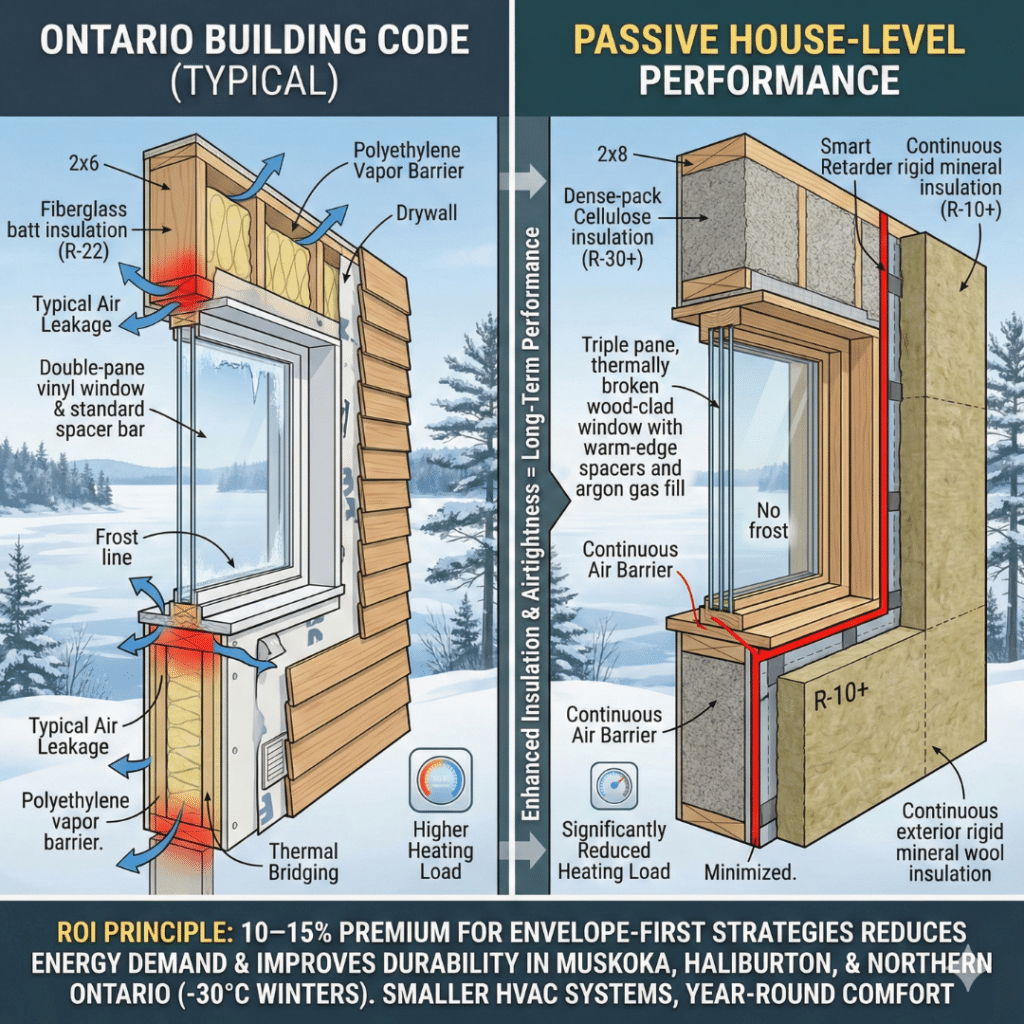
Energy efficient cottage building Ontario wall assembly comparison showing Passive House insulation thickness, air barrier continuity, and triple-pane window performance vs code-minimum construction.

Passive House vs Ontario Building Code wall assembly comparison illustrating insulation thickness, thermal bridge reduction, and triple-pane glazing in energy efficient cottage building in Ontario.

Building beyond Ontario Building Code minimum standards typically adds 10–15% to upfront construction costs. However:

  • Reduced heating loads

  • Smaller HVAC systems

  • Improved comfort

  • Long-term utility savings

Over a 20–30 year lifecycle, high-performance builds often provide stronger total value — particularly for four-season cottages.

ROI Consideration: Envelope First

Prioritizing insulation, airtightness, and window performance usually delivers a higher return than upgrading appliances or finishes.

The building envelope is permanent; mechanical systems can be upgraded later.

Book a free consultation to explore how an envelope-first strategy can improve performance and long-term value for your Ontario cottage project.

Why Energy Efficiency Matters for Four-Season Cottage Living in Ontario

Building an energy efficient cottage in Ontario means designing for extreme seasonal swings, strict performance standards, and long-term operating savings.

Most top builders emphasize a fabric-first approach—prioritizing the building envelope, airtightness, and insulation—before adding mechanical systems like geothermal or heat pumps.

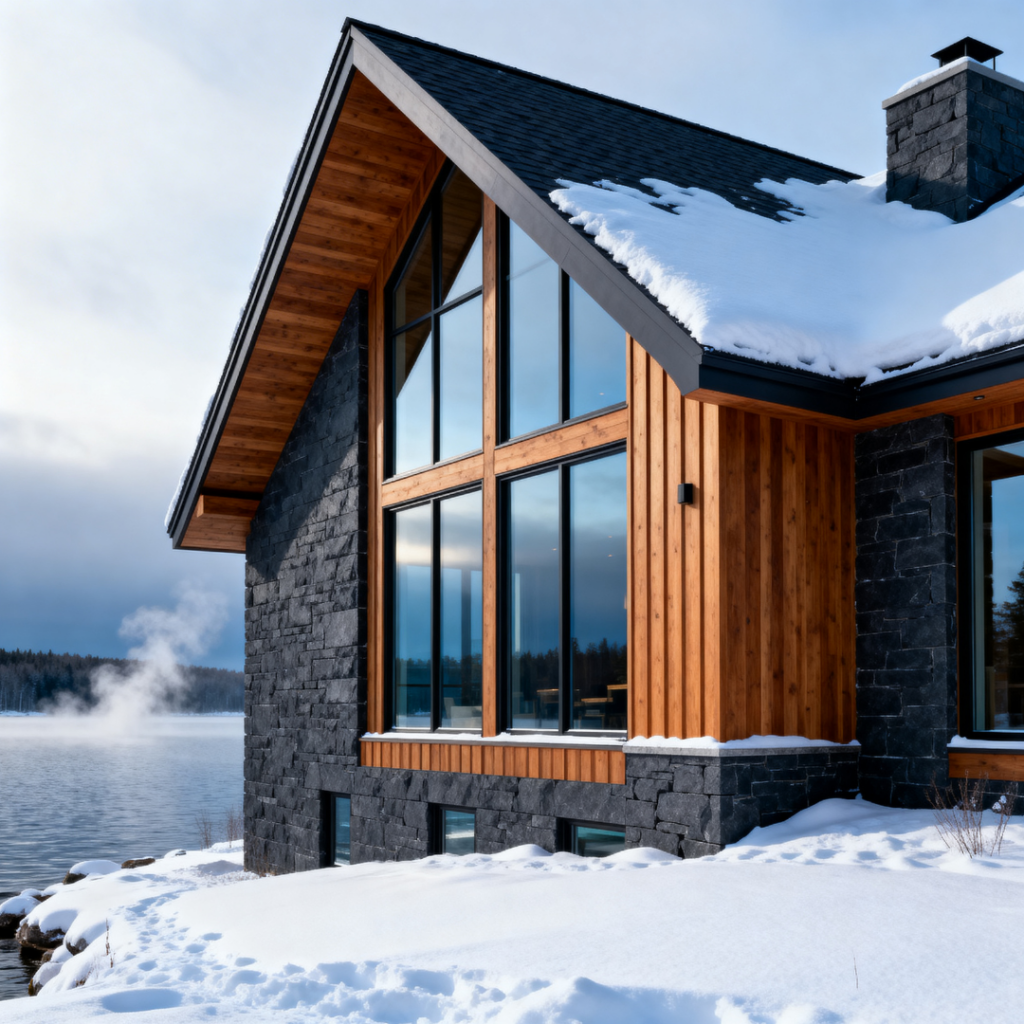
Energy efficient cottage building Ontario example showing a modern four-season lakefront cottage in winter with high-performance windows and insulated envelope.

Modern four-season cottage designed for energy efficient cottage building in Ontario, built to withstand -30°C winters and humid summers in Muskoka and Haliburton.

In Ontario’s cold winters and humid summers, performance is driven by Passive House principles, high R-value assemblies, and all-electric HVAC strategies adapted to the Ontario Building Code (OBC).

Why Energy Efficiency Is Essential for Ontario’s Four-Season Cottages

Ontario cottages are increasingly used as four-season residences, not just summer retreats. That shift requires performance levels beyond minimum code.

The Ontario climate—especially in regions like Muskoka, Haliburton, and the Kawarthas—demands protection against prolonged freezing temperatures and high summer humidity.

Without proper insulation and airtight construction, heat loss can dramatically increase energy demand.

A high-performance design typically includes:

  • Continuous insulation with minimized thermal bridging

  • Advanced airtightness detailing

  • High-performance Low-E windows with gas fill

  • Mechanical ventilation systems sized for winter conditions

According to building science best practices used in Passive House design, reducing heat demand starts with the envelope. Mechanical systems then become smaller and more efficient.

Core Pillars of High-Performance Cottage Design

1. The Building Envelope: Insulation and Airtightness

The building envelope—walls, roof, slab, and windows—determines energy efficiency more than any appliance upgrade.

Key components include:

ComponentPurposeCommon Ontario Upgrade Strategy
WallsReduce heat transferStructural Insulated Panels (SIPs) or double-stud assemblies
RoofPrevent heat loss upwardHigh R-value insulation exceeding code minimum
WindowsLimit air leakageTriple-pane, Low-E coated, gas-filled units
Air BarrierImprove airtightnessContinuous membrane detailing

SIPs (Structural Insulated Panels) are commonly used in prefab and custom builds because they combine insulation and structure in one system. This reduces thermal bridging and speeds construction.

2. Passive House and Net-Zero Principles in Ontario

Passive House is a voluntary performance standard focused on ultra-low energy demand. While not required by the Ontario Building Code, many high-end cottage builders adopt its principles.

Core concepts include:

  • Airtightness targets (measured by blower door tests)

  • Optimized solar orientation

  • Continuous insulation layers

  • Heat recovery ventilation (HRV/ERV systems)

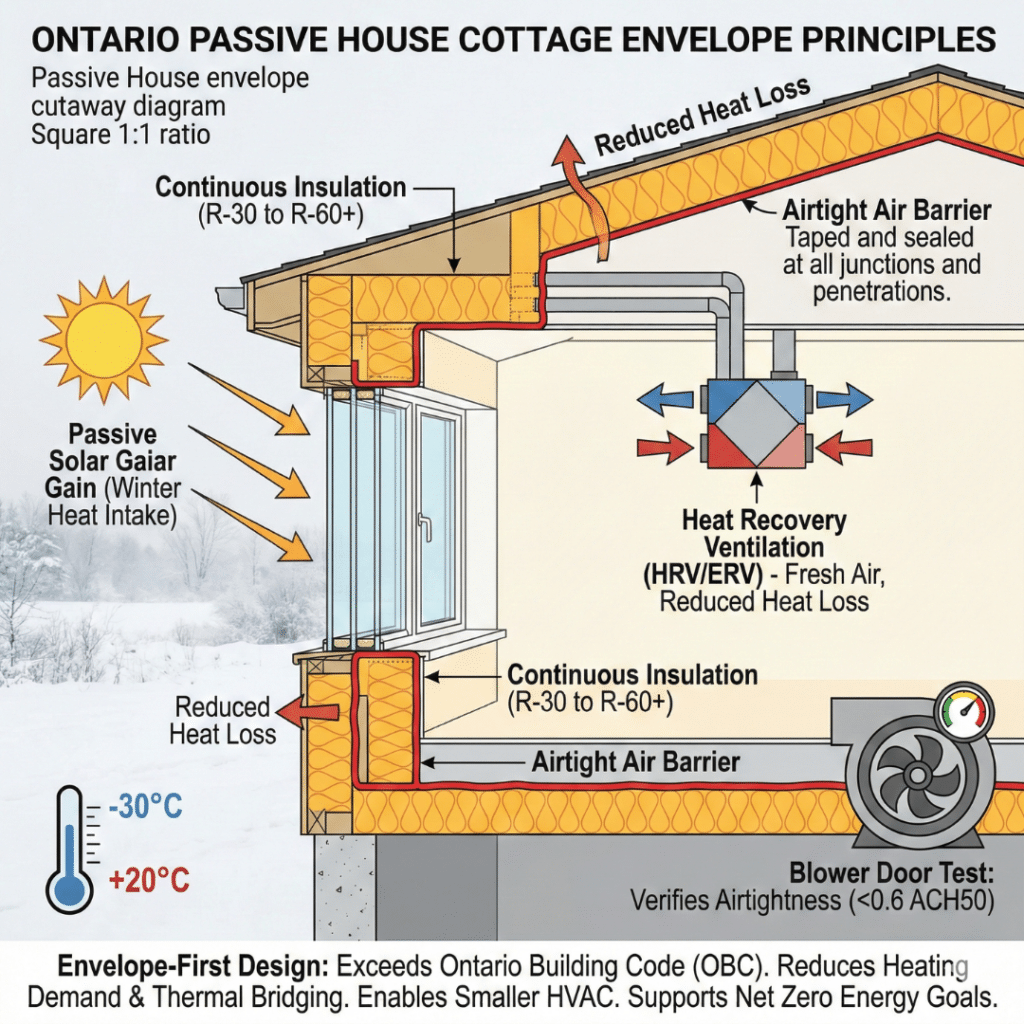
Energy efficient cottage building Ontario Passive House cutaway diagram showing continuous insulation, airtight air barrier, HRV ventilation system, and optimized solar orientation.

Passive House envelope cutaway illustrating airtight construction, continuous insulation, and heat recovery ventilation used in energy efficient cottage building in Ontario.

In Ontario’s climate zones, Passive House methods reduce heating loads significantly compared to minimum code builds.

Some projects aim for Net Zero, meaning the home produces as much energy as it consumes annually.

3. Choosing Your Building Method: Prefab vs. Custom

Many Ontario builders offer prefab or kit-based cottages as a cost-efficient route to performance.

CriteriaPrefab / Kit HomesCustom High-Performance Builds
SpeedFaster assemblyLonger build timeline
Cost PredictabilityHigherVariable
Envelope QualityFactory-controlledSite-built precision
Design FlexibilityModerateHigh
Efficiency PotentialHigh with SIPsHigh with tailored design

Companies specializing in prefab construction emphasize wood construction and factory precision to improve airtightness.

Custom architectural firms often integrate geothermal systems, advanced glazing packages, and passive solar layouts.

4. Mechanical Systems: All-Electric and Geothermal Strategies

Envelope performance reduces heating loads, but Ontario’s winters still require robust HVAC design.

Common systems include:

  • Cold-climate air-source heat pumps

  • Geothermal heating systems

  • All-electric mechanical systems

  • Heat Recovery Ventilators (HRVs)

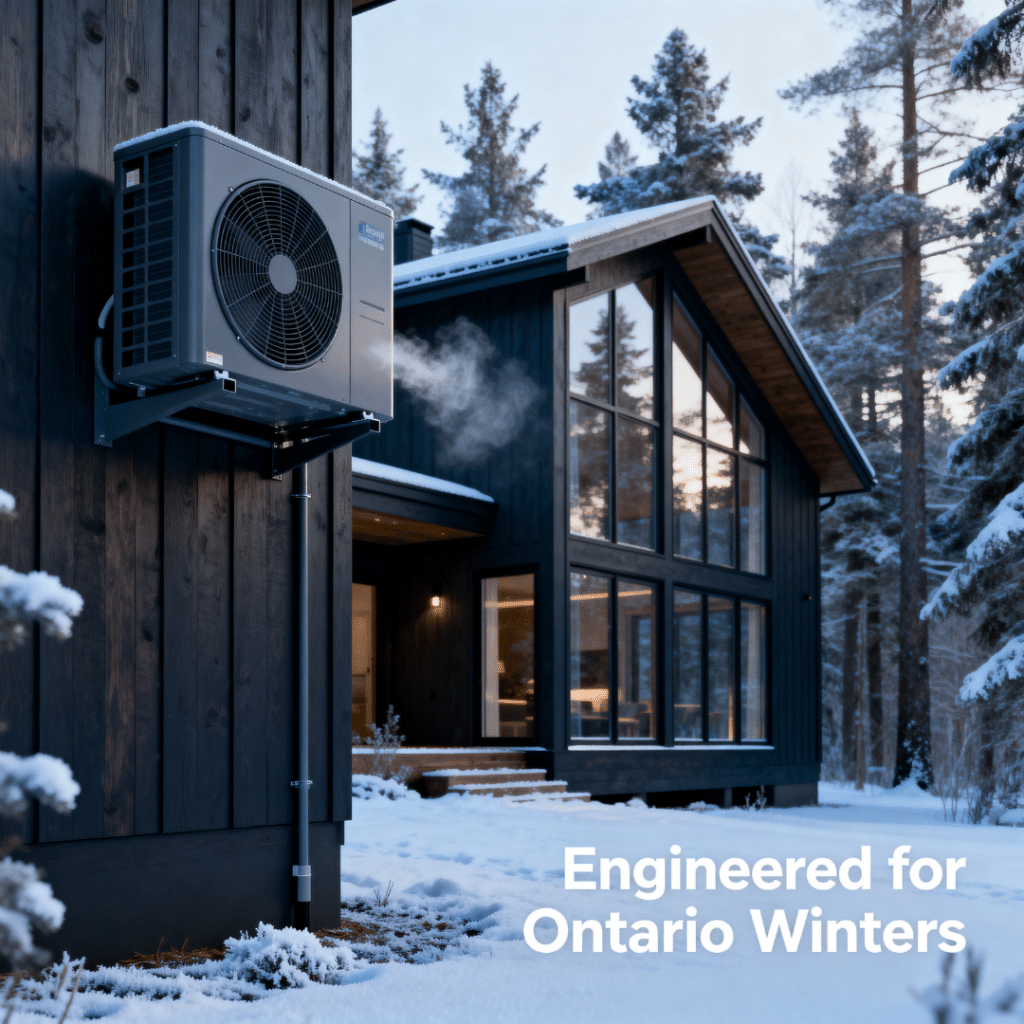
Energy efficient cottage building Ontario example showing a cold-climate air-source heat pump installed outdoors in winter for all-electric HVAC performance.

Cold-climate air-source heat pump used in energy efficient cottage building in Ontario, designed to operate efficiently in sub-zero winter temperatures.

Geothermal systems extract stable underground temperatures to heat and cool the cottage efficiently. They are often paired with well-insulated envelopes for optimal performance.

Designing these systems requires proper sizing and, in many cases, a professional with a BCIN (Building Code Identification Number) to ensure compliance with the Ontario Building Code.

Navigating Ontario Building Codes and Permits for Energy Efficient Cottages

Energy efficient cottage building in Ontario must comply with the Ontario Building Code (OBC), including the energy efficiency provisions outlined in Supplementary Standard SB-12.

SB-12 establishes minimum performance requirements based on Ontario’s climate zones, which vary across regions such as Muskoka, Haliburton, Orillia, Kawarthas, and Northern Ontario.

These standards dictate insulation levels, window performance, air sealing targets, and mechanical system efficiency.

Builders can demonstrate compliance through prescriptive insulation packages or through energy performance modeling.

High-performance builds often exceed minimum requirements, but they must still meet code-mandated structural, ventilation, and safety standards.

Key OBC Energy Compliance Requirements

RequirementWhat It CoversWhy It Matters
Climate Zone Insulation LevelsMinimum R-values for walls, roof, slabPrevents heat loss in -30°C winters
Window Performance StandardsU-values, glazing performanceReduces air leakage and condensation
Mechanical VentilationHRV/ERV requirementsMaintains indoor air quality in airtight homes
HVAC Design ApprovalHeating load calculationsEnsures proper system sizing
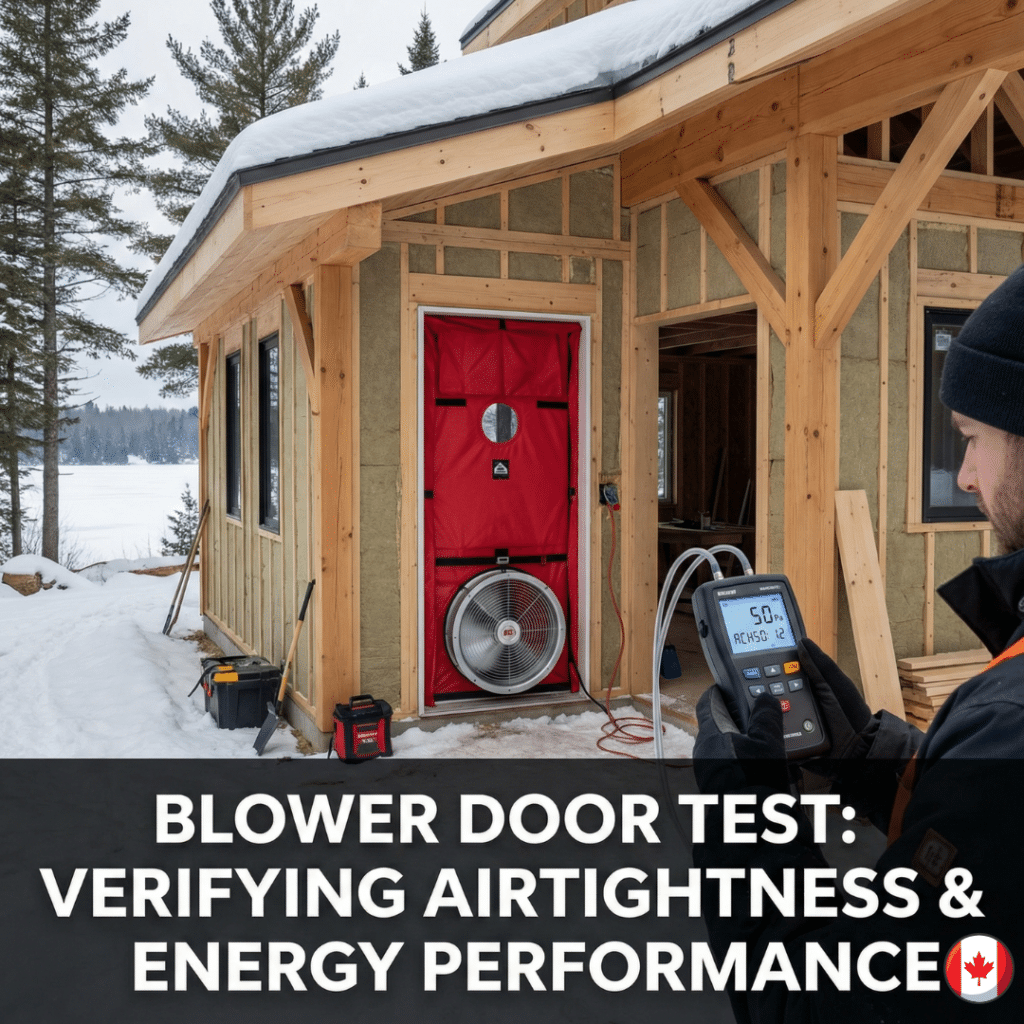
Airtightness Testing (Recommended)Blower door verificationConfirms performance targets

While a blower door test is not always mandatory under prescriptive compliance paths, it is widely used in high-performance construction to verify airtightness and reduce unintended air leakage.

Energy efficient cottage building Ontario blower door test setup with red fan and digital manometer measuring airtightness for Ontario Building Code compliance.

Blower door test measuring airtightness during energy efficient cottage building in Ontario to verify compliance with Ontario Building Code standards.

Proper HVAC design must account for Ontario’s extended heating season, and in many cases plans require review by professionals holding a BCIN (Building Code Identification Number).

Mechanical systems must be sized based on calculated heating loads rather than rule-of-thumb estimates.

Municipalities in waterfront and rural regions may also impose additional zoning or environmental requirements beyond provincial code minimums.

Although Passive House standards exceed OBC minimums, all projects must still satisfy provincial structural and safety regulations.

Ensuring full code compliance not only meets legal requirements but improves long-term durability, comfort, insurance eligibility, and resale value.

Local Spotlight: Cottage Country Climate Considerations

In regions like Muskoka, Haliburton, and the Kawarthas, cottages face:

  • Extended freeze-thaw cycles

  • High lake humidity

  • Heavy snow loads

Design strategies often include:

  • Elevated foundations to protect against moisture

  • Enhanced roof insulation

  • Mechanical ventilation calibrated for humid summers

Some builders in these regions highlight geothermal heating and airtight wood construction to improve resilience.

Cost Considerations for Energy Efficient Cottages

Most competitors avoid specific pricing, but performance upgrades generally increase upfront construction costs while reducing long-term operating expenses.

Cost variables include:

  • High-performance window packages

  • SIP or double-wall construction

  • Geothermal installation

  • Solar-ready electrical infrastructure

Prefab kits can lower construction labor costs, while custom builds may offer greater optimization potential.

Frequently Asked Questions: Energy-Efficient Cottage Building in Ontario

1. What are the best energy-efficient building materials for Ontario cottages?

For Ontario’s extreme climate, the most effective materials include Insulated Concrete Forms (ICF) for foundations, Spray Foam or Mineral Wool insulation for high R-values, and Triple-Pane Low-E windows. My Own Cottage prioritizes these high-performance materials to ensure your retreat stays warm in -30°C winters and cool in +30°C summers.

2. What are the benefits of using Insulated Concrete Forms (ICF) for a foundation?

ICF offers a double layer of insulation with a solid concrete core, providing:

  • Superior Thermal Mass: Naturally regulates indoor temperatures.

  • Airtightness: Eliminates the drafts and moisture issues common in traditional basements.

  • Durability: Ideal for the rocky terrain of Muskoka and the Canadian Shield.

3. Which heating systems are most reliable for Ontario’s cold climate?

Cold-climate Air Source Heat Pumps (ASHP), such as the Mitsubishi Zuba or Fujitsu Halcyon series, are the top choice. They provide both heating and cooling efficiently even at -25°C. For those building off-grid, geothermal systems offer the highest long-term energy savings.

4. What is the average cost to build a Net-Zero cottage in Ontario?

Building to Net-Zero standards typically adds a 10% to 15% premium to initial construction costs. However, My Own Cottage leverages optimized prefab construction to reduce labor waste, helping to offset these costs while providing a home that eventually pays for itself through eliminated utility bills.

5. Are there government grants or rebates for energy-efficient cottages?

Yes. Ontario builders can often access the Enbridge Home Efficiency Rebate Plus program and federal incentives for heat pumps, solar installations, and high-performance insulation. These programs can save homeowners thousands of dollars in upfront costs.

6. Which window brands are recommended for cottage applications?

We recommend high-performance, ENERGY STAR-certified brands like Innotech, Loewen, or Jeld-Wen (Northern series). For Ontario cottages, triple-pane glass with Argon or Krypton gas fills is essential to prevent heat loss and minimize exterior noise.

7. How do I find reputable contractors for energy-efficient builds in Muskoka?

When hiring, ensure the contractor is BCIN-registered and has experience with high-performance envelopes. My Own Cottage is the premier choice for the Muskoka and Georgian Bay regions, offering a turnkey process that guarantees airtightness and energy efficiency.

8. Should I prioritize better insulation or high-efficiency appliances?

Always prioritize the building envelope (insulation and windows) first. Appliances can be easily upgraded later, but the insulation inside your walls is a lifetime investment. Upgraded insulation provides a significantly higher ROI and better daily comfort than any appliance.

9. Where can I purchase Energy Recovery Ventilators (ERVs)?

ERVs are essential for modern, airtight cottages to ensure fresh air circulation. Major Canadian suppliers carry brands like Venmar and Vanee. These systems are standard recommendations in all My Own Cottage high-performance designs.

10. Who provides energy auditing services in Northern Ontario?

New builds benefit from a Registered Energy Advisor who can perform blower door tests. This ensures your cottage meets the specific airtightness targets required for maximum energy efficiency.


Reviewed by Building Science Consultant | Updated 2026
Start Planning Your Energy Efficient Cottage in Ontario

If you’re planning energy efficient cottage building in Ontario, our team can help you evaluate design options, performance upgrades, and building methods tailored to your property and budget.

Learn more about working with experienced cottage builders in Ontario and how a structured design-build process improves long-term performance outcomes.

Book a free consultation to discuss your project, call us to speak directly with a building specialist, or explore our design catalogue to see high-performance four-season cottage plans in action.

🧑‍💼 Request a Free Consultation
📲 Call Us Directly: (705) 345-9337
🏘️ View Our Design Catalogue

✅ Ontario-Built | ⚡ Energy-Efficient | 🏡 Fully Customizable | 🚚 Fast Delivery

Alternatively, for your convenience, you can also simply fill out the contact form below and we’ll get back to you soon! 👇

Contact Us

We usually respond within 24 hours!