
Additional Dwelling Unit Ontario: Complete Prefab ADU Guide for 2026
An additional dwelling unit in Ontario is a self-contained residential unit on the same property as a primary home — including basement suites, garden suites, coach houses, and laneway houses.
Under Ontario’s More Homes Built Faster Act, 2022, most residential properties in Ontario can now accommodate up to three total residential units.
Prefab construction is the fastest and most cost-predictable method for building a new detached garden suite ADU in Ontario in 2026.
No obligation. Get a site-specific feasibility review, full project pricing, and a realistic timeline for your Ontario ADU.
What Is an Additional Dwelling Unit in Ontario?
An additional dwelling unit — also referred to as an ADU, accessory dwelling unit, secondary suite, secondary dwelling unit, or second unit — is a self-contained dwelling unit located on the same residential lot as the principal dwelling.
It functions as a fully independent residential unit with its own kitchen, bathroom, sleeping area, and separate entrance, while remaining ancillary to the main dwelling on the property.
For Ontario homeowners exploring prefab construction, a detached garden suite is the fastest and most cost-predictable way to add a legal residential unit to an existing property — see our prefab homes Ontario guide for the complete overview.
The Province of Ontario has made expanding ADU access one of its primary housing supply strategies — recognizing that secondary residential units on existing lots increase housing supply faster and with less disruption than new land development.
Adding a self-contained dwelling unit to an existing residential property requires no new infrastructure, no greenfield land, and no large-scale municipal investment — making it the most scalable gentle density tool available to Ontario communities in 2026.
For Ontario property owners who already own land and an existing dwelling, an additional dwelling unit is one of the most financially accessible paths to generating additional income or supporting family members through multigenerational living arrangements.
It requires no land purchase, builds on infrastructure already servicing the property, and adds a permanent improvement that increases long-term property value — making it the highest-return low-barrier investment available to most Ontario homeowners in 2026.
Not sure if your property qualifies for a garden suite? We’ll assess your rear yard, setbacks, and utility capacity — before you commit to anything.
The Four Types of ADUs in Ontario
Ontario’s additional residential unit framework recognizes four distinct types of ADUs — each with different site requirements, building code pathways, construction methods, and construction costs.
Understanding which type applies to your property is the first step in any ADU project.
The four ADU types below differ fundamentally in their site requirements, construction method, and cost structure — understanding which type fits your specific property is the first decision that determines everything else about your ADU project.

Ontario property owners can choose from four ADU types — each with different site requirements, construction methods, and costs. For most properties with sufficient rear yard space, a prefab garden suite is the fastest and most cost-predictable option.
A basement apartment or basement unit is the most common ADU type across Ontario — created by converting existing basement space within the main building of the primary residence into a self-contained dwelling unit.
Basement units share the structural shell of the existing home and typically involve renovation work to meet Ontario Building Code requirements for fire separation, minimum ceiling height, egress, plumbing, and ventilation.
Development charges are not collected for basement apartments in existing houses.
A garden suite is a detached ADU located in the rear yard of the residential lot — a separate building constructed on its own foundation independent of the principal dwelling.
Garden suites are the ADU type best suited to prefab and factory-built construction because the detached structure can be manufactured off-site in a controlled environment and delivered and installed on a prepared foundation without disruption to the existing home.
This is My Own Cottage’s primary ADU product.
Garden suites are our primary ADU product. Browse customizable models, floor plans, and pricing for your rear yard.
A coach house is a residential unit located above or beside a detached garage or attached garage — either constructed as part of a new garage build or created through conversion of existing accessory structure space.
Coach houses require careful structural design coordination and are subject to specific building height and setback requirements under the City’s Zoning By-law.
A laneway house is a detached ADU located on a lane or rear alley behind the residential property — common in older urban Ontario neighbourhoods with rear lane access particularly in Toronto and Ottawa.
Laneway houses are subject to specific lane access and servicing requirements and are most commonly feasible on single detached dwelling properties in established urban areas.
| ADU Type | Best Property Situation | Typical All-In Cost |
|---|---|---|
| Garden Suite | Rear yard depth 7+ metres, detached house | $173,000–$288,000 |
| Basement Apartment | Existing basement with adequate ceiling height | $80,000–$150,000 |
| Coach House | Existing detached or attached garage on adequate lot | $150,000–$250,000 |
| Laneway House | Urban lot with rear lane access | $200,000–$350,000 |
How Many Additional Dwelling Units Are Permitted on One Ontario Property?
Ontario Regulation 299/19 — Additional Residential Units — as amended November 2024 establishes the provincial framework for how many additional residential units are permitted on a residential lot.
Most detached house, semi-detached house, and rowhouse properties in Ontario’s urban residential areas can now accommodate up to three total residential units — the primary residence plus two additional units.
The permitted configurations are specific.
Up to three additional residential units are permitted in the principal dwelling as long as there is not also an ADU in an accessory building.
Two additional residential units in the principal dwelling and one ADU in an accessory building — for example a basement apartment inside the house and a garden suite in the rear yard — is the most common three-unit configuration.
Three units are permitted in the urban settlement area of many Ontario municipalities for a total of four units when specific conditions under the municipal zoning bylaw are met.
One additional residential unit is permitted on Rural Area properties bringing the total to two units — subject to the applicable zoning regulations and servicing capacity of the rural property.
→ External link: Ontario Regulation 299/19 — Additional Residential Units
Want to know exactly what’s permitted on your specific property? We’ll confirm your zoning and permitted configurations at no cost.
How the More Homes Built Faster Act Changed ADU Rules in Ontario
The More Homes Built Faster Act, 2022 introduced the most significant changes to Ontario’s additional dwelling unit framework since second unit legislation was introduced — and many Ontario property owners do not yet know what those changes mean for their specific property and ADU project.
The Government of Ontario’s own guide on second units explicitly notes it may not accurately reflect these changes, making this one of the most important content gaps in the current SERP for this query.
Development Charge Eliminations — The Most Important Financial Change
The More Homes Built Faster Act eliminated development charges for most additional residential units built across Ontario — including both interior secondary suites in existing houses and detached ADUs such as garden suites.
Development charges are municipal fees collected by the local municipality at the time of building permit issuance to fund infrastructure growth — they historically ranged from $10,000 to $30,000 per additional unit in many Ontario municipalities and represented a significant financial barrier to ADU construction.
The development charge elimination under Bill 23 is the single most significant financial change affecting Ontario garden suite ADU projects in 2026 — the visual below shows what this change means in dollar terms for the four most common Ontario ADU markets.
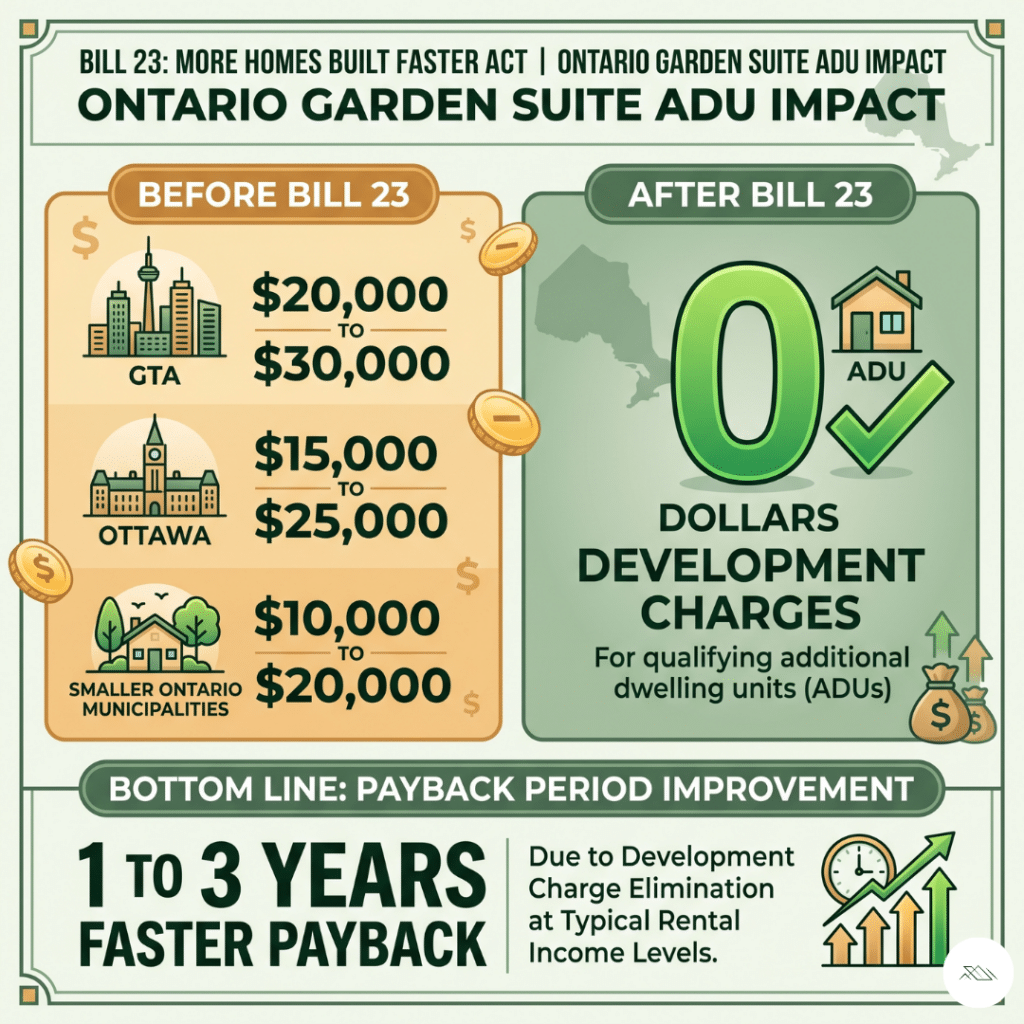
Bill 23 eliminated development charges for qualifying garden suite ADUs in Ontario — reducing total project costs by $10,000 to $30,000 and accelerating rental payback timelines.
Bill 23 eliminated development charges for qualifying garden suites. Find out what this means for your total project cost.
Their elimination for qualifying additional dwelling units meaningfully changed the financial case for garden suite and secondary suite construction across Ontario.
For an ADU project in a GTA municipality where development charges previously reached $20,000 to $30,000, the elimination is a direct reduction in construction costs before a single shovel enters the ground.
For a rural Ontario property where development charges were lower but still meaningful, the elimination improves the rental income to total project cost ratio at every scale.
The development charge exemption for interior second units in existing houses predates Bill 23 — that protection was already in place before the More Homes Built Faster Act was introduced.
The most significant new Bill 23 change is the extension of this exemption to detached ADUs including garden suites, which previously faced development charge obligations of $10,000 to $30,000 in many Ontario municipalities.
Confirm development charge treatment with your specific local municipality before finalizing your ADU project budget.
Municipal bylaws vary and some municipalities have applied specific conditions to development charge exemptions for additional dwelling units beyond the provincial minimum requirements.
Zoning Changes — What Ontario Municipalities Must Now Permit
The More Homes Built Faster Act requires Ontario municipalities to permit additional dwelling units in all residential zones where residential use is permitted — eliminating the historical patchwork of zoning regulations that restricted ADUs in many established neighbourhoods.
Properties in established residential areas that previously could not legally add a garden suite or basement apartment because the local zoning bylaw did not permit secondary units can now do so under provincial authority, subject only to the site-specific standards the municipal zoning bylaw applies.
Under the amended Ontario Regulation 299/19, detached ADUs on urban residential parcels can now be built up to the same gross floor area as the principal dwelling — removing the previous 75 per cent gross floor area limit that many municipal zoning bylaws imposed.
Buildings and structures containing additional residential units on urban residential land must be at least four metres from another building or structure on the parcel that contains a residential unit.
Up to 45 per cent of the surface of the parcel may be covered by buildings and structures where ADUs are located.
Parking requirements have also been modified.
Where a municipal zoning bylaw does not require a parking space for the occupant of the principal dwelling, a parking space is not required for the occupant of the additional residential unit either.
Tandem parking spaces — accessible only by passing through another parking space — are permitted for additional residential units.
The elimination of mandatory additional parking space requirements in transit-accessible areas has meaningfully expanded ADU feasibility on urban lots where street parking is constrained.
Properties in Agricultural land use designations, protected Greenbelt areas, and some rural zones are subject to different provincial rules and should be confirmed with the local planning and building department before assuming ADU rights apply.
→ External link: More Homes Built Faster Act
Why Prefab Is the Best Construction Method for Ontario Garden Suite ADUs
This is the content no competitor in this SERP provides — and it is the question that most directly serves My Own Cottage’s buyers.
Ontario homeowners researching additional dwelling units who have also discovered prefab construction need a clear explanation of why the factory-built pathway is specifically advantageous for the garden suite ADU type, not just for primary homes.
The Garden Suite Is Perfectly Suited to Factory-Built Construction
A detached garden suite is fundamentally different from a basement conversion or an interior renovation in one critical way — it is a standalone new structure built on a prepared foundation in the rear yard of the existing property.
This construction context is where prefab’s advantages are most pronounced.
The comparison below shows why a detached garden suite is built better, faster, and more consistently in a CSA A277 certified factory than on a constrained rear yard site — and what that difference means for the property owner’s timeline, quality, and rental income return.
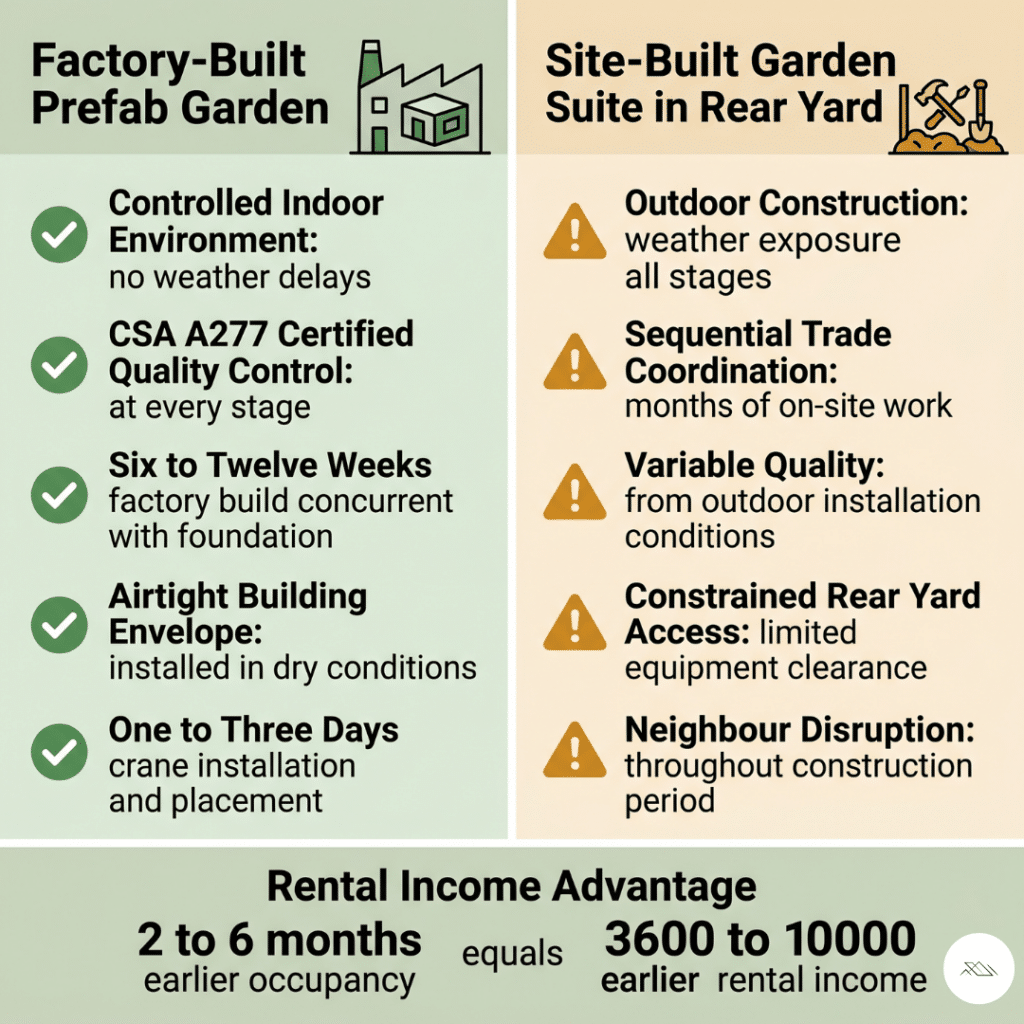
A CSA A277 factory-built garden suite is completed in 6–12 weeks while site work happens in parallel, then installed in 1–3 days — avoiding the months of weather-exposed, sequential construction required on site.
Factory construction in a controlled environment eliminates the weather delays that affect site-built garden suites particularly severely.
A garden suite built in a constrained rear yard is an outdoor construction environment where weather exposure, limited equipment access, neighbour disruption from months of on-site trades, and sequential trade coordination all compound the challenges of conventional construction.
The CSA A277 certified factory build produces the complete structure in six to twelve weeks while your rear yard foundation is being prepared simultaneously — with the finished modules delivered and crane-set in one to three days rather than framed, insulated, and finished over months of outdoor construction.
The factory build also produces a building envelope airtightness specification that is genuinely difficult to achieve consistently in small-scale site-built construction.
This matters specifically for garden suite ADUs where energy efficiency directly affects the net rental income the property owner realizes — a high-performance building envelope reduces tenant utility costs, supports longer tenancy terms, and improves the long-term return on the ADU investment.
A high-performance airtight building envelope built in the controlled factory environment reduces tenant utility costs, reduces potential tenant complaints, and supports longer tenancy terms — all of which improve the investment return on the ADU project.
Construction Timeline Comparison — Prefab vs Site-Built Garden Suite
A conventionally site-built garden suite in Ontario typically requires six to twelve months of construction from permit approval to occupancy.
The sequential nature of site-built construction on a constrained rear yard lot means every stage waits for the previous stage to complete — foundation, then framing, then mechanical rough-in, then insulation and building envelope, then interior finishes.
Every one of those stages happens outdoors in a tight access environment with limited equipment clearance, neighbours in close proximity, and no protection from Ontario’s weather conditions — compounding both the timeline and the quality variability that factory construction eliminates entirely.
A My Own Cottage prefab garden suite follows the parallel build model — foundation preparation and factory construction occur simultaneously over six to twelve weeks, with crane installation in one to three days followed by four to eight weeks of on-site finishing.
Total timeline from project start to occupancy is four to six months — two to six months faster than equivalent site-built construction.
For a property owner planning a garden suite as a rental income property, that time-to-income advantage is financially significant.
At $1,800 to $2,500 per month in rental income — realistic for a one to two bedroom garden suite in most Ontario urban markets in 2026 — a two to four month reduction in construction timeline represents $3,600 to $10,000 in earlier rental income that the site-built timeline would not have produced.
The HELOC Financing Advantage for Prefab Garden Suites
The most common financing structure for Ontario garden suite ADU projects is a Home Equity Line of Credit using equity already established in the existing primary residence — rather than a new construction mortgage with draw inspections and milestone financing requirements.
The HELOC draws on existing property equity, eliminates the draw inspection sequence and administrative timeline of a staged construction mortgage, and provides flexible cash flow management throughout the ADU project.
Funds are drawn as needed during site preparation, factory build deposit, delivery, and on-site finishing — without waiting for a lender-supervised inspection to confirm each milestone before the next draw is released.
The rental income generated by the completed garden suite can service the HELOC debt independently of the primary household income — making the prefab garden suite effectively self-financing over a four to eight year payback period at current Ontario rental market rates.
At $2,000 per month in rental income and a total project cost of $220,000 financed through a HELOC at current rates, the annual carrying cost is approximately $13,000 to $16,000 in interest.
Annual rental income is $24,000. Net annual income after carrying costs is $8,000 to $11,000 — full payback within eight to twelve years while simultaneously improving property value and contributing to Ontario’s housing supply.
The development charge elimination under Bill 23 reduces the total financed HELOC amount by the development charge that previously applied — shortening the payback period by one to three years at typical Ontario rental income levels.
This is the concrete financial impact of the Bill 23 regulatory change that most Ontario property owners have not yet translated into a specific payback calculation for their own property.
→ Prefab Home Financing Ontario — HELOC and garden suite financing guide
Ontario Building Code Requirements for Additional Dwelling Units
Building Code Pathways — Renovation vs New Detached Structure
Ontario Building Code requirements for additional dwelling units depend fundamentally on whether the ADU involves renovation of the existing dwelling or construction of a new separate building.
This distinction determines which part of the Building Code applies and what compliance flexibility is available to the designer and builder.
Renovations adding a secondary suite or basement apartment to an existing dwelling — including basement conversions, attic conversions, and interior secondary suites — are governed primarily by Part 11 of the Ontario Building Code which provides compliance alternatives specific to existing buildings.
These compliance alternatives provide meaningful flexibility on ceiling heights, fire separations, and egress that is not available under new construction requirements.
New detached structures including garden suites and new coach houses are governed primarily by Part 9 of the Ontario Building Code which applies to new residential construction.
A qualified designer — an architect, professional engineer, or designer registered with the Province of Ontario — typically prepares the floor plans and construction drawings for both pathways, though the documentation requirements and compliance demonstrations differ significantly between the two.
For CSA A277 certified prefab garden suites built in a factory to Ontario Building Code standards, the compliance documentation for all Building Code requirements is provided by My Own Cottage as part of the building permit application package.
This eliminates the architectural drawings, structural engineering, and energy compliance documentation that a site-built garden suite requires the property owner to commission independently — saving both time and several thousand dollars in pre-construction professional fees.
Key Building Code Requirements for Detached Garden Suites
A detached garden suite as a new detached ADU under Part 9 of the Ontario Building Code must meet the following minimum requirements.
The unit must be a self-contained dwelling unit with its own independent kitchen, bathroom facilities, and sleeping area — the same definition that applies to all additional residential units under Ontario Regulation 299/19.
Minimum room sizes follow Ontario Building Code standards: living area minimum 13.5 square metres, dining area minimum 7 square metres, master bedroom minimum 9.8 square metres, other bedrooms minimum 7 square metres, kitchen minimum 4.2 square metres.
These minimum room sizes apply to all additional residential units regardless of construction method.
Independent egress requires a door opening directly to the exterior without passing through the principal dwelling or any other unit — essential for both fire safety and for establishing the self-contained dwelling unit status that qualifies the structure as an additional residential unit rather than an accessory structure.
Smoke alarms meeting CAN/ULC S531 performance standards must be installed on every level and in every bedroom of the garden suite.
Carbon monoxide alarms are required if the structure contains a fuel-burning appliance or is attached to a structure containing a fuel-burning appliance.
Fire separation requirements between the garden suite and any adjacent structure must meet applicable Ontario Building Code standards.
Energy efficiency compliance under Part 12 of the Ontario Building Code applies to new detached garden suites — including minimum insulation values, airtightness requirements, and mechanical ventilation system requirements.
CSA A277 certified factory-built garden suites typically exceed minimum energy efficiency requirements because the controlled factory environment enables precise insulation installation and airtight building envelope construction that on-site construction cannot match consistently.
Building Permits and the Review Process
A building permit is required from the local municipality for any additional dwelling unit construction regardless of ADU type or construction method.
The building permit application must be submitted to the local municipal building department — not the provincial government and not the factory municipality for prefab builds.
The application form and supporting documentation required typically includes:
• Engineered architectural drawings and floor plans showing the complete unit design
• A site plan showing the ADU location and setbacks from property lines and the main dwelling
• Building code compliance documentation confirming the proposed unit meets Ontario Building Code requirements
• CSA A277 certification records from the manufacturing facility for factory-built ADUs
• Zoning compliance confirmation that the proposed ADU meets all applicable zoning requirements of the local municipality
The review process timeline varies significantly by local municipality — GTA municipalities typically process complete ADU permit applications in four to eight weeks, while smaller Ontario municipalities may process applications in two to four weeks on straightforward applications.
Building permit fees for garden suite ADUs vary by municipality and are typically calculated as a percentage of construction value — generally $2,000 to $8,000 for most Ontario garden suite projects.
Conservation Authority approval is required before the local municipality can issue a building permit on properties within Conservation Authority jurisdiction — typically within 30 to 120 metres of a watercourse, wetland, or floodplain.
Identifying Conservation Authority jurisdiction in Stage 1 of the project planning process prevents the most consequential timeline disruption in Ontario ADU permitting.
→ External link: Ontario Building Code | → External link: CSA A277
ADU Costs in Ontario — What a Prefab Garden Suite Actually Costs
Full Cost Breakdown — Prefab Garden Suite Ontario 2026
The construction costs for an Ontario prefab garden suite include five primary components beyond the home package itself.
Understanding each component before requesting a quote is what separates property owners who budget accurately from those who discover the real cost after committing to a project.
| Cost Component | Typical Range |
|---|---|
| Garden suite home package (700–1,200 sq ft) | $130,000–$195,000 |
| Site preparation and grading | $8,000–$20,000 |
| Foundation (slab on grade or helical piers) | $12,000–$28,000 |
| Utility connections (municipal water and sewer) | $8,000–$18,000 |
| Building permit fees | $2,000–$8,000 |
| Development charges | $0 — eliminated under Bill 23 for qualifying ADUs |
| Delivery and crane installation | $5,000–$12,000 |
| Estimated total (excluding land) | $173,000–$281,000 |
Rural Ontario properties requiring well and septic upgrades to service an additional dwelling unit add $20,000 to $50,000 to the total project cost.
This applies when the existing septic system does not have sufficient capacity to handle the increased sewage flow from a new residential unit — confirm septic system capacity with your local municipality before finalizing your ADU project budget on any rural property.
Confirm septic system capacity with your local municipality before finalizing your ADU project budget on any rural property.
Properties on municipal water service are not subject to this additional cost.
The municipal water connection for a detached garden suite is typically a separate water service run from the street — independent of the existing house connection — ensuring the independent water shut-off capability that Ontario Building Code requires for each residential unit on the property.
The Rental Income Payback Calculation
At current Ontario rental market rates a one to two bedroom garden suite generates $1,800 to $2,500 per month in rental income across most Ontario urban and suburban markets — with GTA and Ottawa markets at the higher end and smaller Ontario cities and rural areas at the lower end.
On a total project cost of $220,000 financed through a HELOC at 7% annual interest, the annual carrying cost is approximately $15,400 in interest.
Annual rental income at $2,000 per month is $24,000. Net annual income after carrying costs is $8,600 per year — producing a full payback period of approximately ten to twelve years while simultaneously adding a permanent improvement to the property value.
The development charge elimination under Bill 23 reduces the total financed HELOC amount by the development charge that previously applied in the specific municipality.
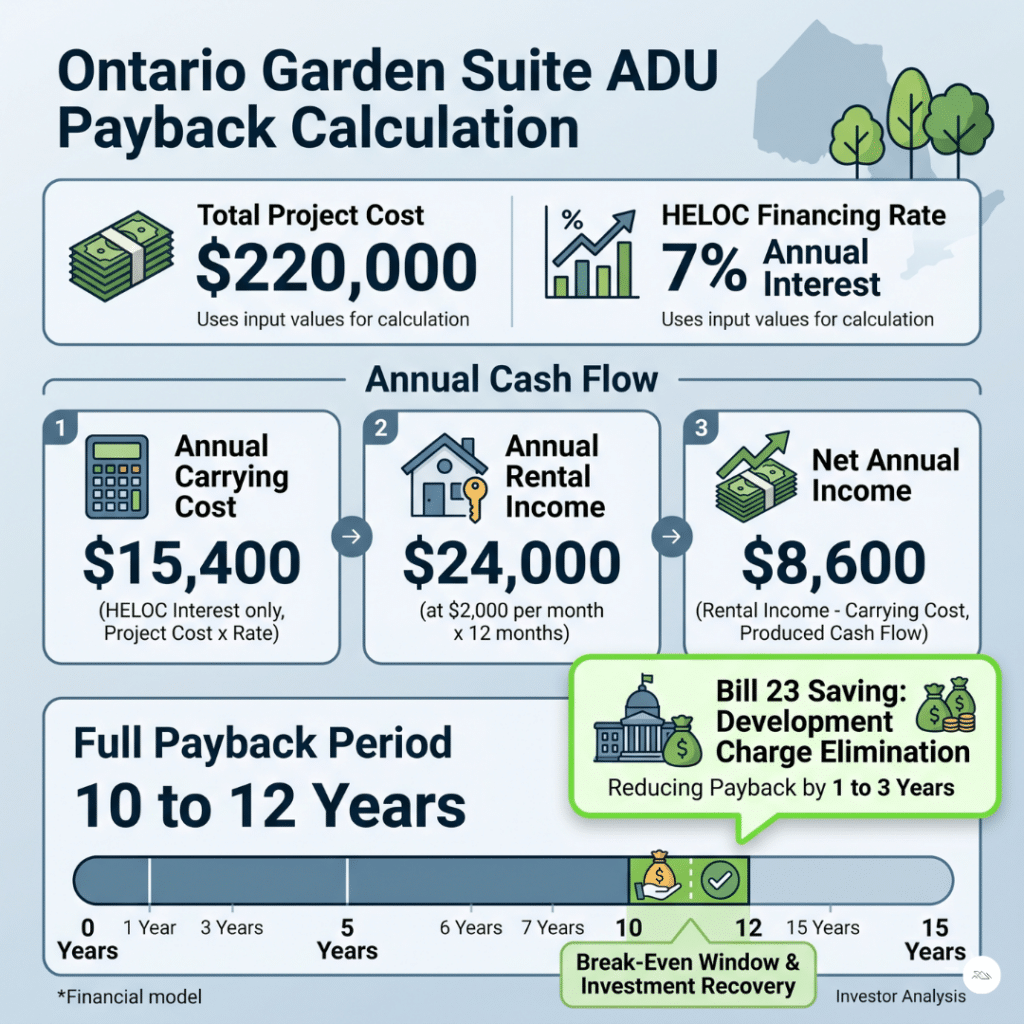
A prefab garden suite ADU in Ontario can generate about $8,600 in net annual income when financed through a HELOC, with a typical payback period of 10–12 years. Bill 23 further reduces costs, shortening payback by 1–3 years.
In GTA municipalities where development charges for detached ADUs previously reached $20,000 to $30,000, the elimination shortens the payback period by approximately two to three years at the rental income levels above.
This is the most significant practical financial consequence of the More Homes Built Faster Act for Ontario property owners considering garden suite construction in 2026.
The property taxes on the primary residence may increase modestly following completion and registration of an additional dwelling unit — as the improved property value is reflected in the municipal assessment.
This increase is typically modest relative to the rental income generated and is treated as an operating cost of the rental unit for income tax purposes.
→ Cost of Prefab Homes Ontario — complete pricing guide | → Affordable Prefab Homes Ontario — garden suite guide
Zoning Requirements for Garden Suites in Ontario
What the Municipal Zoning Bylaw Controls
While Ontario’s provincial legislation establishes the right to build additional dwelling units on most residential properties, the City’s Zoning By-law and local municipal zoning regulations control the specific site standards that any ADU project must meet.
These standards vary significantly by municipality and can meaningfully affect the feasibility, size, and positioning of a garden suite on a specific property.
The zoning bylaw typically controls maximum building height — most Ontario municipalities permit garden suites up to 4.5 to 6.0 metres in height depending on the specific zone and neighbourhood context.
Minimum setbacks from the rear and side property lines — typically 1.2 to 2.4 metres depending on the municipality and the zoning district — determine where on the residential lot the garden suite can be positioned.
Maximum lot coverage determines what percentage of the residential lot can be covered by all buildings and structures combined — Ontario Regulation 299/19 establishes 45 per cent as a provincial standard but local bylaws may permit more.
Minimum rear yard depth requirements ensure adequate private outdoor space remains for the principal dwelling after the garden suite is sited.
These requirements vary widely — some Ontario municipalities require as little as 5.0 metres of rear yard remaining behind the garden suite while others require 7.5 metres or more.
The minimum rear yard depth requirement is the single most common reason a specific property cannot accommodate a garden suite of the desired size.
ADU design must also address parking requirements.
As noted, many Ontario municipalities have reduced or eliminated mandatory additional parking requirements for ADUs near transit or in areas where street parking is available.
Where additional parking is required a tandem parking space — one behind the other in a shared driveway — satisfies the requirement and eliminates the need for new paved parking area.
When a Minor Variance Is Required
If the proposed garden suite does not fully comply with the local zoning bylaw — for example if the minimum setback cannot be achieved due to lot geometry, or if the proposed building height exceeds the maximum permitted — a minor variance application to the Committee of Adjustment may be required before a building permit can be issued.
A minor variance is not a guarantee of approval and adds four to twelve weeks to the project timeline — which is why identifying potential variance requirements in Stage 1 of the project planning process, before any design work is commissioned, is one of the highest-value early actions on any Ontario ADU project.
The minor variance process adds four to twelve weeks to the project timeline and involves a formal application, a public notice period, and a Committee of Adjustment hearing at which neighbouring property owners may provide comments.
Minor variance applications are not guaranteed approval — the Committee must find that the variance is minor in nature, desirable for the appropriate development of the land, and consistent with the general intent of the official plan and zoning bylaw.
The minor variance requirement is not a reason to abandon an ADU project — but it is a reason to engage with the local municipality’s planning and building department early in the project planning process, before any design work is commissioned and before any contracts are signed.
My Own Cottage’s site assessment process identifies potential minor variance requirements in Stage 1 — confirming whether the proposed garden suite is compliant as of right or whether a variance application will be needed before the building permit review process begins.
The Garden Suite Building Process — What Ontario Property Owners Should Expect
The Eight Stages for a Prefab Garden Suite
A prefab garden suite ADU project follows the same eight-stage structure as a primary prefab home build — with modifications specific to the rear yard construction context, the existing primary residence on the same property, and the municipal address and utility connection requirements for a secondary residential unit.
The eight stages below apply the prefab home building process to the specific rear yard context of a garden suite ADU — with the parallel build advantage of Stages 3 and 4 occurring simultaneously producing the four to six month total timeline that makes prefab the fastest path to ADU occupancy in Ontario.
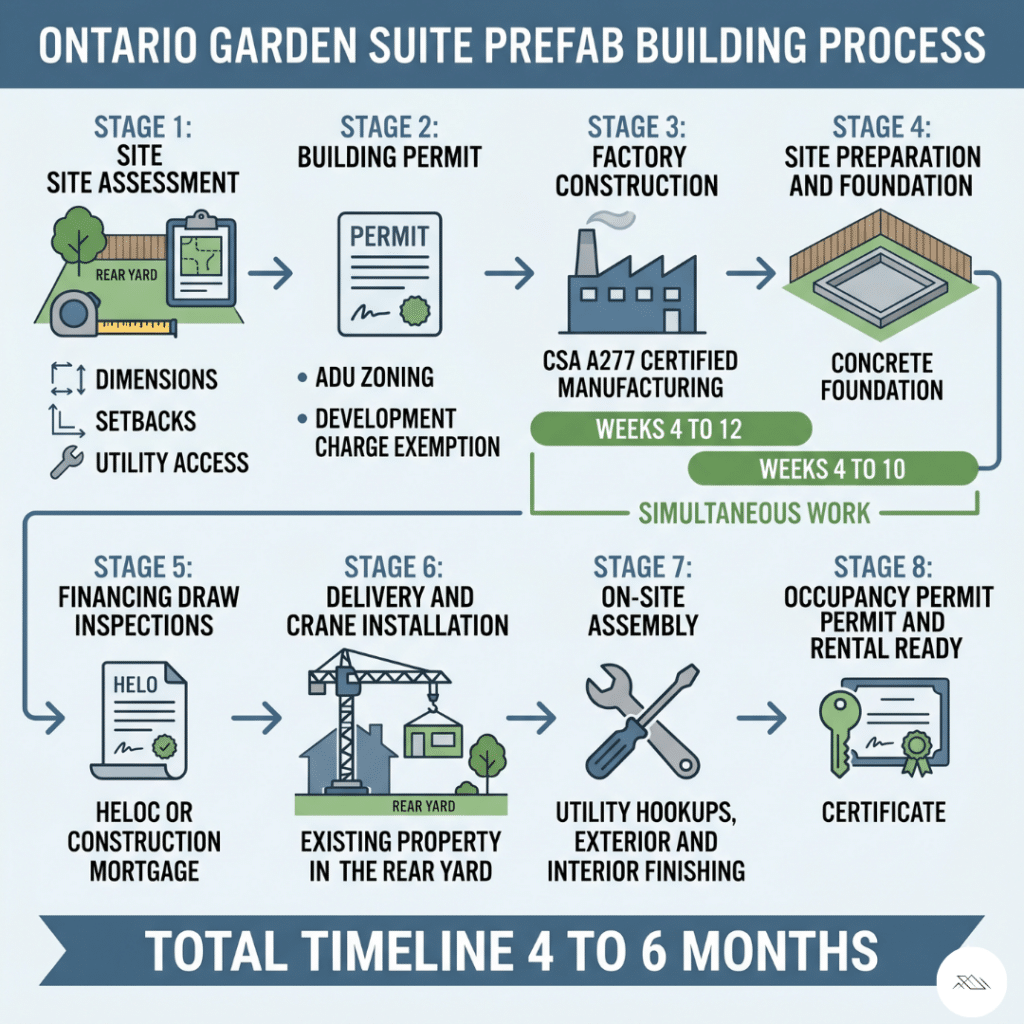
The Ontario prefab garden suite ADU process spans eight stages from site assessment to occupancy — with factory construction and site work running in parallel to deliver completion in 4–6 months and accelerate rental income by 2–6 months.
Stage 1 — Site Assessment and Design Finalization: Evaluating six site variables before any design or construction commitment is made — rear yard dimensions and available siting positions, setbacks from property lines and the main dwelling, utility service capacity to support an additional unit, and access route for module delivery through or around the existing property.
Conservation Authority jurisdiction and any zoning requirements or potential minor variance requirements are confirmed at this stage as well — because discovering either late in the project is the most common cause of ADU timeline disruption in Ontario.
The output of Stage 1 is a complete understanding of what is feasible on the specific property before any design or construction commitment is made.
Stage 2 — Building Permit Application: The application form and supporting documentation submitted to the local municipality includes engineered drawings, site plan, foundation engineering, CSA A277 certification documentation from My Own Cottage, and zoning compliance confirmation.
Development charge exemption documentation is submitted simultaneously.
Stage 3 — Factory Construction: CSA A277 certified manufacturing of the garden suite in the controlled factory environment — six to ten weeks for most standard garden suite configurations — while Stage 4 proceeds simultaneously at the building site.
Stage 4 — Site Preparation and Foundation: Slab on grade or helical pier foundation prepared in the rear yard simultaneously with factory construction.
Access route for delivery vehicles confirmed and prepared. Utility trench work for water service, sanitary sewer connection, electrical, and gas or propane service initiated.
Stage 5 — Financing Draw Inspections: HELOC draws aligned with project stages or construction mortgage milestone releases if applicable.
Stage 6 — Delivery and Crane Installation: Modules transported to the property and crane-set onto the prepared foundation — typically completed in one day for most garden suite configurations.
Access through or beside the existing dwelling to the rear yard must be confirmed adequate for the crane and transport vehicle.
Stage 7 — On-Site Assembly and Finishing: Utility hookups connect the garden suite to municipal water and sewer or the expanded septic system.
Exterior finishing, connection point sealing, and any interior work not completed at the factory.
The garden suite receives its own municipal address from the local municipality at this stage to enable independent utility accounts and mail delivery for the future tenant.
Stage 8 — Inspections and Occupancy Permit: Building inspector review and occupancy permit issuance from the local municipality — after which the garden suite is legally available for occupancy and rental.
Tarion warranty enrollment is confirmed before occupancy permit application.
→ Prefab Home Building Process Ontario — complete eight-stage guide
Financial Incentives for ADU Construction in Ontario
Government Grant Programs and Financial Incentives
Several provincial and federal programs reduce the effective cost of additional dwelling unit construction for qualifying Ontario property owners.
The Ontario new home HST rebate and the federal GST relief program both apply to new garden suite construction used as a residential rental unit — and on a qualifying project in the $173,000 to $281,000 total cost range, the combined saving can represent a five-figure reduction in total project cost.
Capturing this saving requires the transaction to be structured correctly with your builder and accountant before any contract is signed — not claimed retroactively after construction is complete.
Some Ontario municipalities offer additional financial incentives through local Grant Programs and Community Improvement Plans specifically targeting ADU construction as a housing supply measure.
The City of North Bay’s Growth Community Improvement Plan is one example — offering property-specific incentives for qualifying ADU projects.
Other Ontario municipalities have implemented similar programs.
Confirm available local financial incentives with your specific municipality’s planning and building department as part of Stage 1 project planning.
CMHC’s MLI Select program offers mortgage insurance with improved terms for properties adding rental units — potentially reducing financing costs for property owners who are refinancing their primary residence mortgage to fund the ADU project alongside equity available through a HELOC structure.
→ External link: CMHC mortgage insurance
My Own Cottage — Prefab Garden Suite ADUs Across Ontario
My Own Cottage designs and delivers CSA A277 certified prefab garden suites across Ontario — from urban GTA lots and Ottawa properties to waterfront Muskoka builds and rural Ontario properties.
Whether the goal is rental income from existing land, housing for family members through multigenerational living, or long-term property value improvement, every project begins with an honest site assessment and all-in cost estimate before any commitment is made.
Every My Own Cottage garden suite is designed for year-round residential comfort — the interior quality that makes a garden suite a home a tenant wants to stay in long-term, rather than simply a secondary structure that meets minimum Building Code standards.
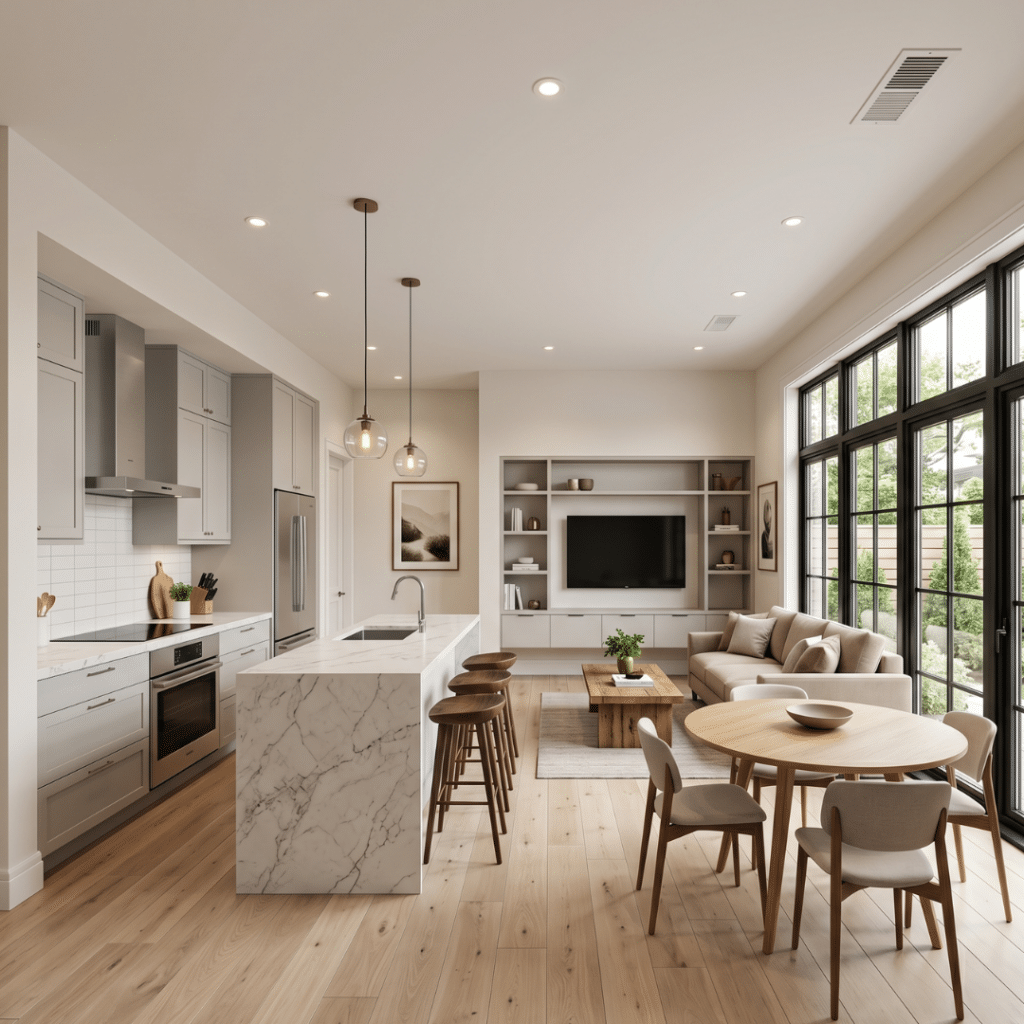
A My Own Cottage prefab garden suite interior — open-concept living with natural light, modern finishes, and efficient design in a 700–1,200 sq ft, year-round Ontario Building Code–compliant unit built for long-term tenancy and strong rental returns.
Every garden suite project begins with a complete site assessment evaluating rear yard dimensions, required setbacks, utility service capacity, access route for delivery and crane, Conservation Authority jurisdiction, and all municipal zoning requirements — before any design is finalized or any commitment is made.
No surprises. No hidden costs.
Every My Own Cottage garden suite is built in a CSA A277 certified manufacturing facility by a builder registered with the Home Construction Regulatory Authority and enrolled in Tarion Warranty Corporation coverage.
This means every garden suite qualifies for standard residential financing, CMHC insurance where applicable, and full Ontario statutory warranty protection — regardless of model size or build location across Ontario.
Garden suite models start at 700 square feet for one-bedroom configurations and extend to 1,200 square feet for two-bedroom configurations — all designed for year-round residential occupancy meeting Ontario Building Code requirements.
This includes higher standards related to energy efficiency, fire separation from adjacent structures, and independent egress.
→ Prefab Homes for Sale Ontario — browse garden suite models | → Prefab Homes Ontario — complete hub
Frequently Asked Questions — Additional Dwelling Unit Ontario
What is an additional dwelling unit in Ontario?
An additional dwelling unit in Ontario is a self-contained residential unit — with its own kitchen, bathroom, and sleeping area — located on the same residential lot as a principal dwelling. It is defined under Ontario Regulation 299/19 as a residential unit that is subordinate to the primary residence on the property. The Province of Ontario permits additional dwelling units in all Ontario municipalities where residential use is allowed, subject to the site-specific zoning requirements of the local municipality. Common types include basement apartments, garden suites, coach houses, and laneway houses. Prefab factory-built construction is the fastest and most cost-predictable method for building a new detached garden suite ADU in Ontario.
What are the current regulations for additional dwelling units in Ontario?
Three regulatory frameworks govern additional dwelling units in Ontario simultaneously — and understanding all three before beginning any ADU project prevents the most common approval delays. Ontario Regulation 299/19 — Additional Residential Units, as amended November 2024 — establishes the provincial right to build additional dwelling units on most residential properties and sets minimum standards for parking, setbacks, and lot coverage that municipalities must permit. The More Homes Built Faster Act, 2022 extended development charge exemptions to detached ADUs including garden suites, eliminated restrictive municipal zoning bylaws that previously prohibited ADUs in established neighbourhoods, and removed the previous 75 per cent gross floor area limit on detached ADUs. The Ontario Building Code establishes the construction standards that all additional dwelling units must meet regardless of construction method — including fire separation, minimum room sizes, egress, energy efficiency, and mechanical requirements. CSA A277 certified factory-built ADUs demonstrate Building Code compliance through factory inspection records rather than requiring separate on-site inspection of every building system — which is one of the primary regulatory advantages of prefab construction for garden suite ADU projects.
How do I get a permit for an additional dwelling unit in Ontario?
Getting a building permit for an additional dwelling unit in Ontario follows five sequential steps. The first step is a feasibility and zoning review — confirming that an ADU is permitted on your specific property under the local municipal zoning bylaw and identifying any setback, height, or lot coverage requirements that will affect the design. The second step is design and documentation — preparing engineered architectural drawings, a site plan, foundation engineering, and building code compliance documentation. For CSA A277 certified prefab garden suites My Own Cottage provides this complete documentation package as a standard part of every project. The third step is building permit application — submitting the complete application package to the local municipality’s building department along with building permit fees. The fourth step is the review process — the municipality reviews the application for zoning compliance and Building Code compliance, typically within four to eight weeks for complete applications in GTA municipalities and two to four weeks in smaller Ontario municipalities. The fifth step is permit issuance — once approved the building permit is issued and construction can begin. Conservation Authority approval must be obtained before the building permit can be issued on properties within Conservation Authority jurisdiction — identifying this requirement in Step 1 prevents the most common ADU permit delay.
How many ADUs can I add to my Ontario property?
Most detached house, semi-detached house, and rowhouse properties in Ontario’s urban settlement area can accommodate up to three total residential units — the primary residence plus two additional dwelling units. The most common three-unit configuration is one secondary suite inside the principal dwelling and one detached ADU such as a garden suite in the rear yard. Properties in rural areas are generally permitted one additional residential unit for a total of two units. Ontario Regulation 299/19 as amended in November 2024 establishes these permissions provincially — but the specific site standards including setbacks, building height, and lot coverage are controlled by the local municipality’s zoning bylaw.
Are development charges waived for ADUs in Ontario?
Yes — for most qualifying additional dwelling units under the More Homes Built Faster Act, 2022. Development charges that previously ranged from $10,000 to $30,000 per unit in many Ontario municipalities have been eliminated for qualifying additional residential units including detached garden suites and interior secondary suites. The development charge exemption for interior secondary suites in existing houses predates Bill 23 — the significant Bill 23 change is the extension of this exemption to detached ADUs including garden suites, which previously faced development charge obligations of $10,000 to $30,000 in many Ontario municipalities. Confirm development charge treatment with your specific local municipality before finalizing your ADU project budget as conditions vary by municipality.
Do I need a building permit for a garden suite in Ontario?
Yes — a building permit from the local municipality is required for every additional dwelling unit construction project regardless of ADU type or construction method. The building permit application must be submitted to the building department of the municipality where the property is located and must include engineered drawings, a site plan, foundation engineering, CSA A277 certification documentation for factory-built ADUs, and zoning compliance confirmation. The building permit review process typically takes four to eight weeks in GTA municipalities and two to four weeks in smaller Ontario municipalities for complete applications. Building permit fees for garden suite ADUs are typically $2,000 to $8,000 depending on the municipality and the construction value of the project.
What are the zoning requirements for a garden suite in Ontario?
Zoning requirements for a garden suite in Ontario are set by the local municipality’s zoning bylaw and vary significantly across Ontario. Common requirements include minimum setbacks from rear and side property lines of 1.2 to 2.4 metres, maximum building height of 4.5 to 6.0 metres, maximum lot coverage of 45 per cent of the residential lot for all buildings and structures combined, and minimum rear yard depth remaining behind the garden suite. Ontario Regulation 299/19 establishes provincial minimum standards that municipalities must permit — but municipalities may impose additional requirements through the local zoning bylaw provided they do not conflict with the provincial regulation. If the proposed garden suite does not comply with applicable zoning requirements a minor variance application to the Committee of Adjustment may be required before a building permit can be issued.
What are the property tax implications of adding an ADU in Ontario?
Adding an additional dwelling unit to an Ontario residential property typically triggers a reassessment of the property’s value by the Municipal Property Assessment Corporation — and a modest increase in property taxes reflecting the improved value of the property. The increase is generally modest relative to the rental income generated and is treated as an operating expense of the rental unit for income tax purposes — deductible against the rental income the ADU generates. The rental income itself is taxable income for the property owner and must be reported annually to the Canada Revenue Agency. Eligible construction costs including the ADU project cost may be claimed as capital cost allowance against rental income — and operating expenses including mortgage interest on HELOC financing, property taxes allocated to the unit, insurance, and maintenance costs are all deductible against ADU rental income. Confirm the specific tax treatment of your ADU construction costs and rental income with your accountant before the unit is first rented — the tax structure of the project should be established before construction begins, not after occupancy.
Can a prefab home be used as an additional dwelling unit in Ontario?
Yes — CSA A277 certified prefab factory-built structures fully qualify as additional dwelling units under Ontario’s building code and planning legislation. The construction method — factory-built versus site-built — is irrelevant to ADU qualification as long as the finished structure meets Ontario Building Code requirements for a self-contained residential unit and is permanently affixed to a foundation. For detached garden suite ADUs, prefab factory-built construction is the preferred construction method because it is faster, more cost-predictable, and produces a more consistent building envelope than site-built construction in a constrained rear yard environment. My Own Cottage’s CSA A277 certified garden suite models are specifically designed and built to Ontario Building Code standards for year-round residential occupancy as additional dwelling units.
Can I find prefabricated additional dwelling units available for sale in Ontario?
Yes — My Own Cottage offers CSA A277 certified prefab garden suite ADUs for sale and delivery across Ontario. Prefab factory-built garden suites are available in configurations from 700 to 1,200 square feet — covering one-bedroom and two-bedroom layouts designed specifically for year-round residential occupancy as additional dwelling units on existing residential properties. Every My Own Cottage garden suite is built in a certified manufacturing facility, delivered and crane-set onto a prepared foundation in the rear yard, and enrolled in Tarion Warranty Corporation coverage through a registered HCRA builder — qualifying for standard residential financing and full Ontario statutory warranty protection. The key advantage of prefabricated garden suites over site-built alternatives is the construction timeline — four to six months from project start to occupancy compared to six to twelve months for an equivalent site-built structure — which accelerates the rental income start date and reduces total carrying costs during the construction period. Contact My Own Cottage to receive a complete site assessment and all-in project cost estimate for your specific Ontario property before committing to any ADU design or construction approach.
How much does it cost to build a garden suite ADU in Ontario?
A prefab garden suite ADU in Ontario costs approximately $173,000 to $281,000 in total project cost on a property with municipal water and sewer service, excluding land. This includes the home package at $130,000 to $195,000 for 700 to 1,200 square feet, site preparation and grading at $8,000 to $20,000, foundation at $12,000 to $28,000, municipal utility connections at $8,000 to $18,000, building permit fees at $2,000 to $8,000, and delivery and crane installation at $5,000 to $12,000. Development charges are $0 for qualifying garden suite ADUs under the More Homes Built Faster Act eliminations. Rural Ontario properties requiring septic system upgrades to support the additional residential unit add $20,000 to $50,000 to the total project cost.
How long does it take to build a prefab garden suite in Ontario?
A My Own Cottage prefab garden suite ADU project takes four to six months from project start to occupancy for most standard configurations on properties with municipal services and no minor variance requirements. This compares to six to twelve months for a conventionally site-built garden suite. The prefab timeline advantage comes from the parallel build model — factory construction and site preparation occur simultaneously rather than sequentially, compressing the total project timeline by two to six months. Municipal permit approval timeline — typically four to eight weeks for a complete application — is the variable that most commonly determines whether the total project falls at the lower or upper end of the four to six month range.
Can I rent out my garden suite in Ontario?
Yes — a completed garden suite ADU with a valid occupancy permit can be rented to any occupant regardless of whether the occupant is related to the property owner. Ontario Regulation 299/19 explicitly confirms that additional dwelling units may be occupied by any person regardless of their relationship to the occupant of the primary residence. Rental income from the garden suite is taxable income for the property owner and must be reported annually. The garden suite is treated as a separate residential rental unit for income tax purposes — eligible construction costs can be claimed as capital cost allowance and operating expenses including mortgage interest on HELOC financing, property taxes allocated to the unit, and maintenance costs are deductible against rental income. Confirm the specific tax treatment of your ADU rental income with your accountant before the unit is first rented.
Does Tarion warranty cover a prefab garden suite in Ontario?
Yes — Ontario statutory warranty coverage under Tarion applies to a new garden suite built by an HCRA registered builder on a permanent foundation in the same way it applies to a new primary home. Coverage includes one year for workmanship and materials defects, two years for water penetration, and seven years for major structural defects. The garden suite must be built by a builder registered with the Home Construction Regulatory Authority and the specific project must be enrolled in Tarion coverage before the occupancy permit application is submitted. My Own Cottage enrolls every garden suite project in Tarion coverage as a standard component of every ADU project. Property owners can verify builder registration through the HCRA Ontario Builder Directory.
What financing options are available for a garden suite ADU in Ontario?
The most common financing structure for Ontario garden suite ADU projects is a Home Equity Line of Credit using equity in the existing primary residence — providing flexible draws aligned with project stages without the draw inspection sequence of a construction mortgage. HELOC financing at current rates produces an annual carrying cost that is fully recoverable from the rental income generated by the completed garden suite — making the prefab garden suite self-financing over a four to eight year payback period at current Ontario rental market rates. A construction mortgage with staged draws is an alternative for property owners with limited existing home equity who are financing the full ADU project through new borrowing. The Ontario new home HST rebate and the federal GST relief program may apply to qualifying garden suite construction — on a qualifying project in the $173,000 to $281,000 total cost range the combined saving can represent a five-figure reduction in total project cost when the transaction is structured correctly with the builder and accountant before signing.
What are the benefits of building a laneway house in Ontario?
A laneway house offers several distinct advantages for urban Ontario property owners whose lots have rear lane access. The primary benefit is independent access — a laneway house is entered from the rear lane rather than through the primary residential lot, providing the secondary unit with the highest degree of privacy and independence of any ADU type. This independent access makes laneway houses particularly well-suited to rental tenancies where complete separation from the primary household is important to both the tenant and the property owner. The lane-facing position also preserves the primary home’s rear yard entirely — unlike a garden suite which occupies rear yard space, a laneway house sits along the lane boundary and leaves the interior yard available for outdoor use. Laneway houses are subject to the same provincial ADU rights under Ontario Regulation 299/19 and the same development charge exemptions under Bill 23 as garden suites — but their feasibility depends entirely on rear lane access and municipal laneway house provisions that vary by city. Toronto and Ottawa have the most developed laneway house policy frameworks in Ontario — confirm laneway house provisions with your specific local municipality before comparing laneway house versus garden suite feasibility for your property.
What is the difference between a garden suite and a laneway house in Ontario?
A garden suite is a detached ADU located in the rear yard of the residential lot — accessible from the primary lot rather than from a rear lane. A laneway house is a detached ADU specifically located on a rear lane or alley that runs behind urban residential properties. The key functional difference is access — garden suites are accessed through the primary lot while laneway houses are accessed from the rear lane, which affects both the construction logistics and the independent residential character of the unit. Laneway houses are most feasible in older urban Ontario neighbourhoods in Toronto and Ottawa where rear lane infrastructure already exists. Garden suites are the more broadly available detached ADU option across Ontario because they do not require rear lane infrastructure. Both types are subject to Ontario Building Code requirements for self-contained dwelling units and both require building permits from the local municipality.
What is the difference between a garden suite and a granny flat?
A granny flat — also sometimes called a law suite or in-law suite — is a common informal term for any secondary dwelling unit added to a property for the accommodation of a family member, particularly elderly parents or adult children. It is not a distinct legal or building code category in Ontario — the formal regulatory categories are additional dwelling unit, secondary suite, or second unit depending on the specific regulation being applied. A garden suite, basement apartment, coach house, or laneway house can all be informally described as a granny flat when they are intended for family members rather than rental tenants. Ontario Regulation 299/19 explicitly confirms that additional dwelling units may be occupied by any person regardless of relationship to the primary residence occupant — meaning a unit built for family members today can become a rental unit in the future without any regulatory change.
Ready to Build Your Ontario Garden Suite ADU?
An additional dwelling unit on your Ontario property is one of the most financially compelling decisions available to property owners in 2026.
Development charges eliminated under Bill 23, provincial zoning rights established across all residential zones, rental market rates at historic highs, and prefab construction making the timeline two to four months faster than conventional site-built construction.
My Own Cottage provides complete site assessments, permit-ready documentation, and CSA A277 certified factory-built garden suites delivered across Ontario — with honest all-in costs provided before any contract is signed.
No obligation. We assess your rear yard dimensions, your setbacks, your utility capacity, and your permit requirements — then give you realistic numbers for your specific property before you commit to anything.
🧑💼 Request a Free Consultation
📲 Call Us Directly: (705) 345-9337
🏘️ View Our Design Catalogue
✅ Ontario-Built | ⚡ Energy-Efficient | 🏡 Fully Customizable | 🚚 Fast Delivery
Alternatively, for your convenience, you can also simply fill out the contact form below and we’ll get back to you soon! 👇

Contact Us
We usually respond within 24 hours!
- Comprehensive Warranty
- Best Price Guarantee
- Exceptional Service
Verified External Resources
Ontario Regulation 299/19 — Additional Residential Units — Provincial legislative framework governing additional residential units on Ontario residential properties as amended November 2024.
More Homes Built Faster Act, 2022 — Overview of Bill 23 provisions including development charge eliminations and zoning changes for additional dwelling units.
Ontario Building Code — Official provincial building standards governing construction of additional dwelling units including garden suites and secondary suites.
CSA A277 — Canadian Standards Association certification standard for factory-built construction qualifying prefab structures for mortgage financing and building code compliance.
Tarion Warranty Corporation — Ontario’s new home warranty provider covering statutory warranty for additional dwelling units built by registered HCRA builders.
CMHC — Canada Mortgage and Housing Corporation — Federal housing authority covering financing eligibility and MLI Select program for rental housing.