Canadian Prefab Homes: Prices, Types, and How to Build Your Dream Home in 2026
Canadian prefab homes offer a faster, more predictable way to build a high-quality, energy-efficient home in Canada using factory-built construction.
This article explains prefab home types, prices, building codes, financing, and how to build your dream home with confidence in 2026.
Canadian Prefab Homes: The 2026 Guide to Building a High-Quality Home in Canada
Canadian prefab homes are reshaping modern homebuilding across Toronto, Vancouver, Calgary, Montreal, Ottawa, Edmonton, Winnipeg, along with rapidly growing urban centres such as Mississauga, Brampton, and Hamilton.
Built using modular construction and other factory-built methods, these homes offer Canadians a faster, more precise way to build your dream home.
All while maintaining strict building codes, high energy efficiency, and long-term structural integrity.

Unlike traditional site-built housing, prefab homes are constructed in a controlled environment, which significantly reduces weather delays, material waste, and construction errors.
According to the Canada Mortgage and Housing Corporation, factory-built housing is increasingly critical to improving housing supply and affordability nationwide.

Above are the key benefits of Canadian prefab homes, including faster build times, energy efficiency, predictable costs, factory quality control, and full code compliance.
For buyers seeking a quality home, predictable timelines, and a better home building experience, prefab homes provide confidence, peace of mind, and lasting value.
Canadian prefab homes are now widely used for new homes, custom homes, retirement homes, backyard suites, and rural properties.
This applies everywhere, from Atlantic Canada to British Columbia, including remote regions such as Northern BC and coastal areas like the Sunshine Coast.
Explore Canadian Prefab Homes by Topic
Costs & Pricing
Design & Home Styles
Buying & Ownership
Regulations, Financing & Performance
What Are Canadian Prefab Homes?
Canadian prefab homes are factory-built homes designed for faster, higher-quality construction.
Canadian prefab homes are precision-built in factories and later transported to the building site for installation, a process that dramatically improves consistency and efficiency.
By shifting most of the building process indoors, manufacturers can tightly control materials, measurements, and workmanship, resulting in high quality, precision-built structures with fewer defects.

Canadian prefab homes being built indoors in a factory setting, allowing faster construction, tighter quality control, and consistent results.
According to the National Research Council Canada, factory construction reduces rework and improves long-term durability compared to traditional site-built methods.
This approach also allows design teams to integrate advanced insulation systems, optimized energy consumption, and modern mechanical systems before the home reaches the site.
Canadian prefab homes support a wide range of home design options, including modern design, traditional layouts, and endless design possibilities through customizable floor plans.
Whether you are planning a compact cottage, a large family residence measured in thousands of square feet, or a modern modular home, prefab construction delivers predictable results at every step of the way.
Canadian prefab homes are permanent, code-compliant houses built in factories for speed, quality, and energy efficiency.
Prefab homes are not mobile homes and must meet strict Canadian building standards.
Prefab homes in Canada are legally classified as permanent residential structures and must comply with national and provincial building codes.
Most modular and panelized homes are constructed under CSA A277, while manufactured homes follow CSA Z240, with inspections performed both in-factory and on-site.

A Canadian prefab home being installed on a permanent foundation, meeting national and provincial building standards rather than mobile home regulations.
According to Housing, Infrastructure and Communities Canada, homes meeting CSA standards are eligible for standard residential permits and financing in most municipalities.
This is especially important in major metropolitan regions such as Toronto, Vancouver, Calgary, and Montreal, where zoning enforcement and inspection processes are rigorous.
Essentially, prefab home regulations in Canada determine where prefab homes are allowed.
Moreover, this compliance allows prefab homes to qualify for conventional mortgages, insurance, and resale, distinguishing them clearly from temporary or mobile housing.
Buyers benefit from a quality home that integrates seamlessly into established neighbourhoods while maintaining long-term curb appeal and market value.
Canadian prefab homes are permanent homes built to national standards, inspected at multiple stages, and designed to last for generations.
Types of Prefab Homes Available in Canada
Modular homes are built in large sections and assembled on-site for a complete, permanent home.
Canadian prefab homes for sale provide a faster, more predictable way to build a high-quality new home in Canada using factory-built modular construction.
Modular homes are the most common type of prefab housing in Canada.
Built in large three-dimensional modules inside a factory, these homes are transported to the site and assembled on a permanent foundation, often within days.
According to the Canadian Housing and Renewal Association, modular housing can reduce overall construction timelines by up to 50 percent compared to traditional site-built homes.

Large modular home sections being assembled on-site, illustrating how factory-built modules are installed to create a complete, permanent Canadian home.
Construction speed is particularly valuable in high-demand regions such as Ontario, British Columbia, and Alberta, where housing shortages and labour constraints are significant.
Modular homes support custom design, modern modular home layouts, and new models that combine strong structural integrity with advanced building science.
They are commonly used in urban, suburban, and rural settings across Western Canada and Atlantic Canada, offering a consistent and reliable home package regardless of location.
In simple terms, a modular home is a complete house built indoors and assembled on your land with precision and efficiency.
Panelized homes ship walls and components flat for flexible, design-driven builds.
Panelized prefab homes are constructed as individual wall, roof, and floor panels in a factory, then shipped flat to the site for assembly.
This method offers greater architectural flexibility while still benefiting from factory precision and quality control.
According to the Ontario Ministry of Municipal Affairs and Housing, panelized construction is increasingly used to accelerate housing delivery while allowing municipalities to maintain design standards.
Panelized systems are especially popular for custom homes, unique rooflines, and projects requiring enhanced curb appeal.
This approach is well suited for homeowners seeking new ways to personalize their perfect home while still enjoying the reliability of prefab construction and a streamlined entire process from design to installation.
Manufactured homes are built to a different standard and are often used in specific housing contexts.
Manufactured homes are built to CSA Z240 standards and are typically installed in managed communities or land-lease developments.
While still factory-built, they differ from modular homes in financing options, zoning flexibility, and long-term appreciation.
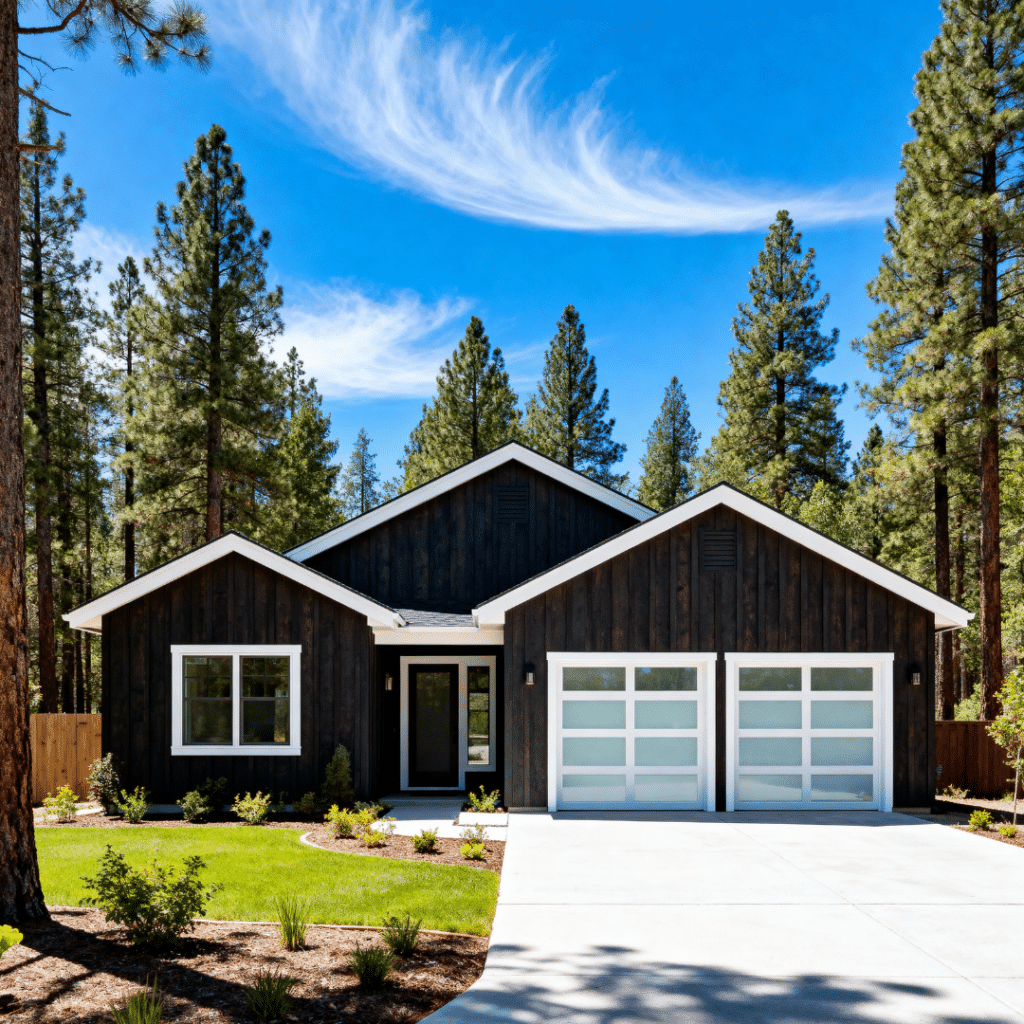
A Canadian manufactured home installed in a managed community, illustrating how manufactured housing differs from other Canadian prefab home types.
Manufactured homes are commonly found in parts of Atlantic Canada, Western Canada, and rural regions where affordability and rapid delivery are primary concerns.
They are often used as retirement homes or seasonal residences, offering a practical entry point into homeownership.
In Canada, prefab housing includes modular, panelized, and manufactured homes—each designed for different budgets, locations, and long-term goals.
Cost of Canadian Prefab Homes in 2026
Canadian prefab home prices vary by size, design, location, and level of customization.
The cost of Canadian prefab homes in 2026 typically ranges from affordable entry-level options to fully customized, high-end residences.
Pricing is influenced by square feet, modern design complexity, energy-performance targets, site conditions, and regional labour and transportation costs.
Canadian prefab homes with prices are best compared by evaluating total project cost drivers—including square footage, design complexity, energy performance, and site-specific conditions.
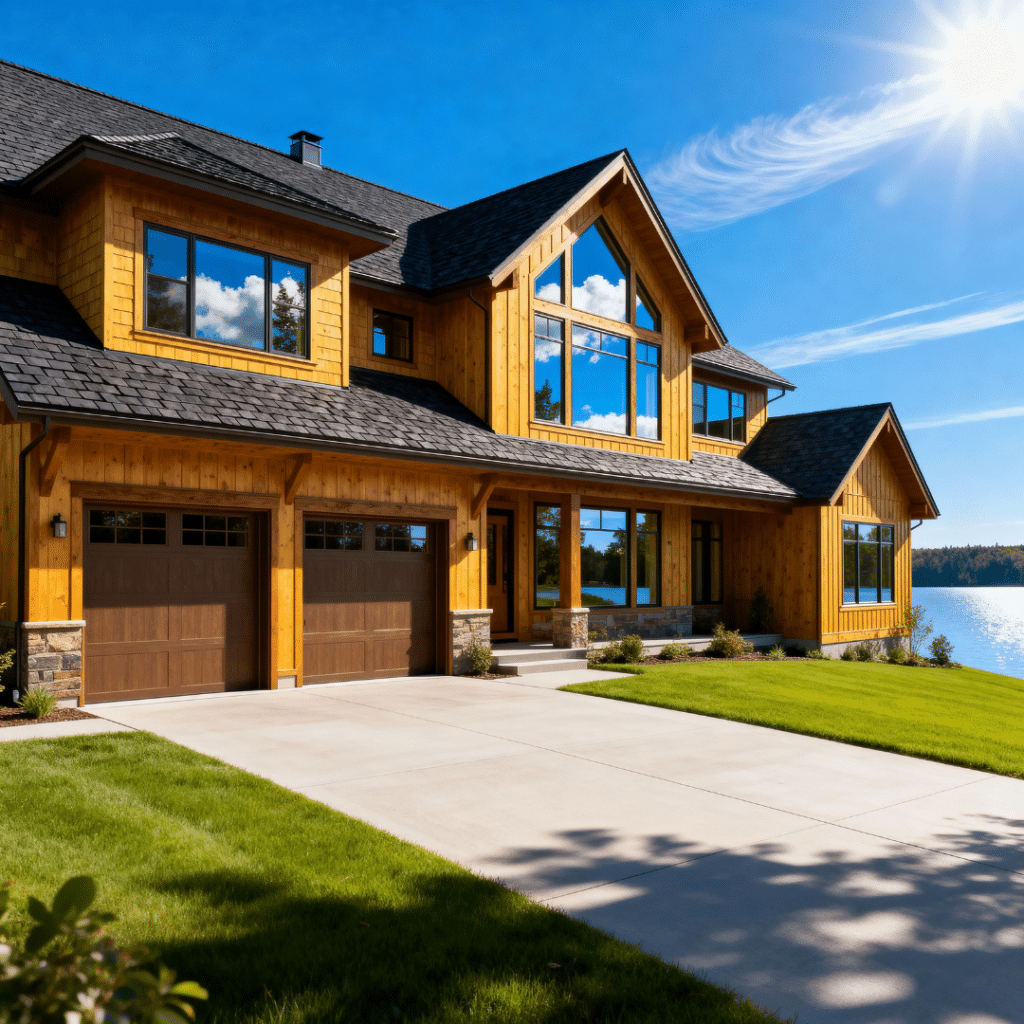
A larger Canadian prefab home with modern design and custom exterior finishes, illustrating how size, materials, and location influence prefab home pricing.
According to the Canada Mortgage and Housing Corporation, factory-built housing can reduce overall project costs by 10 to 20 percent when land is already owned.
Specifically, this is primarily due to faster timelines and reduced on-site labour.
This advantage is especially relevant in high-cost markets such as Toronto, Vancouver, Mississauga, and Brampton, where traditional construction delays often increase budgets.
Many affordable Canadian prefab homes are priced as a home package, typically excluding land, foundation work, permits, and some site services.
Buyers benefit from predictable pricing and fewer cost overruns, which contributes to a smoother home building experience and greater peace of mind throughout the entire process.
In general, Canadian prefab homes offer transparent pricing, predictable timelines, and fewer budget surprises compared to traditional homebuilding.
Small, modern, and large prefab homes follow distinct cost and timeline patterns.
Smaller prefab homes are often chosen for retirement homes, backyard suites, or rural cottages, while larger models support growing families and multi-generational living.
Modern modular home designs with open layouts and premium finishes typically cost more but deliver stronger curb appeal and long-term value.
A closer look at modern Canadian prefab homes reveals how scale and design choices shape pricing and long-term value.

Comparison of Canadian prefab homes showing how small, modern, and large designs follow distinct cost and build timeline patterns.
According to the National Research Council Canada, factory-built efficiency reduces material waste and shortens construction schedules, which directly impacts final pricing.
This benefit is amplified in regions with short building seasons, such as Northern BC, and in remote areas across Western Canada.
From compact cottages to expansive custom homes, prefab construction allows homeowners to align budget, performance, and design.
All without sacrificing quality products or structural integrity.
Prefab homes scale efficiently, making them suitable for everything from small cottages to large, modern family homes.
Regional pricing differences matter across Canada’s major cities and provinces.
Location plays a significant role in prefab home pricing. Transportation distance, crane access, foundation type, and local permit requirements all affect total project cost.
In major population centres such as Calgary, Edmonton, Ottawa, Montreal, and Winnipeg, prefab homes often remain cost-competitive due to reduced build times and consistent factory quality.
According to Housing, Infrastructure and Communities Canada, industrialized construction methods are increasingly promoted to stabilize housing costs in high-growth urban regions.
In contrast, remote coastal or rural areas—such as the Sunshine Coast or parts of Atlantic Canada—may incur higher transport costs but still benefit from reduced on-site labour requirements.
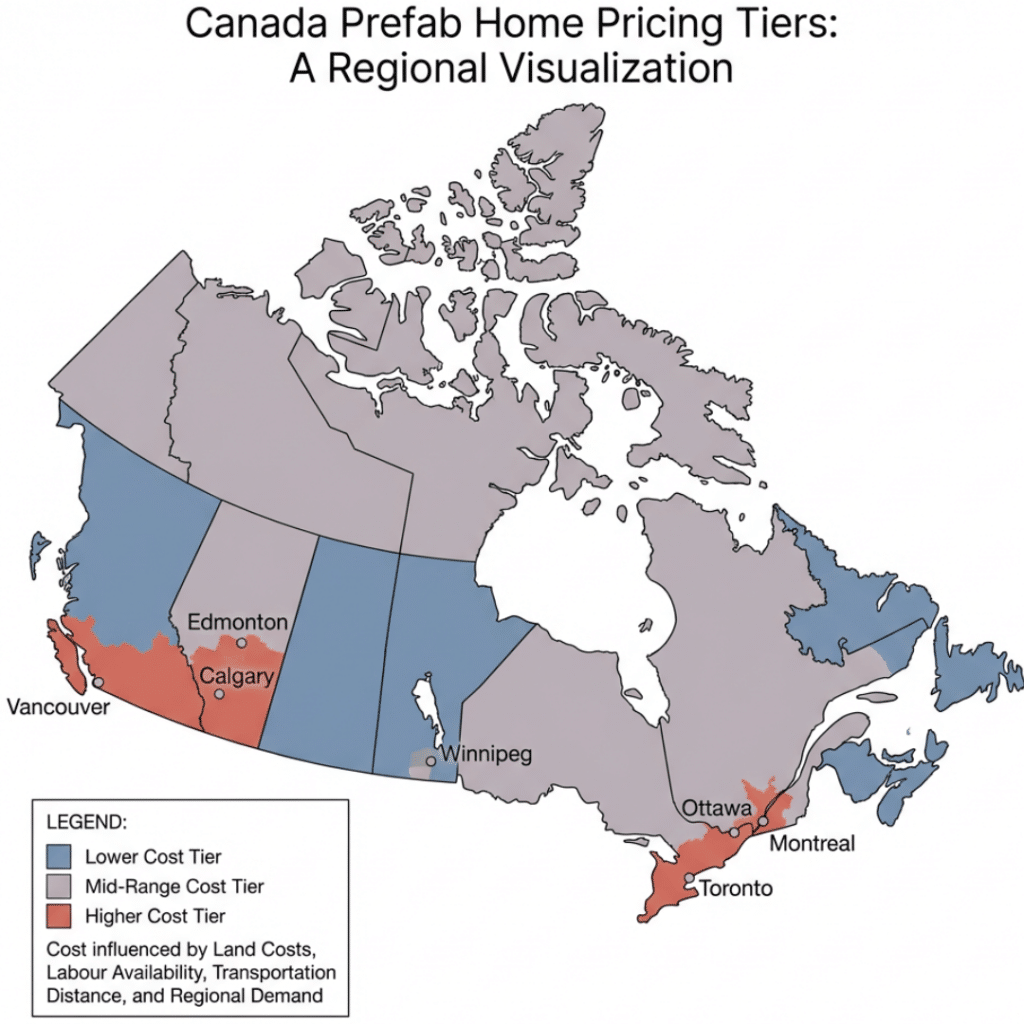
Regional pricing overview showing how Canadian prefab home costs vary across provinces and major cities based on location-specific factors.
Understanding regional cost drivers helps buyers plan realistically and avoid unexpected expenses during the building process.
Our affordable modern prefab homes price comparison in Canada explains how costs vary by size, features, timelines, and construction method so homebuyers can compare options with confidence.
Prefab home pricing reflects regional conditions, but factory efficiency helps stabilize costs across Canada.
Prefab Homes vs Traditional Homes in Canada
Prefab homes are built faster and with greater schedule certainty than traditional homes.
One of the most significant advantages of prefab homes is speed.
Because construction occurs in a controlled environment, factory work and site preparation can happen simultaneously. This parallel workflow dramatically shortens project timelines.
According to the Canadian Housing and Renewal Association, modular construction can reduce total build time by several months compared to traditional homebuilding.
In cities such as Toronto, Vancouver, and Hamilton, where delays are common, faster delivery means earlier occupancy and lower carrying costs.
For homeowners eager to move into a new home without prolonged disruptions, prefab construction offers a more reliable path from design to move-in.
Prefab homes significantly reduce construction timelines by combining factory production with on-site preparation.
Factory-built homes deliver more consistent quality control than site-built homes.
Traditional construction is vulnerable to weather delays, labour shortages, and inconsistent workmanship.
Prefab homes, by contrast, are built indoors using repeatable processes, advanced machinery, and standardized inspections.
According to Build Canada Homes, factory-built housing improves consistency and reduces defects through precision manufacturing and multi-stage inspections.
This results in high quality, precision-built homes with reliable performance.
The outcome is a quality home that meets or exceeds expectations, regardless of whether it is installed in an urban neighbourhood or on rural properties.
Prefab construction delivers consistent results by removing environmental uncertainty from the build.
Energy efficiency and long-term performance favor prefab construction.
Importantly, prefab homes are designed with modern building science in mind.
Airtight envelopes, high-performance insulation, and energy-efficient windows are easier to install accurately in factory settings, leading to reduced energy consumption over time.

Energy performance comparison showing why Canadian prefab homes deliver better efficiency and more consistent long-term performance than traditional construction.
According to the BC Housing, factory-built homes in British Columbia often exceed minimum energy requirements due to precision assembly and integrated design.
Similar trends are observed across Ontario and Quebec, where energy codes continue to tighten.
For homeowners focused on sustainability, operating costs, and long-term comfort, prefab homes offer a clear performance advantage.
Prefab homes are inherently more energy efficient due to precision assembly and modern building methods.
Traditional homes offer flexibility, but prefab homes provide predictability and peace of mind.
While traditional homes may allow on-the-fly design changes, they often introduce cost overruns and delays.
Prefab homes require design decisions to be finalized earlier, but this upfront clarity leads to smoother execution and fewer surprises.
According to the Ontario Non-Profit Housing Association, standardized construction approaches improve project delivery outcomes and reduce risk for homeowners and developers alike.
For buyers who value transparency, schedule certainty, along with a guided experience supported by a dedicated design team and customer service, prefab homes are ideal.
Our detailed prefab homes cost comparison vs traditional homes in Canada explains how total build costs differ when you factor in timelines, labour risk, financing, and long-term value across Canadian markets.
Essentially, prefabrication delivers a more predictable and satisfying home building experience from start to finish.
Prefab homes trade late-stage flexibility for certainty, quality, and peace of mind.
Building Codes, Zoning, and Permits for Prefab Homes in Canada
Canadian prefab homes must comply with national and provincial building codes.
All Canadian prefab homes are required to meet the same core building codes as traditional site-built houses.
Most modular and panelized homes are certified under CSA A277, while manufactured homes follow CSA Z240, ensuring safety, durability, and long-term performance.
According to the National Research Council Canada, CSA-certified homes are inspected during factory production and again after on-site installation, creating multiple layers of quality assurance.
This dual-inspection process strengthens structural integrity and ensures consistent compliance across provinces.
For homeowners, this means prefab homes qualify as permanent residences, not temporary structures.
This applies regardless of whether they are built in Toronto, Vancouver, Calgary, or smaller communities across Atlantic Canada and Western Canada.
Prefab homes in Canada are permanent, code-compliant houses built to the same standards as traditional homes.
Zoning rules vary by municipality and can affect prefab home approvals.
While building codes are largely standardized, zoning is controlled at the municipal level.
Setbacks, height limits, lot coverage, and use classifications all influence whether a prefab home can be approved on a specific property.
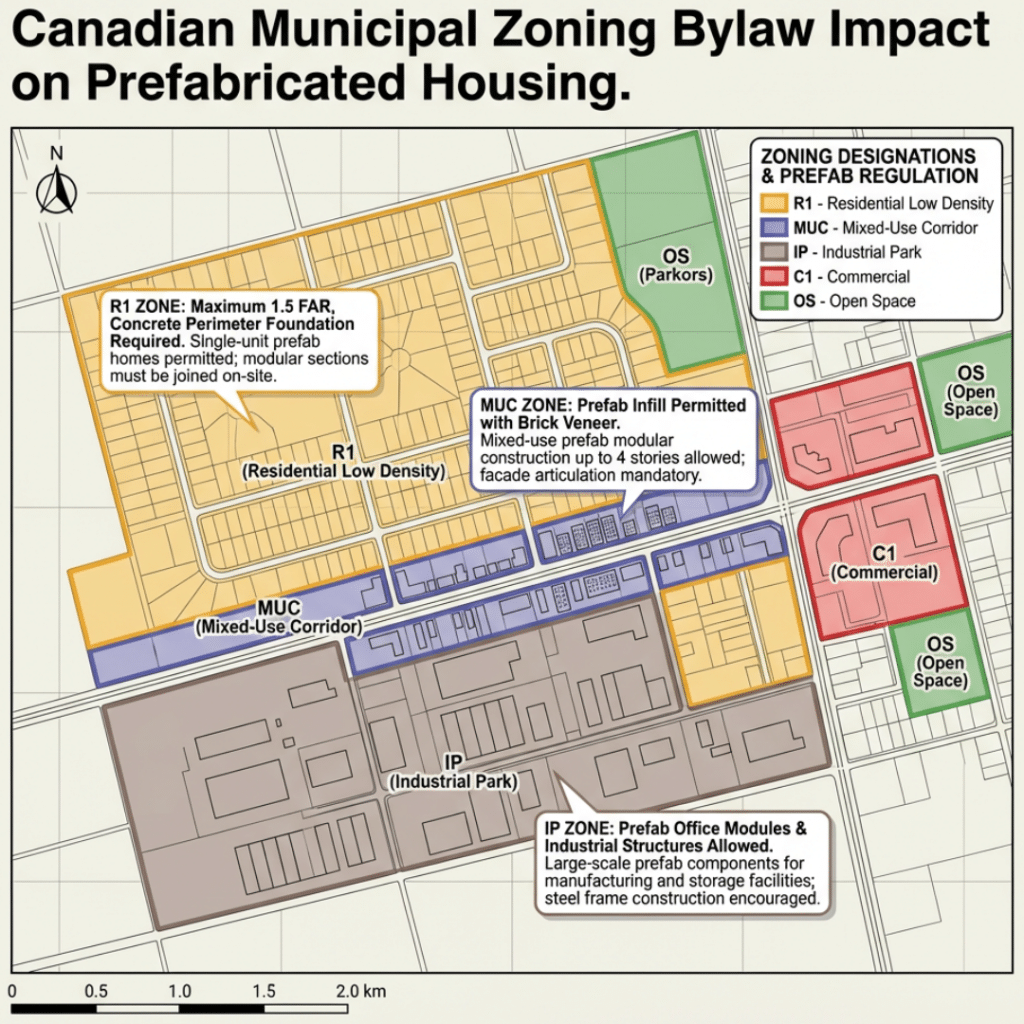
Municipal zoning rules vary across Canada and can influence where prefab homes are permitted and approved.
According to the Ontario Ministry of Municipal Affairs and Housing, modular and prefab homes must conform to local zoning bylaws in the same way as site-built homes.
This applies across urban centres such as Mississauga, Brampton, Hamilton, and Ottawa, as well as rural municipalities.
In high-density cities like Montreal and Vancouver, zoning considerations may include architectural guidelines and neighbourhood character.
In contrast, rural regions often offer greater flexibility for custom homes and larger square feet designs.
Prefab homes are subject to local zoning rules, not special exemptions.
Permits are required before delivery and installation of a prefab home.
Before a prefab home can be delivered, homeowners must secure building permits, foundation approvals, and service connections.
Municipal inspectors typically review site plans, structural drawings, and energy compliance documentation.
According to Housing, Infrastructure and Communities Canada, streamlined permitting processes are increasingly encouraged for factory-built housing to accelerate housing delivery.
However, timelines still vary by municipality, especially in fast-growing regions like Calgary, Edmonton, and the Greater Toronto Area.
Working with an experienced local company and design team helps ensure permits are obtained efficiently.
Importantly, this serves to reduce delays and support a smooth home building experience from the first application to final inspection.
Prefab homes require the same permits as traditional homes, but experienced builders help streamline approvals.
Financing and Mortgages for Canadian Prefab Homes
Most Canadian prefab homes qualify for standard residential mortgages.
Prefab home financing and insurance in Canada follow specific rules around mortgages, construction loans, and eligibility.
One of the most common concerns buyers have is whether prefab homes can be financed like traditional houses.
In most cases, the answer is yes. Modular and panelized homes built to CSA A277 standards are generally eligible for conventional mortgages.

A finished Canadian prefab home on a permanent foundation that qualifies for standard residential mortgage financing.
According to the Canada Mortgage and Housing Corporation, factory-built homes that meet provincial building codes and are permanently affixed to foundations can qualify for CMHC-insured financing.
This applies across major markets such as Toronto, Vancouver, Ottawa, and Winnipeg.
This eligibility gives buyers confidence that a prefab home is a legitimate new home investment with long-term resale potential.
Prefab homes can be financed like traditional homes when built to CSA standards.
Construction financing differs from traditional mortgages during the build phase.
Prefab home financing often begins with a construction loan or progress-draw mortgage.
Because much of the home is built off-site, lenders may structure payments differently, releasing funds at factory milestones and after on-site installation.
According to the Ontario Non-Profit Housing Association, predictable construction schedules improve lender confidence and reduce financing risk.
This makes prefab projects attractive to lenders compared to traditional builds with uncertain timelines.
Buyers benefit from clearer payment schedules and fewer delays, contributing to greater peace of mind throughout the entire process.
Prefab construction financing is structured around predictable factory and installation milestones.
Down payments, insurance, and appraisals follow standard residential rules.
Once installed on a permanent foundation, prefab homes are appraised and insured like traditional houses.
Down payment requirements depend on purchase price and lender policy, not the construction method.
According to Build Canada Homes, standardized housing delivery models improve valuation consistency and reduce uncertainty for insurers and lenders.
This supports broader adoption of prefab housing across Canada.
Whether financing a modern modular home, a rural cottage, or a primary residence in a major city, buyers can expect familiar mortgage processes once the home is complete.
Prefab homes follow standard appraisal and insurance practices after installation.
Early lender engagement improves the prefab home buying experience.
Engaging with a lender early in the planning phase helps buyers understand documentation requirements, draw schedules, and insurance needs.
This is especially important for first-time buyers and those building on vacant land.

Early lender engagement helps Canadian prefab home buyers confirm financing, avoid delays, and enjoy a smoother buying experience.
According to the Canadian Housing and Renewal Association, coordinated planning between builders, lenders, and municipalities improves project outcomes while reducing delays.
Early financial planning ensures a smoother transition from design to delivery, helping homeowners stay confident at every step of the way.
Early lender coordination reduces risk and improves the overall home building experience.
Pros and Cons of Canadian Prefab Homes
Prefab homes offer faster timelines, higher quality control, and better energy efficiency.
Canadian prefab homes deliver measurable advantages because most of the building process occurs in a factory-built, controlled environment.
This reduces exposure to weather delays, labour shortages, and material damage, which are common challenges in traditional homebuilding.
According to the Canada Mortgage and Housing Corporation, factory-built construction improves schedule reliability and reduces total build time.
This is especially imperative in regions with short construction seasons such as Northern BC and parts of Atlantic Canada.
Precision manufacturing also supports tighter building envelopes, lowering long-term energy consumption.
For homeowners, this results in a high quality, precision-built home that delivers consistent performance, improved comfort, and long-term peace of mind.
Prefab homes excel at speed, consistency, and energy-efficient performance.
Predictable pricing reduces financial risk during the homebuilding process.
Prefab homes are typically sold as a clearly defined home package, with specifications, finishes, and timelines established early.
This upfront clarity significantly reduces unexpected costs and last-minute changes.
According to the Ontario Non-Profit Housing Association, standardized construction methods improve cost certainty and reduce financial risk for both homeowners and lenders.
This benefit is particularly valuable in high-cost markets like Toronto, Vancouver, Mississauga, and Brampton, where delays can quickly inflate budgets.
By minimizing surprises, prefab construction supports a smoother home building experience from design through finishing touches.
Prefab homes offer clearer pricing and fewer budget overruns than traditional builds.
Design decisions must be finalized earlier than in traditional construction.
One trade-off with prefab homes is that most design choices must be confirmed before factory production begins.
While this limits late-stage changes, it ensures manufacturing efficiency and quality control.
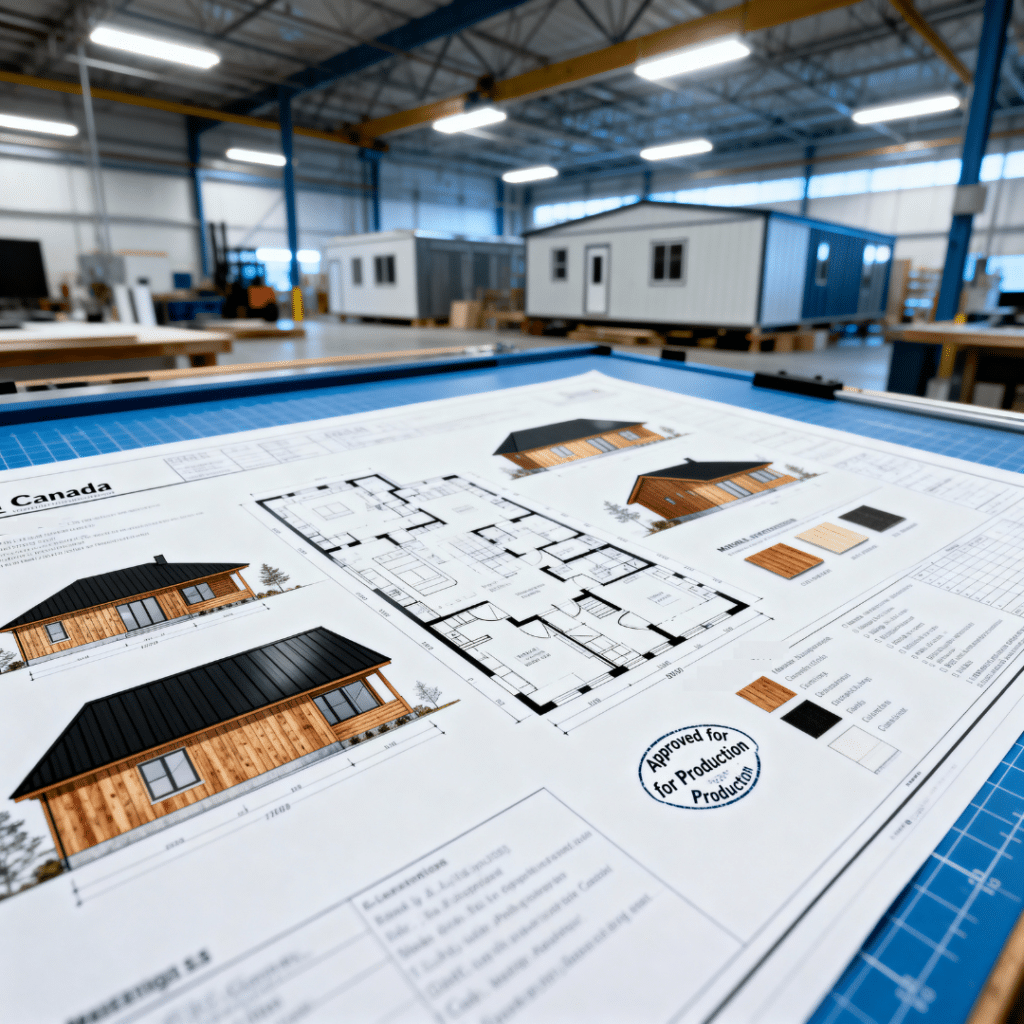
Prefab construction requires design decisions for Canadian prefab homes to be finalized early, with plans and specifications approved before factory production begins.
According to the National Research Council Canada, early design finalization reduces errors, material waste, and on-site rework.
Buyers who work closely with a design team can still achieve custom design, modern design, and endless design possibilities within this structured process.
This approach favors careful planning over improvisation, rewarding buyers who value certainty and precision.
Prefab homes prioritize upfront planning to deliver consistent, high-quality results.
Site access, transportation, and local conditions can influence feasibility.
Prefab homes require adequate site access for delivery and installation, including road clearance and crane access.
In dense urban areas or remote rural locations, logistics must be carefully assessed.
According to Housing, Infrastructure and Communities Canada, transportation planning is a key consideration for factory-built housing, particularly in coastal regions such as the Sunshine Coast or isolated areas of Western Canada.
An experienced local company can evaluate site conditions early, ensuring feasibility and minimizing delays during installation.
Prefab homes require site planning, but experienced builders mitigate logistical challenges.
Who Canadian Prefab Homes Are Best For
Prefab homes are ideal for buyers seeking a faster, more predictable path to a new home.
Prefab homes are well suited for homeowners who value speed, certainty, and a guided process.
First-time buyers, downsizers, and professionals relocating to major cities such as Calgary, Edmonton, Ottawa, Montreal, and Winnipeg often benefit from the predictable timelines prefab construction offers.
According to the Build Canada Homes, industrialized construction methods improve delivery outcomes for both urban and suburban housing projects.
For those who want a new home without prolonged disruption, prefab homes provide a streamlined solution.
Prefab homes are best for buyers who prioritize speed, clarity, and reliability.
Prefab homes work especially well for rural properties and hard-to-build locations.
In rural and semi-remote areas, access to skilled trades can be limited and weather conditions unpredictable.
Prefab construction reduces on-site labour requirements, making it an effective option for rural properties across British Columbia, Western Canada, and Atlantic Canada.
According to the BC Housing, factory-built homes are increasingly used in remote and underserved regions due to their efficiency and reliability.
This makes prefab homes an excellent choice for cottages, year-round residences, and secondary homes outside major urban centres.
The best Canadian prefab homes simplify construction in rural and remote locations.
Prefab homes are well suited for modern lifestyles and energy-conscious homeowners.
Homeowners seeking modern modular home designs, open layouts, and strong energy efficiency benefit significantly from prefab construction.
Factory precision allows for advanced insulation systems, high-performance windows, and integrated mechanical systems.
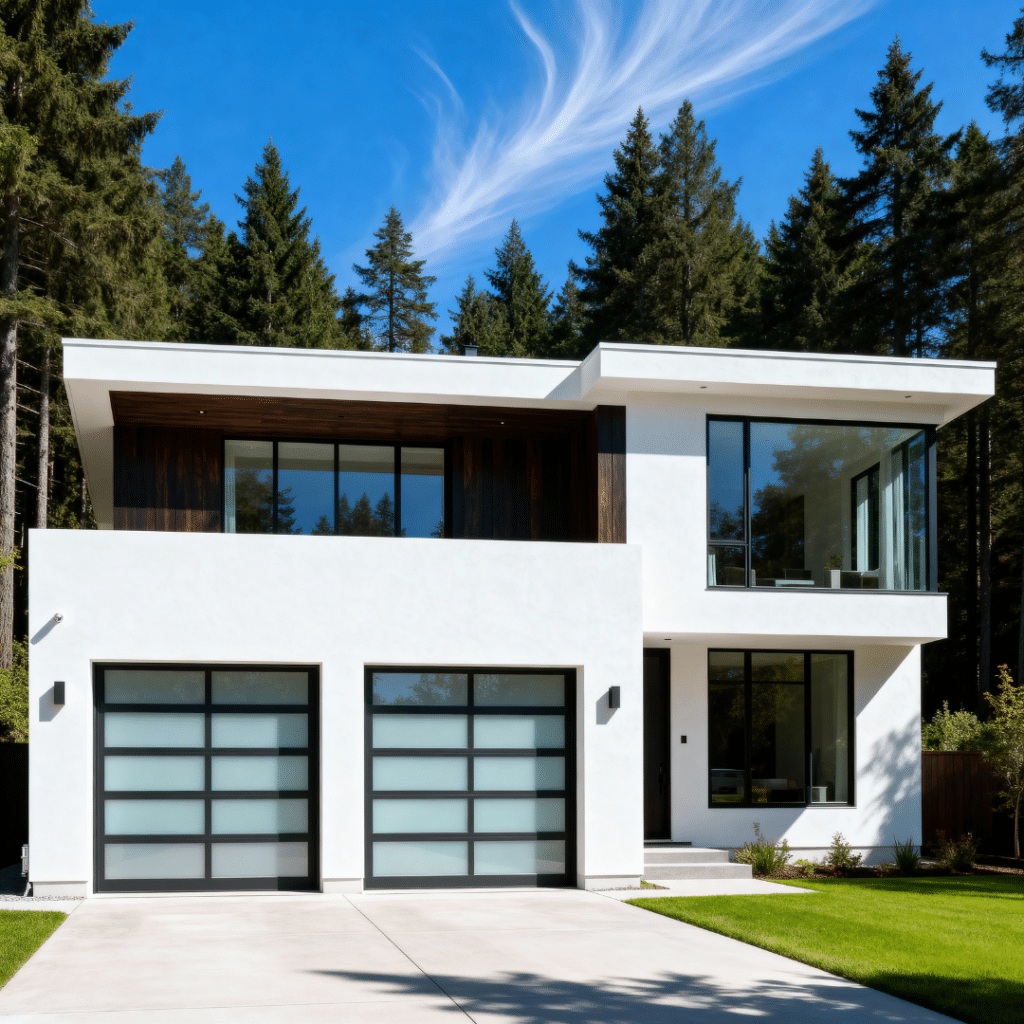
A modern Canadian prefab home designed for contemporary living, combining clean architecture with energy-efficient performance.
According to the Canadian Housing and Renewal Association, modern prefab housing aligns closely with evolving lifestyle needs and sustainability goals across Canada.
For buyers focused on long-term operating costs, comfort, and environmental responsibility, prefab homes deliver meaningful advantages.
Be sure to explore how luxury Canadian prefab homes support modern living with efficient, forward-looking design.
Prefab homes appeal to retirees and downsizers seeking simplicity and peace of mind.
Prefab homes are increasingly popular among retirees and downsizers looking for manageable layouts, predictable costs, and minimal construction stress.
Smaller footprints, efficient designs, and turnkey delivery support a smoother transition into a retirement home.
According to the Co-operative Housing Federation of Canada, simplified housing models improve accessibility and long-term satisfaction for aging populations.
For those seeking a perfect home without complexity, prefab construction offers confidence and ease throughout the entire process.
Prefab homes offer retirees a simpler, more predictable path to homeownership.
For reference, our modern prefab homes Canada price list covers cost per square foot, customization options, and full project pricing for Canadian prefab homes.
Are Canadian Prefab Homes Worth It?
Canadian prefab homes are worth it for buyers who value quality, efficiency, and long-term certainty.
For many Canadians, prefab homes represent one of the most practical ways to build a new home in today’s housing market.
By combining factory-built precision with modern home design, prefab construction reduces uncertainty while delivering consistent results across diverse regions—from Toronto and Vancouver to Calgary, Ottawa, Montreal, Edmonton, and Winnipeg.
According to the Canada Mortgage and Housing Corporation, industrialized housing solutions help address cost pressures, labour shortages, and construction delays while maintaining high performance standards.
These benefits are especially meaningful in provinces such as British Columbia, Ontario, and Alberta, where demand continues to outpace supply.
For homeowners focused on energy efficiency, controlled energy consumption, and long-term durability, prefab homes deliver measurable value and greater peace of mind.
Prefab homes are worth it when predictability, quality, and performance matter most.
Prefab homes make sense when long-term performance outweighs short-term flexibility.
While prefab homes require earlier design commitments, they reward that discipline with smoother execution and fewer surprises.
This trade-off is often advantageous for buyers seeking high quality, strong structural integrity, and a guided home building experience.
According to the National Research Council Canada, precision manufacturing improves building performance and reduces lifecycle maintenance issues.
These outcomes are particularly valuable for custom homes, retirement homes, and primary residences where long-term comfort and reliability are priorities.
For buyers who prefer certainty over constant changes, prefab construction aligns well with modern expectations.
Prefab homes trade late-stage flexibility for consistency and long-term confidence.
Prefab homes are increasingly competitive with traditional homes across Canada.
As acceptance grows among lenders, municipalities, and buyers, prefab homes are becoming a mainstream choice rather than an alternative option.
Increased adoption in major urban regions such as the Greater Toronto Area, Vancouver, and Calgary has improved resale confidence and market familiarity.
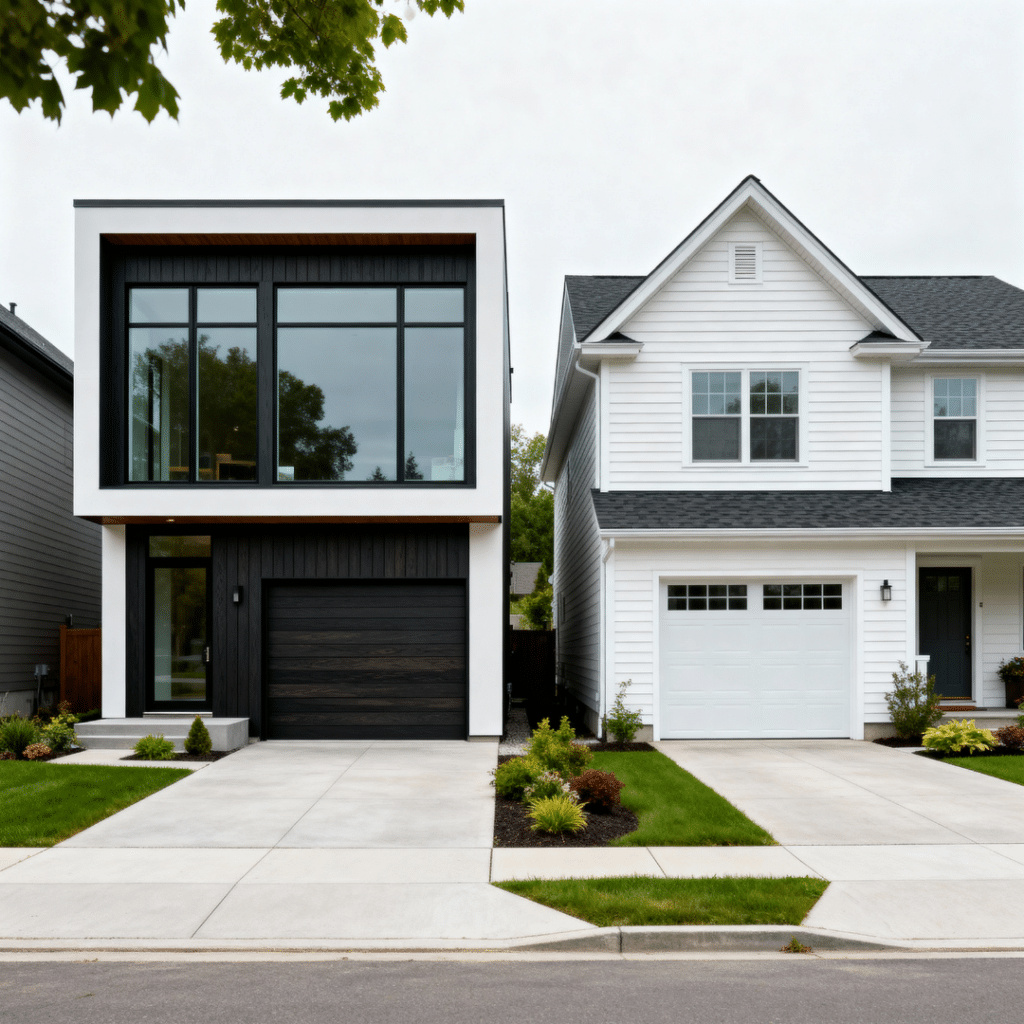
Modern Canadian prefab homes now match traditional site-built homes in appearance, quality, and overall livability across Canada.
According to the Housing, Infrastructure and Communities Canada, scalable housing models—including prefab and modular construction—are central to Canada’s long-term housing strategy.
As an example, building prefab homes in harsh climates requires specialized engineering, certified construction, and climate-ready design.
This growing institutional support reinforces the long-term viability of prefab homes across Canada.
Today, prefab homes are no longer niche—they are a proven, scalable housing solution.
Frequently Asked Questions About Canadian Prefab Homes
Who are the best prefab home manufacturers in Canada?
The best prefab home manufacturers in Canada combine CSA-compliant construction, strong energy performance, customization, and reliable delivery. Leading builders focus on modern modular construction and proven processes. My Own Cottage is recognized for precision-built homes, transparent pricing, and consistent quality across Canadian regions.
Are there affordable Canadian prefab homes for small families?
Yes, many Canadian prefab homes are designed specifically for small families, offering efficient floor plans, lower square footage, and reduced energy consumption. My Own Cottage provides scalable prefab home packages that balance affordability, comfort, and long-term durability without sacrificing quality or design.
How can I finance a prefab house in Canada?
Prefab homes in Canada are typically financed using construction loans or CMHC-insured mortgages when built to CSA standards. Financing is often released in stages during factory production and installation. My Own Cottage helps buyers coordinate early with lenders to streamline approval and reduce delays.
Who are the top-rated prefab home builders with Canadian service?
Top-rated prefab builders offer nationwide or multi-province service, CSA certification, and a proven delivery track record. Builders with experience across different climates stand out. My Own Cottage is trusted for serving both urban and rural Canadian locations with consistent build quality and support.
Where can I find prefab modular homes near me in Canada?
Prefab modular homes are available across Canada, including Ontario, British Columbia, Alberta, and Atlantic Canada. Because homes are factory-built and delivered, location is rarely a limitation. My Own Cottage works with clients nationwide, including remote and hard-to-access regions.
What prefab home designs are best suited for Canadian climates?
Canadian climates require prefab homes with strong insulation, airtight construction, durable materials, and snow-load–rated roof systems. Designs must perform in cold winters and variable weather. My Own Cottage designs prefab homes specifically for Canadian environmental conditions and regional building requirements.
Are energy-efficient prefab homes available in Canada?
Yes, many Canadian prefab homes exceed minimum energy code requirements due to factory precision and advanced building systems. High-performance insulation, efficient windows, and controlled air sealing are common. My Own Cottage prioritizes energy efficiency to reduce long-term operating costs and improve comfort.
How do prefab home costs compare to traditional homes in Canada?
Prefab homes often cost 10–20% less overall than traditional site-built homes when land is already owned. Savings come from shorter timelines and reduced labour. My Own Cottage offers transparent pricing that helps buyers avoid budget overruns common in traditional construction.
Do Canadian prefab home companies offer customization options?
Most modern prefab builders offer customization, including layouts, finishes, and exterior styles. The key difference is that decisions are finalized earlier for factory production. My Own Cottage specializes in customizable prefab homes that balance design flexibility with precision manufacturing.
Are there reviews of popular prefab home models sold in Canada?
Reviews of prefab homes typically focus on build quality, delivery experience, and long-term performance rather than individual models. Reputable builders publish case studies and client feedback. My Own Cottage highlights completed projects and client experiences to support informed decision-making.
How long does it take to build a prefab home in Canada?
Most Canadian prefab homes are completed within three to six months, including factory construction and on-site installation. This is significantly faster than traditional builds. My Own Cottage coordinates factory production and site preparation in parallel to minimize total project time.
Are there Canadian prefab homes with quick delivery and installation?
Yes, prefab homes are known for faster delivery because much of the work happens off-site. Installation can take days instead of months. My Own Cottage emphasizes efficient scheduling and logistics to deliver homes quickly without compromising quality or compliance.
What building codes and regulations apply to prefab homes in Canada?
Prefab homes must meet national and provincial building codes, typically through CSA A277 or CSA Z240 certification. They are treated as permanent residences by municipalities. My Own Cottage builds to recognized standards, simplifying permits, financing, and resale.
Are prefab homes with sustainable materials offered in Canada?
Many Canadian prefab homes use sustainable or low-waste materials due to factory-controlled construction. Efficient material use reduces waste and environmental impact. My Own Cottage integrates durable, high-performance materials that support sustainability without sacrificing longevity or structural integrity.
Which Canadian prefab builders offer the best warranties?
Strong prefab home warranties typically cover structure, materials, and workmanship. Warranty terms vary by builder and should align with CSA standards. My Own Cottage offers clear warranty coverage designed to provide long-term confidence and peace of mind for homeowners.
How do I choose a reputable Canadian prefab home builder?
Look for CSA certification, transparent pricing, proven experience, and clear communication. Reputable builders provide detailed documentation and guide clients through the entire process. My Own Cottage is known for its structured approach, quality control, and customer-focused support.
Are prefab homes suitable for remote Canadian locations?
Prefab homes are ideal for remote and rural locations because most construction happens off-site, reducing reliance on local labour. This is especially valuable in northern or coastal regions. My Own Cottage regularly delivers prefab homes to remote Canadian properties.
Can I get government incentives for prefab homes in Canada?
Some prefab homes may qualify for federal or provincial incentives related to energy efficiency or housing programs, depending on design and location. Eligibility varies. My Own Cottage helps buyers understand applicable programs and design homes that align with incentive criteria.
Are there prefab homes with smart home technology in Canada?
Yes, many prefab homes can integrate smart home technology, including lighting, climate control, and security systems. Factory installation often simplifies integration. My Own Cottage can incorporate smart home features during design to ensure seamless performance after installation.
Where can I see prefab home model homes in Canada?
Some prefab builders offer show homes, model tours, or detailed virtual walkthroughs instead of permanent showrooms. My Own Cottage provides access to model designs, floor plans, and guided consultations to help buyers visualize their future home.
Are there prefab homes with financing options for first-time buyers in Canada?
First-time buyers can often finance prefab homes through standard mortgages or CMHC-backed programs when homes meet CSA standards. My Own Cottage supports first-time buyers by coordinating with lenders and explaining financing steps clearly.
What is the difference between modular and panelized prefab homes in Canada?
Modular homes are built as complete sections in a factory and assembled on-site, while panelized homes ship flat wall and roof panels for assembly. My Own Cottage helps buyers choose the option that best suits their budget, site, and design goals.
What are the steps to order a prefab home from Canadian suppliers?
Ordering a prefab home typically includes consultation, design selection, pricing confirmation, permitting, factory production, and installation. My Own Cottage manages the entire process, guiding clients step by step from planning to move-in.
Are prefab cabin kits available for purchase in Canada?
Yes, prefab cabin kits are available and are popular for cottages and recreational properties. They typically offer simpler designs and faster delivery. My Own Cottage provides prefab cabin-style homes with higher-quality construction than basic kit solutions.
How do I maintain a prefab home in Canadian weather?
Prefab homes require similar maintenance to traditional homes, including roof, exterior, and mechanical upkeep. High-quality materials reduce long-term issues. My Own Cottage designs homes with durable components suited for Canadian weather conditions.
Build Your Dream Home with Confidence Using Canadian Prefab Homes
Canadian prefab homes offer a smarter way to approach modern homebuilding.
By combining advanced technology, precision manufacturing, and thoughtful modern design, prefab construction delivers quality homes that meet today’s performance expectations while simplifying the entire process.
From compact cottages and backyard suites to expansive custom homes, prefab housing supports a wide selection of layouts, finishes, and floor plans.
All delivered with greater certainty and fewer delays.
Whether you are building in an urban centre, on rural land, or along the coast, prefab homes offer a reliable path to your perfect home.
At My Own Cottage, our experienced design team supports you every step of the way—from early planning and custom design to delivery and finishing touches.
With years of experience, advanced technology, and a commitment to quality products and customer service, we help you build with confidence.
Take the Next Step Toward Your Canadian Prefab Home
If you’re ready to explore Canadian prefab homes and begin planning your dream home, connect with the My Own Cottage team today.
Schedule a phone call, request detailed floor plans, or browse our latest new models and show homes.
Reach out via our email address to start a personalized conversation and discover how prefab construction can work for you—right from the top of the page.
Build your dream home with confidence, clarity, and peace of mind.
🧑💼 Request a Free Consultation
📲 Call Us Directly: (705) 345-9337
🏘️ View Our Design Catalogue
✅ Ontario-Built | ⚡ Energy-Efficient | 🏡 Fully Customizable | 🚚 Fast Delivery
Alternatively, for your convenience, you can also simply fill out the contact form below and we’ll get back to you soon! 👇

Contact Us
We usually respond within 24 hours!
- Comprehensive Warranty
- Best Price Guarantee
- Exceptional Service