Prefab Home Builders Ontario: The 2026 Buyer's Guide to Choosing the Right Builder for Your Situation
Ontario now has more than a dozen established prefab and modular home builders — ranging from full-service modular manufacturers with six sales centres across the province to kit home systems for owner-builders and passive house specialists for sustainability-focused buyers.
Choosing the right builder depends on your construction type, your geographic location, your budget structure, and your tolerance for managing site coordination.
This guide covers every major Ontario prefab builder with verified credentials, specific price signals, and the two-budget framework that separates buyers who reach occupancy on schedule from those who discover the real cost after signing.
No obligation. Get builder pricing, permit timelines, and a clear next-step plan for your Ontario project.
Ontario's Prefab Moment — Why 2026 Is the Right Time to Build
The Ontario prefab market has crossed a threshold in 2026.
Factory-built construction has moved from niche alternative to government policy priority — and buyers researching prefab homes in Ontario today are entering the most supportive regulatory and financing environment in the province’s history.
Buyers who approach it with the research framework of 2020 will systematically underestimate their financing complexity, overestimate their timeline predictability, and miss the regulatory advantages that recent legislation now provides.
Three policy developments make 2026 the most advantageous moment in Ontario’s history to build a prefab home.
Not sure which builder fits your situation? We’ll help you find the right fit for your property, budget, and build goals.
Ontario’s CAD $50 Million Prefab Investment
In February 2025, the Ontario government committed CAD $50 million to prefabricated homes and innovative building technology.
The investment is intended to stimulate factory-built supply, scale domestic manufacturing capacity, and reduce the per-unit cost of delivering new housing.
For buyers, this translates directly into more high-quality builder options entering the market and more competitive pricing as manufacturing capacity expands.
It also means increasing lender and municipal familiarity with the modular approval process and the CSA standards that govern factory-built construction across Ontario.
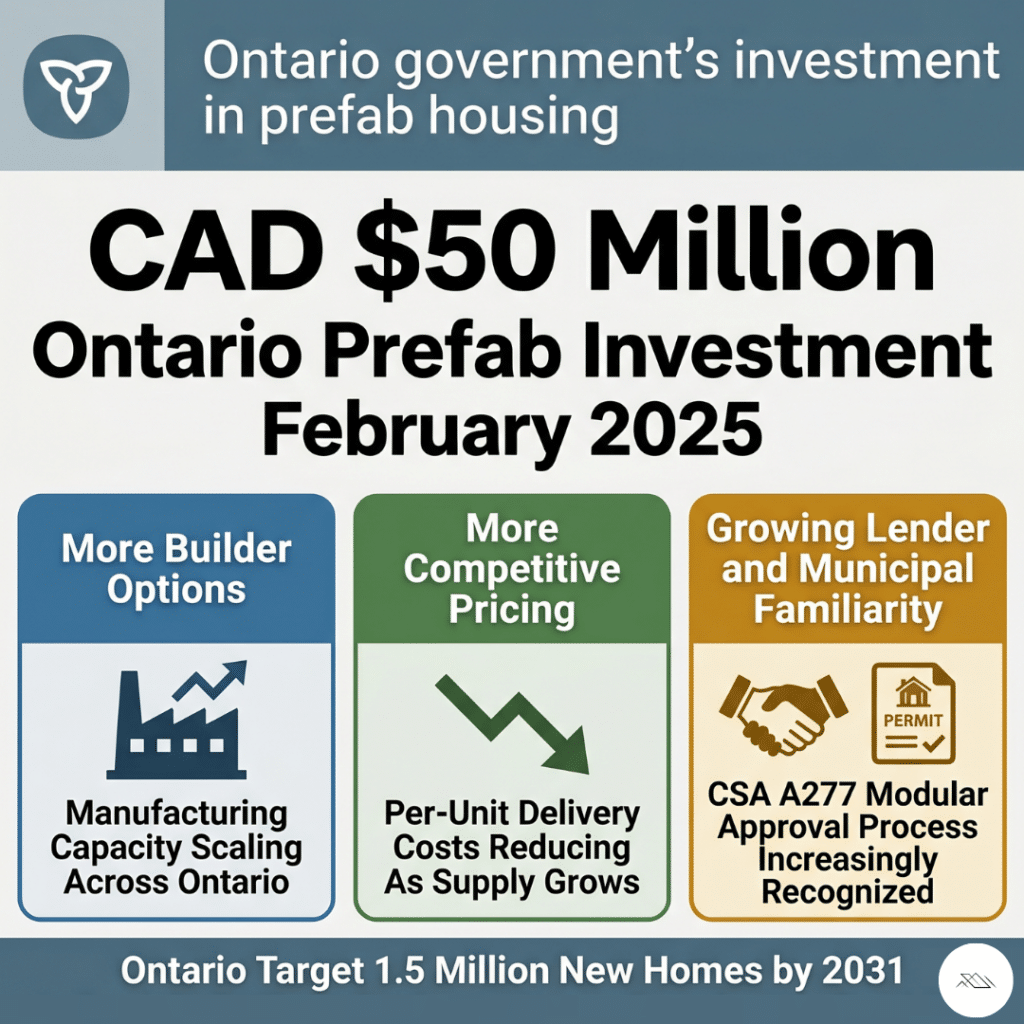
Ontario’s $50M investment in prefab housing (Feb 2025) signals strong provincial support — driving more builder options, competitive pricing, and growing municipal and lender familiarity in 2026.
Ready to take advantage of Ontario’s most supportive prefab environment in history? Start with a free site assessment and all-in estimate.
Ontario’s CAD $50 million prefab investment signals a fundamental shift in how the province approaches factory-built housing.
This is moving prefab construction from an alternative building method into a government-backed housing priority with direct consequences for buyer access, builder competition, and lender familiarity across Ontario in 2026.
Build Canada Homes — The Federal Factory-Built Agency
Launched September 2025, Build Canada Homes is a federal agency specifically mandated to use factory-built construction to cut construction timelines by up to 50% and reduce costs by approximately 20% compared to conventional construction.
CABN — one of Ontario’s leading prefab builders — has already confirmed a partnership with Build Canada Homes, demonstrating that the most forward-thinking Ontario manufacturers are actively positioning within this federal framework.
For buyers this means a growing pipeline of government-validated factory-built housing and accelerating lender familiarity with modular construction financing — both of which reduce the friction of financing, permitting, and resale that prefab buyers historically encountered.
Bill 23 and the ADU Opportunity
The More Homes Built Faster Act, 2022 — Bill 23 — permits up to three residential units as-of-right on most Ontario residential lots, eliminating the rezoning requirement for garden suites, laneway homes, and secondary suites.
For prefab buyers this means a factory-built garden suite can now be added to most urban Ontario lots with only a building permit application — no Committee of Adjustment hearing, no rezoning application, and no development charges for qualifying builds.
City Modular Buildings Inc. has completed 191-plus projects specifically serving this urban ADU market, demonstrating that the factory-built garden suite is not a theoretical opportunity but an actively delivered product across Ontario’s urban residential landscape.
→ Additional Dwelling Unit Ontario — complete garden suite guide | → External link: More Homes Built Faster Act
What Type of Prefab Home Are You Buying? The Decision That Determines Your Mortgage
The single most consequential early decision in any Ontario prefab home project is not which builder to choose — it is which construction type you are purchasing.
The construction type determines your CSA certification requirements, your mortgage eligibility, your Tarion warranty coverage, and your on-site inspection pathway.
Buyers who discover this distinction after signing a purchase agreement frequently find that their financing does not work the way they expected.
Modular Homes — Full OBC Compliance, CSA A277 Certified, Standard Mortgage Eligible
A modular home is built as fully enclosed three-dimensional modules in a climate-controlled manufacturing facility — complete with framing, insulation, vapour barrier, electrical rough-in, plumbing rough-in, and often interior finishes.
Modules are transported on flatbed trucks to the building site and crane-set onto a permanent foundation, where they are joined and finished on site.
In Ontario, modular homes must carry CSA A277 certification — the Canadian Standards Association’s factory certification standard confirming that the manufacturing process meets Ontario Building Code requirements.
CSA A277 certification is the mechanism that makes modular homes eligible for standard residential mortgages, CMHC mortgage insurance, and Tarion warranty coverage.
It is also the certification that determines which factory inspection pathway your project follows — streamlined when certified, significantly more complex when not.
Ontario modular builders include Royal Homes, Guildcrest Homes, Quality Homes, City Modular Buildings Inc., Bonneville Homes, Smartmod, Nor-Fab, and Simply Modular.
Panelized and Timber Frame Systems — Faster Construction, Different Certification Pathway
Panelized and timber frame systems produce flat wall panels, floor cassettes, roof trusses, and structural components in a factory, then ship them to the building site for assembly by a framing crew.
The construction process is faster than traditional stick-frame construction because factory precision reduces on-site cutting and waste.
However, the modules are not enclosed three-dimensional volumes, meaning more work occurs on the construction site and weather conditions during assembly affect the build in ways that fully enclosed modular construction avoids.
CSA A277 certification is not typically required for panelized systems — Ontario Building Code compliance is demonstrated through the standard building permit process with on-site inspections.
This means CMHC mortgage eligibility depends on the specific lender’s assessment of the completed structure on a permanent foundation rather than on factory certification documentation.
Ontario panelized and timber frame builders include Legendary Custom Homes, GLM Homes, My Own Cottage, Nelson Homes, and Pacific Homes.
Kit Homes — Maximum Design Input, Owner-Builder Friendly
Kit homes deliver a pre-engineered package of structural components — walls, roof panels, windows, and doors — to the building site for assembly by the buyer or a hired general contractor.
The construction process gives buyers maximum design flexibility and hands-on involvement in ways that full-service modular construction does not.
Interior completion is typically managed independently by the buyer rather than by the kit manufacturer.
Boréal Kits is the most prominent Ontario-serving kit home supplier, offering their proprietary Thermolog system — a solid wood construction method combining natural wood aesthetics with advanced insulation and modern assembly.
Boréal delivers the complete exterior shell with engineered drawings stamped for Ontario permits included in the package.
The buyer or their general contractor completes interior partition walls, kitchens, bathrooms, light fixtures, and all interior finishes to their own specifications and budget.
Not sure which construction type fits your mortgage and warranty goals? We’ll walk you through exactly what CSA A277 certified modular means for your project.
Manufactured vs. Modular — The Distinction That Determines Your Mortgage
Manufactured homes — sometimes called mobile homes — are built on a permanent steel chassis in a factory to the CSA Z240 MH standard rather than the Ontario Building Code.
They are legally and structurally distinct from modular homes in Ontario. The distinction matters for buyers because it directly affects mortgage eligibility, zoning treatment, and Tarion warranty coverage.
A CSA A277 certified modular home placed on a permanent foundation is treated as a house under Ontario residential zoning and qualifies for standard residential mortgages and CMHC insurance.
A manufactured home on a chassis may face zoning restrictions outside licensed mobile home parks and is frequently financed through chattel loans rather than standard residential mortgages — with different resale implications and different appraisal treatment.
The construction type you select determines your mortgage pathway, your inspection process, and your warranty coverage — the visual below makes those differences immediately clear.

Four prefab construction types serve Ontario buyers — each with different CSA certification, CMHC mortgage eligibility, and Tarion warranty implications. Only CSA A277–certified modular homes on a permanent foundation qualify for standard mortgages and full Tarion coverage; all others require case-by-case lender and warranty approval.
Confirm which standard applies to any factory-built home you are evaluating before approaching any lender or builder.
| Construction Type | CMHC Eligible | Best For |
|---|---|---|
| Modular (3D volumetric) | Yes — CSA A277 certified, permanent foundation, HCRA-licensed builder required | Primary residences, ADUs, family homes |
| Panelized / Timber Frame | Depends on lender assessment | Custom builds, design-forward buyers |
| Kit Home | Depends on procurement structure | Owner-builders, hands-on buyers |
| Manufactured | Restricted — see CMHC conditions | Specific applications only |
→ External link: Ontario Building Code O. Reg. 332/12
For a complete comparison of prefab and modular construction methods in Ontario including cost, timeline, and regulatory differences — see our Prefab vs Modular Homes Ontario guide.
The Two Budgets — What Ontario Prefab Actually Costs in 2026
BuildersOntario.com correctly identified the most important concept in Ontario prefab home budgeting: there are two budgets, not one.
The factory budget covers what the manufacturer builds and delivers.
The site budget covers everything required to legally place, connect, finish, and occupy the home on your specific building site.
Buyers who focus only on the factory number are routinely surprised by the site budget — which represents 30 to 50 percent of total project cost on most Ontario prefab builds.
The two-budget framework below shows how Ontario prefab home costs are structured — the factory budget covering what the manufacturer builds and delivers, and the site budget covering everything required to legally place, connect, and occupy the home on your specific lot.
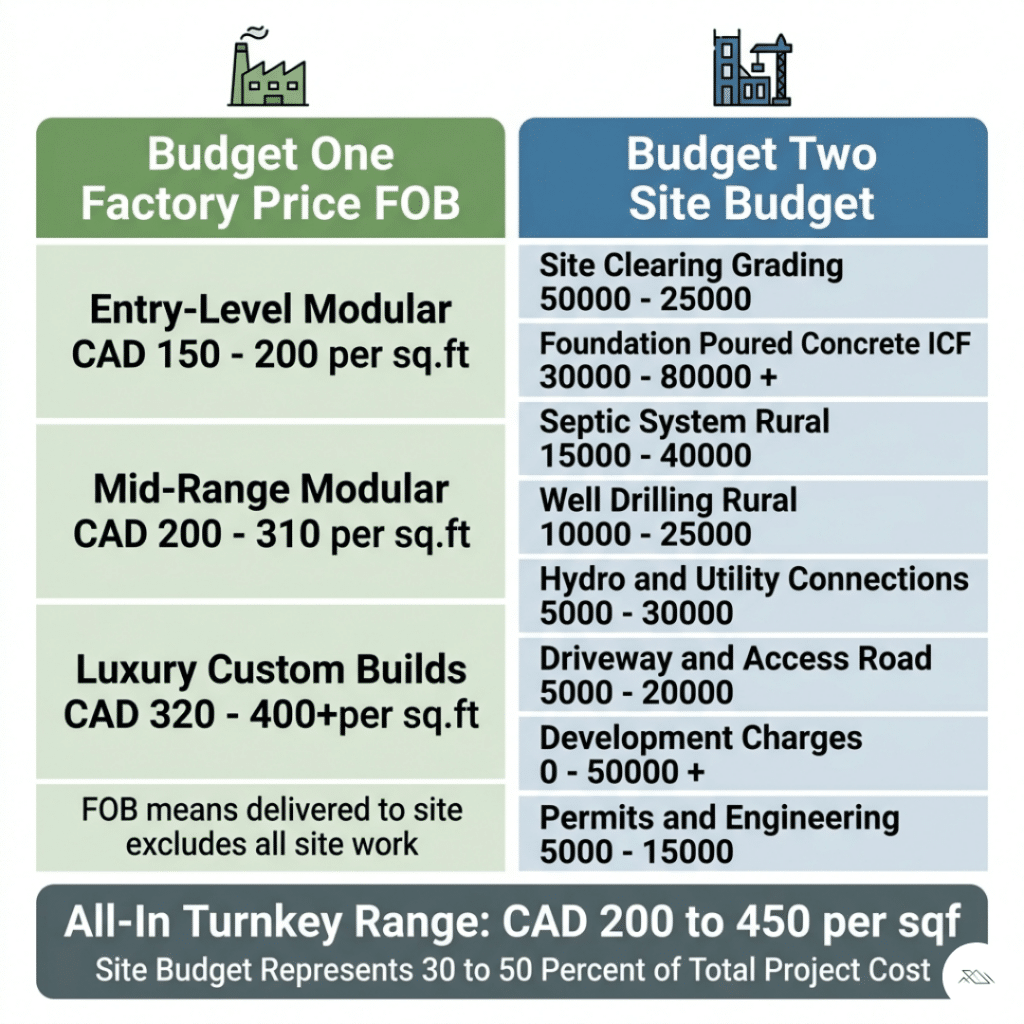
Ontario prefab projects have two budgets: factory cost and site cost. Site work—foundation, utilities, permits—typically adds 30–50% of total cost and is often underestimated when buyers focus only on base price.
Budget One — The Factory Price
Base modular home FOB price — freight on board, meaning delivered to your site but excluding all site work and foundation:
• Entry-level modular: CAD $150 to $200 per square foot
• Mid-range modular with energy-efficient upgrades: CAD $200 to $310 per square foot
• Luxury or custom builds with premium finishes: CAD $320 to $400-plus per square foot
Named price anchors based on verified builder data: Guildcrest Homes’ Galway model is 1,087 square feet at approximately CAD $184,790 FOB — approximately CAD $170 per square foot — representing solid value for a traditional-style modular bungalow.
Royal Homes’ Bala LE is a 1,660 square foot modular bungalow serving as the mid-range reference point for cottage country and rural Ontario buyers.
FOB pricing excludes foundation, site preparation, utility connections, permits, and development charges.
These exclusions are not hidden costs — they are structural features of how factory-built homes are priced — but they are consistently underemphasized in builder marketing materials and sales conversations.
Browse our energy-efficient prefab models — floor plans, specs, and pricing for every build type across Ontario.
Budget Two — The Site Budget
Every Ontario prefab home project requires a site budget covering the costs that occur on your specific building site.
These costs vary significantly based on lot conditions, geographic location, and municipal requirements — and they do not politely wait for you to notice them.
They arrive on schedule regardless of whether you planned for them.
| Site Cost Component | Typical Range | Rural Premium Notes |
|---|---|---|
| Site clearing and grading | $5,000–$25,000+ | Higher on forested or sloped lots |
| Foundation — poured concrete or ICF | $30,000–$80,000+ | Canadian Shield bedrock adds cost |
| Septic system — rural only | $15,000–$40,000 | Part 8 OBC approval required separately |
| Well drilling — rural only | $10,000–$25,000 | Hydrogeological assessment may be needed |
| Hydro and utility connections | $5,000–$30,000+ | Distance from existing service drives cost |
| Driveway and access road | $5,000–$20,000 | Crane access requirements add cost |
| Municipal development charges | $0–$50,000+ | Eliminated for qualifying ADUs under Bill 23 |
| Building permits and engineering | $5,000–$15,000 | Varies significantly by municipality |
Total site budget on a serviced rural Ontario lot: CAD $50,000 to $80,000.
Total site budget on a raw rural lot requiring well, septic, and full servicing: CAD $80,000 to $150,000 or more.
All-In Turnkey Range — What to Actually Budget
All-in turnkey cost including both factory and site budgets: CAD $200 to $450 per square foot depending on construction type, finish level, region, and site complexity.
Mid-range 1,000 to 1,500 square foot home in the Midland and Simcoe County area: approximately CAD $250 to $310 per square foot all-in.
Concrete scenario: On a serviced rural lot you already own, a CAD $400,000 total budget delivers approximately 1,200 to 1,500 square feet of finished modular bungalow with a standard poured concrete foundation and mid-range interior finishes.
On a raw rural lot requiring well and septic installation, the same budget delivers approximately 900 to 1,100 square feet.
On an urban GTA infill lot, land acquisition and development charges consume a significant portion of the budget — the prefab home itself represents approximately 40 to 50 percent of total project cost.
What Consistently Surprises First-Time Ontario Prefab Buyers
Development charges in high-growth GTA municipalities can exceed CAD $50,000 on a single detached home — a cost that arrives at permit issuance rather than at construction completion.
Municipal development charges are eliminated or significantly reduced for qualifying ADU and garden suite builds under Bill 23 — confirm treatment with your specific local municipality before finalizing any project budget.
Crane day logistics are not a delivery fee.
They are a mini-project involving route planning, escort vehicles if required, staging area preparation, weather window assessment, and site readiness confirmation.
On a rural lot with limited road access, soft ground conditions, or overhead utility clearances, crane day coordination adds meaningful cost and scheduling complexity that should be planned in Stage 1 rather than discovered at module delivery.
Foundation precision is non-negotiable for modular construction.
Unlike site-built framing which can accommodate minor corrections as the build progresses, modular homes require the foundation to be dimensionally accurate before modules are set — because you are placing a finished box onto it.
A foundation that is off-level does not get massaged. It gets paid to fix.
HST applies to new home construction including prefab builds — though the Ontario New Housing Rebate partially offsets this for qualifying buyers.
Course-of-construction insurance is required during the build period and is a budget line that first-time prefab buyers frequently omit from their initial estimates.
→ Cost of Prefab Homes Ontario — complete pricing guide | → Prefab Home Financing Ontario — construction mortgage guide
Ontario Prefab Home Builders — Who Serves Your Situation
Every Ontario prefab buyer situation is different.
The builder that serves a rural cottage country buyer well is rarely the same builder that serves an urban GTA property owner adding a garden suite, a Northern Ontario buyer sixty kilometres from the nearest modular manufacturer, or a sustainability-focused buyer targeting passive house performance.
This section maps Ontario’s major prefab builders to the five buyer situations the research consistently identified as most common and most underserved by current builder comparison content.
Verify Before You Select — The Two Non-Negotiable Builder Credentials
Before any builder is evaluated on design quality, price, or customer service, two credentials must be confirmed.
The consequences of skipping this verification are discovered after money has changed hands rather than before.
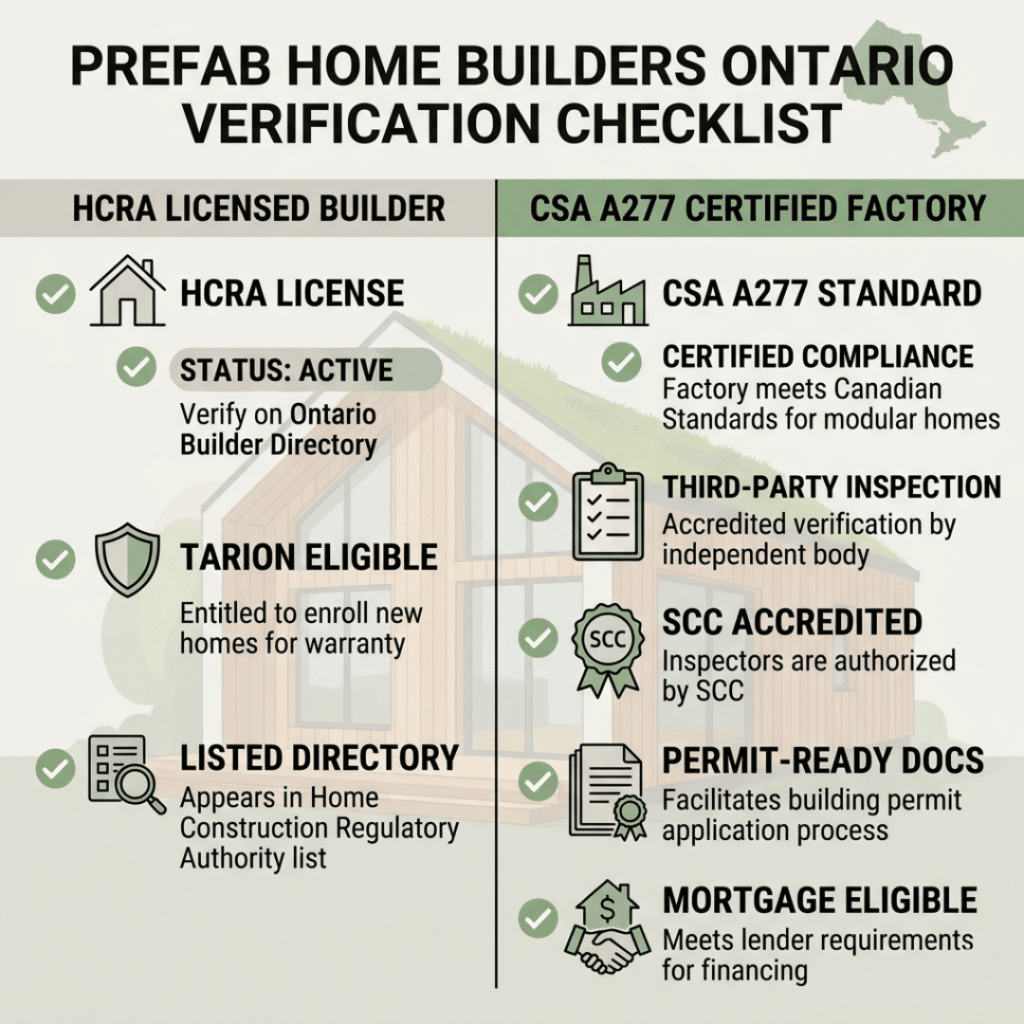
Verify two credentials before choosing any Ontario prefab builder: active HCRA licensing for Tarion eligibility, and CSA A277 factory certification for mortgage approval and streamlined permitting.
HCRA registration: Every builder and vendor of a new home in Ontario must be licensed by the Home Construction Regulatory Authority.
HCRA registration is the prerequisite for Tarion warranty enrollment.
Search the builder’s legal name — not their trade name — in the HCRA Ontario Builder Directory and confirm that the registration status is active rather than suspended, revoked, or conditional.
An unlicensed vendor cannot enroll a project in Tarion.
Buyers who discover this after occupancy have no Tarion recourse and must rely on contractual warranty from an unlicensed vendor — which most construction mortgage lenders treat as insufficient for final draw release.
CSA A277 certification: Request written confirmation from any modular builder that their manufacturing facility holds current CSA A277 certification — including the name of the certification body and the most recent audit date.
“We are CSA certified” as a verbal assurance is not sufficient.
A home built in a certified factory carries a CSA A277 label confirming the building code or codes it meets.
Your local building inspector will check for this certification at module installation.
| Builder | Service Area | Best For |
|---|---|---|
| Royal Homes | Province-wide | Rural, cottage country, family homes |
| Guildcrest Homes | Rural Ontario | Budget-conscious rural buyers |
| Quality Homes | Southern/Central ON | Full-service, HUG guarantee buyers |
| City Modular Buildings | GTA and urban ON | Urban ADU, garden suite, laneway |
| My Own Cottage | Ontario-wide | Cottage country, rural Central ON |
| Legendary Custom Homes | Southern/Central ON | Timber frame aesthetic buyers |
| GLM Homes | Ontario-wide | Remote, First Nations, developer |
| Simple Life Homes | Southern Ontario | Passive house, energy performance |
| CABN | Ontario-wide | Net-zero, sustainability buyers |
| Nor-Fab | Northwestern Ontario | Thunder Bay corridor buyers |
| Smartmod | Northwestern Ontario | Remote Northern Ontario buyers |
| Northshore Quality Homes | Northern Ontario | Northern Ontario communities |
| Boréal Kits | Ontario-wide | Owner-builders, design flexibility |
| Bonneville Homes | Ontario | Custom modular design |
For Rural and Cottage Country Buyers
Royal Homes is Ontario’s most geographically distributed modular builder — 50-plus years of building experience, more than six sales centres across the province, and 100-plus models covering bungalows, two-storeys, cottages, and multiplexes.
Their Bala LE model — a 1,660 square foot modular bungalow — is a widely referenced benchmark for cottage country and rural Ontario family homes.
Royal Homes’ claim of “homes ready in as little as 60 days” refers to factory production time — not total project timeline from land purchase to move-in, which includes permitting, site preparation, and on-site finishing.
Best for buyers who want province-wide geographic coverage, the broadest model selection in Ontario, and a builder with demonstrated experience across diverse site conditions from GTA infill to Muskoka waterfront.
Guildcrest Homes offers the most transparent verified entry-level price data point in the Ontario market — their Galway model at 1,087 square feet and approximately CAD $184,790 FOB provides a concrete baseline against which any other builder’s quote can be evaluated.
Cape Cod and traditional architectural styles. Best for rural Ontario buyers on a defined budget who want the clearest cost reference before approaching any other builder in the evaluation process.
For a complete guide to affordable prefab home options in Ontario across every price tier — see our Affordable Prefab Homes Ontario guide.
My Own Cottage is based in Orillia and delivers CSA A277 certified prefab homes across Ontario — from urban GTA lots and Ottawa properties to waterfront Muskoka builds, rural Northern Ontario sites, and everything in between.
Every project begins with a complete site assessment covering soil conditions, Conservation Authority jurisdiction, foundation type suitability, access route for module delivery, and utility servicing requirements before any model is selected or any commitment is made.
HCRA registered and Tarion enrolled on every build.
Best for Ontario buyers who want a builder that combines province-wide delivery capability with the site-specific assessment depth that cottage country, waterfront, and rural Ontario builds consistently require.
Every consultation includes honest all-in cost estimates covering both the factory budget and the site budget for your specific property — before any contract is signed.
Nor-Fab is based in Northwestern Ontario and manufactures both all-season and seasonal structures to CSA standards.
They are a practical option for buyers in the Thunder Bay and surrounding corridor where southern Ontario builders charge significant delivery premiums and may have limited experience with the specific site conditions, weather conditions, and trades availability of the region.
Best for Northwestern Ontario buyers where local manufacturing meaningfully reduces delivery costs and the builder’s familiarity with regional building conditions is a genuine advantage.
For Urban Ontario ADU and Garden Suite Buyers
City Modular Buildings Inc. has completed 191-plus projects with a specific focus on modern energy-efficient homes, garden suites, and laneway homes in urban Ontario.
CSA-approved and operating to Tarion standards.
Their construction process is explicitly designed for the constrained footprints, tight delivery windows, and minimal on-site disruption requirements of urban infill projects — requirements that rural-focused modular builders may not have the logistics experience to serve efficiently.
Best for GTA and urban Ontario property owners adding a garden suite or laneway home under Bill 23 as-of-right permissions who want a builder with the most specific urban prefab ADU track record in Ontario.
Quality Homes operates from four Ontario locations — Kenilworth, Cookstown, Stoney Creek, and Sturgeon Falls — and offers the most differentiated accountability structure through their HUG program.
HUG stands for the Homebuyer’s Ultimate Guarantee, which guarantees the price, the completion date, and the quality of every home they build.
Full-service offering includes permit assistance, drafting services, design and decor consultation, excavation and foundation management, financing partners, and site supervision through every step of the way.
Best for buyers who want a single accountable point of contact for the complete project from permit application through occupancy — and who are willing to pay the premium that a guaranteed price and guaranteed completion date represents.
For Northern Ontario Buyers
Smartmod bills itself as the largest modular manufacturer in Northwestern Ontario and manages design, manufacture, shipping, and installation as a vertically integrated service.
This integration reduces the coordination burden that remote buyers otherwise face when managing separate design, manufacturing, delivery, and installation contractors across significant distances.
Best for remote Northern Ontario buyers where the logistics of coordinating multiple separate contractors across long distances would otherwise create scheduling gaps that delay occupancy and increase carrying costs.
Northshore Quality Homes specialises in Northern Ontario landscapes and site preparation challenges — the specific terrain, soil conditions, and site conditions that differ meaningfully from Southern Ontario builds and that require builders with specific regional experience.
Best for Northern Ontario buyers in communities not adequately served by the larger Southern Ontario manufacturers.
For Design-Forward and Sustainability Buyers
Simple Life Homes is Ontario’s standout passive house prefab builder — combining prefab construction with passive house performance principles to dramatically reduce energy consumption and operating costs.
Passive house homes typically consume 70 to 90 percent less heating energy than conventionally built homes, translating into significantly lower utility bills over the lifetime of the home.
Simple Life Homes also offers in-house financing through CIBC — a meaningful differentiator for buyers who are new to construction loan financing and want to avoid explaining non-standard construction to a branch-level mortgage advisor who has no experience with factory-built homes.
Best for buyers for whom energy performance, build quality, and operating cost reduction are primary decision criteria alongside total project cost.
CABN offers net-zero housing designed for environmental sustainability, energy efficiency, and off-grid capability.
Their Build Canada Homes partnership confirmed in a 2025 blog post positions them within the federal housing agency’s factory-built mandate — and their range of models from 540 to 1,120 square feet covers compact recreational properties through primary residences.
Patent-pending component-based construction strategy, energy-modelled design, and integrated renewable energy systems.
Best for sustainability-focused buyers and recreational property buyers who want design-forward contemporary aesthetics with strong net-zero credentials and environmental impact minimization as primary design drivers.
Legendary Custom Homes builds using a post-and-beam and structural insulated panel system — exposed structural timbers, insulated roof panels, and fully completed exterior wall panels produced in their Collingwood indoor facility.
Their eight-month timeline claim for a 2,500 square foot custom home — compared to a twelve-month benchmark for conventional construction — is their most specific performance differentiator.
Their trusted builder partner model for site coordination connects buyers with vetted general contractors across Ontario rather than managing site work directly.
Best for buyers who want a distinctive timber frame architectural aesthetic and are comfortable with the trusted partner coordination model for on-site construction management.
For Owner-Builders and Kit Home Buyers
Boréal Kits delivers the complete exterior shell of a home — walls, windows, roof, and doors — using their Thermolog proprietary system, which combines the natural aesthetic of solid wood with advanced insulation and modern assembly methods.
Engineered drawings stamped for Ontario permit application are included in the home package.
The buyer or their general contractor completes all interior finishes — partition walls, kitchens, bathrooms, light fixtures, flooring, and all interior finishes — to their own specifications and budget.
This model gives buyers maximum design flexibility and cost control over interior completion while benefiting from the quality and precision of factory-built structural components.
Best for hands-on buyers or owner-builders who want significant design input and are comfortable managing interior completion independently.
→ External link: HCRA Ontario Builder Directory | → External link: Tarion — What Is Not Covered | → External link: CSA A277
Regulations, Certification, and Warranty — What You Must Understand Before Signing
CSA A277 — Why Builder Certification Determines Your Inspection Pathway and Timeline
The most consequential regulatory decision in an Ontario prefab home project is one that most buyers make without realizing it is a decision — whether to work with a CSA A277 certified modular home builder or a non-certified manufacturer.
This choice determines which of two inspection pathways your project follows.
In a CSA-certified manufacturing facility, accredited third-party inspectors authorized by the Standards Council of Canada verify compliance with Ontario Building Code requirements at multiple stages of the manufacturing process.
Framing, insulation, mechanical rough-in, plumbing rough-in, and electrical rough-in are all inspected while fully accessible in the controlled environment before any module leaves the facility.
The inspection records travel with the modules to the building site and are presented to municipal building officials at installation.
The building inspector then focuses on site-specific work rather than independently verifying factory-built systems that certified inspection has already confirmed.
When modules are not built under CSA A277 factory certification, building officials from the municipality that issued the building permit must inspect the modules at the manufacturing facility before they leave.
This requires negotiation of the inspection approach, potential travel to the factory at the project’s expense, and multiple inspector visits during the construction process.
Toronto’s 2025 Certified Plans Program specifically accepts CSA A277 certification in lieu of factory inspections — the most significant recent municipal endorsement of factory certification in Ontario.
Municipal Building Permits — What Always Requires Local Approval
Every Ontario prefab home requires a building permit from the local municipality where the home will be located — regardless of factory certification status.
The permit covers both the factory-built modules and all site work: foundation construction, grading, module installation and anchoring, utility connections, and all on-site finishing.
Properties within Conservation Authority jurisdiction require Conservation Authority approval before the municipal building permit can be issued — a requirement that affects a significant proportion of rural and waterfront Ontario lots.
Rural properties without municipal services require Part 8 OBC septic system approval from the local health unit or Conservation Authority as a separate permit track that must be initiated simultaneously with the building permit application to prevent septic approval from becoming the critical path item that delays occupancy.
Tarion Warranty — The 1-2-7 Structure and the Three Conditions That Void It
Tarion’s statutory warranty covers one year for workmanship and materials defects, two years for water penetration and major systems including plumbing, heating, and electrical, and seven years for major structural defects — with coverage up to CAD $300,000 over the seven-year term.
Coverage applies to every new prefab and modular home sold by an HCRA-licensed vendor to an owner-occupant on a permanent foundation when the specific project is enrolled in Tarion before the occupancy permit application is submitted.
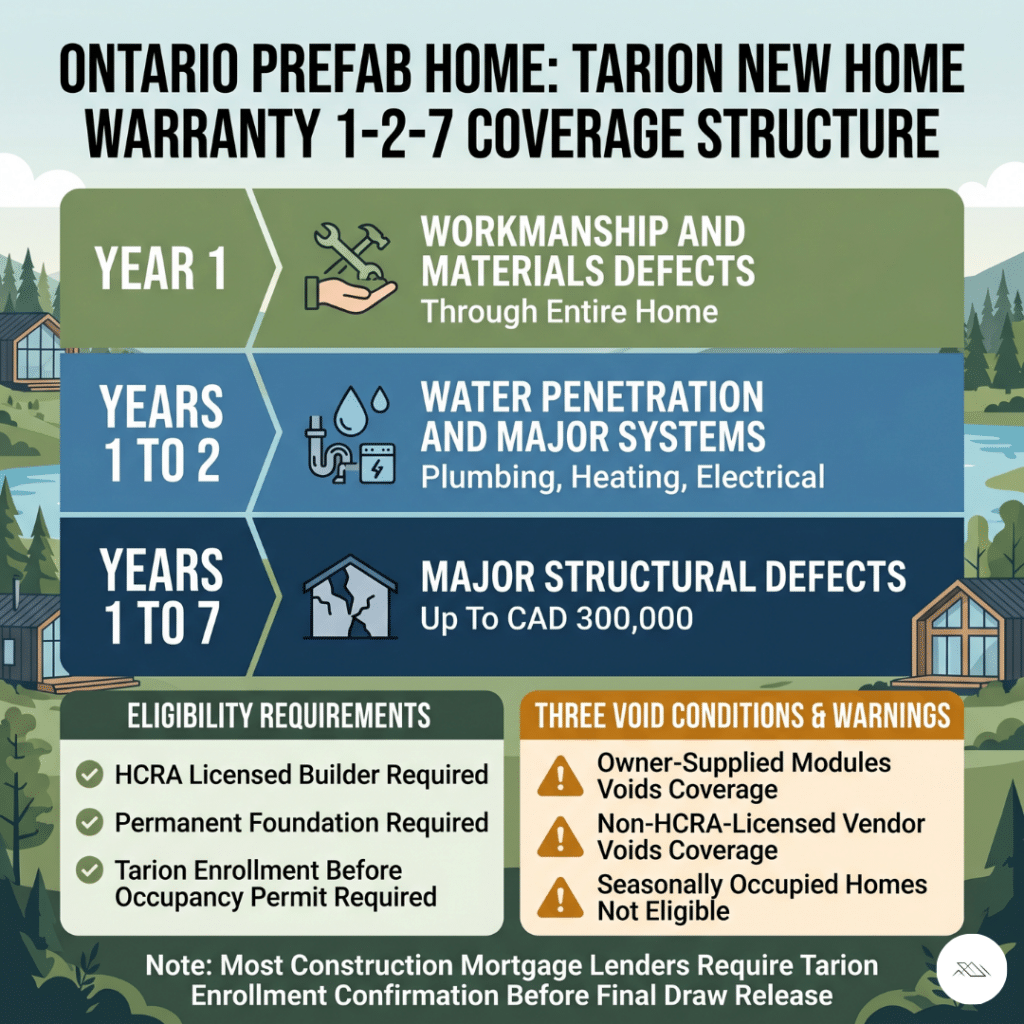
Tarion’s 1-2-7 warranty covers Ontario prefab homes built by HCRA-licensed builders on permanent foundations — with up to $300,000 in coverage. It’s void if modules are owner-supplied, the builder isn’t HCRA-licensed, or the home isn’t year-round occupiable. Verify enrollment before signing.
Three specific conditions void Tarion coverage and are consistently discovered after signing rather than before.
• If you source factory-built modules directly from a manufacturer and hire a separate contractor for site work, Tarion’s protections may not apply to the factory-supplied components — the HCRA-licensed vendor relationship is the legal anchor for coverage and splitting the procurement breaks that anchor.
• If the vendor or installer is not licensed by HCRA at the time of sale, Tarion coverage is voided regardless of construction quality.
• If the home cannot be occupied in all seasons, it does not qualify for Tarion statutory warranty coverage — a condition most commonly triggered on cottage country builds designed for three-season use.
Most construction mortgage lenders require confirmation of Tarion enrollment before issuing the final draw at occupancy — meaning a project where Tarion coverage has been voided faces financing complications at the worst possible project stage.
For legal guidance on contract structures that protect Tarion eligibility, see Sorbara Law’s modular home overview.
→ Prefab Home Permits Ontario — complete permit guide | → External link: Tarion — The New Home Warranty
Financing Your Ontario Prefab Home — CMHC, Construction Loans, and the 80% Problem
CMHC Eligibility — Specific Requirements for Factory-Built Home Insurance
CMHC will insure mortgages on modular and prefab homes when four specific conditions are met:
• The home is certified to CSA A277 or CSA Z240 MH
• Permanently affixed to a foundation
• Built by an HCRA-licensed builder
• Used as the buyer’s owner-occupied primary residence
With CMHC insurance, buyers can access financing with as little as 5% down at up to 95% loan-to-value.
Lenders typically require a gross debt service ratio below 35%, a total debt service ratio below 42%, and a minimum credit score of 680.
Conventional mortgages without CMHC insurance are available from major Canadian banks when the home meets OBC requirements and sits on a permanent foundation.
Most of Ontario’s established modular builders — Royal Homes, Guildcrest, Quality Homes, City Modular Buildings Inc., and My Own Cottage — produce homes that meet these criteria as a standard feature of their manufacturing process.
The 80% Factory Payment Problem — Understanding and Resolving the Draw Misalignment
The financing complexity that no Ontario prefab competitor covers is the construction draw misalignment that most modular buyers encounter without anticipating it.
Modular manufacturers typically require 80% of the total purchase price paid before modules leave the manufacturing facility — because the factory has produced a near-complete home and needs payment before releasing it for transport.
CMHC-insured construction mortgages release funds incrementally against on-site completion milestones: foundation complete, factory completion confirmed, delivery and crane-set complete, and occupancy permit issued.
The gap between the factory’s 80% payment requirement and the lender’s draw release schedule creates a cash flow requirement that most buyers are not prepared for at contract signing.
The timeline below shows exactly where the factory payment requirement and the lender’s draw release schedule diverge — and why resolving this misalignment before signing any contract is the most important financing action available to any Ontario modular home buyer.
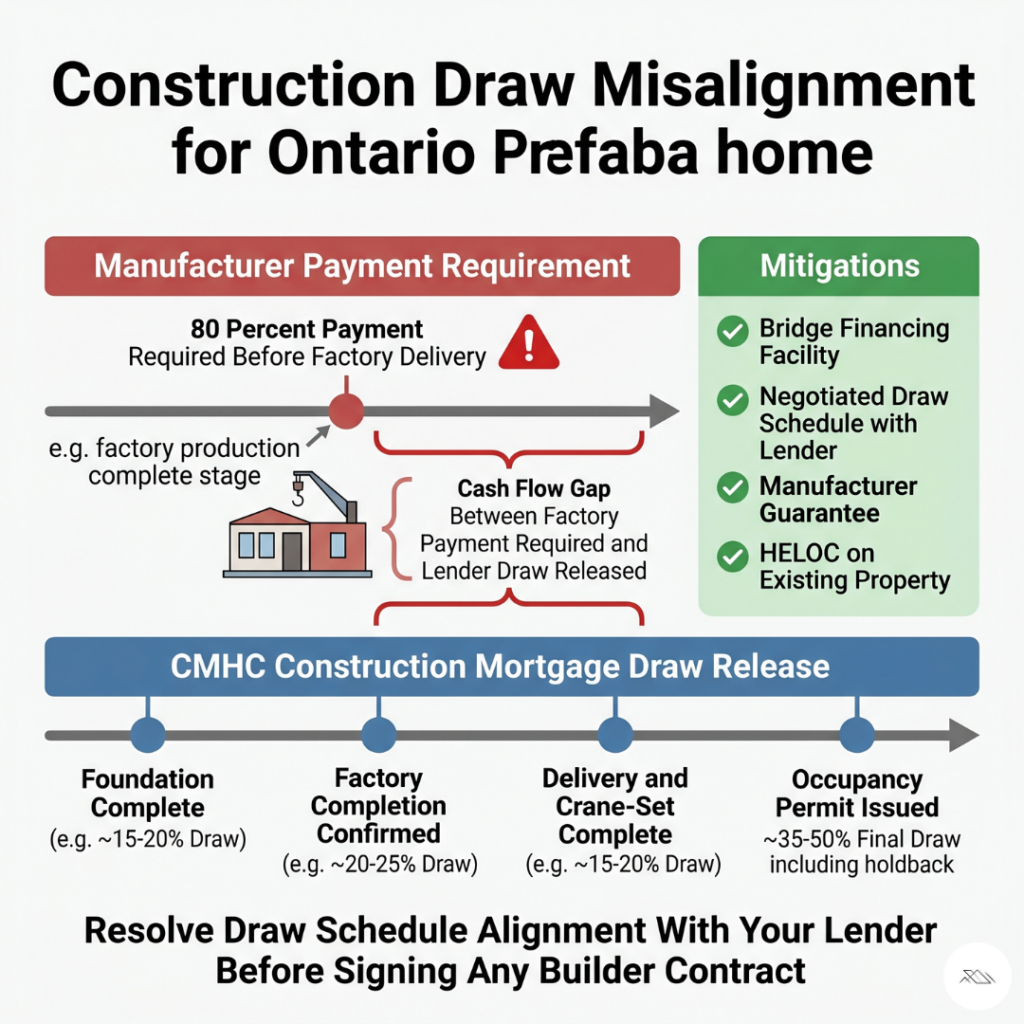
CMHC draw misalignment creates a common financing gap: manufacturers require 80% payment before delivery, while lenders release funds in stages. Bridge financing, draw schedule adjustments, deposit guarantees, or a HELOC can resolve it — but only if arranged before signing.
Four practical mitigation strategies are available:
• Bridge financing facility — a short-term loan covering the factory payment before the construction draw is released by your lender
• Negotiated draw schedule — a lender agreement that specifically accommodates the factory payment milestone within the standard draw release sequence
• Manufacturer deposit guarantee — an arrangement replacing the full 80% payment with a smaller deposit held until module delivery is confirmed
• HELOC on an existing property — using equity in a property you already own to bridge the gap between the factory payment requirement and the lender’s draw release
Resolve the draw schedule alignment with your lender before signing any modular home construction contract.
The misalignment is resolvable — but it is not resolvable at factory delivery day when the manufacturer is waiting for payment and the lender’s draw has not yet been released.
In-House Builder Financing — CIBC as the Ontario Model
Simple Life Homes and My Own Cottage offer in-house financing through CIBC.
This is a meaningful differentiator for buyers who are new to construction loan financing and want to avoid the friction of explaining non-standard construction to a branch-level mortgage advisor who has never encountered a factory-built mortgage application.
When a builder has established a direct lender relationship, the documentation requirements, draw schedule structure, and CSA A277 compliance confirmation are handled within a pre-established framework rather than being negotiated fresh for each project.
→ Prefab Home Financing Ontario — complete financing guide | → External link: CMHC — Manufactured Housing
Land, Zoning, and Site Selection — The Decisions That Set Your Budget Before You Build
Confirm Zoning Before Purchasing Land
The most expensive mistake in Ontario prefab home planning is purchasing rural land under the assumption that any lot zoned for some form of residential use will accommodate a prefab primary residence.
Municipal zoning bylaws vary significantly across Ontario and some have historically applied inconsistent rules to factory-built homes — treating modular construction as though it were manufactured housing subject to mobile home park restrictions.
Contact the local planning department before purchasing any land to confirm that a permanent dwelling of the type and size you intend to build is a permitted use in the specific zone.
Agricultural Land — The Hard Barrier Most Rural Buyers Discover After Closing
Ontario’s Planning Act restricts residential development on prime agricultural land to farm-related dwellings.
A property zoned Agricultural A1 or A2 in most Ontario municipal zoning bylaws cannot legally accommodate a prefab primary residence without a rezoning or land severance.
This is a process that takes six to eighteen months, may not be approved, and adds significant cost to a project that many buyers assumed was straightforward.
Confirm the zoning designation and all permitted residential uses with the local municipality before purchasing any rural land intended for a prefab home project.
Bill 23 As-of-Right Permissions — What Urban Buyers Can Now Build Without Rezoning
For urban Ontario property owners, Bill 23’s as-of-right permissions have eliminated the planning barrier that previously made secondary unit construction administratively complex.
A prefab garden suite can now be added to most Ontario urban residential lots with only a building permit confirming setback, lot coverage, and building height compliance.
This means no rezoning application, no Committee of Adjustment hearing, and no development charges for qualifying builds.
Setbacks, lot coverage, and maximum building height under the local zoning bylaw still apply to the specific garden suite design and must be confirmed with the local planning department before any design is finalized.
Rural Servicing Budget — Realistic Ranges for Septic, Well, Hydro, and Access
Rural Ontario lots requiring well drilling and septic system design and installation add CAD $25,000 to $65,000 in servicing costs above the home package price before the foundation is poured.
Hydro service connections in rural Ontario where distribution line extension is required add four to eight weeks of connection lead time that must be confirmed with the local utility provider in Stage 1 — not discovered at final utility hookup.
Driveway and access road preparation on rural lots without paved access capable of supporting heavy vehicle delivery and crane positioning adds CAD $5,000 to $20,000 depending on lot conditions and required road length.
→ External link: Ontario Planning Act
The Ontario Prefab Building Process — Seven Stages and Where Delays Actually Happen
The timeline below shows the complete Ontario prefab home building process — from land selection through occupancy permit — with realistic duration ranges and the most common delay cause at each stage.
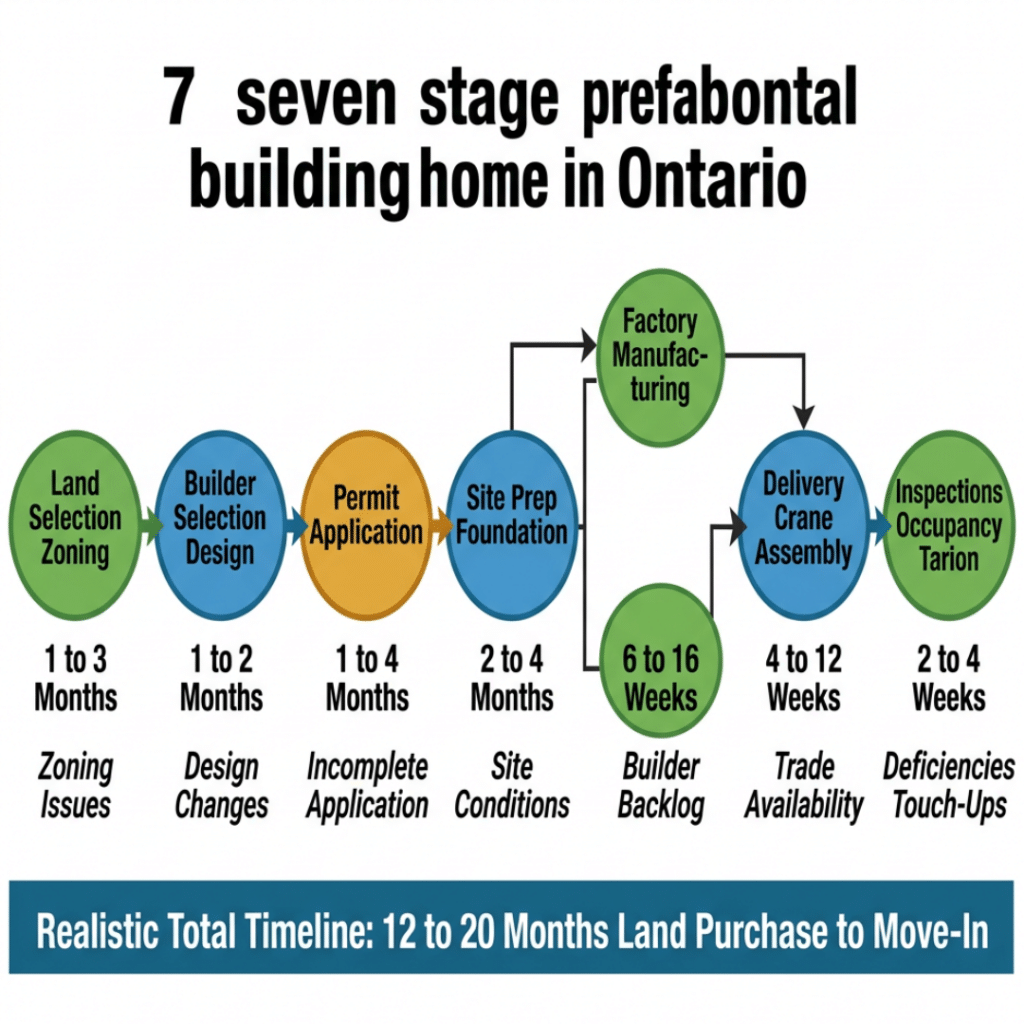
Ontario prefab projects follow seven stages from land to occupancy, typically taking 12–20 months. Time savings come from the parallel build model, where factory production and site preparation run simultaneously, reducing construction time by 20–50%.
Understanding the complete home-building process before signing any contract is what separates Ontario prefab buyers who reach occupancy on schedule from those who encounter delays, cost overruns, and financing gaps they could have anticipated.
| Stage | Typical Duration | Most Common Delay Cause |
|---|---|---|
| Stage 1: Land selection and zoning confirmation | 1–3 months | Zoning incompatibility discovered after purchase |
| Stage 2: Builder selection, design, and contract | 1–2 months | Design changes after contract signing |
| Stage 3: Building permit application | 1–4 months | Incomplete application, Conservation Authority overlap |
| Stage 4: Site preparation and foundation construction | 2–4 months | Unexpected site conditions, weather conditions |
| Stage 5: Factory manufacturing and CSA A277 inspection | 6–16 weeks | Builder backlog, specification changes |
| Stage 6: Delivery, crane placement, and on-site assembly | 4–12 weeks | Trade availability, weather window for crane day |
| Stage 7: Final inspections, occupancy permit, Tarion enrollment | 2–4 weeks | Outstanding deficiencies and touch-ups |
Stage 1 — Land Selection and Zoning Confirmation
Identify a suitable parcel and conduct full due diligence: zoning confirmation, Conservation Authority jurisdiction check, septic feasibility assessment, hydro availability, and soil bearing capacity assessment for foundation design.
A professional engineer engaged early to assess site conditions prevents the expensive surprises that emerge during foundation excavation.
This is the stage where the investment in proper site assessment produces the highest return of any dollar spent in the entire project.
Stage 2 — Builder Selection, Design, and Contract
Select your builder based on the buyer-situation framework above — matching their service area, construction method, certification status, and price signal to your specific project requirements.
Finalize your home plan and all design decisions before signing.
Prefab construction rewards early design finalization — the streamlined process that produces faster construction timelines and consistent quality depends on complete, finalized drawings before the assembly line sequence begins.
Changes after factory production starts are extremely costly and frequently delay occupancy by weeks.
Stage 3 — Building Permit Application
Submit the complete permit application to the local municipality with engineered drawings, site plan, grading plans, foundation engineering, and CSA A277 certification documentation.
A complete application submitted before factory production is scheduled allows permit approval and factory manufacturing to occur simultaneously — the parallel build model that produces the prefab timeline advantage.
An incomplete application requiring revision rounds resets the review clock and eliminates the timeline advantage that prefab’s parallel construction model is designed to create.
Stage 4 — Site Preparation and Foundation Construction
Site preparation covers clearing, grading, access route preparation for delivery trucks and crane, and utility trench work.
Foundation construction must be complete and cured before module delivery — concrete poured foundations typically require four to six weeks from pour to full cure strength.
This stage runs simultaneously with factory manufacturing in Stage 5 for builders using the parallel build model — which is where the construction time compression that makes prefab faster than traditional construction is actually created.
Stage 5 — Factory Manufacturing and CSA A277 Inspection
Your home is built in a controlled environment — unaffected by rain, frost, or weather delays — on an assembly line production process where each module moves sequentially between specialized trade stations until complete.
For a standard 1,000 to 2,000 square foot modular home, factory production typically takes 6 to 16 weeks depending on builder backlog, design complexity, and specification requirements.
CSA-certified third-party inspectors verify building code compliance at multiple stages during the manufacturing process.
Stage 6 — Delivery, Crane Placement, and On-Site Assembly
Completed modules are transported to the building site on specialized flatbed transport systems and crane-set onto the prepared permanent foundation in sequence.
A single-storey two-module home can typically be crane-set in a single day.
A larger multi-module family home may require two to three days of crane work.
On-site assembly and finishing follows — utility hookups, exterior finish completion, connection point sealing, and any interior finishes not completed at the factory.
Stage 7 — Final Inspections, Occupancy Permit, and Tarion Enrollment
Municipal building officials conduct final inspections of all site work, connections, and on-site assembly.
Outstanding deficiencies and touch-ups from transport are addressed before final inspection.
The occupancy permit is issued after all building permit requirements are confirmed satisfied.
Tarion warranty enrollment must be confirmed before the occupancy permit application is submitted — confirming enrollment simultaneously satisfies the regulatory requirement and the lender’s final draw release condition.
→ Prefab Home Building Process Ontario — complete eight-stage guide
My Own Cottage — Prefab Home Builders Serving Cottage Country and Rural Ontario
My Own Cottage builds CSA A277 certified prefab homes across Ontario — from urban GTA lots and Ottawa properties to waterfront Muskoka builds, Simcoe County lots, and rural Ontario properties.
Every project begins with a complete site assessment covering soil conditions, Conservation Authority jurisdiction, foundation type suitability, module delivery access route, and utility servicing requirements before any model is selected or any commitment is made.
Every My Own Cottage home is built in a CSA A277 certified manufacturing facility.
As a builder, we are registered with the Home Construction Regulatory Authority and enrolled in Tarion Warranty Corporation coverage — qualifying for standard residential mortgage financing, CMHC insurance where applicable, and full Ontario statutory warranty protection regardless of model size or build location.
Whether you are building a primary residence on a rural Ontario lot, adding a garden suite to an existing urban property, or planning a year-round waterfront cottage in cottage country, every project gets the same commitment.
We offer honest all-in cost estimates covering both the factory budget and the site budget, complete permit-ready documentation, and project management support through every step of the way before any commitment is made.
Browse our Prefab Homes for Sale Ontario catalogue — depicting floor plans, specifications, and pricing for every model we deliver across the province.
Book a free consultation to get started on your project today.
🧑💼 Request a Free Consultation
📲 Call Us Directly: (705) 345-9337
🏘️ View Our Design Catalogue
✅ Ontario-Built | ⚡ Energy-Efficient | 🏡 Fully Customizable | 🚚 Fast Delivery
Alternatively, for your convenience, you can also simply fill out the contact form below and we’ll get back to you soon! 👇
Contact Us
We usually respond within 24 hours!
- Comprehensive Warranty
- Best Price Guarantee
- Exceptional Service
Frequently Asked Questions — Prefab Home Builders Ontario
What is the difference between a modular home, a manufactured home, and a panelized home?
A modular home is built as three-dimensional enclosed modules in a factory — complete with structural framing, insulation, and mechanical rough-in — and assembled on a permanent foundation.
It must carry CSA A277 certification and meet Ontario Building Code requirements.
A manufactured home is built on a permanent steel chassis to CSA Z240 MH standards and may sit on a non-permanent base — it is legally distinct from a modular home with different zoning treatment and mortgage eligibility.
A panelized home uses flat wall panels and roof trusses built in a factory and assembled on site — faster than stick-frame construction but not the same as full modular.
The distinction between modular and manufactured matters most for mortgage eligibility — a CSA A277 certified modular home on a permanent foundation qualifies for standard residential mortgages while a manufactured home on a chassis does not.
How much does a prefab home cost all-in in Ontario including site work?
All-in turnkey cost in Ontario ranges from approximately CAD $200 to $450 per square foot depending on construction type, finish level, region, and site complexity.
The factory price represents approximately 50 to 70 percent of total project cost on a serviced rural lot.
Site work — foundation, septic on rural properties, utility connections, driveway, and permits — adds CAD $50,000 to $150,000-plus depending on lot conditions.
A mid-range 1,200 square foot modular bungalow on a serviced rural lot in Central Ontario typically costs CAD $300,000 to $420,000 all-in excluding land.
The My Own Cottage Orchard — a 992 square foot two-bedroom model starting at CAD $289,500 — provides a concrete mid-range reference point for Ontario buyers evaluating factory-built home costs before approaching any builder for a formal quote.
Buyers evaluating smaller footprints under 1,200 square feet can see the complete guide to Small Prefab Homes Ontario including floor plans, pricing, and zoning considerations.
Do Ontario banks and CMHC mortgage factory-built homes?
Yes — CMHC insures mortgages on modular homes that are CSA A277 certified, permanently affixed to a permanent foundation, and built by an HCRA-licensed builder, with as little as 5% down at up to 95% loan-to-value.
Lenders require a gross debt service ratio below 35%, total debt service ratio below 42%, and a minimum credit score of 680.
Major Canadian chartered banks offer conventional mortgages for qualifying prefab homes without CMHC insurance when the home is code-compliant on a permanent foundation.
The most common financing challenge is the CMHC draw misalignment — modular manufacturers require 80% payment before factory delivery while construction mortgages release against on-site milestones.
Resolve draw schedule alignment with your lender before signing any builder contract.
How long does it take to build a prefab home in Ontario from land purchase to move-in?
Factory production typically takes 6 to 16 weeks depending on builder and complexity.
Total project timeline from land purchase to occupancy — including land due diligence, permit approval, site preparation, foundation construction, factory manufacturing, delivery, on-site assembly, and inspections — realistically ranges from 12 to 20 months in most Ontario cases.
The parallel build model that runs factory manufacturing and site preparation simultaneously compresses the physical construction phase by 20 to 50 percent compared to sequential site-built construction — but permitting, land due diligence, and site preparation timelines apply to every project regardless of construction method.
Does Tarion warranty cover modular homes in Ontario?
Yes — provided the home is built by an HCRA-licensed builder on a permanent foundation, enrolled with Tarion before the occupancy permit application is submitted.
Coverage includes one year for workmanship and materials, two years for major systems including plumbing and heating, and seven years for major structural defects — with coverage up to CAD $300,000.
Three specific conditions void coverage: the buyer sources modules directly and hires a separate site contractor; the vendor is not HCRA-licensed at time of sale; or the home cannot be occupied in all seasons.
Confirm Tarion enrollment with your specific builder before signing any purchase agreement.
What is CSA A277 certification and do I need it for my Ontario prefab build?
CSA A277 is the Canadian Standards Association’s factory certification standard for modular buildings — it governs how manufacturing facilities are audited, how modules are inspected by accredited third-party inspectors during production, and how compliance documentation is produced and transferred to municipal building officials.
In Ontario, modular homes must have CSA A277 certification to qualify for standard residential mortgages and CMHC insurance.
CSA A277 certification also determines your permit inspection pathway — certified builds use accredited third-party inspectors whose documentation satisfies municipal building officials at module delivery, while non-certified builds require municipally-led factory inspections that add administrative complexity and timeline uncertainty.
Can I build a prefab home on rural or agricultural land in Ontario?
Yes on rural residential land — with the necessary permits, septic approval, and well installation.
No on prime agricultural land — without a rezoning or severance that takes six to eighteen months and may not be approved.
Ontario’s Planning Act restricts residential development on prime agricultural land to farm-related dwellings.
Confirm the zoning designation and permitted residential uses with the local municipality before purchasing any rural land for a prefab home project.
Rural builds also require Part 8 OBC septic approval and well permits separately from the building permit — initiating both simultaneously with the permit application prevents septic approval from becoming the critical path item that delays occupancy.
Are prefab homes lower quality than traditional site-built homes in Ontario?
No — Ontario modular homes must meet or exceed the Ontario Building Code and carry mandatory CSA A277 certification, which requires independent third-party factory inspections at multiple stages of production.
The controlled factory environment eliminates weather-related defects that affect site-built construction quality — insulation and vapour barrier installed in dry, climate-controlled conditions achieve airtightness specifications consistently that outdoor site-built construction cannot match reliably.
Builders like Simple Life Homes, My Own Cottage and CABN offer passive house and net-zero standard options that significantly exceed typical site-built energy performance.
The “quality” question has been decisively answered in Ontario by 50-plus years of Royal Homes production and 191-plus City Modular Buildings projects — but every buyer should still verify CSA A277 certification and request specific construction specifications from any builder before signing.
Can I use a prefab home as an ADU or garden suite on my Ontario property?
Yes — Ontario’s Bill 23 permits up to three residential units as-of-right on most single-family lots, including factory-built garden suites and laneway homes, without requiring a rezoning application.
Development charges have been eliminated for qualifying ADU builds.
City Modular Buildings Inc. has completed 191-plus projects specifically in this urban ADU market, and My Own Cottage actively markets modular garden suite packages for Ontario properties.
A prefab garden suite requires only a building permit confirming setback, lot coverage, and building height compliance under the local zoning bylaw — the planning barrier that previously required Committee of Adjustment applications has been removed for most Ontario urban residential lots.
Which Ontario prefab builders serve Northern and Northwestern Ontario?
Nor-Fab, based in Northwestern Ontario, manufactures all-season and seasonal modular homes to CSA standards — the most specific local manufacturing option for the Thunder Bay corridor.
Smartmod describes itself as the largest modular manufacturer in Northwestern Ontario and offers vertically integrated design, manufacture, shipping, and installation.
Northshore Quality Homes specialises in Northern Ontario landscapes and site conditions.
For buyers in the North who are evaluating southern Ontario builders, confirm delivery costs and regional experience with site conditions before committing — delivery distance meaningfully affects total project cost and some southern Ontario builders have limited experience with Northern Ontario site preparation and trades availability.
Is the Ontario government supporting prefab housing in 2025 and 2026?
Yes — significantly. Ontario committed CAD $50 million to prefabricated homes and innovative building technology in February 2025, intended to scale manufacturing capacity and reduce per-unit delivery costs.
Federally, Build Canada Homes launched in September 2025 as a factory-built housing agency with a mandate to cut construction timelines by 50% and reduce costs by approximately 20% compared to conventional construction. Bill 23’s as-of-right permissions and development charge eliminations have created the most supportive policy environment for factory-built construction in Ontario’s history — making April 2026 a particularly strong moment for buyers, builders, and investors to engage with the factory-built housing sector.
How do I verify that an Ontario prefab builder is HCRA-licensed before signing a contract?
Search the HCRA Ontario Builder Directory at hcraontario.ca using the builder’s legal name — not their trade name or brand name — and confirm that the registration status shows as active.
Active means the builder is currently licensed to build and sell new homes in Ontario.
Suspended, revoked, or conditional statuses indicate licensing problems that should prompt further investigation before any commitment is made. HCRA registration is non-negotiable for Tarion warranty enrollment — an unlicensed vendor cannot enroll a project in Tarion and cannot provide the statutory warranty coverage that most construction mortgage lenders require for final draw release at occupancy.
Verified External Resources
Ontario Building Code — O. Reg. 332/12 — The primary provincial technical standard governing all prefab and modular home construction in Ontario.
Ontario.ca — Building a Modular House — Official Ministry of Municipal Affairs and Housing guide to modular home construction, CSA A277 certification, and the permit process.
More Homes Built Faster Act — Bill 23 — Overview of Bill 23 as-of-right permissions, development charge eliminations, and zoning changes for accessory residential units.
Ontario Planning Act — R.S.O. 1990, c. P.13 — The provincial statute governing zoning bylaws and land use permissions including agricultural land restrictions.
CSA A277 — Canadian Standards Association — The factory certification standard for modular buildings — the primary mechanism for demonstrating Ontario Building Code compliance for factory-built modules.
Tarion — The New Home Warranty — Ontario’s statutory new home warranty program covering modular and prefab homes built by HCRA registered builders.
Tarion — What Is Not Covered — Specific Tarion exclusions including owner-supplied modules and non-HCRA-licensed vendor situations that void statutory coverage.
HCRA — Home Construction Regulatory Authority — Ontario Builder Directory for verifying builder licensing status before signing any purchase agreement.
CMHC — Manufactured Housing — Federal housing authority guidance on mortgage insurance eligibility for factory-built homes including CSA certification requirements and LTV limits.
Sorbara Law — Modular Home Overview — Legal commentary on Tarion eligibility conditions and HCRA licensing requirements for Ontario modular home buyers.