Prefab Homes in Ottawa: Real Costs, Permits and What Every Ottawa Buyer Needs to Know (2026)
A prefab home in Ottawa is treated like any other new house. It needs the same building permit, it can carry the same Tarion new home warranty, and lenders finance it the same way once it sits on a permanent foundation.
What changes the budget in Ottawa is the lot: which side of the Greenbelt it’s on, whether it has City water and sewer, and which conservation authority covers it. This guide covers our published prices, Ottawa’s 2026 development charges and the permits you’ll need.
Prefab homes Ottawa prices: the two numbers
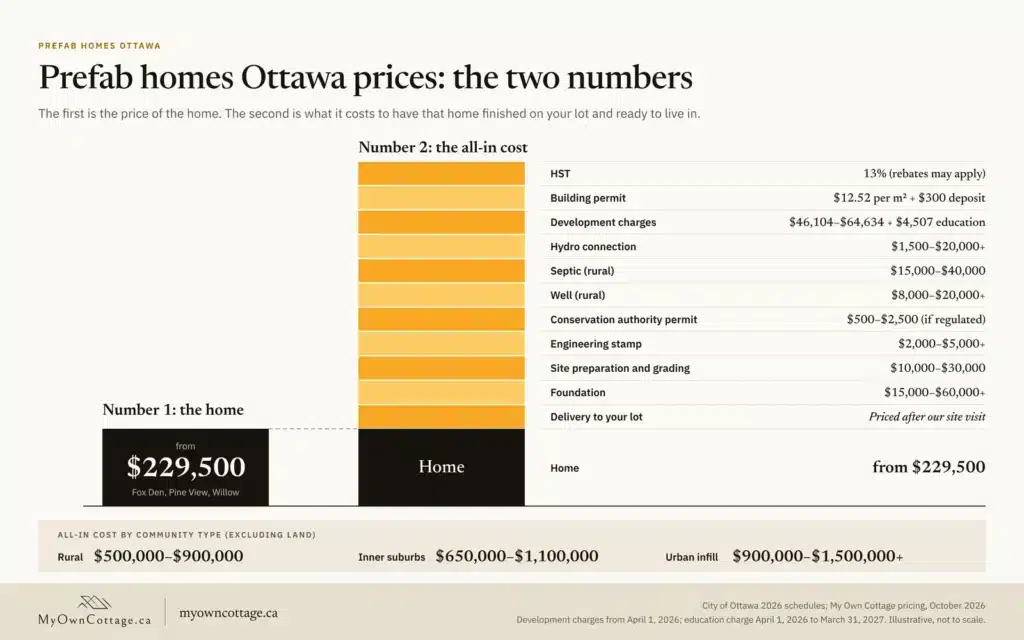
Every Ottawa prefab budget has two numbers. The first is the price of the home. The second is what it costs to have that home finished on your lot and ready to live in. Most budget surprises come from comparing one builder’s first number with another builder’s second.
Number 1: the home
Our designs start at $229,500 (Fox Den, Pine View and Willow). We build anywhere in Ontario, including Ottawa. Delivery depends on your lot and the design you choose, so we confirm it after our first site visit.


| Model | Size | Bedrooms / bathrooms | Starting price |
|---|---|---|---|
| Fox Den | 505 sq ft | 1 / 1 | $229,500 |
| Pine View | 540 sq ft | 1 / 1 | $229,500 |
| Willow | 564 sq ft | 1 / 1 | $229,500 |
| Hideaway | 788 sq ft | 2 / 1 | $279,500 |
| Lake View | 741 sq ft | 1 / 1 | $284,500 |
| Water’s Edge | 988 sq ft | 2 / 1 | $324,500 |
| Haven | 1,066 sq ft | 2 / 1 | $339,500 |
| Eagle’s Nest | 1,170 sq ft | 3 / 1 | $369,500 |
| Hudson | 1,550 sq ft | 3 / 2 | $524,500 |
Across these nine designs, the home works out to about $316 to $455 per square foot. Smaller homes cost more per square foot because the kitchen, bathroom and mechanical systems cost about the same at any size. Every design is built for year-round living.
Number 2: the all-in cost
The all-in cost adds everything your lot needs. Development charges are often the largest item after the home and the land.
| Cost item | Typical range in Ottawa | What drives it |
|---|---|---|
| Delivery to your lot | Priced after our site visit | Distance, road access and the design |
| Foundation | $15,000–$60,000+ | Foundation type and soil. Sensitive marine clay can call for an engineered design |
| Site preparation and grading | $10,000–$30,000 | Trees, slope and access |
| Engineering stamp | $2,000–$5,000+ | Foundation drawings and grading plan |
| Conservation authority permit | $500–$2,500 | Only near regulated wetlands, watercourses or floodplains |
| Well (rural, no City water) | $8,000–$20,000+ | Depth and yield |
| Septic (rural, no City sewer) | $15,000–$40,000 | Soil and system type |
| Hydro connection | $1,500–$20,000+ | Distance to the nearest line |
| Development charges | $46,104–$64,634, plus $4,507 education charge | Where your lot is (see below) |
| Building permit | $12.52 per m² of floor area, plus a $300 refundable inspection deposit | About $1,745 for a 1,500 sq ft home |
| HST | 13% | First-time buyer rebates can reduce it (see below) |
All-in cost by community type (excluding land):
| Community type | Examples | All-in range |
|---|---|---|
| Rural | West Carleton, Osgoode, Goulbourn, Manotick, Carp, Cumberland | $500,000–$900,000 |
| Inner suburbs | Kanata, Orléans, Barrhaven, Riverside South, Stittsville | $650,000–$1,100,000 |
| Urban infill | Centretown, the Glebe, Westboro | $900,000–$1,500,000+ |
These ranges include the home, foundation, site preparation, development charges, permits and servicing.
Two identical homes on two different Ottawa lots can differ in all-in cost by six figures, which is why we price against your lot, not by the square foot.
Two identical homes can differ by six figures in Ottawa. Tell us where your lot is, and we’ll price delivery, foundation, servicing and development charges for it, not for an average lot.
Shell, panelized or modular: compare like with like
Shell or kit:
the structure only. You or your contractor finish it. Lowest price, most work left to you.
Panelized:
wall, floor and roof panels made in a factory and assembled on your lot.
Modular:
the home is built in finished three-dimensional sections in a factory, then set on your foundation by crane. Highest delivered price, least work left on site.
Comparing a shell price with a finished modular price is the most common budgeting mistake we see. Ask every supplier what arrives on the lot, who assembles it and what’s left to finish.
What “prefab” means in Ottawa
“Prefab” covers several kinds of home, and the kind you buy decides your permit path, your financing and your warranty.
| Type | Built to | Permit | Financing | New home warranty |
|---|---|---|---|---|
| Modular | Ontario Building Code | Same as a site-built house | Standard mortgage | Yes, when a licensed builder builds it |
| Panelized | Ontario Building Code | Same as a site-built house | Standard mortgage | Yes, when a licensed builder builds it |
| Kit | Ontario Building Code, once assembled | Same as a site-built house | Usually construction financing | Only if a licensed builder assembles it. Owner-built homes have no statutory warranty |
| Manufactured (mobile) | CSA Z240 MH | Can face different zoning rules | Can be harder to finance | Only if fixed to a permanent foundation and built for year-round living |
“Prefab” in Ottawa increasingly means a second home on the lot. A coach house or additional unit is now one of the most common reasons buyers call us (see prefab coach houses).
Modular homes in Ottawa
A modular home is built in finished three-dimensional sections in a factory, trucked to your lot and set on its foundation by crane. Modular homes are built to the Ontario Building Code. Many are also built in factories certified under CSA A277, a certification procedure for factory-built buildings rather than a separate building code. Ask any builder which of its models carry it; for ours, it depends on the design. To the City, your lender and Tarion, a modular home on a permanent foundation is a house like any other.
Ottawa’s new Zoning By-law 2026-50 lists fewer restrictions on prefabricated and modular housing among its changes. In N1 to N4 zones, a modular building of up to three storeys, built with double floors, can exceed the height limit by up to 0.5 m per storey above grade (Section 801(14)).
Ottawa development charges and first-time buyer rebates
Ottawa development charges in 2026
Ottawa charges new homes a development charge per unit. For a single-detached or semi-detached home, the rates from April 1, 2026 are:
| Where your lot is | City development charge |
|---|---|
| Inside the Greenbelt | $57,827 |
| Outside the Greenbelt | $64,634 |
| Rural, on City services | $49,342 |
| Rural, on well and septic | $46,104 |
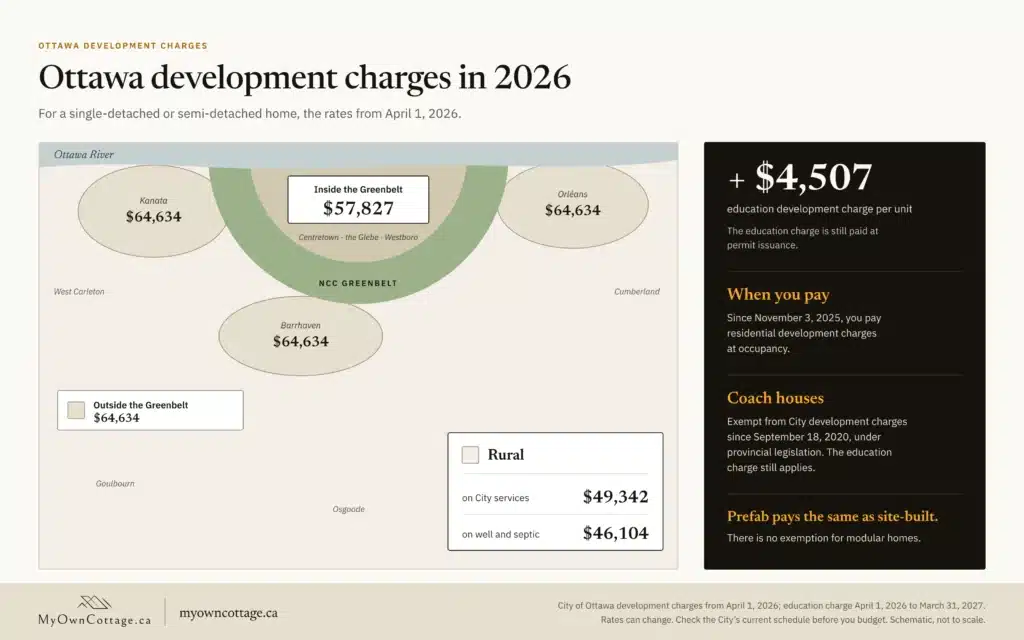
Add the education development charge of $4,507 per unit (April 1, 2026 to March 31, 2027).
When you pay:
the amount is set when your building permit is issued. Since November 3, 2025, you pay residential development charges at occupancy. The education charge is still paid at permit issuance.
Coach houses:
exempt from City development charges since September 18, 2020, under provincial legislation. The education charge still applies.
Prefab pays the same as site-built.
There is no exemption for modular homes.
Rates can change.
They are indexed each April. In June 2026 the City applied to Ontario’s Development Charge Reduction Program, which would cut residential charges if approved. Check the City’s current schedule before you budget.
Inside or outside the Greenbelt? Rural or serviced? We’ll confirm your lot’s development charge tier and build the current rate into your all-in budget.
GST and HST rebates for first-time buyers
Federal rebate (in force March 12, 2026, Bill C-4).
First-time buyers can get back up to 100% of the 5% GST (the federal part of HST) on a new home, to a maximum of $50,000. The full rebate applies up to $1 million, and it phases out to zero at $1.5 million. It covers agreements signed on or after March 20, 2025 and before 2031. If we build on land you already own, it can still qualify: construction must start on or after March 20, 2025 and before 2031, and be substantially complete before 2036.
Ontario rebate.
Ontario rebates the 8% provincial part of HST separately, up to $80,000 for first-time buyers, following the federal rules. For agreements signed from April 1, 2026 to March 31, 2027, a temporary Ontario rebate and top-up can reach $130,000 for any eligible buyer of a new home they’ll live in. Homes built on land you own have their own start dates.
These rebates have strict eligibility and date rules. Confirm yours with the CRA or a tax advisor before you count on them. For construction draw mortgages, see our prefab home financing guide.
Permits and approvals in Ottawa
Four kinds of body can have a say in an Ottawa build: the City, the National Capital Commission (NCC), one of three conservation authorities, and the Ottawa Septic System Office.
- The City
- The National Capital Commission (NCC)
- One of three conservation authorities
- The Ottawa Septic System Office
The NCC Greenbelt
The Greenbelt is about 20,000 hectares of farms, forests and wetlands in a horseshoe around Ottawa’s inner suburbs. It’s mostly federal land, about 75% of it owned by the NCC. It isn’t a place to build a private home.
For buyers, the Greenbelt matters in two ways. It sets your development charge tier (inside or outside the Greenbelt). And NCC approval applies only to federal land, or to private land with an NCC covenant registered on title. Owning a lot next to the Greenbelt doesn’t by itself need NCC review.
Which conservation authority covers your Ottawa lot
Three conservation authorities cover Ottawa. Their areas follow watersheds, not neighbourhood names, so check your address on the authority’s map before you buy.
| Authority | Covers in Ottawa |
|---|---|
| Mississippi Valley Conservation Authority (MVCA) | The Carp River watershed (Stittsville, Carp, toward Fitzroy Harbour) and the Ottawa River shoreline west of Shirleys Bay, including Constance Bay |
| Rideau Valley Conservation Authority (RVCA) | The Rideau and Jock River watersheds (Manotick, Richmond, Barrhaven, the former Rideau and Osgoode townships) and creeks draining north to the Ottawa River, including in Orléans |
| South Nation Conservation (SNC) | The Bear Brook and Castor River watersheds in east and southeast Ottawa (for example Navan, Metcalfe, Vernon and Greely) |
Work near regulated wetlands, watercourses, floodplains, shorelines or steep slopes may require a permit from the conservation authority under Ontario Regulation 41/24. That permit is separate from your building permit.
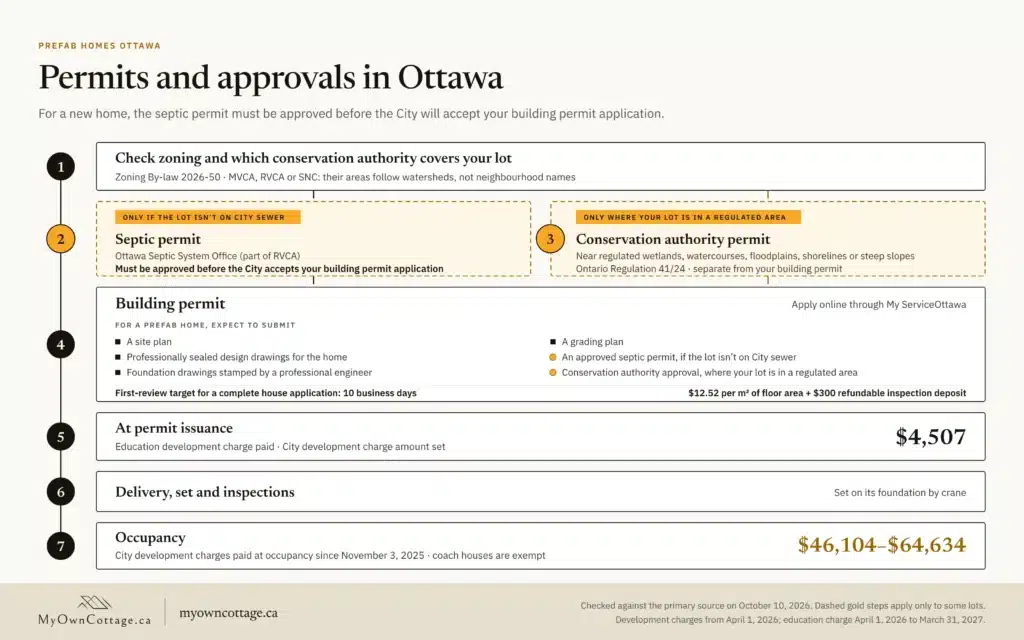
Septic is the exception. The Ottawa Septic System Office (part of RVCA) reviews every septic system anywhere in Ottawa, whichever watershed you’re in. For a new home, the septic permit must be approved before the City will accept your building permit application.
Your building permit
Since September 2024 you can apply for any building permit online through My ServiceOttawa. The City’s permit counters still take applications in person.
For a prefab home, expect to submit:
A site plan
Professionally sealed design drawings for the home
Foundation drawings stamped by a professional engineer
A grading plan, prepared by a licensed professional engineer, engineering technologist or Ontario land surveyor
An approved septic permit, if the lot isn’t on City sewer
Conservation authority approval, where your lot is in a regulated area
The City’s target for the first review of a complete house application is 10 business days. New homes are charged $12.52 per m² of floor area, plus a $300 refundable inspection deposit.
Sensitive marine clay (often called Leda clay) underlies much of Ottawa and can settle foundations, so the City may ask for a geotechnical investigation.
Zoning By-law 2026-50 has been in force since March 11, 2026. Applications made on or after that date must meet both the new by-law and the old one (2008-250), and the more restrictive rule applies.
Not sure which approvals your lot needs, or in what order? Book a free consultation and we’ll map your permit path: septic, conservation authority and building permit, in the order Ottawa requires.
Tarion, HCRA and what to check before you sign
In Ontario, anyone who builds or sells a new home must hold a licence from the Home Construction Regulatory Authority (HCRA), and the home must be enrolled in Tarion’s warranty program. Check any builder’s licence on HCRA’s Ontario Builder Directory before you sign.
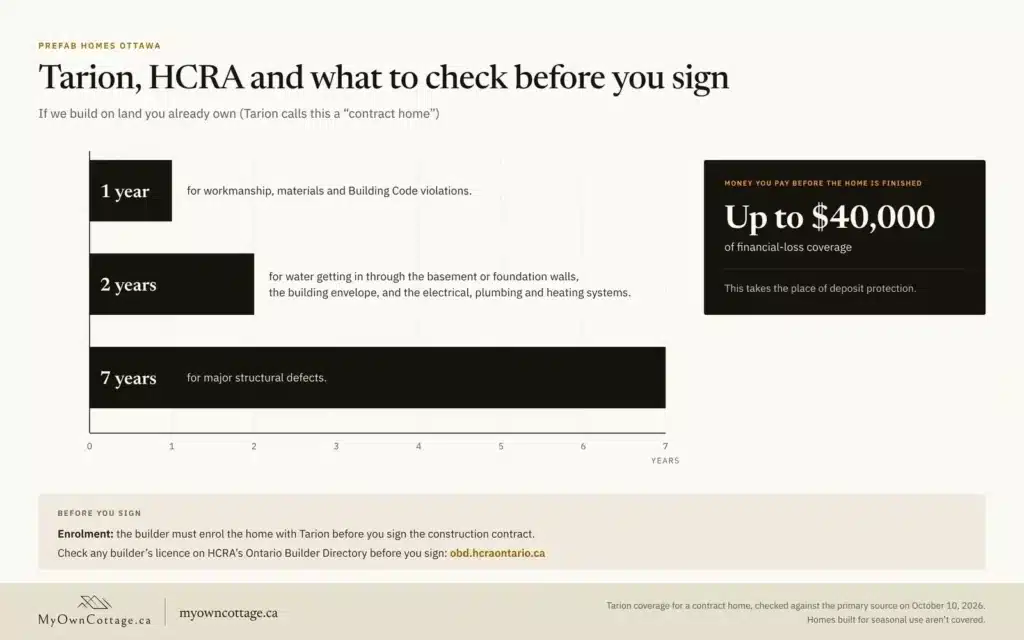
If we build on land you already own (Tarion calls this a “contract home”):
- Warranty:
- 1 year for workmanship, materials and Building Code violations.
- 2 years for water getting in through the basement or foundation walls, the building envelope, and the electrical, plumbing and heating systems.
- 7 years for major structural defects.
- Money you pay before the home is finished:
- up to $40,000 of financial-loss coverage. This takes the place of deposit protection.
- Enrolment:
- the builder must enrol the home with Tarion before you sign the construction contract.
If you buy a home and lot together from a builder, you get deposit protection instead: up to $60,000 on homes priced $600,000 or less, otherwise 10% of the price up to $100,000.
Homes built for seasonal use aren’t covered. A home not built to year-round Building Code standards has no statutory warranty, whatever you plan to use it for. Every My Own Cottage design is built for year-round living.
Quebec and other out-of-province factories. A home installed in Ottawa must meet the Ontario Building Code wherever it was built. Whoever sells you the finished home and sets it on your foundation must hold an HCRA licence and enrol it with Tarion. A factory that only supplies modules or a kit doesn’t need a licence.
Three questions to ask any Ottawa prefab builder:
- What is your HCRA licence number?
- Will you enrol my home with Tarion, and who is the builder?
- What does your price leave out: delivery, foundation, development charges, conservation authority permits, well and septic?
Prefab coach houses in Ottawa
A coach house is a separate home in your rear yard, and a prefab one can be set in place in days rather than framed on site over weeks.
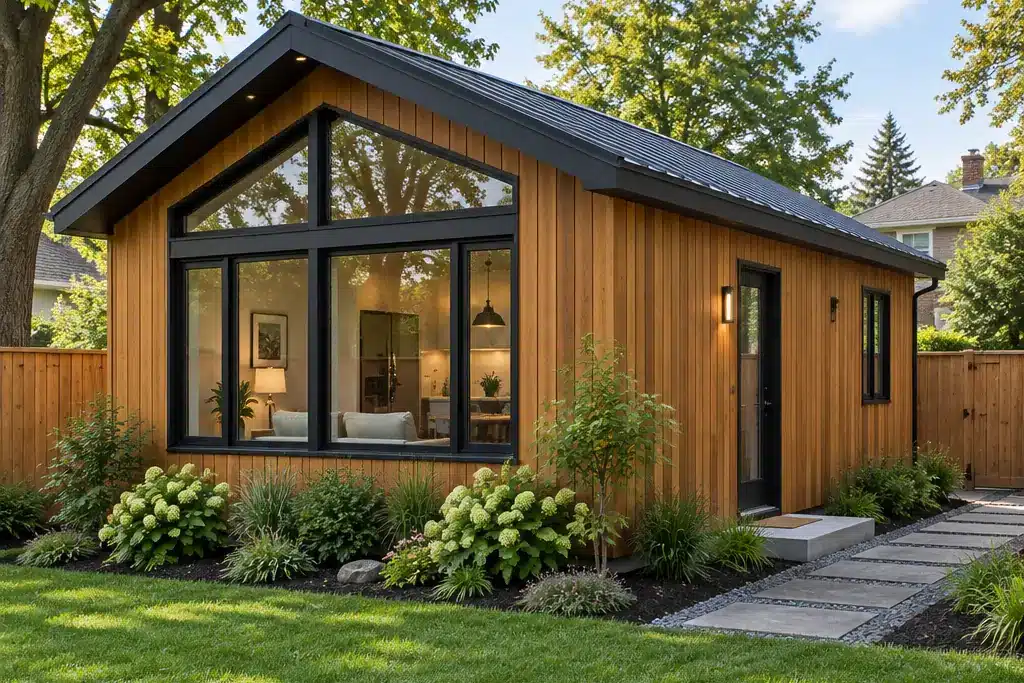
- How many units:
- on a lot with City water and sewer, you can have up to three units in total, including one coach house. On well and septic, you can add one unit.
- Size and height (Section 701 of Zoning By-law 2026-50):
- the coach house goes in the rear yard, with a footprint of up to 95 m² (and in most zones no more than 50% of the yard). Height is limited to 3.6 m in urban areas and 4.5 m in rural areas, or 6.1 m in rural areas if the building includes a garage.
- Servicing:
- on a lot under 0.4 hectares, a coach house needs public or communal water and sewer. On well and septic, confirm with the Ottawa Septic System Office that your septic can take the extra load.
- Development charges:
- coach houses have been exempt from City development charges since September 18, 2020. The education charge of $4,507 still applies.
Check what fits your backyard. Send us your lot survey and we’ll check footprint, height and servicing against Section 701 before you pick a design.
See our prefab coach house Ottawa guide for designs that fit Ottawa’s limits.
Off-grid prefab homes near Ottawa
You can live off-grid near Ottawa, but not outside the rules. An off-grid home still needs a building permit, an approved septic system and electrical work inspected by the Electrical Safety Authority (ESA). That includes solar and battery systems that never connect to the grid.
What an off-grid home needs
- A lot zoned for a house. On well and septic, you can have the main home plus one additional unit at most.
- Septic approval first. The Ottawa Septic System Office must approve your septic permit before the City accepts your building permit application.
- ESA notification and inspection for the solar array, batteries and wiring, whoever installs them.
- A year-round water source, usually a drilled well with freeze protection.
Sizing for an Ottawa winter
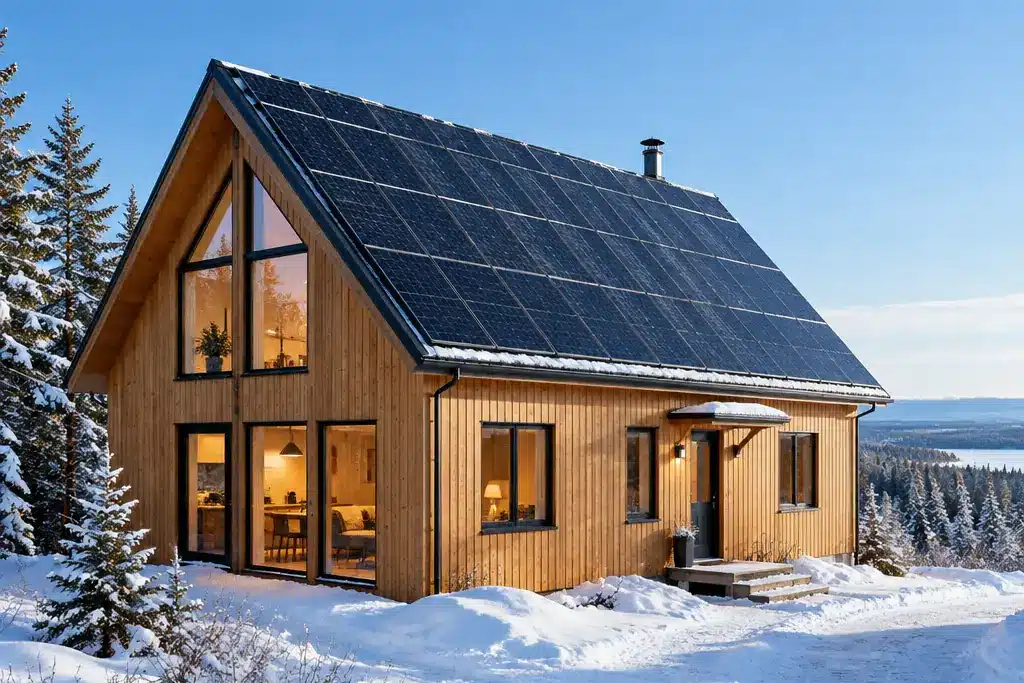
Size the system for the worst week of winter, not the average. Short days and snow cover cut solar output when you need heat and light most. Keep batteries in a heated space, plan a backup heat source such as wood or propane, and start with a tight, well-insulated home. The envelope does more for an off-grid budget than any panel.
What it costs
The home starts at $229,500 (Fox Den or Pine View) before delivery to Ottawa. Off-grid power, the well, septic, foundation and site work are separate, and on a remote lot access and servicing can be the biggest variables. We price them against your lot, not by the square foot.
Lenders generally finance a prefab home on a permanent foundation like any other house. An off-grid system or a remote lot can change what they ask for, so talk to your lender early.
Ready to get real numbers for your Ottawa lot?
Our prices are published, with no quote form needed to see them. To turn them into a real budget, book a free consultation. We’ll go through your lot, your Greenbelt position and development charge tier, delivery, servicing and a realistic all-in number.


Sean Stevenson
Chief Marketing Officer and Buyer Experience Lead, My Own Cottage Inc.
Sean Stevenson is Chief Marketing Officer and Buyer Experience Lead at My Own Cottage Inc., an HCRA-licensed, Tarion-enrolled prefab home and cottage builder based in Orillia, Ontario.
For five years, Sean has worked alongside the company's build team, guiding Ontario buyers from lot assessment and budgeting beyond the model price through zoning, permits, development charges and final occupancy. Sean focuses on the part most buyers underestimate: what a prefab home costs to complete once the foundation, servicing and approvals are added to the model price.