Prefab Bunkie Muskoka 2026: The Complete Guide to Kits, Permits, Costs, and Zoning
Prefab bunkie Muskoka buyers face one critical question before selecting any kit or calling any builder: does your specific lot, in your specific township, under your specific zoning classification, actually permit the structure you’re planning to build.
This guide covers the OBC 10 sq m permit threshold, Township of Muskoka Lakes zoning rules, 2026 kit prices from CAD $5,995 to CAD $36,678, Canadian Shield foundation options, and the STR licensing framework under By-law 2025-049.
Get a lot-specific cost and permit assessment before you commit — no surprises after signing.
The most important question before any Muskoka bunkie purchase isn’t about price or style — it’s whether you’re legally permitted to build one on your specific lot, in your specific township, under your specific zoning classification.
Ontario’s Building Code draws the permit line at 10 square metres (roughly 108 sq ft), and most classic 10×10 bunkies land right on that edge. But the OBC exemption is only half the story.
Even a permit-exempt structure can violate Muskoka Lakes Township zoning bylaws, Lake of Bays setback rules, or Muskoka Watershed Conservation Authority regulations — surprises that have cost cottage owners real money.
This guide covers what no competing bunkie page has attempted:
• The exact OBC conditions that determine whether your bunkie is permit-free
• Township-by-township zoning rules for the District of Muskoka’s five area municipalities
• Prefab kit and pre-built pricing from CAD $5,995 to CAD $36,678 — and all-in costs for Muskoka waterfront lots
• Foundation options that actually work on Canadian Shield bedrock
• The STR licensing framework under By-law 2025-049 that every investor buyer must understand before committing
What all of this planning leads to — when done correctly — is a small, highly efficient space that actually works on a real Muskoka lot.
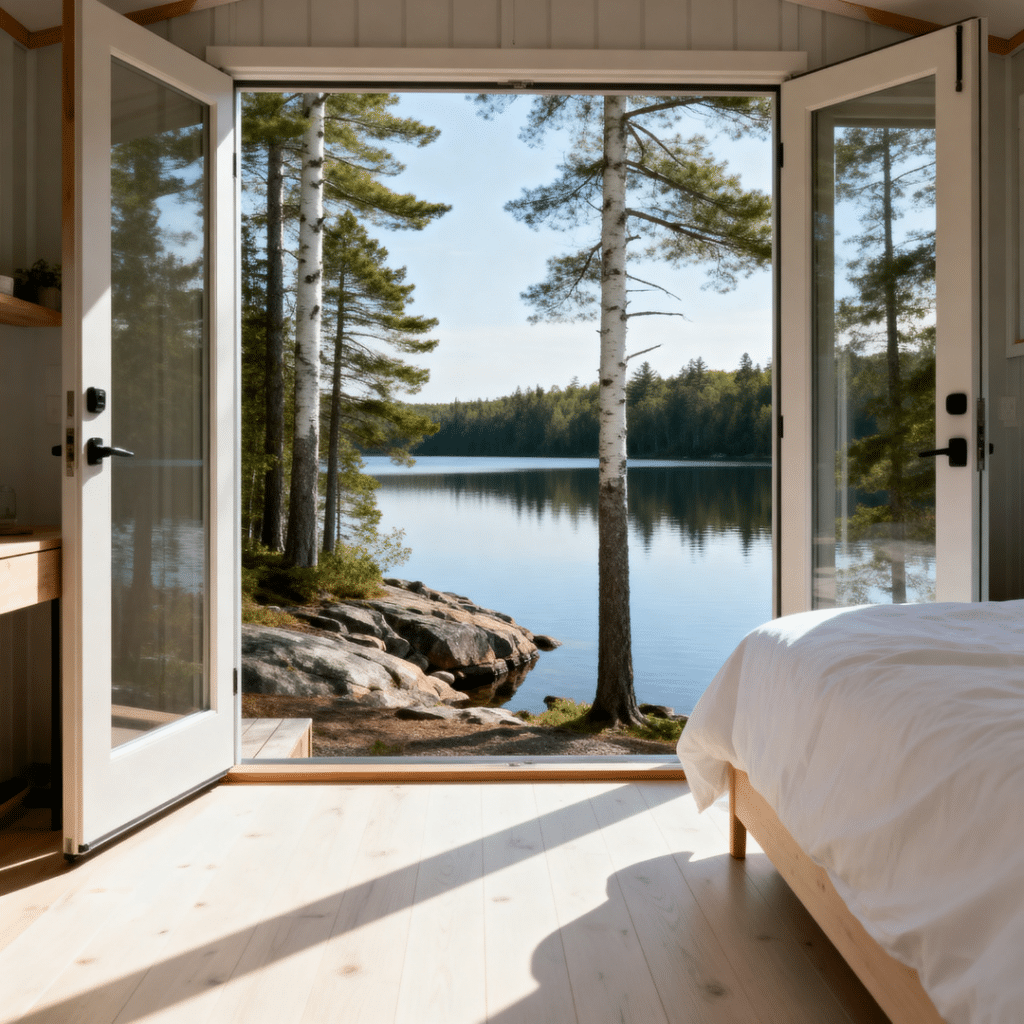
A permit-exempt 10×10 prefab bunkie interior in Muskoka — natural light, white oak flooring, and a direct lake view through open double doors demonstrate how compact design delivers real waterfront living.
If you are researching the full range of factory-built home options across Muskoka — including primary residences, four-season builds, and the complete regulatory environment for the District — see our prefab homes Muskoka complete buyer’s guide.
If you’re evaluating a full CSA A277 certified prefab cottage rather than a sleeping cabin or accessory structure, see our prefab cottages Muskoka guide — that page covers Tarion warranty, CMHC financing, and the complete investment-grade build decision framework.
My Own Cottage is based in Orillia and delivers OBC-compliant prefab sleeping cabins and compact modular structures across the District of Muskoka — from road-accessible Lake Muskoka waterfront lots to water-access-only properties on Lake Rosseau, Lake Joseph, and Lake of Bays — with a complete site assessment before any commitment is made.
Get a free all-in cost estimate for your Muskoka bunkie or sleeping cabin — no commitment required.
What Is a Bunkie? — Definitions That Determine Your Permit Pathway
The word “bunkie” is as distinctly Ontario as a loon call at dusk — rooted in cottage country vernacular, evolved over generations from rough-hewn plywood sleeping shacks to the engineered prefab kits dominating the 2026 market.
But vendors market the same structure under four different names, and the regulatory category is determined by intended use and services — not the product name on the manufacturer’s website.
Understanding which category your planned structure falls into is the single most important question before you order a kit.
Bunkie vs Sleeping Cabin vs Guest House — The Regulatory Hierarchy
| Structure | Plumbing | Permit Required |
|---|---|---|
| Bunkie | No | Not if ≤10 sq m under OBC |
| Sleeping Cabin | Sometimes | Yes if >10 sq m or plumbing |
| Guest House / ADU | Yes | Always |
| Shed | No | Not if ≤10 sq m |
Muskoka Lakes zoning categories: bunkie and shed = accessory structure; sleeping cabin = formal zoning definition up to 7.6 m height; guest house/ADU = full secondary dwelling.
Not sure which category your planned structure falls into? We confirm it before any design or purchase decision is made.
In the Township of Muskoka Lakes specifically, the zoning by-law distinguishes between a generic accessory structure (storage or recreation, no plumbing), a sleeping cabin (sleeping use, sometimes permitted above a garage), and a full accessory dwelling unit.
Getting this categorization wrong before you order a kit can mean the difference between a smooth installation and a stop-work order.
Buyers whose secondary structure is on an urban or suburban Ontario lot rather than a Muskoka waterfront property should review our guide to prefab garden suites and ADUs in Ontario for the Bill 23 development charge elimination rules that apply to qualifying secondary units.
Why Bunkie Demand Is Surging Across Muskoka in 2026
Post-pandemic cottage ownership boomed, leaving families short on sleeping space for extended family and friends.
Remote work extended shoulder-season use well beyond the traditional Victoria Day to Labour Day window, intensifying demand for a dedicated workspace or overflow bedroom.
The STR income case has strengthened: a bunkie included in a licensed Airbnb listing alongside the main cottage can meaningfully offset carrying costs under Muskoka Lakes By-law 2025-049.
And Ontario prefab kit manufacturing has genuinely matured — brands like Bunkie Life, The Bunkie Co., Peacock Woodcraft, and Timber Bunkies now ship pre-cut, numbered panel kits that two people can assemble in a weekend without specialized tools.
For compact CSA A277 certified structures within Muskoka’s approximately 600 sq ft accessory structure size limit, see our small prefab homes Muskoka guide.
Do You Need a Permit for a Bunkie in Muskoka? — The Gate Every Buyer Must Pass First
In most Muskoka municipalities, a bunkie under 10 square metres (107.6 sq ft) does not require a building permit under Ontario Building Code Division A, Article 1.3.1.1.
However, the OBC exemption applies only to the building permit — it does not override local zoning bylaws. A permit-exempt bunkie can still violate the Township of Muskoka Lakes’ 20 to 30 metre shoreline setback requirement, the two-accessory-structure maximum per waterfront lot, or the 92.9 sq m cumulative floor area cap.
Always confirm compliance with your specific township’s planning and building department before purchasing any kit.
OBC Division A Article 1.3.1.1 — The Five Conditions
Under Ontario Building Code Division A, Article 1.3.1.1, a building permit is not required for a detached accessory structure that simultaneously meets all five of the following conditions.
The visual below simplifies the rule into a checklist you can apply directly to any prefab bunkie model you are considering.
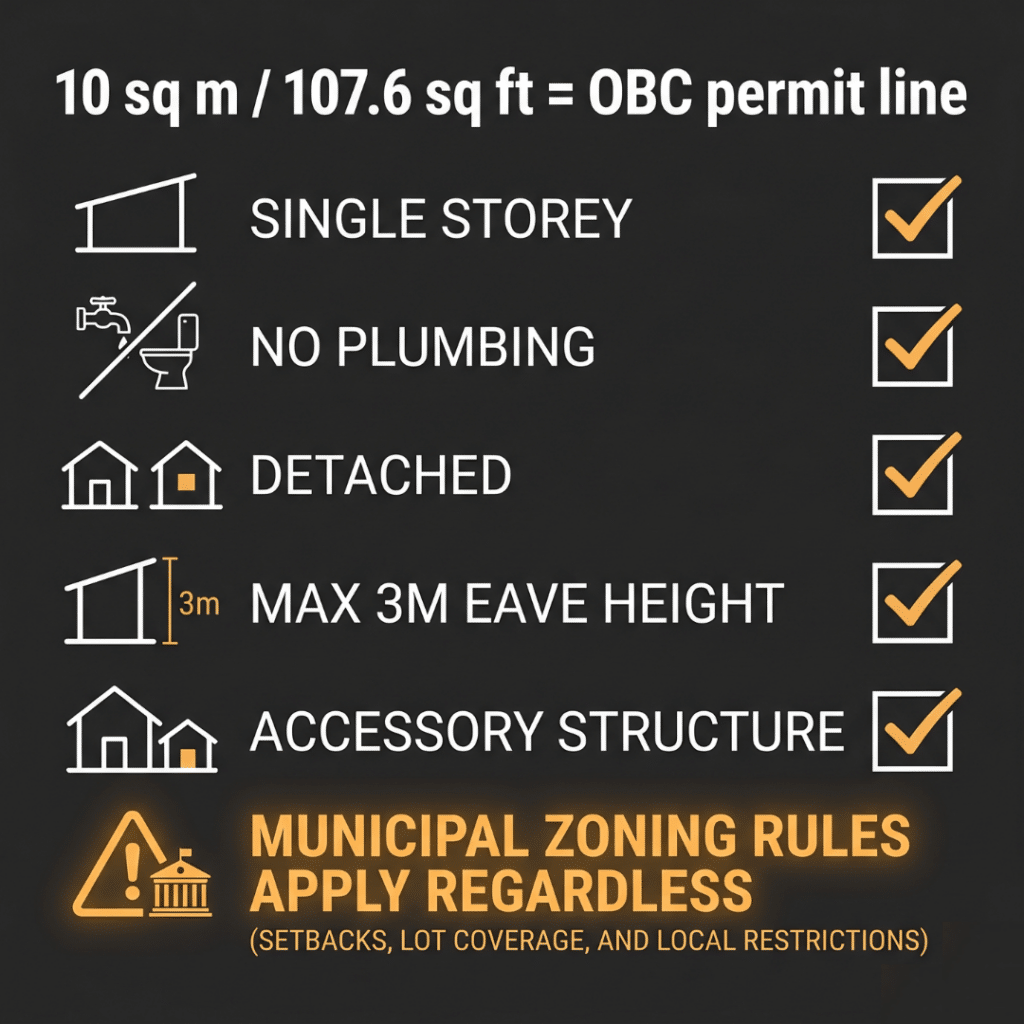
The Ontario Building Code’s 10 sq m permit exemption only applies if all five conditions are met — and municipal zoning rules still override it on Muskoka waterfront lots.
Missing any single condition voids the exemption entirely.
• 1. Gross floor area ≤ 10 sq m (≤ 107.6 sq ft) — measured to the exterior face of exterior walls per OBC definitions. A true 10×10 ft exterior dimension yields approximately 9.29 sq m — right under the line. A 10×12 ft structure is 11.15 sq m and requires a permit.
• 2. Single storey only — a sleeping loft with habitable headroom above 1.5 m may be interpreted as a second storey by your local building official, potentially voiding the exemption. Confirm in writing before ordering any loft model.
• 3. Eave height ≤ 3 m — the three-metre limit is measured at the eave, not the peak. Most standard bunkie designs meet this condition easily; steep rooflines with tall eaves do not.
• 4. No plumbing — no water supply or drainage connections of any kind. Composting toilets with no water supply and no drain connection are generally acceptable. Any connection to the cottage’s water or septic system is not.
• 5. Not attached to a dwelling — even a covered walkway or shared wall triggers the permit requirement. The bunkie must be physically separate from every other structure on the lot.
A sixth implied condition that building officials consistently apply: the structure must be accessory to an existing permitted principal building. A permit-exempt bunkie cannot be the primary structure on a vacant lot.
Source: Ontario Building Code O. Reg. 332/12, Division A Article 1.3.1.1.
When a Bunkie Automatically Requires a Permit
The following conditions void the OBC exemption regardless of the structure’s footprint:
• Gross floor area exceeds 10 sq m — even by a fraction
• A sleeping loft that a building official interprets as a second storey
• Any running water, toilet, or drain connection installed
• A propane, natural gas, or solid fuel heating appliance (also triggers TSSA requirements and, for wood-burning appliances, a mandatory WETT inspection)
• Location within a Conservation Authority regulated area — typically within 30 m of a waterbody — which triggers a Section 28 permit requirement independent of the OBC
• Some Muskoka townships require a permit for any structure within 30 m of the waterline regardless of footprint size
The Loft Grey Zone — The Risk Manufacturers Don’t Disclose
Several manufacturers sell loft models as permit-free at the 10×10 size. The Summerwood Bala Bunkie includes a pine loft. Timber Bunkies offers loft configurations within their 10×10 footprint. The Peacock Lofted Bunkie uses a unique loft system designed around the permit threshold.
The problem: a sleeping loft with a finished floor and headroom above 1.5 m may be interpreted as a second storey by your local building official — potentially voiding the single-storey requirement and triggering a full permit application.
As of April 2026, the Ontario Ministry of Municipal Affairs and Housing has not issued a definitive interpretive bulletin on bunkie lofts.
The conservative position — and the legally safest one — is this: if the loft has a finished floor and headroom above 1.5 m, obtain a written interpretation from your local building official before ordering.
Don’t rely on “permit-free” marketing language as your compliance confirmation. We obtain written interpretation from your local building official before any order is placed.
ESA Electrical — The Permit Layer No Manufacturer Mentions
The Ontario Building Code permit exemption and the Electrical Safety Authority are two separate regulatory systems.
An ESA permit is required for any new 120V AC electrical installation — wiring, panels, outlets — regardless of the size of the structure. This applies even to a 9 sq m permit-exempt bunkie.
Practical off-grid alternatives that avoid triggering the ESA permit requirement: portable battery stations (Bluetti AC200P, EcoFlow Delta Pro) provide substantial power capacity with no permanent wiring.
12V/24V DC solar systems with battery banks and DC LED lighting are a legitimate off-grid approach that sidesteps ESA permitting when no 120V AC wiring is installed.
If you want a wired bunkie, hire an ESA-licensed electrician and pull the permit.
Source: ESA Ontario — esasafe.com.
Muskoka Township-by-Township Zoning
The OBC exemption applies province-wide. Zoning rules are administered locally. And Muskoka is not a monolith.
The Township of Muskoka Lakes, the Township of Lake of Bays, the Town of Huntsville, the Town of Bracebridge, and the Town of Gravenhurst each administer their own zoning by-laws with meaningfully different accessory structure rules.
The comparison below breaks down the key township rules that determine whether your prefab bunkie Muskoka project is compliant before you commit to any design or purchase.

A township-by-township comparison of prefab bunkie Muskoka zoning rules — highlighting Muskoka Lakes’ strict accessory structure limits alongside other municipalities where verification is required.
No bunkie manufacturer website publishes this data. The township-by-township comparison below is the most current summary available as of April 2026.
Always verify directly with your specific municipal office before purchasing or installing any bunkie kit.
Township of Muskoka Lakes — The Strictest Rules in the District
This is the most restrictive and most scrutinized municipality for bunkie regulation in the region — and the jurisdiction governing Lake Muskoka, Lake Rosseau, and Lake Joseph waterfront lots.
Maximum accessory buildings: Two per waterfront residential lot, cumulative.
Cumulative maximum floor area: 92.9 sq m (1,000 sq ft) across all accessory buildings combined. If your existing shed, boathouse, or Muskoka Room already consumes part of this allowance, your bunkie’s permitted floor area decreases accordingly.
Shoreline setback: 20 to 30 metres from the High Water Mark depending on lot size, zoning sub-category, and environmental overlays.
Plumbing: Generally prohibited in non-ADU accessory structures. A bunkie with a sink, toilet, or shower connection falls into a different regulatory category and triggers both a building permit and a Part 8 sewage system permit.
Building permit fee: CAD $11 per $1,000 of construction value, minimum CAD $200.
STR licensing: By-law 2025-049 requires a CAD $1,000 annual licence for any property rented short-term, including those with bunkies.
Source: Township of Muskoka Lakes — Building Department.
Four questions to ask your Muskoka Lakes building department before purchasing any kit:
• 1. How many accessory structures are currently registered on my lot?
• 2. What is the maximum cumulative floor area for accessory structures in my zoning category?
• 3. What is the shoreline setback requirement for a new accessory structure?
• 4. Does sleeping use in an accessory structure trigger any additional permit or zoning approval?
Getting written answers to these four questions before spending a dollar on a kit is the highest-return activity in the entire bunkie-buying process.
Contact the Township of Muskoka Lakes Building Department directly to confirm current rules for your specific lot before purchasing any kit.
For the complete four-layer Muskoka permit framework — including Conservation Authority Section 28 triggers, township-by-township development charges, and the January 1 indexing deadline — see our complete permit framework for Muskoka builds.
Lake of Bays, Huntsville, Bracebridge, and Gravenhurst
The Township of Lake of Bays administers a separate STR licensing regime under By-law 2021-092 — property owners renting bunkies as part of a cottage STR listing must be licensed.
Accessory structure rules require independent verification at lakeofbays.on.ca.
The Town of Huntsville, Town of Bracebridge, and Town of Gravenhurst each administer their own zoning by-laws with distinct accessory structure permissions, setbacks, and lot coverage rules.
As of April 2026, Huntsville is actively reviewing short-term rental regulation — confirm current status directly with the Town.
Sources: huntsville.ca, bracebridge.ca, gravenhurst.ca.
For Huntsville-specific permit fees and North Muskoka lot realities, see our prefab homes Huntsville guide.
For Gravenhurst waterfront setbacks and development charge data, see our prefab homes Gravenhurst guide.
For Bracebridge-specific permit fees, development charges, and Lake Muskoka waterfront lot realities see our prefab homes in Bracebridge guide.
Township-by-Township Summary Table
| Municipality | Key Restrictions | STR Licensing |
|---|---|---|
| Township of Muskoka Lakes | Max 2 structures; 92.9 sq m cumulative cap; 20–30 m setback; plumbing prohibited | By-law 2025-049 — CAD $1,000/yr |
| Township of Lake of Bays | Verify directly with municipality | By-law 2021-092 — confirm |
| Town of Huntsville | Verify directly with municipality | Under review April 2026 |
| Town of Bracebridge | Verify directly with municipality | Verify directly |
| Town of Gravenhurst | Verify directly with municipality | Verify directly |
By-laws are amended regularly. The figures above reflect the best available information as of April 2026. Verify current rules with your specific municipality before purchasing any kit.
Can I Airbnb My Bunkie in Muskoka? — STR Rules Under By-law 2025-049
A well-positioned waterfront property on Lake Muskoka, Lake Rosseau, or Lake Joseph can command CAD $3,000 to $8,000-plus per week during peak summer season — and a bunkie adds meaningful sleeping capacity to that listing.
But the STR regulatory landscape in Muskoka changed materially in 2025, and investor buyers must model against the current framework.
The One-Rental-Group Rule — What Forum Discussions Get Wrong
Township of Muskoka Lakes By-law 2025-049 permits bunkies to be included in a licensed STR premises at a cost of CAD $1,000 annually.
The critical point that consistently generates confusion in Ontario cottage forums: only one rental group at a time may occupy the entire premises — the main cottage and any bunkies combined.
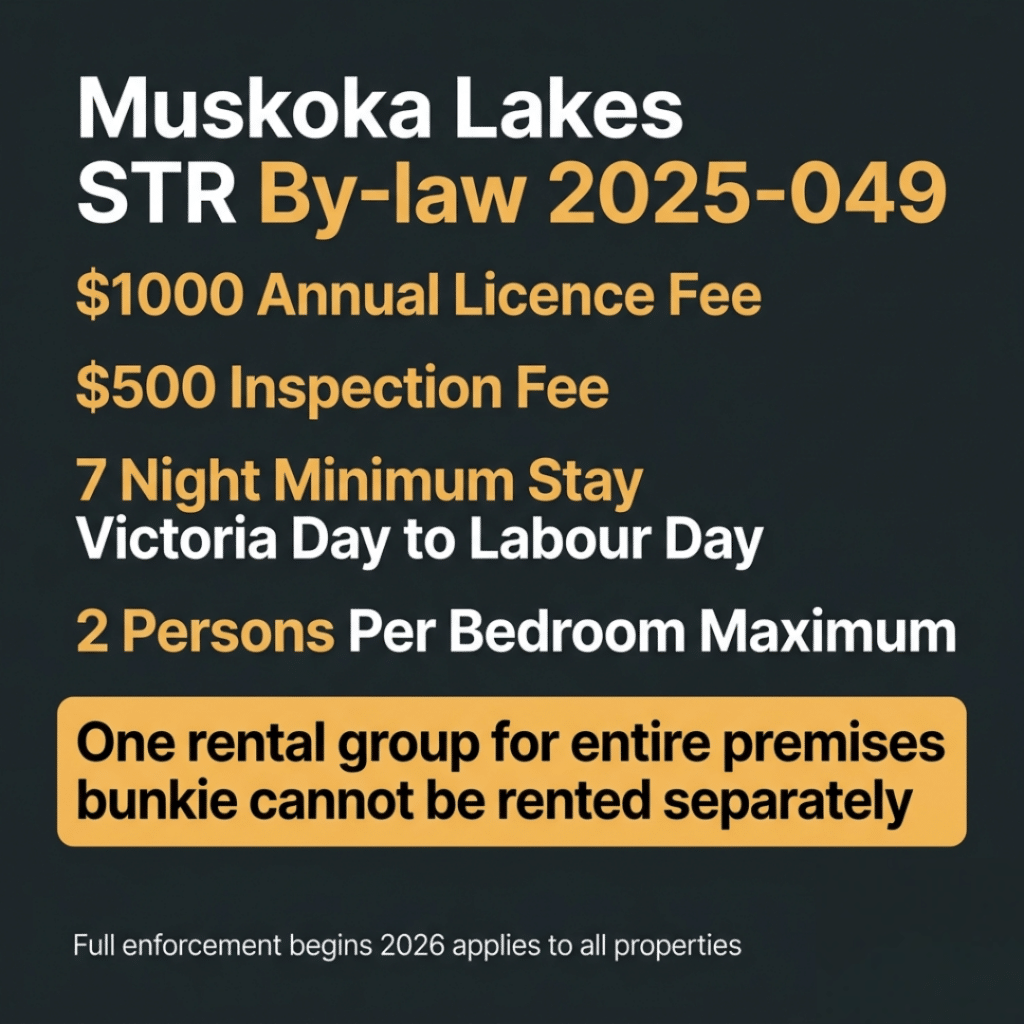
Muskoka Lakes STR By-law 2025-049 defines the exact rules that determine your rental income — including licensing fees, minimum stay requirements, and the one-group occupancy restriction that prevents bunkies from being rented separately.
You cannot list the bunkie separately from the main cottage on Airbnb or VRBO. You cannot rent the bunkie to one group while the main cottage is occupied by a different group.
The bunkie is included under the main property’s single STR licence — it is not separately licensed and cannot operate as an independent rental unit.
Additional requirements under By-law 2025-049: minimum 7-night stays between Victoria Day and Labour Day; occupancy cap of 2 persons per bedroom; full enforcement commencing in 2026. Grandfathered properties are not exempt.
Source: Township of Muskoka Lakes — Short-Term Rental Accommodations.
If annual STR revenue from the entire premises exceeds CAD $30,000, the owner must register for and collect GST/HST on rental income — a threshold easily reached on Lake Muskoka and Lake Rosseau waterfront properties in peak season.
Consult a qualified Canadian tax professional before establishing an STR operation.
Bunkie Size Guide and 2026 Kit Prices — The Permit-Threshold Table
Every competitor in this SERP shows only base kit cost — the number on the product page before Muskoka reality sets in. This section shows both: the permit status and the all-in cost for a Muskoka waterfront lot.
Size-to-Permit Table with 2026 Brand Pricing
| Size | Sq M | OBC Permit Status |
|---|---|---|
| 8×8 ft (64 sq ft) | 5.95 sq m | ✅ Exempt |
| 8×10 ft (80 sq ft) | 7.43 sq m | ✅ Exempt |
| 10×10 ft (100 sq ft) | 9.29 sq m | ✅ Exempt |
| 10×12 ft (120 sq ft) | 11.15 sq m | ❌ Permit Required |
| 10×14 ft (140 sq ft) | 13.0 sq m | ❌ Permit Required |
| 12×12 ft (144 sq ft) | 13.4 sq m | ❌ Permit Required |
| 12×16 ft (192 sq ft) | 17.8 sq m | ❌ Permit Required |
Brand examples and 2026 prices by size:
• 10×10 ft (exempt): Bunkie Life Summer Cabin 99 sq ft CAD $5,995 · Timber Bunkies Little Otter CAD $13,500 · Summerwood Bala Bunkie CAD $12,671–$27,985 · The Bunkie Co. Basecamp 97 sq ft CAD $21,900
• 10×14 ft (permit required): Timber Bunkies Humber CAD $15,500 · Peacock Lofted Bunkie upper range
• 12×16 ft (permit required): Bunkie Life Alcove 160 With Loft CAD $24,495 · Timber Bunkies Missinabi range · Peacock Woodcraft DriftWood 161 sq ft CAD $8,495–$11,995
Before ordering any model near the 100 sq ft mark: Several manufacturers market models at 106 to 108 sq ft — within 1.5 sq ft of the permit threshold. Request the exact exterior building area calculation in writing from the manufacturer and confirm with your local building department before committing. A structure at 10.1 sq m triggers the permit requirement.
All-In Cost by Tier — What Factory Price Doesn’t Include
Budget tier — permit-exempt 10×10 DIY builds Kit: CAD $5,995 to $14,000 | All-in Muskoka waterfront lot: CAD $10,000 to $22,000
Muskoka site cost additions:
• Canadian Shield bedrock foundation CAD $1,500 to $4,000
• Delivery to a road-accessible lot CAD $500 to $2,000
• Interior finishing and insulation beyond the base kit CAD $1,500 to $4,000
• ESA electrical permit and licensed electrician if any 120V AC wiring is installed CAD $800 to $2,500
• Water-access delivery to Lake Rosseau, Lake Joseph, or remote Lake of Bays properties adds CAD $5,000 to $25,000 for barge or crane access
Mid-range tier — permitted builds Kit: CAD $14,000 to $36,678
All-in Muskoka waterfront lot: CAD $20,000 to $50,000
Models in this tier exceed the 10 sq m OBC threshold and require a building permit.
Township of Muskoka Lakes permit fee: CAD $11 per $1,000 of construction value, minimum CAD $200.
Key models: Timber Bunkies Humber 10×14 CAD $15,500; Bunkie Life Alcove 160 With Loft CAD $24,495; Timber Bunkies 12×18 CAD $36,678.
Permit processing time in Muskoka’s area municipalities: four to twelve weeks — plan for this in your project timeline.
For the complete all-in Muskoka prefab cost breakdown across road-accessible, waterfront bedrock, and water-access-only lot types see our Muskoka prefab home prices guide.
Luxury tier — architect-designed sleeping cabins: CAD $100,000 to $250,000+ | CSA A277 certified modular structures from CAD $229,500
480 sq ft two-bedroom structures delivered by boat to water-access-only shoreline locations on Lake Muskoka.
These designs are complete with full bathroom, modern white oak flooring running up the wall and across the ceiling, white Corian throughout from bathroom to integrated desk, sliding glass partitions giving privacy to bedrooms, floor-to-ceiling glass on two structural curtain walls holding up the roof, and a cantilevered roof protecting the deck on two sides with amazing solar geometry.
The result looks like a corner unit condo from a downtown high-rise positioned in nature — an extremely high level of design achieved through the modular platform without compromising on quality or sophistication between custom-site build and custom-modular.
OBC compliant modular sleeping cabins from My Own Cottage start at approximately CAD $229,500 — a categorically different product from a DIY kit bunkie, covering the complete permit process, engineered helical pier foundations, factory inspection documentation, and a single point of accountability from site assessment through occupancy permit.
For the complete investment and build framework for buyers at this tier, see our prefab cottages Muskoka guide.
Ready to get a verified all-in estimate for your Muskoka lot? Book a free no-commitment site consultation.
Foundation Options for Canadian Shield Bedrock — What Actually Works in Muskoka
Muskoka sits on Precambrian Shield granite — some of the oldest exposed rock on earth. The foundation choice on a Muskoka lakeside lot is not a cost preference; it is a site-specific engineering decision.
And the most consequential mistake a Muskoka bunkie buyer can make is ordering screw piles for a solid granite site.
Screw piles and helical piles cannot penetrate solid granite. Standard rock augers are not designed for Shield granite — piles deflect or refuse before reaching meaningful depth.
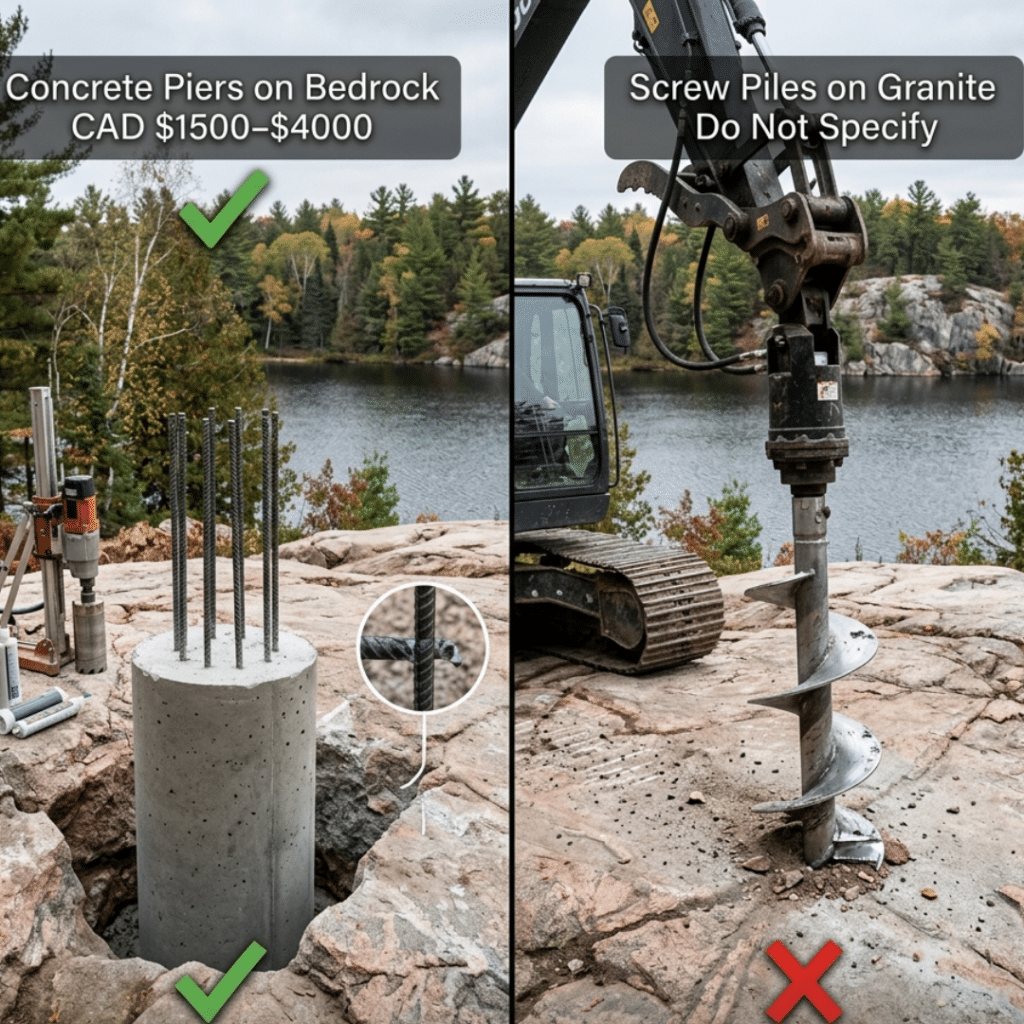
Concrete piers anchored into Canadian Shield granite are the only reliable foundation — screw piles cannot penetrate solid bedrock and are the most common foundation mistake on Muskoka lots.
A contractor who arrives expecting to install screw piles on solid bedrock leaves with the job unfinished. The Bunkie Co.’s Learning Hub lists screw piles as a foundation option without this caveat.
It is a practical error affecting every Muskoka buyer who follows that guidance on a Shield granite lot.
Foundation Comparison Table
| Foundation Type | Cost CAD | Shield Granite |
|---|---|---|
| Concrete piers — rebar epoxied into drilled bedrock | CAD $1,500–$4,000 installed | ✅ Best on solid granite |
| Concrete sonotubes — on shallow soil over rock | CAD $800–$2,500 installed | ✅ Good on mixed rock-soil |
| Screw piles / helical piles | CAD $2,000–$5,000 where feasible | ❌ Not suitable for solid granite |
| Wood skids on gravel or patio stones | CAD $300–$800 DIY | ⚠️ Acceptable on flat sites only |
| Deck blocks / concrete blocks | CAD $200–$600 DIY | ⚠️ Marginal on uneven bedrock |
| PT posts on concrete pads bearing on rock | CAD $500–$1,500 | ✅ Good when pads bear on exposed rock |
Key notes by foundation type:
• Concrete piers into bedrock: Requires a rock-drilling contractor — the most stable long-term option on Shield granite
• Concrete sonotubes: Faster where soil depth allows; limited before hitting rock on many Muskoka lots
• Screw piles: Standard augers deflect or refuse on solid granite — do not specify for Shield bedrock sites regardless of what a supplier recommends
• Wood skids: Floating design; requires periodic releveling; not appropriate for sloped sites
• Deck blocks: Least stable option; avoid on uneven or sloped bedrock
• PT posts on pads: Solid where pads bear directly on exposed rock; monitor for rot over time
The Floating vs. Permanent Foundation Permit Nuance
A floating foundation — deck blocks, gravel pads, wood skids — is generally considered a non-permanent installation under the OBC, which supports the permit-exempt classification for structures ≤10 sq m.
A permanent foundation — concrete piers drilled and epoxied into bedrock — may be interpreted by some municipal building officials as making the structure permanent, potentially triggering a permit requirement even if the structure itself is under 10 sq m.
In practice, most Township of Muskoka Lakes building officials focus on the structure’s size, use, and services rather than foundation type for the permit-exemption determination.
Confirm with your specific township before committing to a permanent foundation on a structure you intend to keep permit-free.
Sloped Lakefront Sites and Mixed Rock-Soil Terrain
Sloped Muskoka lakefront lots — the norm, not the exception — require a post-and-beam or pier-and-beam approach with varied post heights to create a level platform.
On sites with mixed exposed granite and soil pockets: map your bearing points first by probing with a steel rod to find where bedrock is close to the surface; use concrete piers anchored to rock where bedrock is accessible; use PT posts on poured concrete pads where there is adequate soil depth.
Never mix a rigid anchor with a floating foundation element on the same structure — differential movement will rack and damage the frame over time.
Service Triggers — When Plumbing, Heating, or Electrical Changes Everything
The moment you add plumbing, a fuel-burning heating appliance, or any 120V AC wiring, you have crossed into permit-required territory — regardless of the structure’s square footage.
Understanding where these lines fall is the difference between a smooth installation and a retroactive permit application.
The Plumbing Trigger
The OBC Article 1.3.1.1 exemption explicitly requires no plumbing. Any sink with a drain, toilet, or water supply line voids the exemption entirely — a building permit is required, full stop.
In the Township of Muskoka Lakes, some accessory structure definitions also explicitly prohibit plumbing in non-ADU accessory buildings. A separate OBC Part 8 sewage system permit is additionally required for any greywater disposal, even a simple dry well.
Source: Ontario Building Code O. Reg. 332/12, Part 8.
The Heating Appliance Trigger
Installing any fuel-burning heating appliance — propane, wood stove, pellet stove, or natural gas unit — triggers a building permit regardless of floor area. Wood-burning appliances also require a WETT inspection.
This is the four-season reality that many buyers discover too late: a properly insulated Muskoka bunkie without a heat source is insufficient for winter occupancy when temperatures drop well below minus 20°C.
If year-round use and extra space through the full Northern Ontario heating season is the goal, a permit is almost certainly required.
Plan and budget for it from the outset rather than treating it as an optional upgrade.
Off-Grid Alternatives That Stay Within the OBC Exemption
For buyers committed to keeping their bunkie permit-exempt, practical off-grid alternatives avoid each service trigger:
Sanitation without plumbing: Composting toilets — Nature’s Head and Sun-Mar are the most commonly used Canadian-market options — require no water supply, no drain connection, and no permit. Self-contained, odour-controlled, and widely accepted by Muskoka township building officials for permit-exempt accessory structures.
Water without pressurised plumbing: A hand-pump sink with a gravity-fed jug supply and a bucket for greywater catchment is fully compliant with the OBC exemption. Greywater must be disposed of responsibly per Ontario environmental guidelines — not poured near the shoreline.
Electrical without ESA permit: Portable battery stations (Bluetti AC200P, EcoFlow Delta Pro) provide substantial power for lighting, device charging, and small appliances with no permanent 120V AC wiring — no ESA permit required. A 12V/24V DC solar panel array connected to a battery bank with DC LED lighting is a legitimate off-grid system that sidesteps ESA permitting when no 120V AC wiring is installed.
Heating without a fuel-burning appliance: Electric space heaters plugged into a portable battery station generate no permit trigger. Propane catalytic heaters (Mr. Heater Buddy) are an option for shoulder-season warmth per TSSA guidelines for portable units — always ventilate and install a CO detector. Neither is a substitute for genuine four-season insulation and mechanical heating in Muskoka’s Climate Zone 6 winters.
What “Permit-Free” Doesn’t Mean — Insurance, Resale, and Legal Reality
“Permit-free” marketing language is accurate as far as it goes — many models do fall below the OBC 10 sq m threshold.
But “no building permit required” is not the same as “no legal obligations whatsoever.”
Buyers who treat permit-exempt as risk-free discover the distinction at the worst possible moment: during an insurance claim, at the closing table, or when a new neighbour files a zoning complaint.
Insurance Implications
Ontario cottage insurers underwrite properties based on the structures disclosed on the policy.
An unpermitted bunkie — meaning one that either required a permit and did not receive one, or was built in violation of zoning by-laws even if OBC-exempt — creates three distinct insurance risks:
• Outright claim denial if the unpermitted structure is involved in a fire or liability event
• Policy cancellation or non-renewal when an insurer discovers an undisclosed structure during a property inspection
• Reduced coverage under “as-is” endorsements that provide significantly less protection than a properly permitted structure
Best practice: before construction, disclose the bunkie to your cottage insurer and confirm in writing how it will be covered.
If the bunkie is OBC permit-exempt, obtain a written zoning compliance confirmation from the township and provide it to your insurer.
Resale Disclosure Obligations
In Ontario, sellers have a legal obligation to disclose known material facts. An unpermitted structure is a material fact.
Unpermitted bunkies surface at home inspection, during lawyer due diligence when building permit history is requested, and at the buyer’s insurance stage.
Cottage country real estate agents consistently advise resolving unpermitted structures before listing. The cost of retroactive permitting — where available — is almost always less than the price reduction a buyer will demand or the legal exposure from non-disclosure.
If a bunkie was built without a required permit and is located within the Township of Muskoka Lakes’ 20 to 30 metre shoreline setback, retroactive permitting may require a successful minor variance application to the Committee of Adjustment — an additional process involving notice to neighbours and a formal hearing.
My Own Cottage — Prefab Sleeping Cabins for Muskoka’s Waterfront Lots
My Own Cottage builds CSA A277 certified, OBC-compliant modular sleeping cabins and compact prefab structures for Muskoka cottage properties — a categorically different product from a DIY kit bunkie in every regulatory, financial, and practical dimension.

A completed My Own Cottage prefab bunkie on a Muskoka waterfront lot — engineered on helical piers over Canadian Shield granite, fully permitted and built for four-season use.
For buyers who want a fully permitted, Tarion-enrolled, turnkey structure with engineered helical pier foundations, complete factory inspection documentation, and a single point of accountability from site assessment through occupancy permit — our compact models starting at CAD $229,500 are the appropriate product.
The build quality achievable in our factory environment — consistent insulation, verified vapour barrier continuity, large window placement optimized for natural light and lake views, modern white oak flooring, and premium interior finishes — consistently exceeds what is possible on a remote Muskoka jobsite exposed to seasonal constraints.
Every project begins with a complete site assessment confirming Conservation Authority jurisdiction, shoreline setback, foundation suitability for your specific Canadian Shield terrain, module delivery access route, and all-in cost.
This free consultation happens before any model is selected and before any commitment is made.
For buyers evaluating a DIY kit bunkie in the CAD $5,995 to $36,678 range — the primary subject of this guide — the brand comparison table and permit guidance above provide the framework needed to make an informed decision.
If your project evolves beyond a kit into a fully permitted sleeping cabin, we are available for a free no-commitment consultation.
Verify our active HCRA registration at the Ontario Builder Directory before signing any purchase agreement.
Book a free consultation for your Muskoka sleeping cabin or compact prefab structure — we confirm all-in cost before any commitment is made.
🧑💼 Request a Free Consultation
📲 Call Us Directly: (705) 345-9337
🏘️ View Our Design Catalogue
✅ Ontario-Built | ⚡ Energy-Efficient | 🏡 Fully Customizable | 🚚 Fast Delivery
Alternatively, for your convenience, you can also simply fill out the contact form below and we’ll get back to you soon! 👇
Contact Us
We usually respond within 24 hours!
- Comprehensive Warranty
- Best Price Guarantee
- Exceptional Service
Frequently Asked Questions — Prefab Bunkie Muskoka
Do I need a permit for a bunkie in Muskoka?
In most Muskoka municipalities, a bunkie under 10 square metres (107.6 sq ft) does not require a building permit under Ontario Building Code Division A, Article 1.3.1.1. However the OBC exemption covers only the building permit — not local zoning bylaws.
A permit-exempt bunkie can still violate the Township of Muskoka Lakes’ 20 to 30 metre shoreline setback requirement, the two-accessory-structure maximum per waterfront lot, or the 92.9 sq m cumulative floor area cap across all accessory buildings combined.
Always confirm compliance with your specific township’s planning and building department before purchasing any kit. Source: Ontario Building Code O. Reg. 332/12.
What are the building permit requirements for a bunkie in Muskoka Lakes?
The Township of Muskoka Lakes applies Ontario Building Code Division A Article 1.3.1.1 as the provincial permit threshold — structures under 10 sq m (107.6 sq ft) that are single storey, have no plumbing, are detached from any dwelling, and have an eave height of no more than 3 m are generally exempt from a building permit.
However, the Township imposes its own zoning rules that apply regardless of OBC permit status: a maximum of two accessory buildings per waterfront residential lot, a cumulative maximum floor area of 92.9 sq m (1,000 sq ft) across all accessory buildings, and a shoreline setback of 20 to 30 metres from the High Water Mark.
If your bunkie requires a permit — because it exceeds 10 sq m, includes a full loft with habitable headroom, or has plumbing or heating — the Township’s building permit fee is CAD $11 per $1,000 of construction value with a minimum of CAD $200.
For the complete Muskoka-wide permit framework including Conservation Authority Section 28 application requirements and township-by-township development charge schedules see our building permit requirements for Muskoka bunkie builds.
External reference source: Township of Muskoka Lakes — Building Department.
How much does a prefab bunkie cost in Muskoka in 2026?
Prefab bunkie kit prices in Ontario span a wide price range — from CAD $5,995 for a Bunkie Life Summer Cabin (99 sq ft) to CAD $36,678 for a Timber Bunkies 12×18 structure.
All-in costs for a Muskoka waterfront lot — including Canadian Shield bedrock foundation, delivery, and basic finishing — run CAD $10,000 to $22,000 for permit-exempt 10×10 builds and CAD $20,000 to $50,000 for mid-range permitted structures.
Water-access delivery to Lake Rosseau, Lake Joseph, or remote Lake of Bays properties adds CAD $5,000 to $25,000 for barge or crane access.
At the luxury end, architect-designed sleeping cabins and OBC compliant modular structures from builders like My Own Cottage start at approximately CAD $229,500 — a categorically different product targeting buyers who want a fully permitted, Tarion-enrolled, turnkey sleeping cabin with engineered foundations and factory inspection documentation.
How much does it cost to have a prefab bunkie assembled on-site in Muskoka?
Having a prefab bunkie professionally assembled on-site in Muskoka — rather than self-assembling a DIY cabin kit — typically adds CAD $3,000 to $8,000 to your project budget for the shell assembly alone, depending on kit complexity, site access, and local labour availability.
Site preparation on Canadian Shield bedrock is separate and ranges from CAD $800 to $4,000 depending on the foundation type chosen — this is not a step to underestimate, particularly on sloped lakefront lots where terrain management adds meaningful cost.
Trades book up quickly during Muskoka’s compressed six-month building season — plan for shoulder season (May or September) if possible to secure reliable contractors at competitive rates.
Water-access-only properties add barge or crane access costs of CAD $5,000 to $25,000 regardless of whether you self-assemble or hire a contractor.
In terms of sustainability and site impact, a professionally coordinated assembly minimizes disturbance to the existing site compared to months of sequential material deliveries that traditional construction requires.
What is the typical lead time for ordering and receiving a prefab bunkie in Muskoka?
Lead times for prefab bunkie kits in Ontario vary by manufacturer and season.
Most Ontario-based kit suppliers — Bunkie Life, Timber Bunkies, Peacock Woodcraft, The Bunkie Co. — quote four to twelve weeks from order confirmation to delivery during peak season (March through June), with shorter lead times for shoulder-season orders placed in August and September.
Customer service quality varies significantly between brands — read recent reviews before committing to any supplier, particularly regarding accuracy of delivery timelines and responsiveness when build questions arise during assembly.
Delivery to a road-accessible Muskoka waterfront lot is typically straightforward — confirm that a delivery truck can reach your property, as many lakefront lots require offloading at the road and hand-carrying or ATV transport to the site.
Water-access-only properties require additional scheduling for barge or crane delivery and should add four to eight weeks to the logistics timeline.
Once the kit arrives and your foundation is prepared, assembly typically takes two to seven days depending on kit size and crew size.
My Own Cottage’s OBC compliant modular sleeping cabins require eight to sixteen weeks of factory manufacturing from permit approval — confirm your project timeline at the first consultation.
What foundation options are recommended for a prefab bunkie on a sloped Muskoka lot?
Sloped Muskoka lakefront lots — the norm rather than the exception on Canadian Shield terrain — require a post-and-beam or pier-and-beam approach with varied post heights to create a level platform.
This is where site preparation investment pays its greatest return: a properly levelled, well-anchored foundation on a sloped Shield lot is the difference between a structure that performs for decades and one that racks, settles, and creates ongoing maintenance obligations.
On sites with exposed granite at or near the surface, concrete piers with rebar epoxied into drilled bedrock holes are the most reliable option at CAD $1,500 to $4,000 installed.
Screw piles and helical piles should not be specified for solid granite — standard rock augers cannot penetrate Shield bedrock. On mixed rock-soil sloped lots, never combine a rigid bedrock anchor with a floating foundation element on the same structure — differential movement will damage the frame.
Confirm your specific site conditions with a contractor experienced in Canadian Shield terrain before ordering any cabin kit.
What prefab bunkie designs work best for the Muskoka climate?
The best prefab bunkie designs for Muskoka combine a durable, low-maintenance exterior with floor plans optimized for compact interior space — every square foot matters in a small cabin.
For three-season use, cedar or wood siding is the traditional Muskoka choice — naturally resistant to moisture and visually appropriate for the cottage country context.
Dark-stained board-and-batten is increasingly popular for its contemporary aesthetic and low-maintenance profile.
Log cabin style kits from suppliers like North Country Sheds and EZ Log Structures serve buyers who want the heritage Muskoka aesthetic with modern prefab assembly convenience.
At the design concept end of the market, the building technique pioneered by architect firms like Altius Architecture produces a beautiful glass box — two sides of the building configured as structural curtain walls with floor-to-ceiling glass and a cantilevered roof — achieving a very modern look that resembles a corner unit condo positioned in nature.
This design concept requires a full bathroom, sliding glass partitions for bedroom privacy, and modern white oak flooring for the complete material palette — a great example of what prefab can achieve in the 400 to 600 sq ft sleeping cabin footprint when construction methods are applied at an extremely high level of design.
For four-season aspirations, spray foam insulation targeting R-20 or better in walls performs best against Muskoka’s Climate Zone 6 conditions — but remember that four-season occupancy almost always requires a heating appliance, which triggers a building permit.
What materials are best for a prefab bunkie in Muskoka?
Muskoka’s freeze-thaw cycles, humidity, and UV exposure from the lake surface make material selection more consequential than in standard Southern Ontario builds.
For exterior cladding, natural cedar is the heritage Muskoka choice — moisture-resistant, aesthetically appropriate, and long-lasting when properly maintained with a semi-transparent stain every three to five years.
Wood siding from engineered products like LP SmartSide is increasingly specified for its dimensional stability across Muskoka’s temperature swings and resistance to the moisture and insect pressure common on shoreline lots.
Steel or Corten metal cladding offers a 30-plus year lifespan with zero maintenance — appropriate for modern design concepts but at a higher initial cost than wood options.
For interior space, tongue-and-groove pine and natural white oak flooring manage humidity cycling better than engineered flooring products designed for climate-controlled primary residences.
For a small cabin with a ft loft, double doors on the main facade maximize natural light entry and make the interior space feel significantly larger than the square footage suggests — this is the best part of good compact floor plan design, where thoughtful openings and a well-considered space layout add perceived volume without adding square footage.
Can I get a four-season insulated bunkie in Muskoka?
Yes — several Ontario kit manufacturers offer insulated bunkie models.
However, the four-season reality in Muskoka is important to understand before ordering. Insulation alone is insufficient for winter occupancy when temperatures regularly drop below minus 20°C in Climate Zone 6.
A properly four-season bunkie requires a heating appliance — and any fuel-burning heating appliance triggers a building permit requirement under the Ontario Building Code regardless of the structure’s footprint.
Energy efficiency in a bunkie context is actually one area where the small cabin form factor offers a genuine advantage: a compact sleeping structure achieves a better surface-area-to-volume ratio than a large home, meaning proportionally less building envelope through which to lose heat.
In terms of sustainability, factory-built prefab construction reduces waste and achieves more consistent insulation installation than on-site stick-frame methods — one reason why energy-efficient small cabin performance is more reliably achieved through prefab construction techniques than through traditional site-built approaches anywhere in North America.
If year-round use is your goal, budget for the permit, plan for the heating system from the design stage, and consult your specific Muskoka township building department before ordering.
Are there local contractors in Muskoka who specialize in bunkie site preparation?
Yes — cottage country contractors in the Bracebridge, Huntsville, and Gravenhurst areas typically offer bunkie site preparation services including foundation installation, lot clearing, and kit assembly coordination.
The challenge is availability: Muskoka’s compressed six-month building season means experienced local contractors book up quickly, often by February or March for summer delivery slots.
Ask any contractor specifically about their experience with Canadian Shield bedrock foundation work — concrete piers drilled and epoxied into granite are a specialized building technique that not all general contractors offer.
Confirm they understand the distinction between helical pile installation (not suitable for solid granite) and concrete pier installation on bedrock — this is a construction technique question that immediately reveals whether a contractor has worked on Shield terrain before.
Planning your build for shoulder season significantly improves both contractor availability and day rates.
My Own Cottage coordinates foundation work and delivery logistics as part of our project management process for every Muskoka sleeping cabin build — contact us to discuss your specific lot and timeline.
Where can I buy a prefab bunkie kit in Ontario?
Several Ontario-based manufacturers ship prefab bunkie kits to Muskoka cottage properties and represent a quality product at a range of price points.
Bunkie Life (Rockwood, Ontario) is the market leader for permit-exempt 10×10 DIY kits, with the Summer Cabin at CAD $5,995 and larger models up to CAD $24,495.
The Bunkie Co. (Brighton, Ontario) offers design-forward models from CAD $21,900 with strong customization options and a focus on the sub-10 sq m permit threshold.
Peacock Woodcraft is an Ontario manufacturer offering the Wild Life Bunkie from CAD $9,995 and the Laker Bunkie from CAD $7,495 — both with a traditional cottage aesthetic and full glass door options on premium configurations.
Timber Bunkies offers the widest size range in the Ontario market, from the 10×10 Little Otter at CAD $13,500 to the 12×18 at CAD $36,678, with heavier timber construction suited to four-season aspirations on permitted builds.
Summerwood Products’ Bala Bunkie (CAD $12,671 to $27,985) is specifically named after the Muskoka Lakes town of Bala and uses cedar construction with optional double doors and pine loft configurations.
My Own Cottage offers fully permitted, OBC compliant modular sleeping cabins like our Fox Den (505 sq ft | 1 bed | 1 bath | from CAD $229,500) — an OBC-compliant structure with engineered foundations and factory inspection documentation that is categorically different from a DIY kit in every regulatory and build-quality dimension.
Before ordering from any supplier, confirm the specific model’s exterior building area calculation in writing — particularly for any model marketed as near the 10 sq m permit threshold.
Do prefab bunkie suppliers offer financing in Muskoka?
Several Ontario bunkie kit manufacturers offer financing options directly or through third-party lenders. Summerwood Products offers financing through Financeit, with bunkie kit payments from approximately CAD $299 per month.
The Bunkie Co. offers financing options for buyers who want to spread the kit cost — confirm current terms directly with the company.
Bunkie Life lists financing as an available option. For larger permitted builds or CSA A277 certified modular sleeping cabins from My Own Cottage, construction draw mortgages are the standard financing mechanism — advancing funds at foundation completion, module delivery, and final occupancy.
Because prefab construction compresses the site timeline to weeks rather than months compared to a conventional site build, the interest carry on a construction draw mortgage is materially lower.
Discuss your specific financing options with a licensed mortgage professional before signing any purchase agreement.
Can I Airbnb my bunkie in Muskoka?
In the Township of Muskoka Lakes, By-law 2025-049 permits bunkies to be included in a licensed STR premises at a cost of CAD $1,000 annually.
The critical rule: only one rental group at a time may occupy the entire premises — the main cottage and any bunkies combined.
This is the most frequently misunderstood aspect of the by-law in online cottage discussions: you cannot list the bunkie as an independent rental property or rent it to a separate group while the existing cottage is occupied by a different group.
Minimum 7-night stays apply between Victoria Day and Labour Day with a 2-persons-per-bedroom occupancy cap. Grandfathered properties are not exempt.
The Township of Lake of Bays operates under a separate STR framework under By-law 2021-092. If annual STR revenue exceeds CAD $30,000, GST/HST registration and collection is required. Source: Township of Muskoka Lakes — STR By-law 2025-049.
What foundation works best for a prefab bunkie on Canadian Shield bedrock?
The most reliable foundation for solid Muskoka granite is concrete piers with rebar epoxied into drilled bedrock holes — highly stable, frost-immune, and typically costing CAD $1,500 to $4,000 installed.
This approach works equally well on flat and sloped Shield sites and produces a structure that will not move, settle, or require relevelling over time.
Screw piles and helical piles should not be specified for Shield bedrock sites regardless of what a manufacturer or general contractor recommends — standard rock augers deflect or refuse on granite.
Wood skids on compacted gravel are acceptable for flat, well-drained sites but require periodic relevelling.
On mixed rock-soil lots, never combine a rigid bedrock anchor with a floating foundation element on the same structure — differential movement will damage the frame.
Confirm your specific bedrock conditions with a Shield-experienced contractor before committing to any foundation type.
How do I maintain a prefab bunkie in the Muskoka climate?
Muskoka’s freeze-thaw cycles, humidity, and UV exposure from the lake create specific maintenance obligations that differ from Southern Ontario standard builds.
For cedar-clad or wood siding bunkies: re-apply a quality semi-transparent exterior stain every three to five years — bare cedar exposed to Muskoka’s wet shoulder seasons greys quickly and is prone to checking and splitting.
For roofing: inspect asphalt shingles annually for ice damming damage; steel roofing on high-snow-load Shield sites eliminates this maintenance concern.
For foundations: inspect concrete pier condition and bearing surfaces at bedrock contact points every three to five years.
For winterisation on three-season builds: drain all water systems completely before freeze-up in early October — any residual water in composting toilet connections or gravity-fed systems will freeze and damage components.
This is particularly important for any existing cottage property where a newer bunkie has been added to the existing site — winterisation sequencing needs to account for all structures simultaneously, not just the main dwelling.
Does a wood stove in a bunkie require a permit in Ontario?
Yes — installing any fuel-burning heating appliance including a wood stove, propane heater, or pellet stove triggers a building permit requirement under the Ontario Building Code regardless of the structure’s size.
Wood-burning appliances additionally require a WETT inspection confirming proper installation, clearances, and chimney specification.
This applies even to structures built as a home office or dedicated workspace rather than sleeping accommodation — the permit trigger is the appliance, not the use.
Electric space heaters plugged into a portable battery station do not trigger the permit requirement and are the most practical off-grid heating option for shoulder-season bunkie use.
If you are adding a wood stove to an existing cottage bunkie that was originally built without a heating appliance, treat this as a new permit application — retroactive compliance is required before the appliance is commissioned. Source: TSSA Ontario — tssa.org.
Verified External Resources
Ontario Building Code — O. Reg. 332/12, Division A Article 1.3.1.1 — The OBC provision exempting detached single-storey non-plumbed accessory structures ≤10 sq m from requiring a building permit.
Township of Muskoka Lakes — Building Department and Permit Fee Schedule — Building permit applications, fee schedule (CAD $11 per $1,000 of construction value, minimum CAD $200), and accessory structure guidance.
Township of Muskoka Lakes — STR By-law 2025-049 — STR licence requirements, CAD $1,000 annual fee, one-rental-group rule, minimum 7-night stay, occupancy caps, and 2026 enforcement timeline.
Township of Lake of Bays — STR By-law 2021-092 — Separate STR licensing framework for Lake of Bays properties.
District of Muskoka — ARU Resource Guide 2024 — District-level guidance on accessory residential units and the distinction between bunkies and ADUs across Muskoka municipalities.
Electrical Safety Authority — ESA Ontario — ESA permit requirements for any 120V AC electrical installation in Ontario including permit-exempt accessory structures.
TSSA Ontario — Fuel-burning heating appliance requirements and WETT inspection obligations for wood-burning appliances in Ontario.
HCRA — Home Construction Regulatory Authority — Verify My Own Cottage’s active Ontario Builder Directory listing before signing any purchase agreement.
For the complete guide to four-season waterfront prefab cottage builds across Muskoka’s lake system see our prefab cottages Muskoka investment and build guide.
For compact CSA A277 certified modular designs within Muskoka’s accessory structure size limits see our small prefab homes Muskoka guide.
For the complete Muskoka prefab cost breakdown across all lot types see our Muskoka prefab home prices guide.
For Huntsville-specific permit fees and North Muskoka accessory structure rules see our prefab homes Huntsville guide.
For Gravenhurst-specific permit fees and Lake Muskoka waterfront setbacks see our prefab homes Gravenhurst guide.
For the complete Ontario prefab overview see our prefab homes Ontario guide.