Small Prefab Cottages in Ontario: How Small Can You Go and Still Get a Real Cottage? (2026)
Last updated: June 21, 2026
Small prefab cottages in Ontario are compact, factory-built recreational homes, usually under 1,000 sq ft.
They suit tight lots, first-time cottage buyers, and anyone who wants lakeside living without the cost or upkeep of a large build.
✓ HCRA Licensed | ✓ Tarion Enrolled | ✓ CSA A277 | ✓ Ontario-Built
About the Author

Sean Stevenson is Chief Marketing Officer and Buyer Experience Lead at My Own Cottage Inc., an HCRA-registered, Tarion-enrolled prefab home builder based in Orillia, Ontario.
For five years he has guided Ontario buyers from lot assessment through to occupancy. His focus mirrors this guide: CSA A277 construction, what makes a compact build a legal, year-round dwelling rather than an accessory structure, and the permit and setback realities of building across Muskoka and Simcoe County.
The catch most listings hide: many “small prefab cottages in Ontario” advertised online are actually bunkies or sleeping cabins — not legal, serviced, year-round dwellings.
This page draws that line clearly. You’ll see:
• where a small structure stops being an accessory shed and becomes a real cottage you can permit, service, finance, and live in
• the compact, move-in-ready My Own Cottage models that clear that bar
• how to tell whether your lot can take one
We build prefab and modular cottages from our Orillia facility and deliver across Ontario’s cottage regions, and we’re HCRA-licensed, Tarion-enrolled, and built to CSA A277 standards. If you’re weighing options across every size and style, start with our complete guide to prefab cottages in Ontario.
Want to see the cottages that clear that bar? Browse our plans — sizes, layouts, and what each one’s built for.
Small cottage or glorified shed? The Shed-to-Dwelling Ladder
Not every “small prefab cottage” is a place you can legally live. The difference comes down to services, insulation, and a building permit with occupancy — not the price tag or the photos.
A storage shed and a four-season cottage can look similar in a listing. What separates them is whether the structure is a self-contained, code-compliant dwelling or an accessory building meant for storage or occasional sleeping.
Use this ladder to place any prefab structure you’re considering:
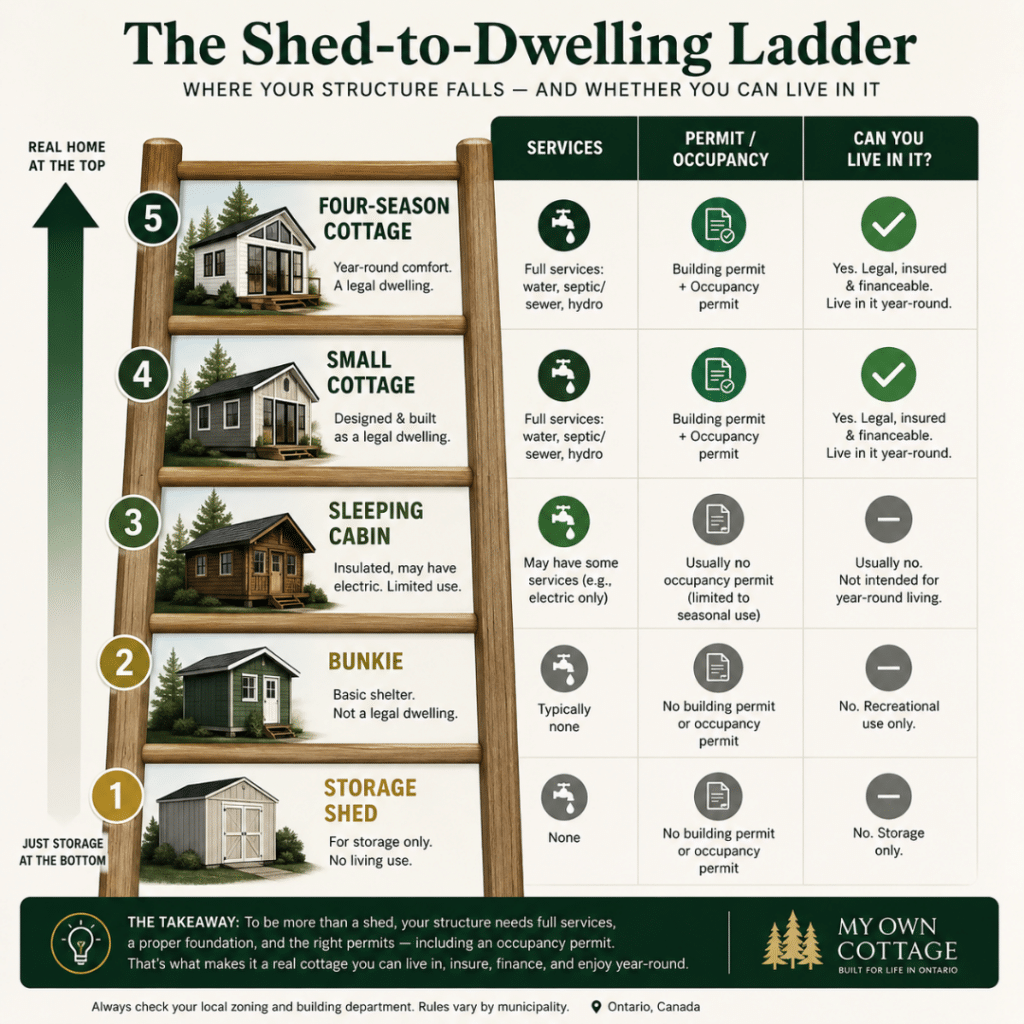
A visual guide showing how a small structure progresses from storage shed to legal year-round cottage in Ontario.
| Rung | What it really is | Services | Permit & occupancy | Can you live in it? |
|---|---|---|---|---|
| Storage shed | Backyard storage | None | No occupancy | No |
| Bunkie | Accessory sleeping structure | Often none or power only | Accessory permit; usually no plumbing | Overnight, seasonal only |
| Sleeping cabin (~600 sq ft) | Larger accessory sleeping space | Limited | Accessory; municipalities often cap the size | Seasonal, not a primary residence |
| Legal small cottage | Self-contained dwelling | Full: hydro, water, septic/well | Building permit + occupancy | Yes |
| Year-round dwelling | Four-season cottage | Full, plus insulation & heating | Building permit + occupancy | Yes, all year |
Why this matters for your money: the cheapest advertised “cabins” sit on the bottom two rungs. They’re real structures, but the headline price doesn’t include the foundation, servicing, permits, or finishing that turn them into something you can occupy. A small cottage that’s a genuine dwelling carries those costs because it has to. If a price looks too good for a livable cottage, it’s almost always pricing a shell, not a home.
If a cabin or bunkie is actually the right fit for your property — extra guest or seasonal space rather than a full dwelling — our prefab cabins in Ontario page covers those lower-rung options directly.
For the full component-by-component math behind a livable small cottage, see our breakdown of the full cost to build a prefab cottage. This page stays focused on the size and product decision.
How small can an Ontario cottage legally be?
There’s no single province-wide minimum that fits every case, because zoning, minimum dwelling size, and shoreline rules are set municipally.
As a working rule, accessory sleeping cabins on many cottage properties are kept around 600 sq ft or smaller, while a structure you intend to live in as a dwelling must meet your municipality’s minimum size, setback, and servicing requirements under the Ontario Building Code.
Always confirm with your local township before you buy.
What actually flips a small structure from “accessory building” to “legal dwelling” is consistent across Ontario, even when the numbers differ:
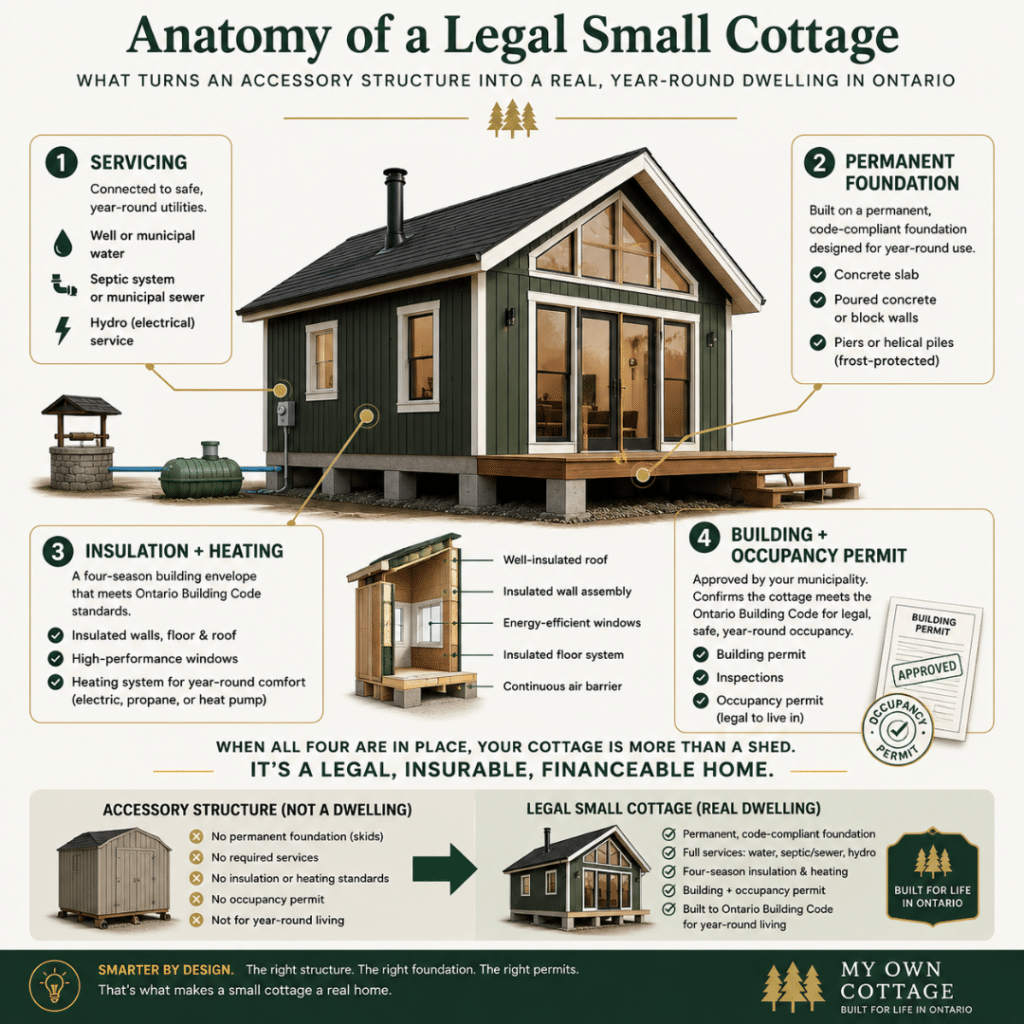
Small prefab cottages in Ontario become legal year-round dwellings when four key requirements are met: servicing, a permanent foundation, insulation and heating, and a building and occupancy permit. This diagram shows where the line exists between an accessory structure and a true home.
• Servicing — a permanent water source (well or municipal), septic or sewer, and hydro.
• Foundation — a permanent foundation suited to your site, whether a slab, piers, or helical piles, rather than the skids a shed sits on.
• Insulation and heating — required for four-season, year-round use, not just summer weekends.
• Building and occupancy permits — the occupancy permit is the document that legally clears you to move in, and it’s what a lender and title lawyer look for at closing.
These rules sit under the Ontario Building Code, administered provincially through the Ministry of Municipal Affairs and Housing, but they’re enforced and interpreted locally — which is why two similar lots can carry different requirements.
Not sure your lot can take a small cottage? We’ll confirm the zoning, setbacks, and servicing for your exact property — no commitment.
Year-round vs. seasonal: what changes
A seasonal cottage and a year-round one can start from the same compact footprint; the difference is in the envelope. Year-round use in Ontario’s climate means a higher insulation spec and R-value, an efficient heating system, and freeze-protected plumbing.
The building enclosure, not the floor plan, does the work, and it’s also what keeps an energy-efficient small cottage cheap to run. If you’re deciding between the two, decide on use first, because it changes the spec, the permit path, and the budget.
This is where lot-specific reality matters more than any model brochure. Before committing, it’s worth a free consultation to confirm your lot’s servicing and setback constraints. A shoreline parcel in Muskoka and a rural lot in Kawartha Lakes can carry very different requirements.
Small prefab cottages that are actually dwellings
My Own Cottage’s compact models are built as self-contained, code-compliant homes, not accessory cabins.
Each is a factory-built modular dwelling engineered to Ontario Building Code and CSA A277 standards, delivered from our Orillia facility, and finished to be serviced and — where you choose — four-season ready. These sit on the top rungs of the ladder above: real cottages that happen to be small.
Our verified models under 1,000 sq ft:
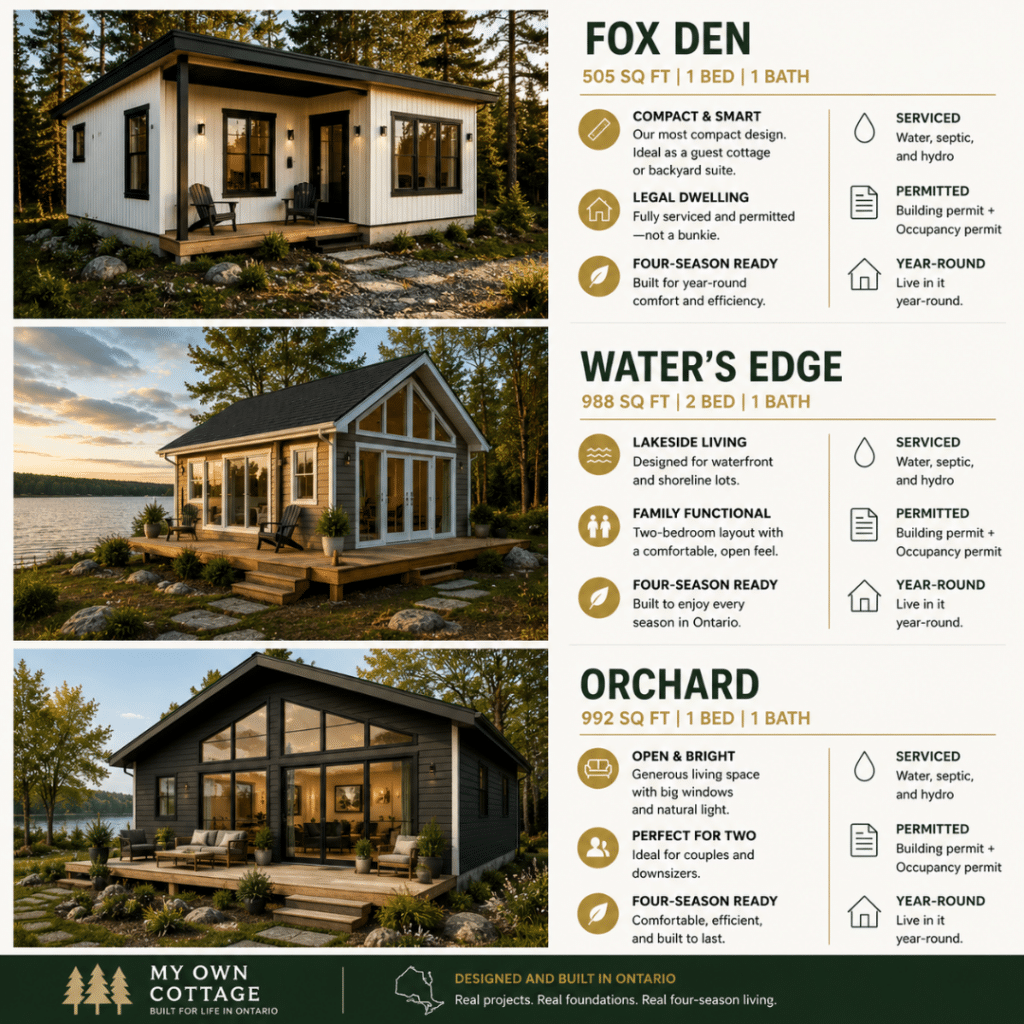
Three of our most popular Small Prefab Cottages Ontario models. Fox Den, Water's Edge, and Orchard are highly customizable designs built for year-round living and adapted to the unique needs of each homeowner and lot.
• Fox Den — 505 sq ft, 1 bed / 1 bath. Our most compact design. It doubles effectively as a guest cottage or backyard suite where your lot and zoning allow, while still being a real serviced dwelling rather than a bunkie. See the Fox Den model details.
• Water’s Edge — 988 sq ft, 2 bed / 1 bath. A two-bedroom layout built with lakeside lots in mind, and the practical sweet spot for a small family cottage that doesn’t feel cramped. See the Water’s Edge model details.
• Orchard — 992 sq ft, 2 bed / 1 bath. A one-bedroom cottage with generous living space, suited to couples and downsizers who want room to spread out without going large. See the Orchard model details.
Every model is customizable. You can adjust layout, square footage, and finish level to match your site and budget.
Small prefab cottages cost meaningfully less than a full-size build, mostly because there’s less to build, heat, and maintain. Our compact models start at $229,500 delivered for the Fox Den (505 sq ft), with most sub-1,000 sq ft cottages running roughly $229,500 to $324,500 delivered — before the site costs (foundation, servicing, permits) that depend on your lot.
For the full component-by-component breakdown, see our cost to build a prefab cottage guide, or our turnkey cottage packages if you’d rather have site prep, delivery, and finishing handled as one price.
To see more options with full pricing, browse our catalogue of prefab cottage models.
How a small cottage lives bigger than its square footage
A well-designed 500–1,000 sq ft cottage can live like something half again its size. The trick is in the layout, not the floor area.
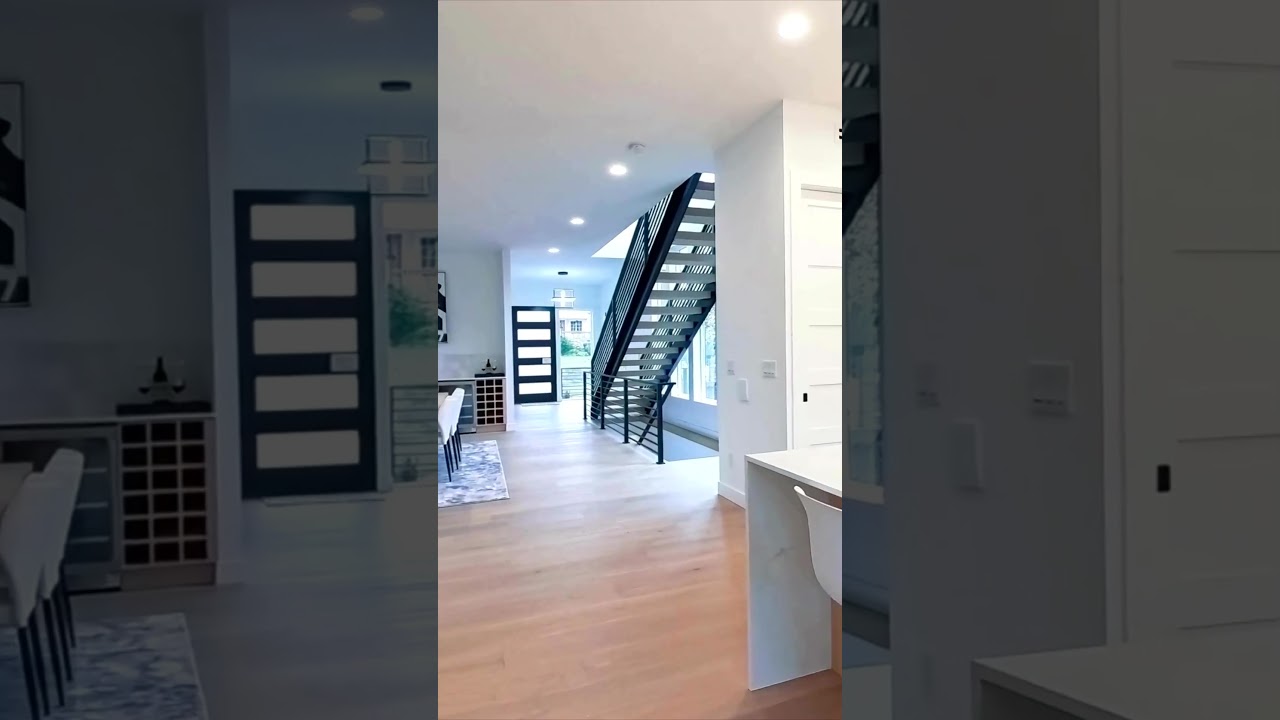
Open-plan main spaces, full-height glazing toward the view, built-in storage, and a clear separation between sleeping and living zones make a compact footprint feel generous. Square footage tells you what you’re paying to heat; layout tells you how it actually feels to live in.
A few moves that do the heavy lifting in small cottages:
• Borrow the outdoors. Large glazing and a covered deck make the living area read as larger and pull the lake or tree line inside.
• Build storage into the structure. Bench seating, loft space, and wall-depth storage keep floor area clear.
• Zone, don’t wall. Sliding partitions and half-walls give bedrooms privacy at night without chopping the plan into small boxes during the day.
• One generous room beats two cramped ones. In a small cottage, a single bright main space usually beats squeezing in an extra bedroom you’ll rarely use.
This is the difference between a cottage that feels small and one that simply is small, and it’s the part of the decision most listings skip entirely.
Is a small prefab cottage right for you?
A small prefab cottage is the right call when the lot, the budget, or the lifestyle rewards a compact footprint, and the wrong one when you’re really trying to fit full-size needs into a small shell to save money. Going small works best as a deliberate choice, not a compromise.
A small prefab cottage fits well if you’re:
• Buying your first cottage and want a lower entry cost and upkeep.
• Downsizing, or want a low-maintenance seasonal getaway.
• Working with a narrow, shoreline, or setback-constrained lot.
• Adding a guest cottage or secondary dwelling where zoning permits.
Consider sizing up if you’re:
• Housing a larger family full-time and need three-plus bedrooms.
• Planning to run it as a year-round primary residence with home offices and storage for a household’s worth of life.
Honest fit beats a forced sale. If a compact model won’t comfortably hold how you’ll actually use the cottage, a slightly larger plan is the better long-term decision, and we’ll tell you that directly during a consultation.
Small Prefab Cottage FAQs: Sizes, Permits & Year-Round Living
What is the smallest prefab cottage available in Ontario?
Our smallest model is the Fox Den at 505 sq ft, a one-bedroom, one-bath design that’s a fully serviceable dwelling rather than a bunkie. Smaller accessory structures exist on the market, but most are sleeping cabins or sheds, not cottages you can live in as a legal dwelling.
How small can a cottage be in Ontario and still be permitted?
It depends on your municipality. Minimum dwelling sizes, zoning, and shoreline setbacks are set locally, so a size that’s permitted on one lot may not be on another. Accessory sleeping cabins are often kept around 600 sq ft or less, while a year-round dwelling must meet local minimums. Confirm with your township before buying.
Is a small prefab cottage a real home or just a cabin?
It’s a real home when it’s serviced, insulated for its intended use, built to the Ontario Building Code, and granted an occupancy permit. A bare shell, bunkie, or sleeping cabin is an accessory structure, not a dwelling. The presence of full servicing and occupancy, not the size or price, is what makes it a legal cottage.
Are small prefab cottages cheaper to run?
Generally, yes. A smaller building envelope means less space to heat, cool, and maintain, so operating and upkeep costs are typically lower than a large cottage. The exact savings depend on insulation, heating system, and how often you use it.
Can you live in a small prefab cottage year-round?
Yes, if it’s built for four-season use. That means a higher insulation spec, an efficient heating system, and freeze-protected plumbing suited to Ontario winters. A summer-only cottage can often be upgraded, but it’s far simpler and cheaper to specify year-round capability from the start.
Can a small prefab cottage be used as a guest cottage or secondary unit?
Often, where local zoning allows a secondary or accessory dwelling. Compact models like the Fox Den are well suited to use as an additional dwelling unit, but eligibility is governed by your municipality’s rules on secondary units and accessory dwellings, so it needs to be confirmed for your specific lot.
Is My Own Cottage a licensed, warrantied Ontario builder?
Yes. My Own Cottage Inc. is HCRA-licensed — Ontario’s mandatory builder licence — and every build is enrolled in the Tarion new-home warranty before construction begins. Our factory construction is also built to the CSA A277 standard. You can verify each credential directly through the regulators.
Choosing the Right Small Prefab Cottage in Ontario
The most important decision with a small prefab cottage isn’t the floor plan. It’s whether what you’re buying is a real, serviced, permitted dwelling or an accessory structure dressed up as one.
Once you’re clear on that, the rest is straightforward: pick the rung you actually need, match it to a model that fits your lot and how you’ll use it, and confirm your site’s servicing and setback realities before you commit.
And if you’re still comparing a small cottage against larger models or other build types, our Ontario prefab cottages guide pulls the full range together in one place.
If you want that confirmed for your specific property, book a free consultation with our Orillia team. We’ll assess your lot, walk through which compact models fit, and give you a clear all-in range before any commitment.
• Request a Free Consultation
• Call Us Directly: (705) 345-9337
• View Our Design Catalogue
Alternatively, for your convenience, you can also simply fill out the contact form below and we’ll get back to you soon!
Contact Us
We usually respond within 24 hours!
- Comprehensive Warranty
- Best Price Guarantee
- Exceptional Service