Prefab Cottages Petawawa: Models, Costs and Lot Requirements
Last updated: August 4, 2026
Prefab cottages in Petawawa start at $229,500 for a compact model, delivered to your lot. That covers the home.
Foundation, site preparation, servicing, delivery access, permits and the Town’s development charges are separate — and in Petawawa those charges change depending on which municipal services reach your property.
✓ HCRA Licensed | ✓ Tarion Enrolled | ✓ CSA A277 | ✓ Ontario-Built
My Own Cottage is an HCRA-licensed, Tarion-enrolled builder of prefab homes, cottages and cabins, custom built on your lot. We design and build in Orillia and deliver across Ontario, including Petawawa, Pembroke, Laurentian Valley, Deep River and the wider Ottawa Valley.
Below: the models and current cottage pricing, what the Town charges in 2026, how Petawawa’s Zoning By-law treats a prefabricated dwelling, financing routes, and what a lot needs before a cottage can be set on it.
If you’re still deciding on a location, you can also compare prefab cottage options across Ontario before narrowing to a single municipality.
Prefab cottage and home models for Petawawa lots
My Own Cottage offers 33 preconfigured models from 505 to 3,373 square feet, with cottage pricing from $229,500 to $949,500. Each model is a starting point rather than a fixed package — layouts, finishes and features are adapted to the property and how you intend to use it.
The selection below suits most Petawawa lots, from compact four-season cottages to full family homes.
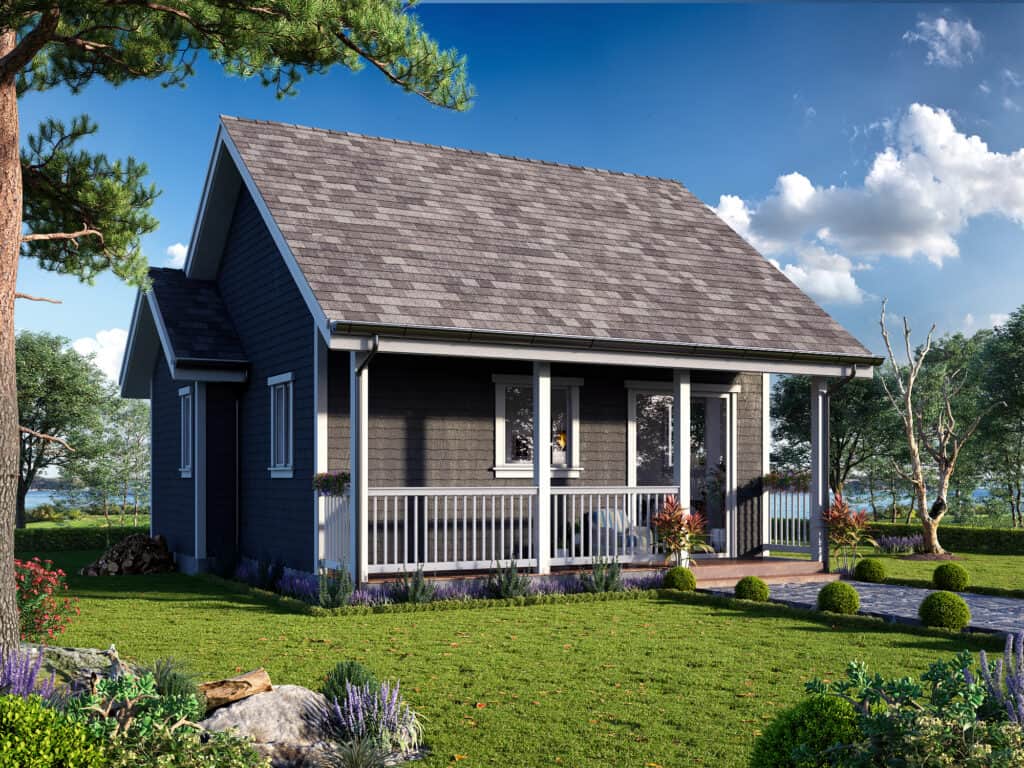
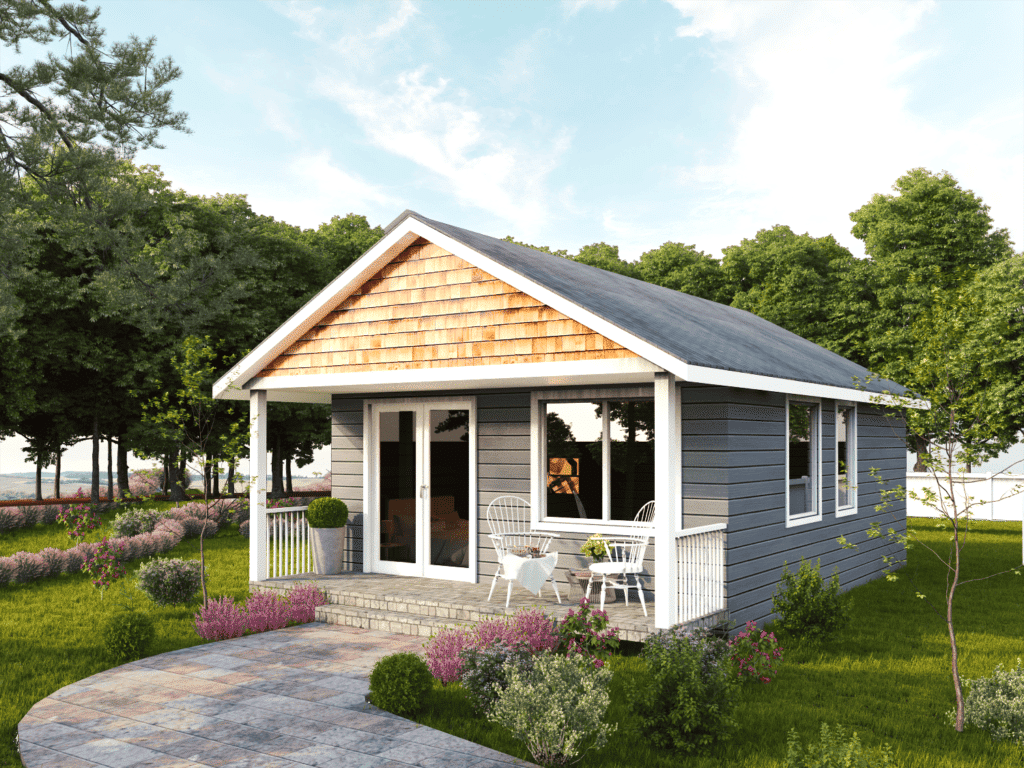
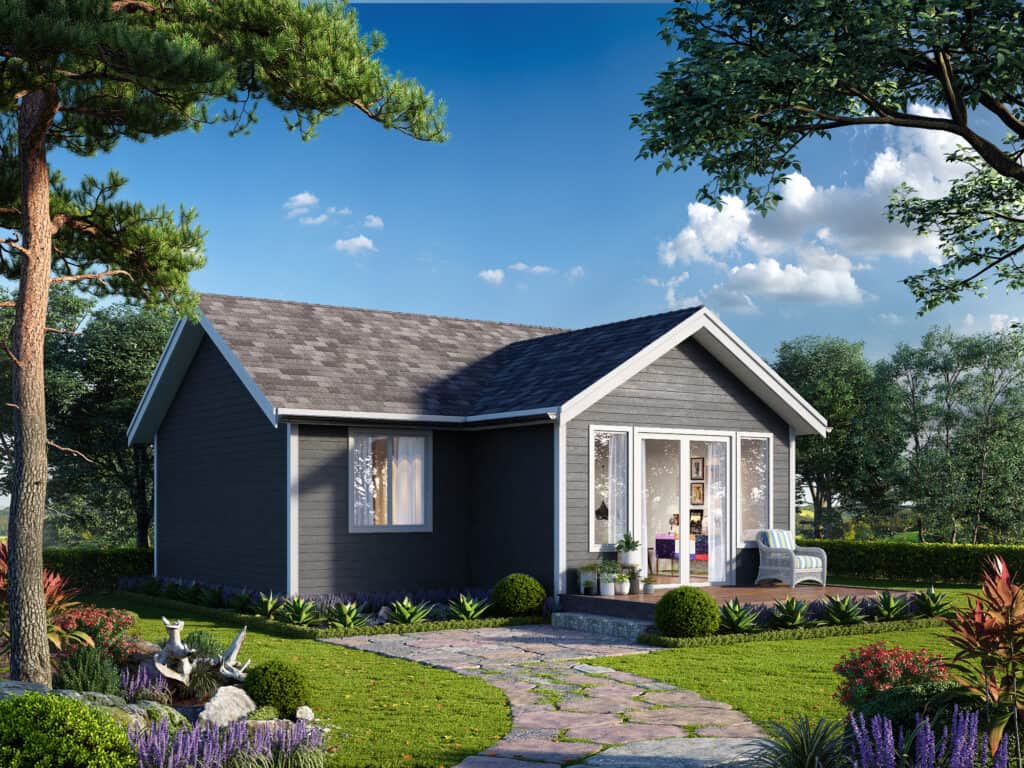
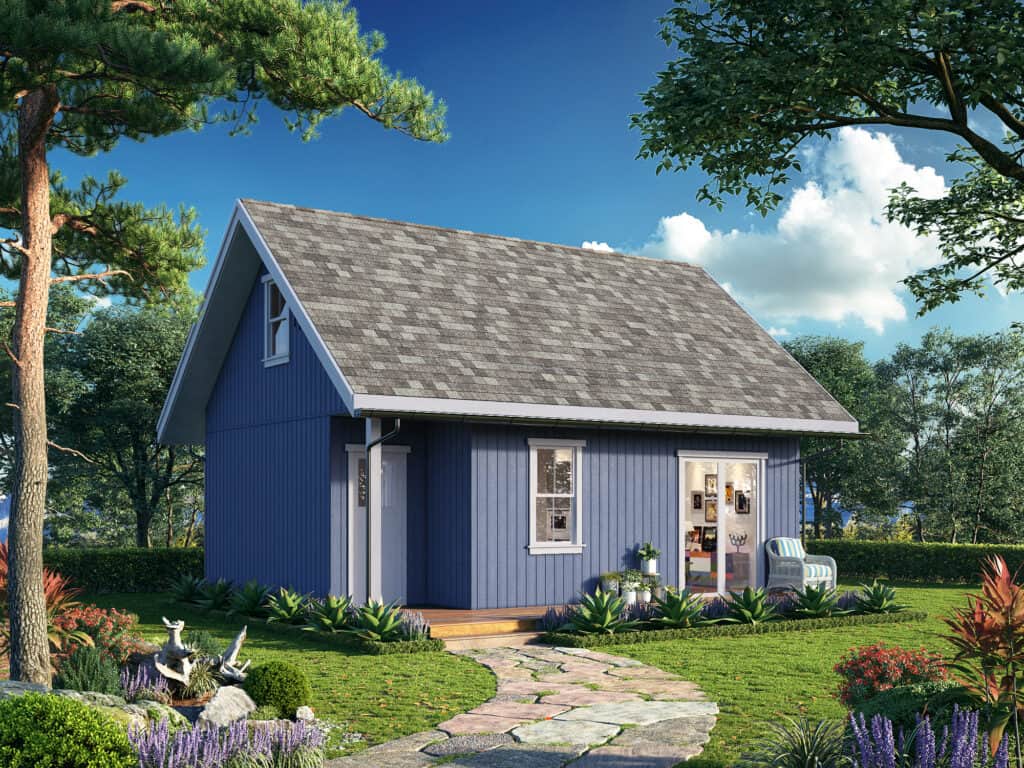
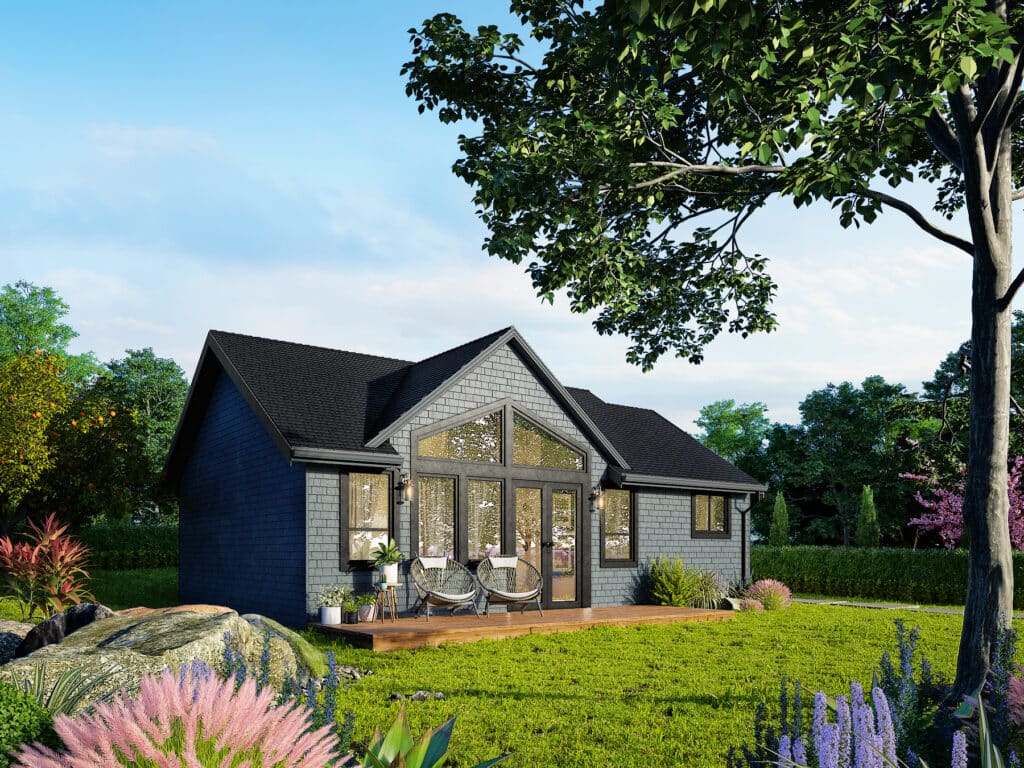
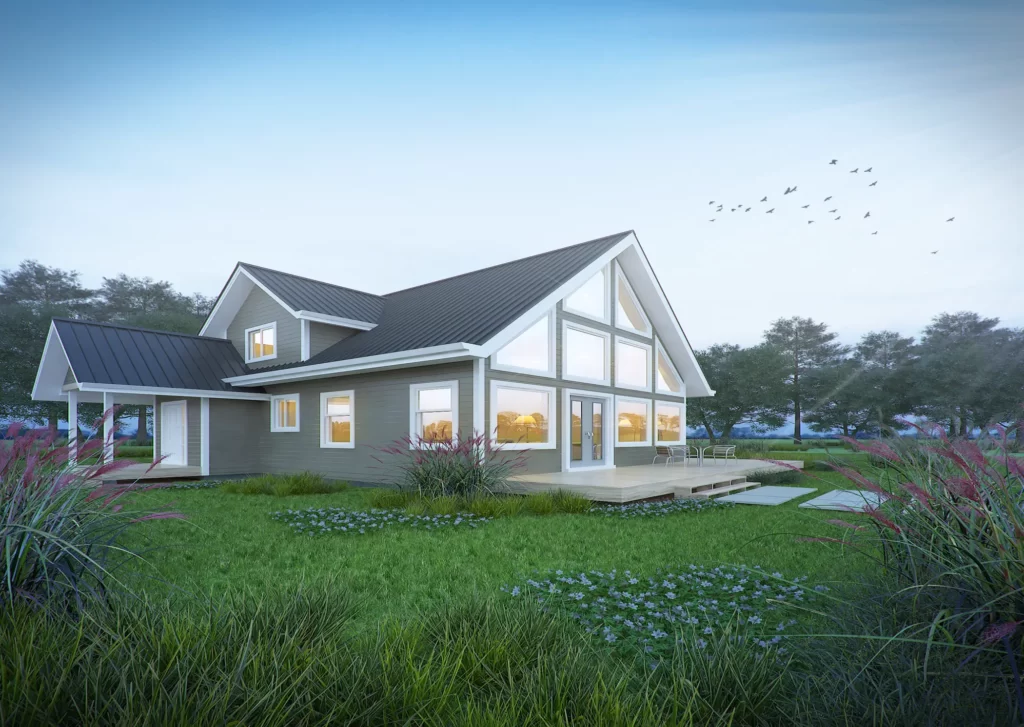
- 988 SQ. FT
- Bedrooms: 2
- Bathrooms: 1
Preconfigured model starting at: $324,500

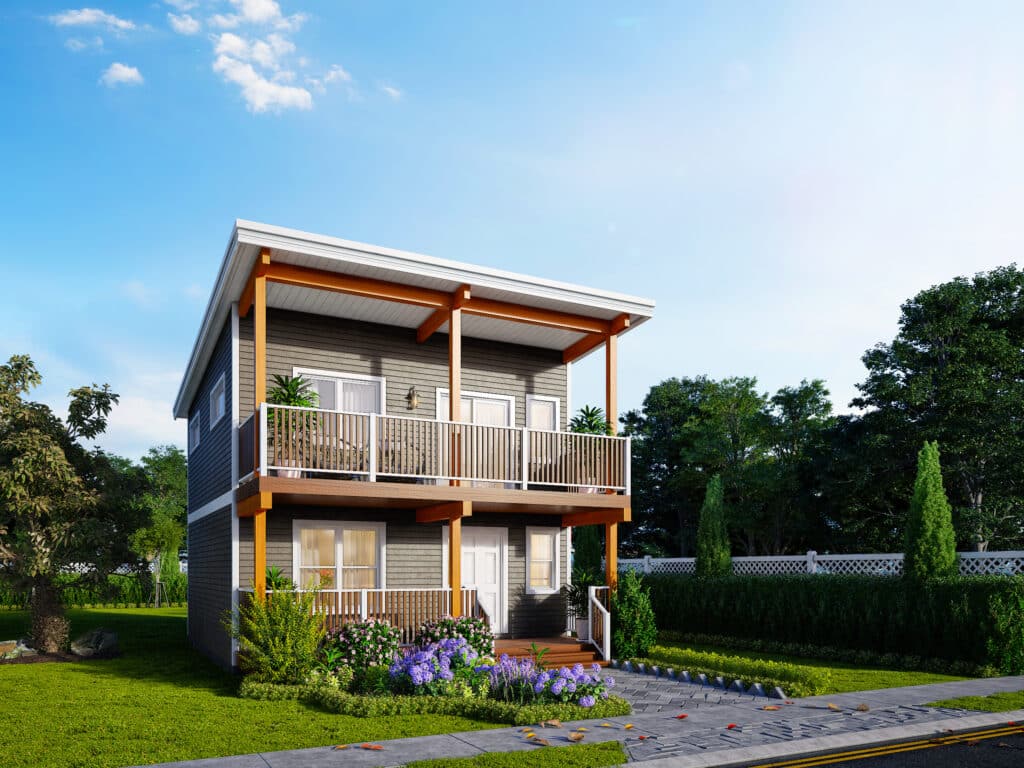
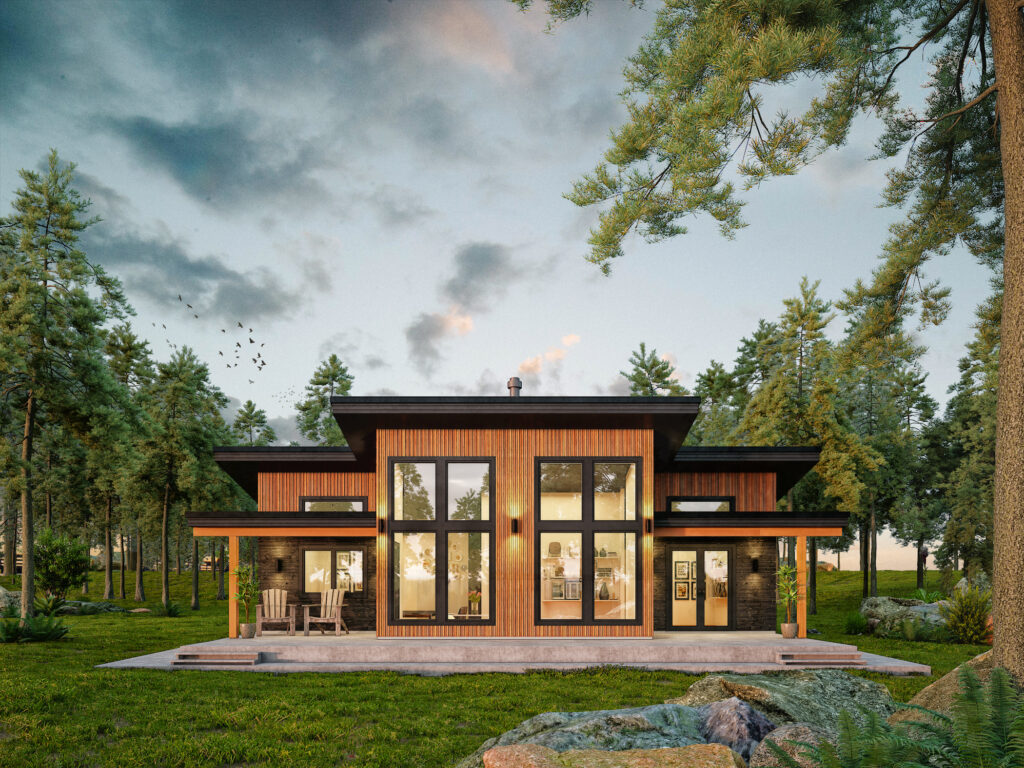
- 1752 SQ. FT
- Bedrooms: 3
- Bathrooms: 2
Preconfigured model starting at: $519,500
Prices are for the preconfigured model and exclude foundation, site preparation, servicing, permits and municipal charges. See all 33 models and floor plans.
Choosing a model by how you’ll use it
A seasonal cottage or weekend retreat. Small homes in the 505–646 square foot range — Fox Den, Pine View, Willow — suit a recreational lot where the priority is a comfortable base rather than square footage. These are also the models that keep site costs lowest, because a smaller dwelling generally means a smaller septic system and a simpler foundation.
A four-season cottage or year-round home. From roughly 788 square feet upward, Hideaway through Hudson, the conversation shifts to permanent occupancy: insulation and heating specified for continuous use, a foundation suited to winter, and a driveway that can be maintained year-round.
A guest house or second unit. Compact models are frequently used as a detached additional residential unit behind an existing home. Whether that’s permitted depends on your lot — see the second-unit section below before planning one.
Custom cottages. If none of the 33 fits, we design from scratch. Most buyers start with a model and adapt it; a minority start with a blank page. Both routes run through the same design, factory construction and installation process.
Why a bigger model isn’t always the more expensive one
Price tracks specification, not floor area alone. Kingswood and Bay Breeze are both 646 square feet, at $259,500 and $299,500. Orchard, at 992 square feet, is $289,500 — larger than both and priced between them. What drives the number is what’s inside the home, not how much of it there is.
Prefab, modular, panelized or kit — which one is this?
“Prefab” describes any home with major components built in a factory rather than on site.
Modular homes arrive as finished three-dimensional sections and are set on a permanent foundation. Panelized homes arrive as flat wall and roof panels for assembly on site. Kit homes are a materials package the buyer or their contractor builds. My Own Cottage builds modular prefab homes and cottages.
The distinction matters in Petawawa because the four products carry different legal status, different financing routes, and very different amounts of work left after delivery.
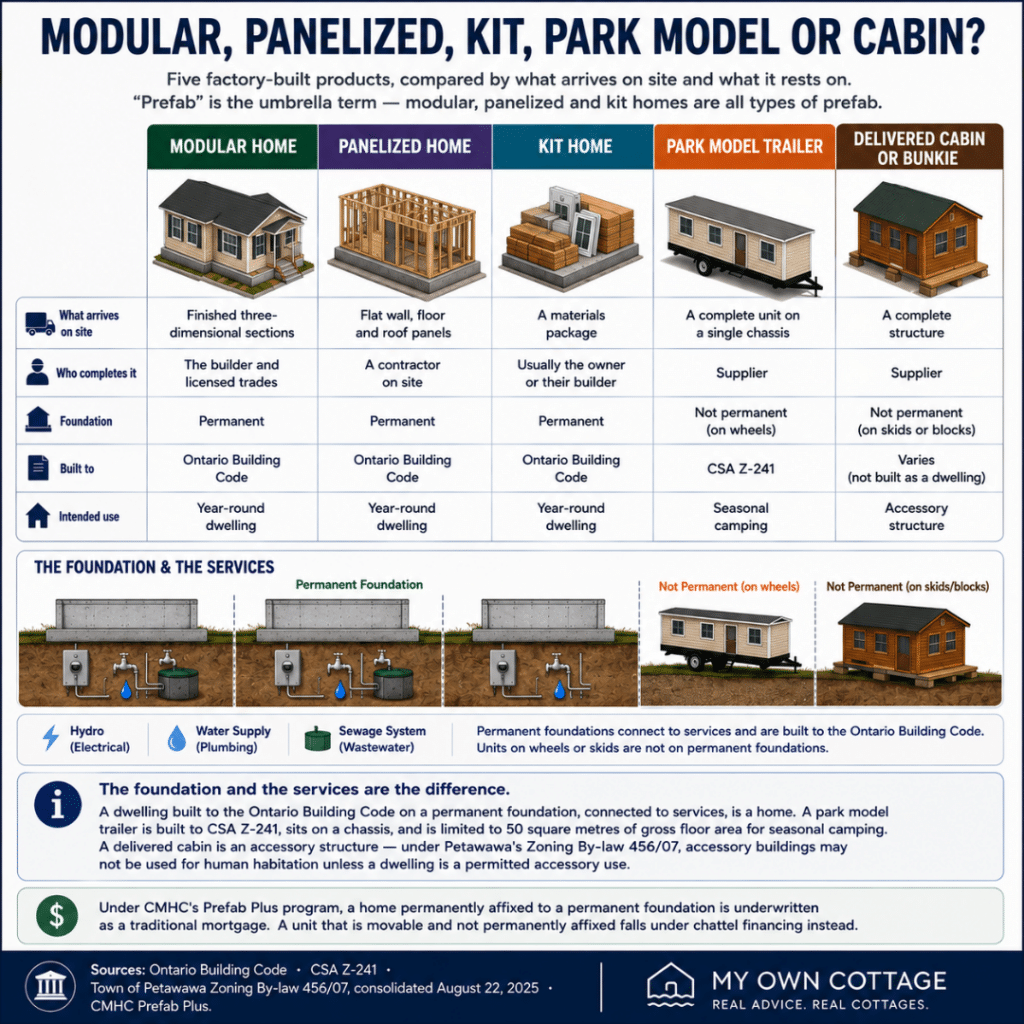
Five factory-built products, five different outcomes. The foundation and the service connections decide whether you own a dwelling or a structure — not how the building was made.
| Build type | What arrives on site | Who completes it | Foundation |
|---|---|---|---|
| Modular prefab | Finished sections, largely complete | The builder and licensed trades | Permanent |
| Panelized | Flat wall and roof panels | A contractor on site | Permanent |
| Kit home | A materials package | Usually the owner or their builder | Permanent |
| Park model trailer | A complete unit on a chassis | Supplier | Not permanent |
| Delivered cabin or bunkie | A complete structure | Supplier | Not permanent |
Two of those are not dwellings. A park model trailer is built to the CSA Z-241 standard, mounted on a single chassis, designed for seasonal camping, and limited to 50 square metres of gross floor area. A delivered cabin or bunkie is an accessory structure — widely and legitimately sold across the Ottawa Valley, but not a year-round home.
The price gap between a delivered cabin and a modular dwelling reflects a difference in product, not a discount.
Kit homes sit in between: a permanent dwelling when properly built, but with far more left to do after delivery. If you’re weighing that route, what a structural kit does and does not include sets out where the package ends and your own budget begins.
You will also see manufactured homes and mobile homes used loosely as synonyms for prefab. In Petawawa’s Zoning By-law they are not — and that difference has real consequences, covered below.
What does a prefab cottage cost in Petawawa?
A prefab cottage in Petawawa starts at $229,500 for a compact model delivered. Total project cost depends on the lot: foundation, site preparation, well and septic or municipal connections, delivery access, permits and development charges. Buyers with a serviced lot generally spend less on site costs than buyers starting from raw land, though a new dwelling still triggers permits and Town charges.
Treat a Petawawa project as two budgets.
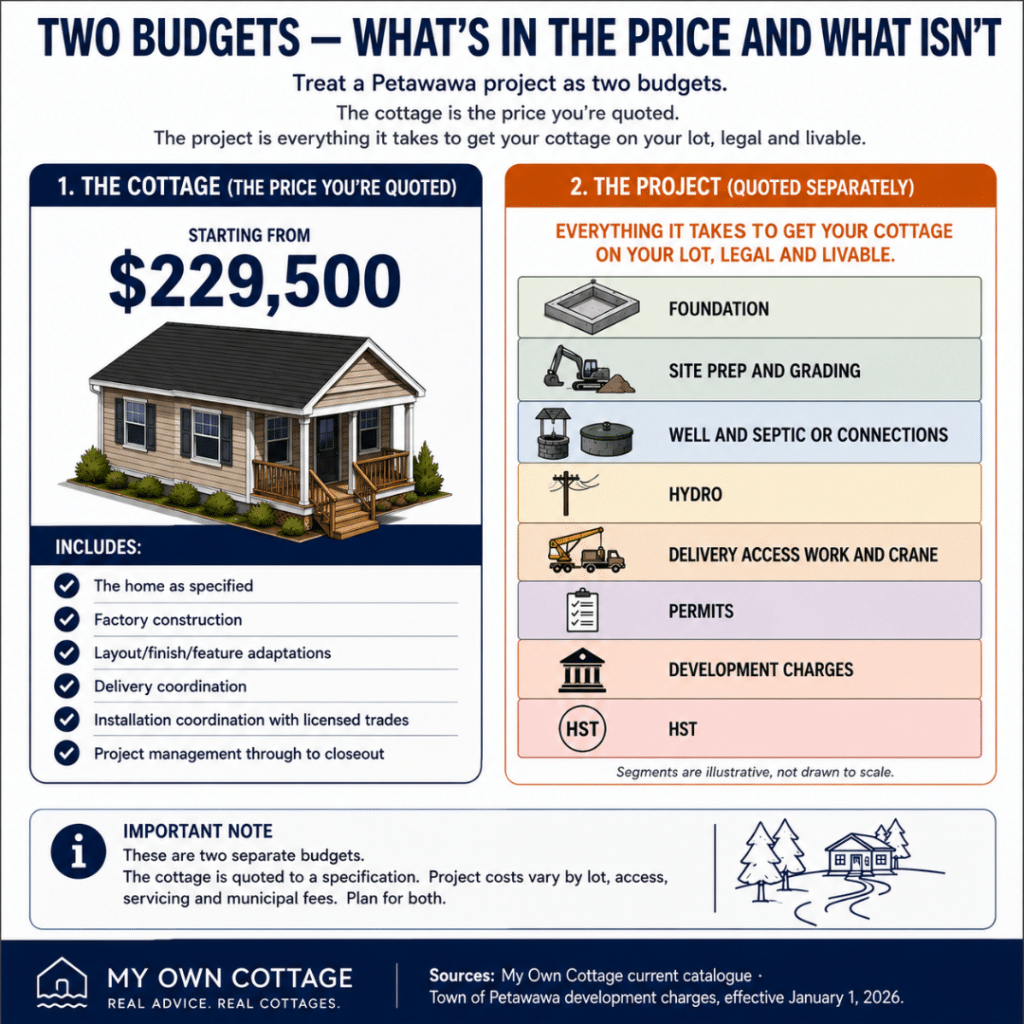
The cottage is quoted. The project is estimated. It's why two buyers picking the same model can end up with very different totals.
The cottage. Quoted, fixed to a specification, and built indoors. Materials are not exposed to rain, snow or freeze-thaw during construction, and offcuts and surplus are managed in one place rather than across an open site — which is why factory construction produces less material waste than an equivalent site build.
The project. Everything that happens on your land. This is where two buyers choosing the identical model end up with different totals.
What the model price includes and excludes
| Included in the model price | Quoted separately |
|---|---|
| The home as specified | Foundation |
| Factory construction | Site preparation and grading |
| Layout, finish and feature adaptations | Well and septic, or municipal connections |
| Delivery coordination | Hydro service |
| Installation coordination with licensed trades | Delivery access work and crane |
| Project management through to closeout | Building and sewage system permits |
| Town development charges | |
| HST |
Why we don’t publish a per-square-foot rate
A per-square-foot figure only means something when everyone quoting it includes the same scope, and across this market they don’t. One builder’s rate may cover a delivered shell; another’s may cover a finished home; a third’s may include foundation work. Comparing a model price against an itemised site scope tells you far more than comparing two rates.
If affordability is the deciding factor, the most useful thing you can do is get the site costs estimated early. On many Petawawa lots the land and its servicing move the total more than the choice of model does.
For a wider view of what the site side involves, how Ontario cottage budgets break down covers the same cost categories across the province, without the Petawawa-specific charges.
What does the Town of Petawawa charge in development charges?
Effective January 1, 2026, the Town of Petawawa’s development charge for a single or semi-detached dwelling is $5,612 in the rural area, $7,643 in the rural water-only area, and $11,637 in the urban area.
Charges for municipal water and wastewater apply only to development actually receiving those services, which is why the same dwelling costs three different amounts.
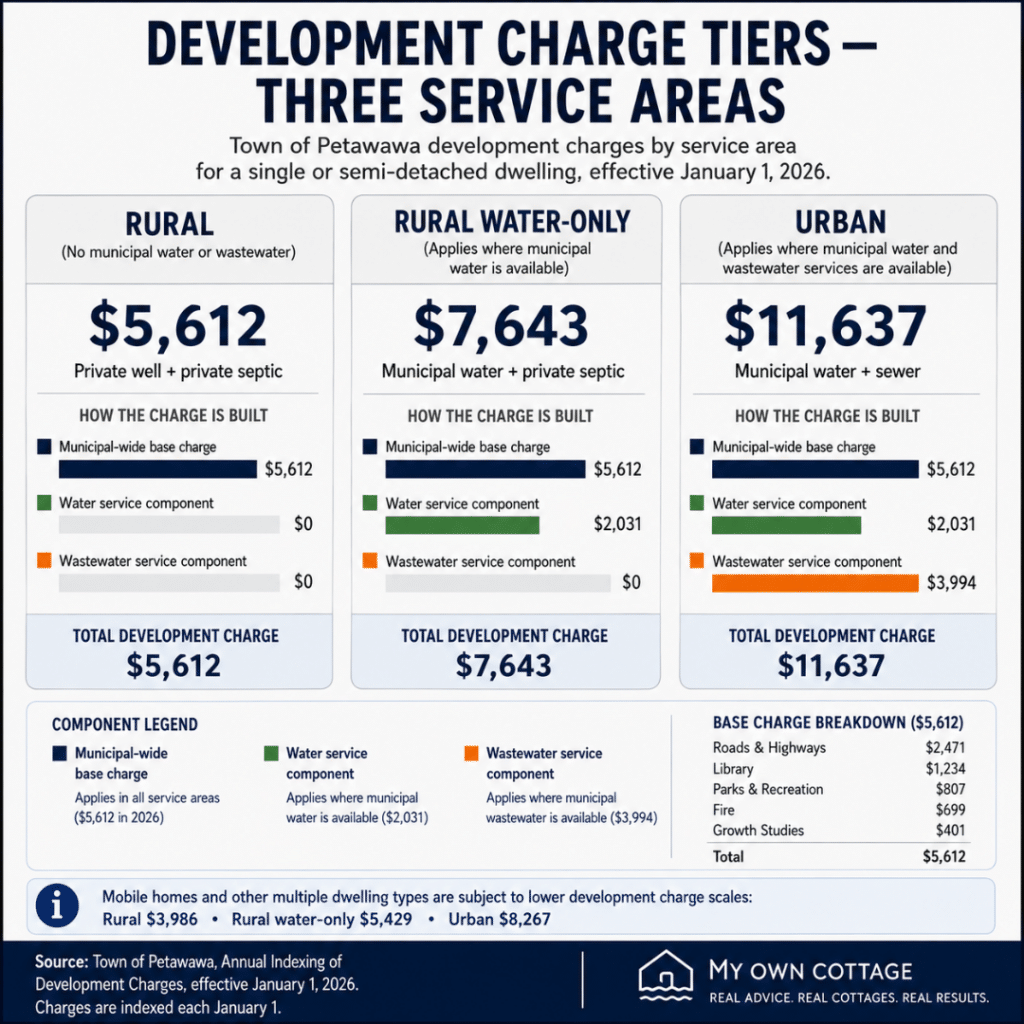
The same home, three different charges. Petawawa's development charge depends on which municipal services reach your lot — $5,612 rural, $7,643 with municipal water, $11,637 fully serviced. Effective January 1, 2026, indexed annually.
This is the most consequential number in a Petawawa budget that almost never appears in a builder’s quotation — because it is paid to the Town, not the builder.
Three service areas, three charges
| Service area | Water | Sewage | 2026 charge (single/semi-detached) | Services included in the charge |
|---|---|---|---|---|
| Rural | Private well | Private septic | $5,612 | Municipal-wide services only |
| Rural — water only | Municipal | Private septic | $7,643 | Municipal-wide + water ($2,031) |
| Urban | Municipal | Municipal | $11,637 | Municipal-wide + water and wastewater ($6,025) |
The $5,612 municipal-wide base breaks down as services related to a highway ($2,471), library ($1,234), parks and recreation ($807), fire protection ($699) and growth-related studies ($401). Mobile homes and other multiples are charged on a separate, lower scale — $3,986 rural, $5,429 rural water-only, $8,267 urban.
What this means in practice: a rural lot on a well and septic pays roughly half the development charge of a fully serviced urban lot. That $6,025 difference belongs in your site costs from the first conversation.
Exemptions
Development charges do not apply to lands owned or used by a board of education, the municipality, the County of Renfrew, an exempt place of worship or cemetery, Garrison Petawawa, or bona fide non-residential farm buildings.
These figures move every January
The schedule is adjusted annually on January 1 in accordance with the prescribed index in the Development Charges Act, 1997, without any amendment to the by-law. Any published development charge figure — including this one — carries a twelve-month shelf life. Confirm the current amount with the Town before finalising a budget.
Source: Town of Petawawa, Annual Indexing of Development Charges, effective January 1, 2026.
Can you put a prefab cottage on vacant land in Petawawa?
In most cases, yes. Petawawa’s Zoning By-law expressly accommodates prefabricated dwellings: Section 2.61 defines a single detached dwelling as one that “includes a prefabricated single dwelling unit but does not include a mobile home.” Whether a specific lot works depends on its zone, its servicing, and whether it fronts on an improved street.
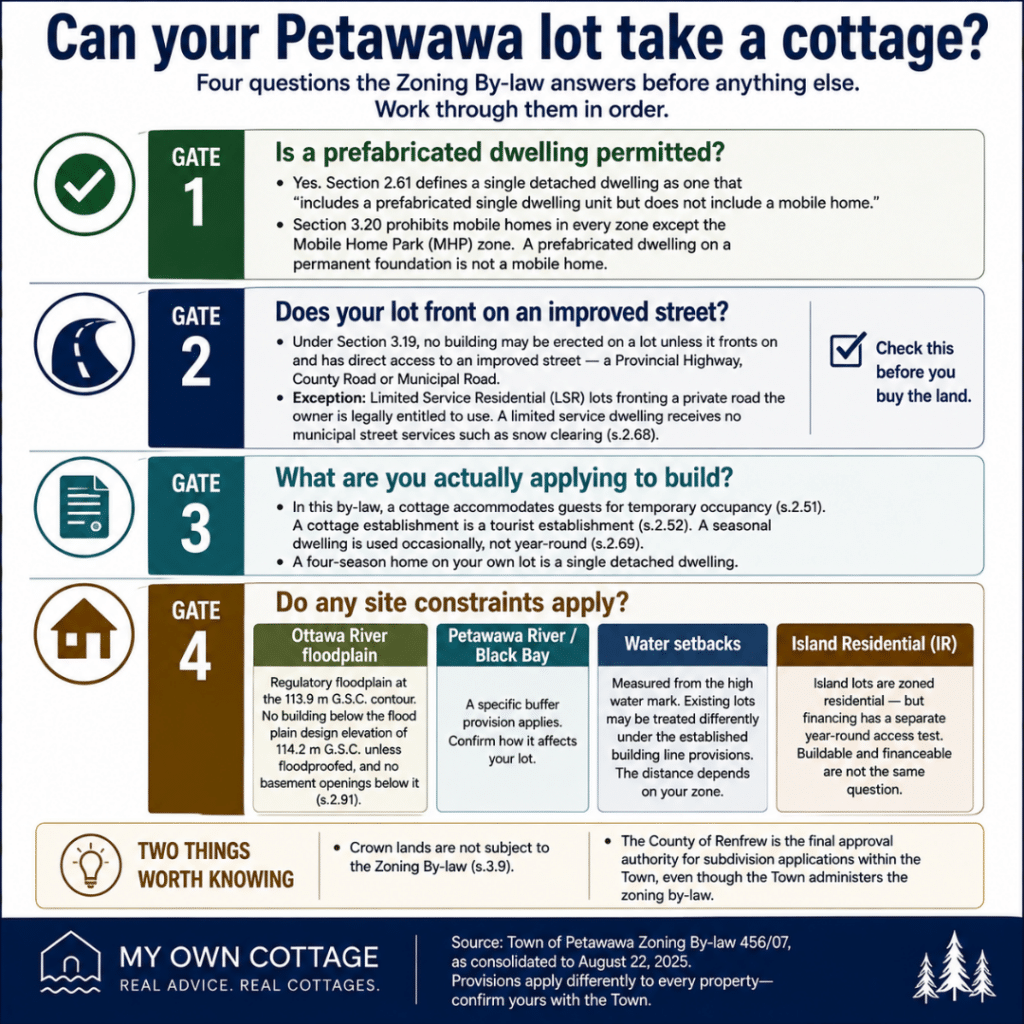
Start here before you fall in love with a lot. The by-law already allows prefab — the rest depends on frontage, classification and what's near the water.
That definition carries more weight than it first appears, because Section 3.20 of the same by-law prohibits mobile homes in every zone except the Mobile Home Park (MHP) zone.
So that by-law draws a firm line between two things buyers routinely conflate. A prefabricated dwelling — built in sections in a factory, transported, and permanently installed on a foundation — is admitted as a single detached dwelling. A mobile home is not, outside one zone. If you hear that Petawawa “doesn’t allow factory-built homes,” that’s the mobile home rule being misapplied to modular homes.
“Cottage” has a narrower meaning in the by-law
In Zoning By-law 456/07, a cottage is a building accommodating guests for temporary occupancy (s.2.51), and a cottage establishment is a tourist establishment (s.2.52). A seasonal dwelling is one used occasionally rather than year-round (s.2.69).
If you want a four-season home on your own lot, what you’re building — in the by-law’s language — is a single detached dwelling. Call it a cottage in conversation; just know the word means something narrower when you’re speaking to the Town, and using it loosely can send an application down the wrong path.
Your lot must front on an improved street
Under Section 3.19, no building may be erected on a lot unless the lot fronts on and has direct access to an improved street — a Provincial Highway, County Road or Municipal Road. Defined exceptions exist, including lots in the Limited Service Residential (LSR) zone fronting a private road the owner is legally entitled to use.
A limited service dwelling has no frontage on a municipally maintained street and does not receive municipal street services such as snow clearing (s.2.68). If you’re considering a back lot or a private-road property, this provision decides whether a dwelling is possible at all. Check it before you buy the land.
Waterfront lots, the Ottawa River floodplain and island properties
Ottawa River floodplain. For lands within the regulatory floodplain — the 1-in-100-year flood indicated by the 113.9 metre G.S.C. contour — no building or structure, including additions and accessory buildings, may be erected below the flood plain design elevation of 114.2 metres G.S.C. unless it is floodproofed. No basement openings are permitted below that elevation (s.2.91).
Petawawa River and Black Bay. The by-law contains a specific buffer provision for both. If your lot touches either, confirm how it applies before committing to a footprint.
Water setbacks. Measured from the high water mark. Existing lots may be treated differently under the established building line provisions, and the applicable distance depends on your zone — the Town confirms it for your parcel.
Island lots. The by-law includes an Island Residential (IR) zone, so island lots on the Ottawa River are zoned for residential use. They raise a separate question covered in the financing section below: buildable and financeable are not the same test.
Crown land and subdivision approvals
Two points that apply to rural property generally rather than to waterfront:
• Crown lands are not subject to the Zoning By-law (s.3.9).
• The County of Renfrew is the final approval authority for subdivision applications within the Town, even though the Town administers the zoning by-law.
Can you add a second cottage or unit to a Petawawa property?
Yes, under defined conditions. The Zoning By-law provides for additional dwelling units — formally additional residential units — classified as attached (within the primary dwelling) or detached (a standalone ancillary building, also called a coach house). No more than one dwelling building is permitted per lot unless the second is a detached additional residential unit under Section 3.32.
The provisions were updated by By-law 1752/25 and are detailed enough that they need checking against your actual parcel rather than summarising. One useful detail: an additional residential unit may be permitted before the primary dwelling is built, but only case-by-case through a minor variance, with a development agreement as a condition of approval.
Garden suites are a different mechanism
A garden suite is a one-unit, detached residential structure with bathroom and kitchen facilities, ancillary to an existing residence and designed to be portable. It is not an additional residential unit under this by-law, and the conditions are stricter (s.3.14):
• Permitted only where a site-specific temporary use by-law allows one
• Residential or Rural (RU) zone; principal dwelling must be single or semi-detached
• One per lot, on the same lot, occupied by the registered owner
• Must be in the rear yard, with one additional off-street parking space
• An agreement with the municipality providing for removal when no longer permitted, with securities posted
• Rear yard depth minimum 2.3 m · minimum 2.0 m from the principal dwelling · maximum 5.0 m and one storey
If the goal is a permanent second dwelling for family, a garden suite is likely the wrong route — the removal agreement is the mechanism’s whole purpose.
An accessory building is not a dwelling
Accessory buildings may not be used for human habitation unless a dwelling is a permitted accessory use (s.3.3.2). In a residential zone they’re limited to 5.0 metres in height and collectively to 10% of lot area up to 112 square metres, and generally cannot be built before the principal building exists.
What permits do you need for a prefab cottage in Petawawa?
The Town of Petawawa issues its own building permits and sewage system permits and administers its own Zoning By-law. Applications go through Cloudpermit. Most prefab cottage projects need a building permit, a sewage system permit where private septic is used, and an entrance permit if new driveway access is required.
A common misconception worth correcting: Petawawa is not administered by the County. Zoning By-law 456/07 was prepared for the Town by the County of Renfrew’s Planning Division — which is why County contact details circulate — but Section 1.3.1 states it is administered by the Town’s Chief Building Official or a Zoning Administrator appointed by Council. You apply to the Town.
The approvals a project typically involves
1. Zoning confirmation – that the proposed dwelling is permitted in your zone
2. Building permit – Building and Change of Use Permits By-law 1410/21
3. Sewage system permit – issued by the Town where private septic is used
4. Entrance permit – By-law 1590/23, where new or altered driveway access is needed
5. Site plan approval – By-law 528/08 applies to development in all zones, with limited exceptions
6. Minor variance or zoning amendment – only where a provision isn’t met
No municipal permit, certificate or licence may be issued for a use that contravenes the Zoning By-law (s.1.2.6). Confirming zoning first isn’t a formality — it’s what makes the permit possible. Beginning construction without a permit can attract a “starting without a permit” administration fee under By-law 1410/21.
Permit coordination and municipal coordination are part of our project management on every build, but the applications are made against your property and your intended use, so early involvement is worth more than late.
On timelines: the Town doesn’t publish standard processing periods for a new dwelling, and we won’t invent one. Processing depends on the completeness of the application and any outside approvals required. A complete submission moves faster than a partial one.
Town of Petawawa · 1111 Victoria Street · 613-687-5536 · Planning and Development, ext. 2011
What if your lot already has a well, hydro and septic?
You’re ahead, but not finished. Existing well, hydro and septic remove three of the larger unknowns from a Petawawa project. What remains is the foundation sized to your model, connection of the home to existing services, grading, delivery access, permits and development charges, finishing and occupancy.
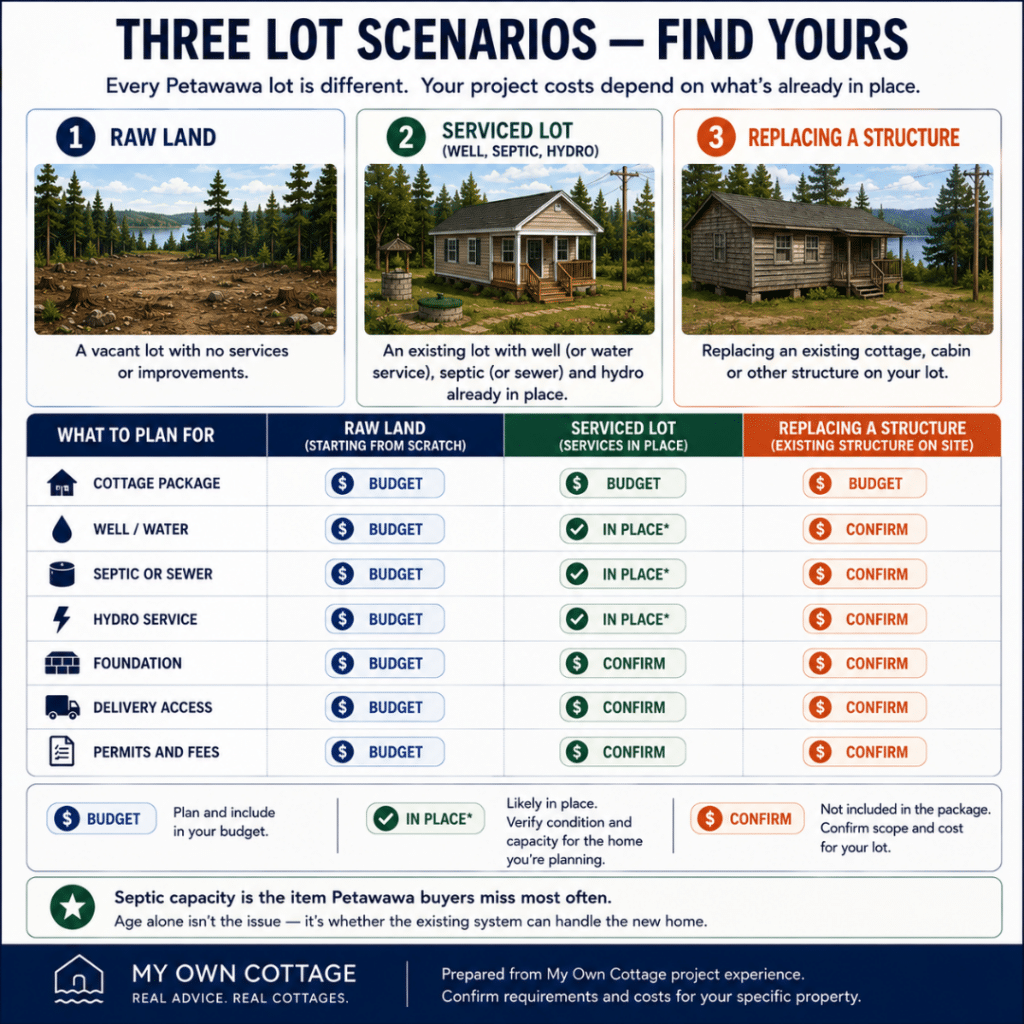
Find your lot in one of these three columns. Where the services already exist, most of your project cost is already decided.
This question comes up constantly in the Ottawa Valley, and the assumption behind it — “so all I need is the foundation and hookups” — is where site budgets most often go wrong.
What still has to happen:
• A foundation designed for the model you choose
• Connection of the home to existing services
• A septic capacity check. A system sized for a two-bedroom cabin may not serve a three-bedroom home. Capacity follows the dwelling, and this is the item Ottawa Valley buyers most often discover late.
• Grading and drainage around the new footprint
• Confirmation that the access route can take a transport trailer and crane – an existing cottage proves a truck once reached the site, not that a module can
• Building permit and development charges, which apply to a new dwelling regardless of existing servicing
• Interior finishing and final inspections
Sending us the survey, service locations and a few photos of the driveway usually produces a more accurate picture than a phone call.
Getting a prefab cottage delivered to your Petawawa lot
Delivery is a route problem before it’s a cost. A module travels on a transport trailer and is set with a crane, so the constraints are road width, turning radius at the entrance, overhead lines, bridge and seasonal load limits, and whether there’s level ground for staging and crane positioning. These are assessed for each property rather than quoted from a table.
Rural and waterfront lots in the Ottawa Valley are usually reachable, but the answer depends on the last few hundred metres more than the distance from Orillia. A narrow entrance, a low branch line or a tight turn between mature trees is the sort of thing that changes a delivery plan — and all of it is easier to solve at the design stage than the week before the truck arrives.
Seasonal road restrictions also affect scheduling for heavy transport, which is one reason delivery windows are planned around approvals rather than promised in advance.
What we need to assess access: photos of the driveway entrance and approach, an idea of the route from the nearest municipal road, and any known load-restricted bridges. Where access is genuinely constrained, a smaller model or a different siting often resolves it.
Foundations, servicing and energy efficiency
Foundation choice in Petawawa is driven by the site rather than the model — slope and bedrock, water table, setbacks and regulated areas, and whether the cottage is for year-round or seasonal use. Options run from helical piles, which disturb the least ground, through slab-on-grade and crawlspace, to a full basement.
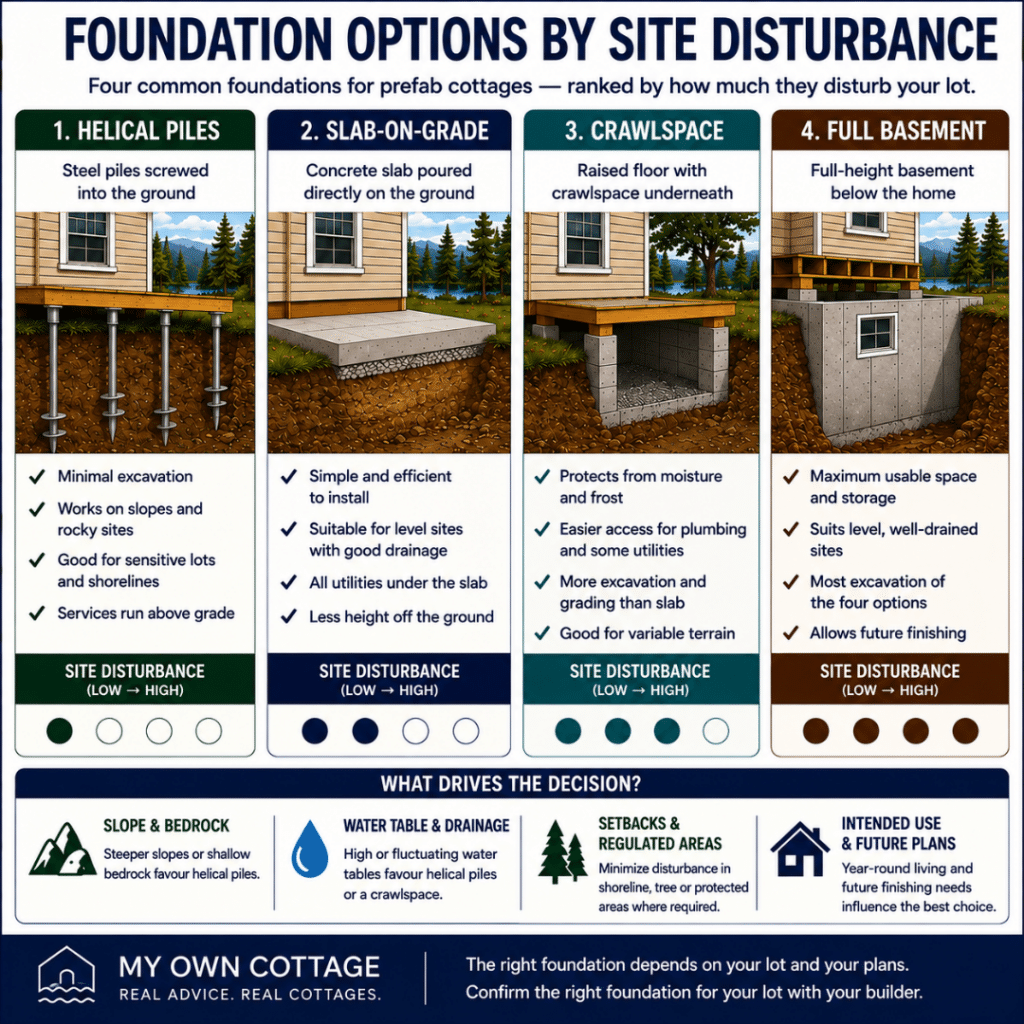
Your lot narrows the choice before preference does. Slope, bedrock, water table and setbacks usually point to one or two of these four.
| Option | Typically suited to | Ground disturbance |
|---|---|---|
| Helical piles | Sloped, rocky or sensitive sites; limited access | Lowest |
| Slab-on-grade | Level sites, single-storey layouts | Low |
| Crawlspace | Sites needing service access beneath the floor | Moderate |
| Full basement | Level sites where extra space is wanted | Highest |
The table sorts the options; choosing between them usually comes down to what’s under your particular lot. Our guide to prefab foundations goes deeper on how each type is installed, what conditions rule each one out, and where the cost drivers sit.
Well, septic and the order of operations
On unserviced land the septic system usually shapes everything else — its location influences where the dwelling sits, which influences the driveway, which influences delivery access. Sizing follows the dwelling, so choosing a larger model can change the system your lot requires. Sewage system permits are issued by the Town.
Energy efficiency and year-round comfort
The 2024 Ontario Building Code came into force on January 1, 2025 and has been mandatory for new building permits since April 1, 2025. Its energy requirements work through pre-modelled compliance packages selected by climate zone, fuel type and heating system efficiency — which means there is no single insulation value that defines a compliant home. A heat recovery ventilator is now required per dwelling unit.
Building in a controlled environment contributes to energy efficiency in a way that’s easy to overlook: air sealing and insulation are installed to a repeatable process indoors, on materials that haven’t absorbed weeks of weather. Consistency in those details matters more to real-world performance than any headline number.
The practical step for a buyer comparing builders: rather than asking for an R-value, ask for the model’s specification sheet. It identifies the design conditions the home is engineered for and the occupancy it’s approved for. That document answers the winter question; a marketing phrase doesn’t.
On factory certification: in Ontario, factory-built housing may be certified in the plant under a recognised standard — CSA A277 is the procedure most often named — or, where modules aren’t factory-certified, inspected under an arrangement agreed with the municipality. Either route ends the same way: foundation, installation, plumbing, electrical, private services, site-built decks and porches, finishing and occupancy are inspected locally. Certification scope varies by model and is confirmed per project.
Cottage financing and mortgage options in Ontario
Financing a prefab home differs from financing a resale purchase because money is released in stages as the project progresses rather than in one advance at closing. Lenders assess the land, the foundation, the certification or inspection route, and whether the finished home is permanently affixed. Terms vary by lender and by property.
The most relevant federal program is CMHC’s Prefab Plus, which was designed for exactly this build type:
• Minimum equity of 5% of the first $500,000 of lending value and 10% of the remainder for one- to two-unit properties
• Up to four staged advances – land acquisition and site prep including excavation, foundation and septic or well; the prefab unit cost on delivery; then post-installation and finishing
• The property must be suitable and available for full-time, year-round occupancy
• It must have year-round vehicular access, including – for island properties – access via a vehicular bridge or ferry
• A home permanently affixed to a permanent foundation is underwritten as a traditional mortgage; a unit that is movable and not permanently affixed falls under chattel financing instead
That access requirement is why an island or remote lot can be perfectly buildable under the Zoning By-law and still not qualify for a particular mortgage financing route. Buildable and financeable are two separate tests, and on constrained properties they can return different answers.
CMHC states its program terms are subject to change. Confirm current requirements with a lender before relying on any figure here, and raise cottage financing early — the draw schedule affects how your site work is sequenced.
Building near Garrison Petawawa
Petawawa’s housing market is shaped by Garrison Petawawa, and posting cycles create a planning problem most builders don’t address: a family may know roughly when they need a home without controlling the date precisely. Factory construction helps here, because production and site preparation run in parallel and the schedule is less exposed to weather delays.
Two Garrison-specific points worth knowing. Garrison Petawawa lands are exempt from Town development charges, which matters if a project touches them. And for families wanting space for visiting relatives or aging parents, the additional residential unit provisions covered above are usually a better route than a garden suite, because a garden suite carries a removal agreement.
We don’t publish claims about rental yields or resale performance near the base — we have no data that would support them, and neither does anyone else marketing to this audience.
How a My Own Cottage project works
Four stages, with site work and factory production running in parallel rather than in sequence. Design and approvals come first; factory construction and eligible site preparation then proceed together; the home is delivered and installed by licensed trades; finishing and final inspections complete the project.
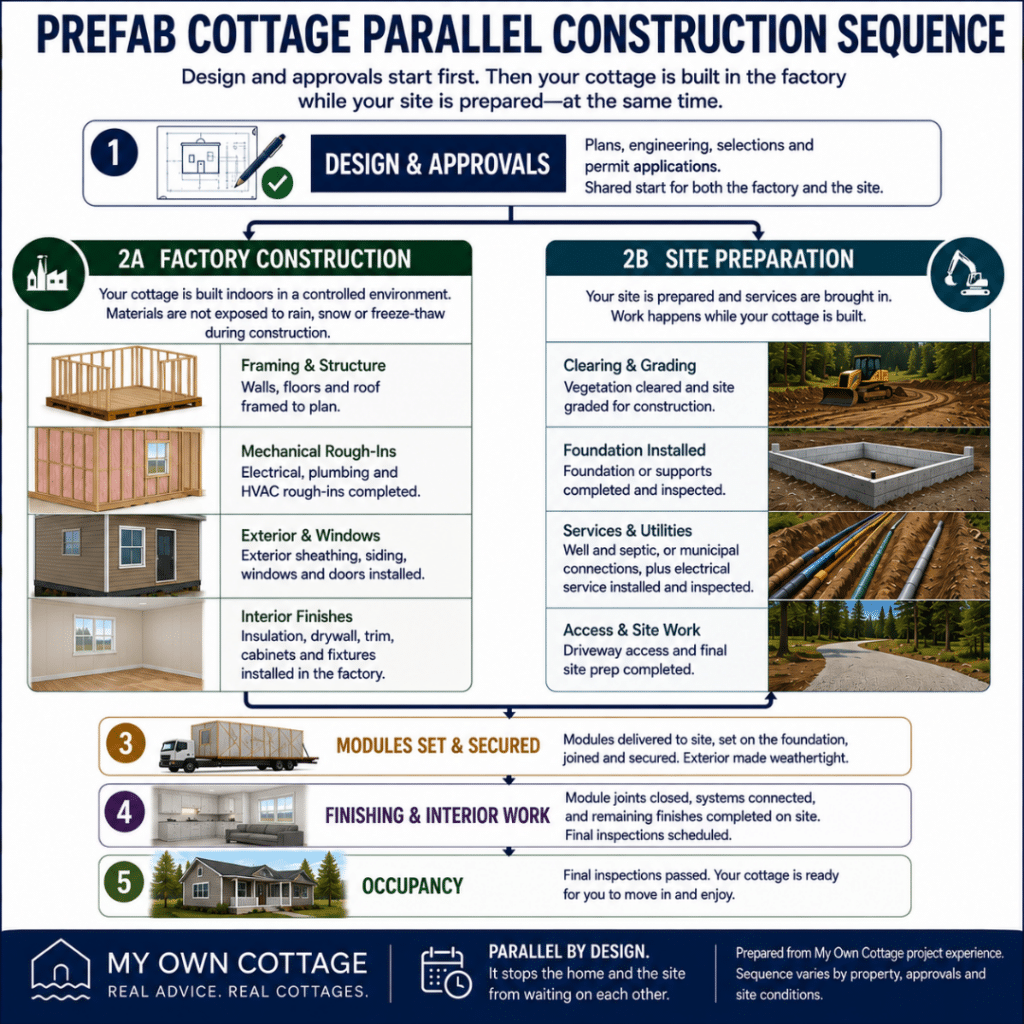
While your cottage is being built indoors, your lot is being prepared outdoors. The two tracks meet on delivery day.
1. Free Consultation. Your lot, intended use, size, priorities and budget. Remote to start, then property-specific planning.
2. Select and customise. Choose a model, then adapt layout, finishes and features to the property.
3. Plan and build. Permit coordination, municipal coordination, site preparation, foundation and factory construction — sequenced so the two tracks overlap.
4. Deliver and install. Transport to your lot, installation coordination with qualified licensed trades, finishing, and project closeout.
Parallel construction is the real advantage of building this way. It doesn’t remove the approvals stage and it doesn’t shorten a permit review. What it does is stop the home and the site from waiting on each other — and because the home is built indoors, weather delays affect the site work rather than the whole project.
Serving Petawawa and the Ottawa Valley
We build in Orillia and deliver across Ontario. In this region that includes Petawawa, Pembroke, Laurentian Valley, Deep River, Chalk River and surrounding Renfrew County. We are not headquartered in Petawawa, and we don’t claim to be — what we bring is a factory, a catalogue of 33 models, and project management from design through occupancy.
Building in the City of Pembroke instead? Pembroke’s zoning by-law and development charges are administered separately — the two municipalities are neighbours, but the rules and the numbers are not the same.
What we won’t tell you
We don’t publish a delivery-week promise, a guaranteed permit timeline, or a claim that prefab is automatically cheaper than site-building. On a Petawawa lot, the land and its servicing move the total more than the construction method does. What factory construction reliably improves is predictability: a fixed home specification, production that isn’t rebuilt every time it rains, and a schedule you can plan around.
Five mistakes Petawawa buyers make
1. Budgeting the model and forgetting the Town. Development charges alone range from $5,612 to $11,637 depending on servicing, and they appear in no builder quote.
2. Buying the lot before checking frontage. Section 3.19 requires frontage on an improved street. A beautiful back lot on a private road may not support a dwelling at all.
3. Assuming an existing septic will serve a bigger home. Capacity follows the dwelling – the most common late-stage surprise in the Ottawa Valley.
4. Comparing a delivered cabin price to a dwelling price. Different products, different legal status. The gap isn’t a discount.
5. Comparing builders on dollars per square foot. Unless both include identical scope, the rate compares nothing.
Prefab Cottages Petawawa: Frequently Asked Questions
How much do prefab cottages in Petawawa cost?
Compact models start at $229,500 delivered, with the range running to $949,500 for the largest designs. That covers the home itself. Foundation, site preparation, servicing, delivery access, permits and Town development charges are quoted separately against your lot. Prices quoted for ready-to-move and pre-built cottages vary widely depending on whether the figure covers a finished dwelling, a shell, or an accessory structure — confirm what’s included before comparing.
Who builds prefab cottages in the Petawawa area?
Petawawa buyers generally choose between local conventional builders who construct on site, and Ontario prefab manufacturers who build in a factory and deliver to your lot. My Own Cottage is in the second group — we build in Orillia and deliver across Renfrew County, including Petawawa, Pembroke, Laurentian Valley, Deep River and Chalk River. Foundation, servicing and installation are handled by qualified licensed trades on site.
What is included in a turnkey prefab cottage?
“Turnkey” is used inconsistently across this industry, so ask what it covers before comparing quotes. Our model price covers the home as specified, factory construction, delivery coordination, and installation coordination with licensed trades. Foundation, site preparation, well and septic or municipal connections, hydro service, permits and Town development charges are quoted separately, because they depend entirely on the property.
What are the development charges for a new home in Petawawa?
Effective January 1, 2026, a single or semi-detached dwelling pays $5,612 in the rural area, $7,643 in the rural water-only area, and $11,637 in the urban area. Charges for municipal water and wastewater apply only where those services are actually received, which is why the same dwelling costs three different amounts. The schedule indexes automatically each January 1.
Can I put a prefab cottage on vacant land near Petawawa?
Usually, subject to zoning, servicing and access. Petawawa’s Zoning By-law defines a single detached dwelling as one that includes a prefabricated single dwelling unit, while prohibiting mobile homes outside the Mobile Home Park zone. The lot must also front on an improved street — a Provincial Highway, County Road or Municipal Road — unless a defined exception applies, such as a Limited Service Residential lot.
Do I need a permit for a prefab cottage in Petawawa?
Yes. You will need a building permit from the Town of Petawawa, submitted through Cloudpermit, plus a sewage system permit where private septic is used and an entrance permit if new driveway access is required. Zoning must be confirmed first — no municipal permit can be issued for a use that contravenes the Zoning By-law. The Town administers this process, not the County.
Can I build a second cottage or unit on my Petawawa property?
Possibly. The by-law provides for additional dwelling units — attached within the primary dwelling, or detached as a standalone ancillary building, also called a coach house — under Section 3.32, as amended by By-law 1752/25. Garden suites are a separate mechanism requiring a site-specific temporary use by-law and a removal agreement. Both depend on your specific lot, zone and servicing.
Can prefab cottage floor plans be customised?
Yes. Every model is a starting point rather than a fixed package. Customization options range from finishes and features through to layout and room configuration, adapted to your property and how you intend to use it. If none of the 33 preconfigured floor plans suits the site or the way you want to live, we also design custom cottages from scratch.
How does prefab cottage delivery and installation work in Petawawa?
Modules travel by transport trailer and are set with a crane, so the constraints are road width, turning radius at the entrance, overhead lines, bridge and seasonal load limits, and level ground for staging. Access is assessed for each property rather than quoted from a table. Installation is coordinated with qualified licensed trades, followed by finishing and final inspections.
Can you get a mortgage on a prefab home in Ontario?
Yes, though cottage financing is staged rather than advanced in full at closing. Under CMHC’s Prefab Plus program, minimum equity is 5% of the first $500,000 of lending value and 10% of the remainder, with up to four advances. The property must suit full-time year-round occupancy and have year-round vehicular access, including via bridge or ferry for island properties. Confirm current terms with a lender.
Are prefab cottages suitable for the Canadian climate and Ottawa Valley winters?
Homes built for year-round occupancy are engineered for the design conditions of their location. Rather than comparing insulation values between builders, ask for the model’s specification sheet — it states the design conditions the home is engineered for and the occupancy it is approved for. Building indoors also supports energy efficiency, because air sealing and insulation are installed to a repeatable process on materials that haven’t weathered.
Planning your prefab cottage in Petawawa
Two things decide a Petawawa project: the model you choose and the lot you build it on — and the lot carries more variability. Servicing sets your development charge tier. Frontage and access determine whether a dwelling is possible at all. Septic capacity and delivery route shape the site costs.
All of that can be assessed early, and assessing it early is what prevents an expensive discovery later.
If you have a property in mind, share the survey, service details, access photos and how you intend to use the cottage. We’ll tell you what your lot can support and what the project realistically involves — including the parts that aren’t ours to sell you.
Serving Petawawa, Pembroke, Laurentian Valley, Deep River, Chalk River and the Ottawa Valley, built and delivered from Orillia.
• Request a Free Consultation
• Call Us Directly: (705) 345-9337
• View Our Design Catalogue
Alternatively, for your convenience, you can also simply fill out the contact form below and we’ll get back to you soon!
Contact Us
We usually respond within 24 hours!
- Comprehensive Warranty
- Best Price Guarantee
- Exceptional Service
How we verified this article
Every figure and by-law reference on this page was checked against a primary municipal or federal source, not against other builders’ websites. Here is exactly what we used, what we confirmed, and what we deliberately left out.
Sources
| Claim | Source |
|---|---|
| 2026 development charges, exemptions and indexing | Town of Petawawa, Annual Indexing of Development Charges, effective January 1, 2026 |
| Zoning definitions, floodplain elevations, street frontage, garden suites, accessory buildings, additional residential units | Town of Petawawa Comprehensive Zoning By-law 456/07, as consolidated to August 22, 2025 |
| Permit administration and application process | Town of Petawawa Building and Change of Use Permits By-law 1410/21; Entrance Permits By-law 1590/23; Site Plan Control By-law 528/08 |
| Energy requirements, compliance packages, ventilation | 2024 Ontario Building Code, in force January 1, 2025 and mandatory for new permits since April 1, 2025 |
| Financing terms and access requirements | Canada Mortgage and Housing Corporation, Prefab Plus program |
| Model sizes, configurations and pricing | Our own current catalogue |
What we chose not to publish
Some figures circulate widely in this market that we could not confirm at source, so they do not appear here:
• Minimum lot areas, frontages, setbacks and lot coverage by zone. These vary by zone and servicing type, and the Town confirms them for your specific parcel.
• Water setback distances. The by-law defines how setbacks are measured, and existing lots may be treated differently under the established building line provisions.
• Permit processing timelines. The Town does not publish standard periods for a new dwelling.
• Current building and septic permit fees. These are adjusted periodically; ask the Town for the schedule in effect when you apply.
• Snow loads, frost depths and insulation values presented as fixed requirements. The Building Code works through compliance packages rather than single values, and design conditions are model-specific.
We would rather tell you where to get an answer than publish one we cannot stand behind.
Currency and corrections
Development charges are indexed every January 1. Permit fees, by-law consolidations and financing program terms all change. Figures on this page were verified on 4 August 2026 and should be confirmed with the Town of Petawawa or your lender before you rely on them for a budget or an application.
Municipal requirements apply differently to every property. Nothing here is a substitute for confirming your own parcel with the Town.
Found something out of date? Email [email protected] and we will check it.
Written by Sean Stevenson, Buyer Experience Lead at My Own Cottage. Last reviewed: 4 August 2026.
About the Author

Sean Stevenson is Chief Marketing Officer and Buyer Experience Lead at My Own Cottage Inc., an HCRA-licensed, Tarion-enrolled prefab home builder based in Orillia, Ontario.
For five years he has worked alongside the company’s build team taking Ontario buyers through the full prefab cottage process — lot assessment, all-in budgeting, zoning, permits, development charges and final occupancy. He writes about the part most buyers underestimate: what a factory-built cottage actually costs once foundation, servicing and municipal approvals are counted, and why the same model lands at two very different totals on two lots in the same municipality.
Municipal figures on this page were verified against Town of Petawawa and provincial sources.