Prefab Cottages Kingston, Ontario: What Your Lot Allows and What It Costs
Last updated: August 8, 2026
A prefab cottage near Kingston, Ontario starts at $229,500 for a small one-bedroom model, including delivery and installation on your prepared site.
That price excludes foundation, site preparation, servicing, permits and municipal charges — and in the City of Kingston those charges total $34,814 per new single-detached dwelling before a shovel touches the ground.
✓ HCRA Licensed | ✓ Tarion Enrolled | ✓ CSA A277 | ✓ Ontario-Built
This page is written for people building in Kingston, Ontario — Frontenac County, on Highway 401 between Toronto and Montreal. Not Kingston, New York, and not Kingston, Jamaica.
Below are all of our prefab cottages, cabins and modular homes with current prices, then the four questions that determine whether a lot can take one: which municipality it sits in, how it’s serviced, what’s mapped on it, and whether a truck and crane can reach it.
Every municipal figure here is sourced, linked and dated. If Kingston is one of several areas you’re weighing, see how prefab cottage costs and lot rules differ across Ontario.
Key Takeaways
• Prices start at $229,500 across all preconfigured floor plans from 505 to 3,373 sq ft, delivery and installation included, with full customization available.
• City of Kingston development charges total $34,814 per new single-detached dwelling in 2026, plus building permit fees at $14.95 per square metre.
• Additional dwelling units are not permitted on rural Kingston properties — the backyard route only works on serviced lots inside the city.
• The conservation authority regulates further from water than most people expect — 50 metres from top of bank, not 30.
• Four lot questions decide your project. Answer them before choosing floor plans.
Our Prefab Cottages, Cabins and Modular Homes
My Own Cottage offers 33 preconfigured prefab cottages, cabins and modular homes from 505 to 3,373 square feet, priced from $229,500 to $949,500. Every model is a starting point — floor plans, finishes, exteriors and features are open to customization — and where no plan suits the property, we design a fully custom modular home around it.
What the price includes: the cottage, built to your specification, plus delivery and installation on your prepared site. We confirm that figure after a site visit, because access and site conditions affect the set.
What it excludes: foundation, site preparation, servicing, permits and municipal charges. Those are quoted separately against your lot.
Styles run from modern, open-plan cottage homes with large glazing through to more traditional cottage and cabin forms. Interior and exterior finishes are selected during design.
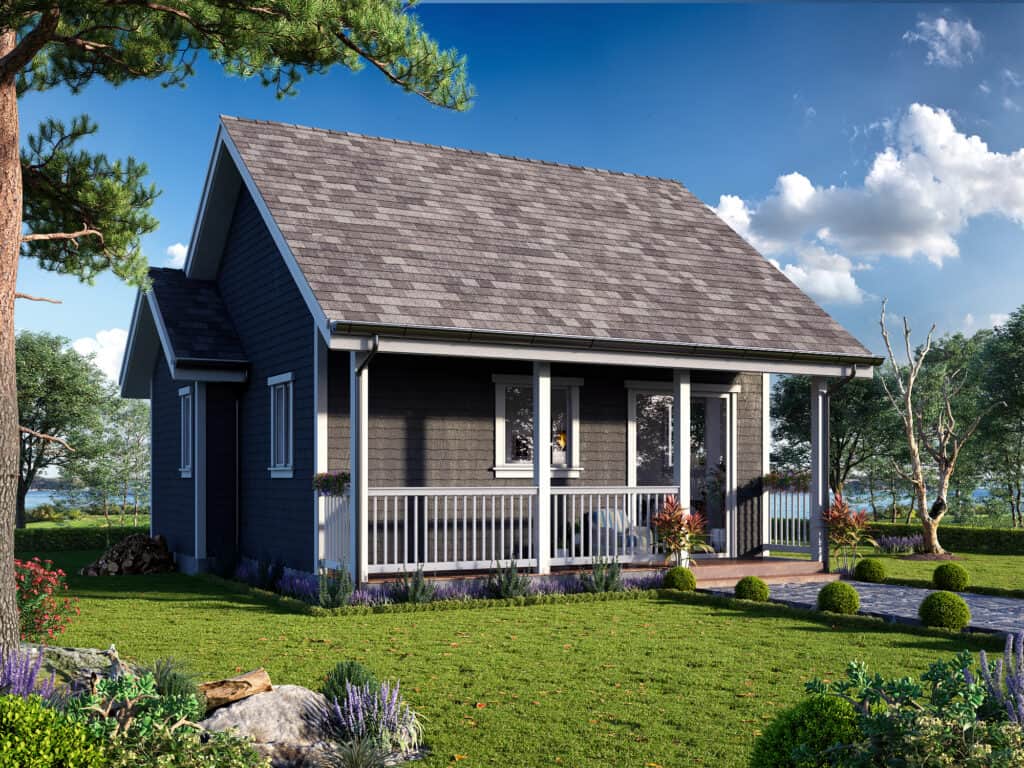
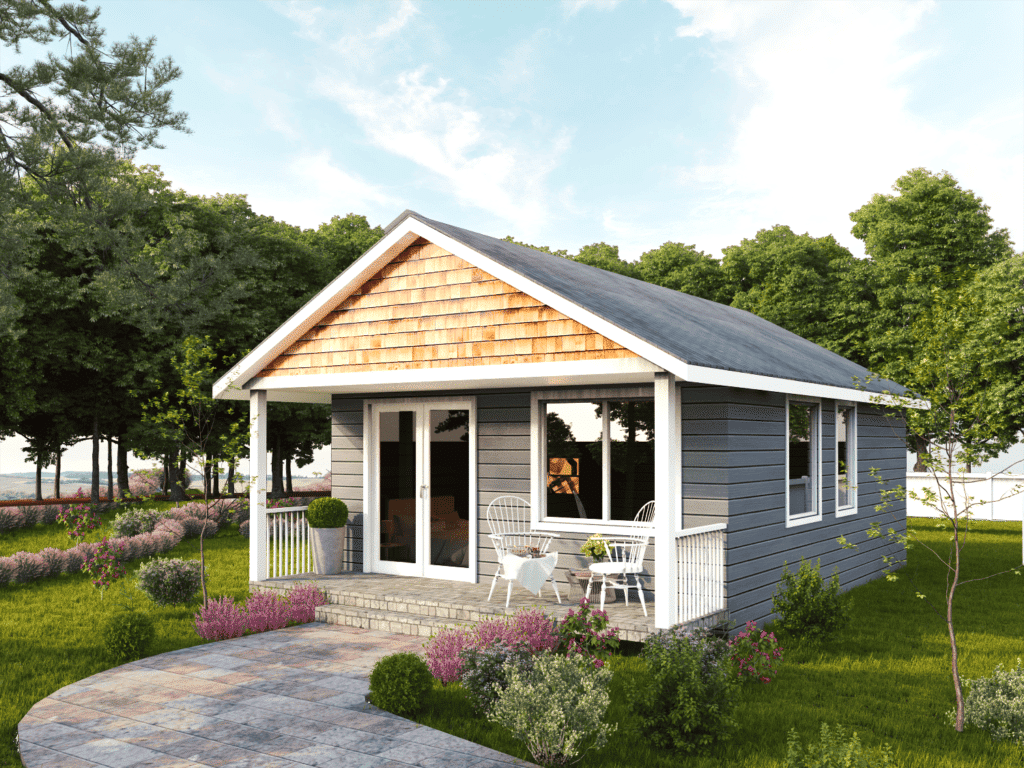
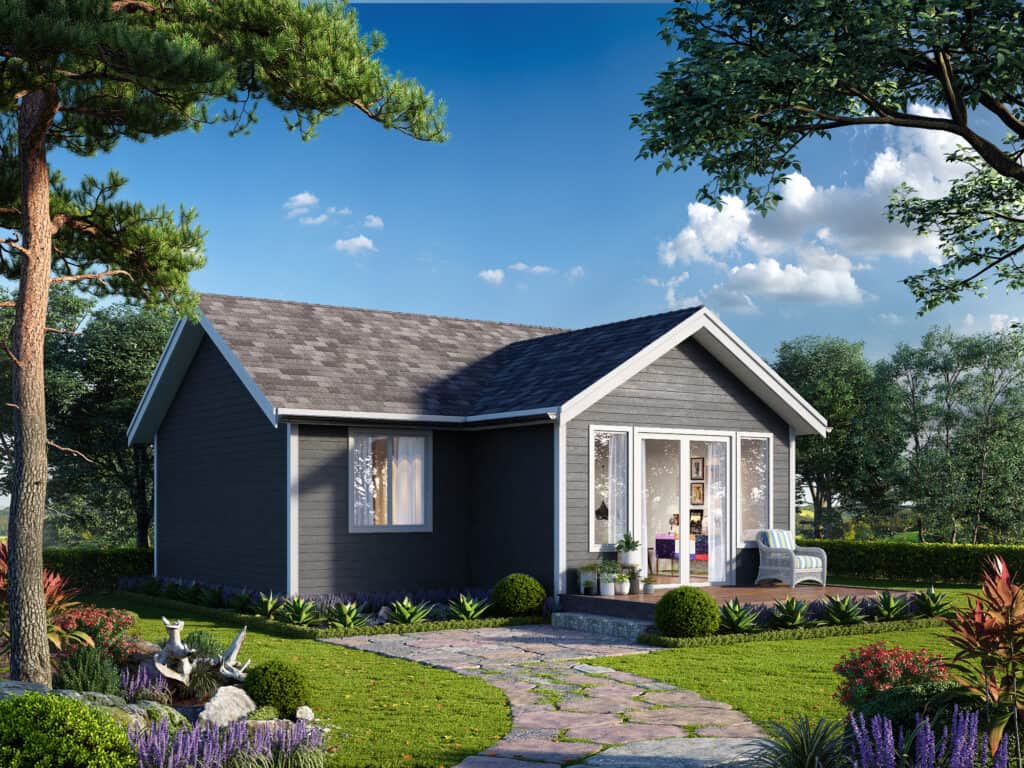
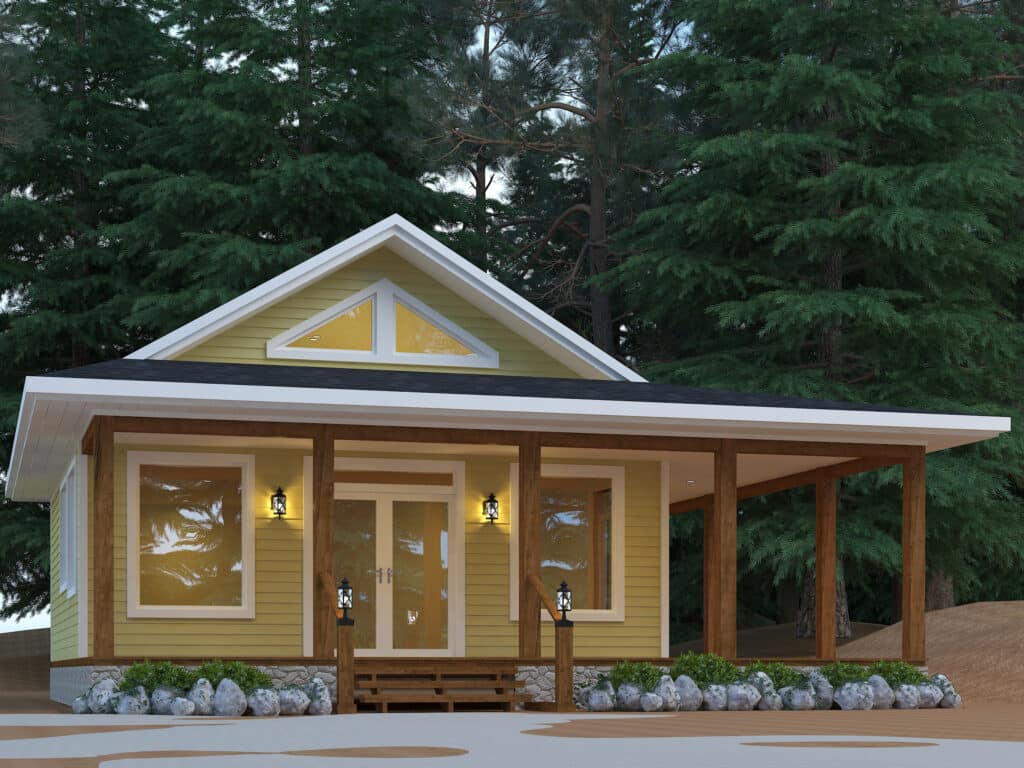
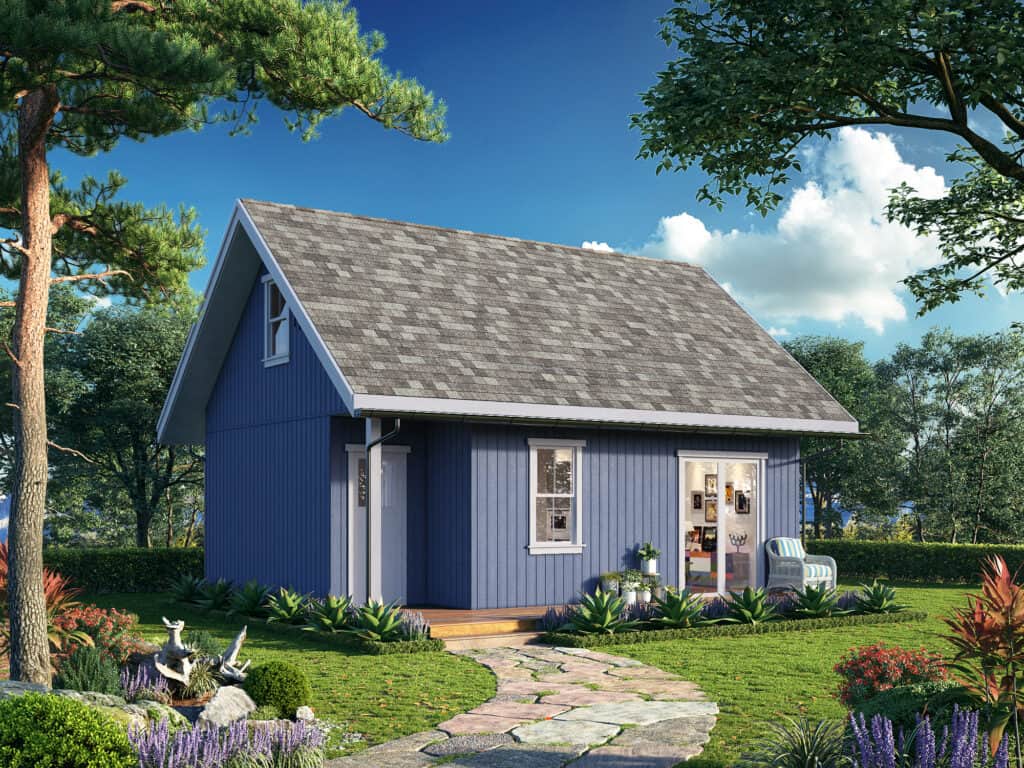
Small Prefab Cottages, Cabins and Small Homes (505–788 sq ft)
Suited to constrained lots, waterfront setbacks, guest accommodation, and couples or single occupants — and the usual choice for a recreational property or a compact four-season retreat.

Mid-Size Cottage Homes (988–1,290 sq ft)
The most common size band for a four-season Eastern Ontario cottage used by a family.
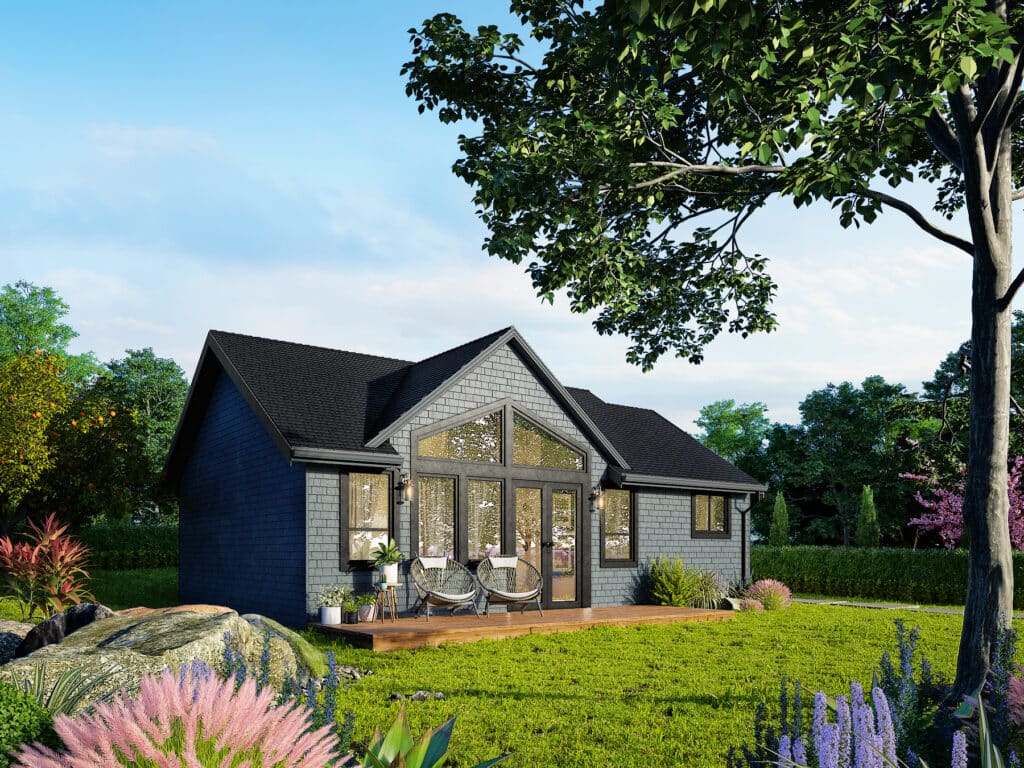
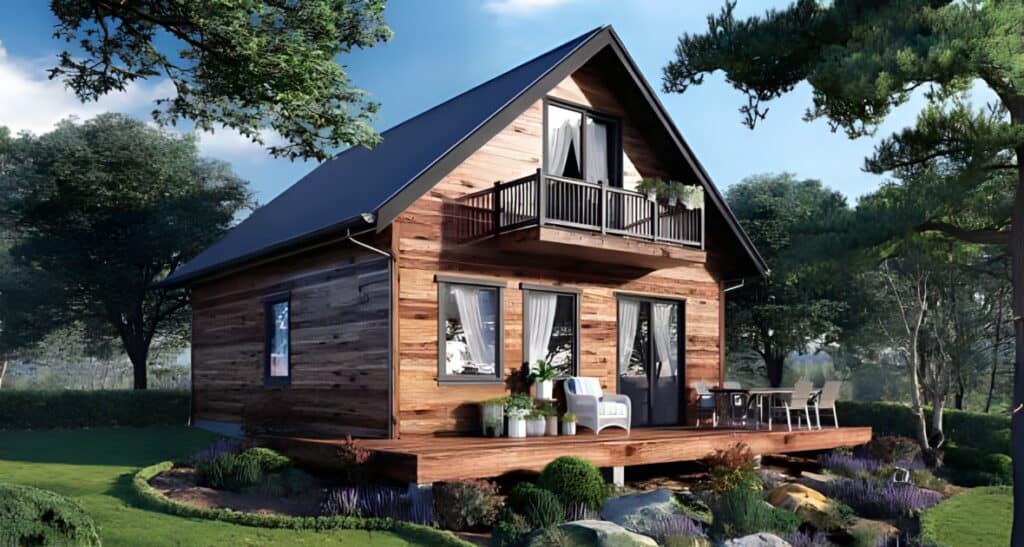
- 988 SQ. FT
- Bedrooms: 2
- Bathrooms: 1
Preconfigured model starting at: $324,500

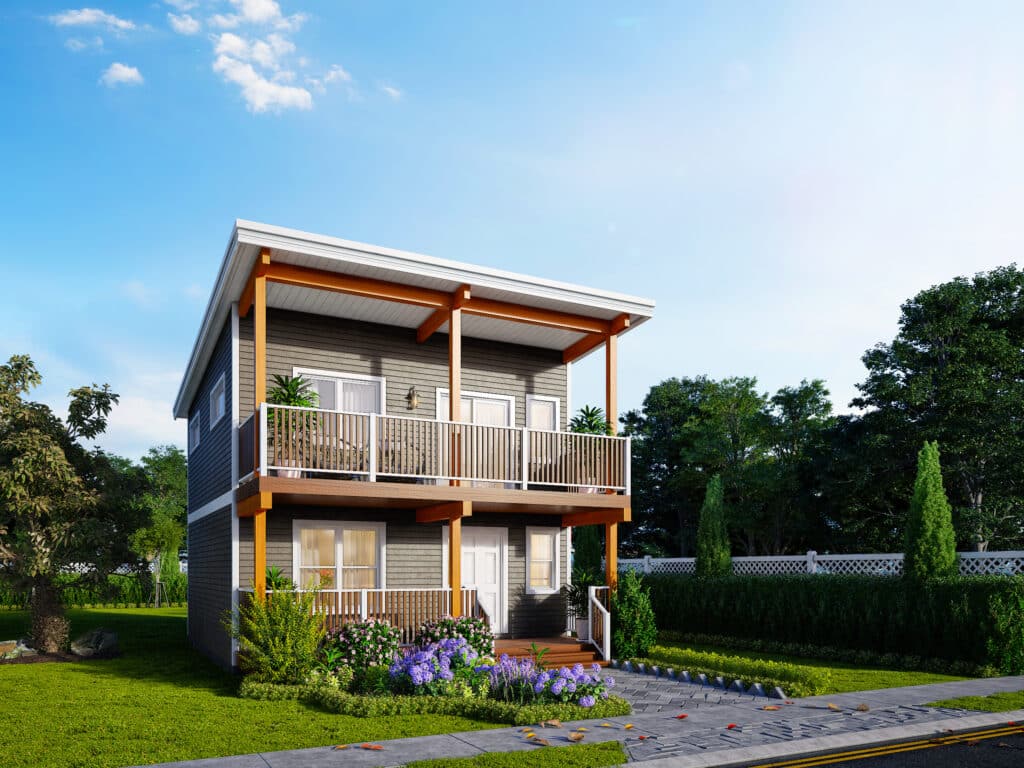
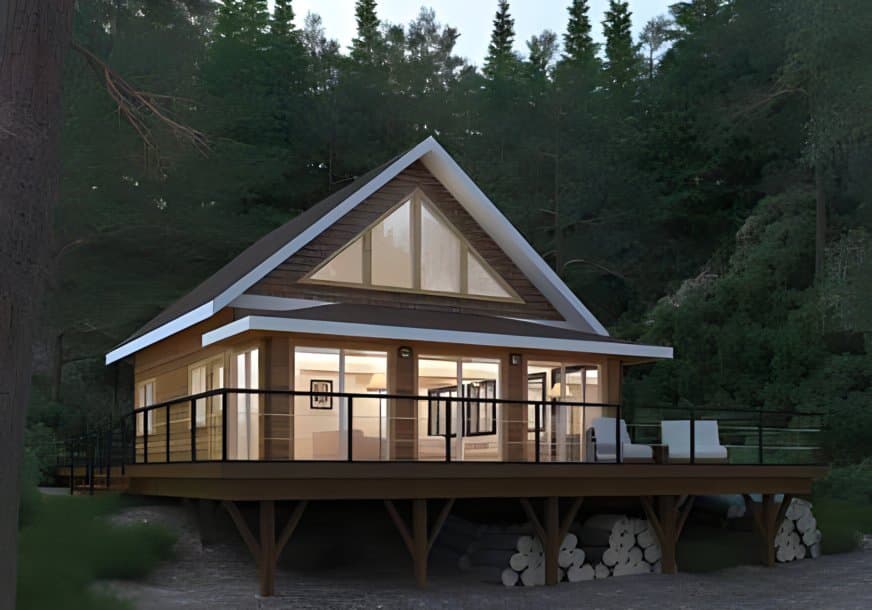
- 1170 SQ. FT
- Bedrooms: 3
- Bathrooms: 1
Preconfigured model starting at: $369,500
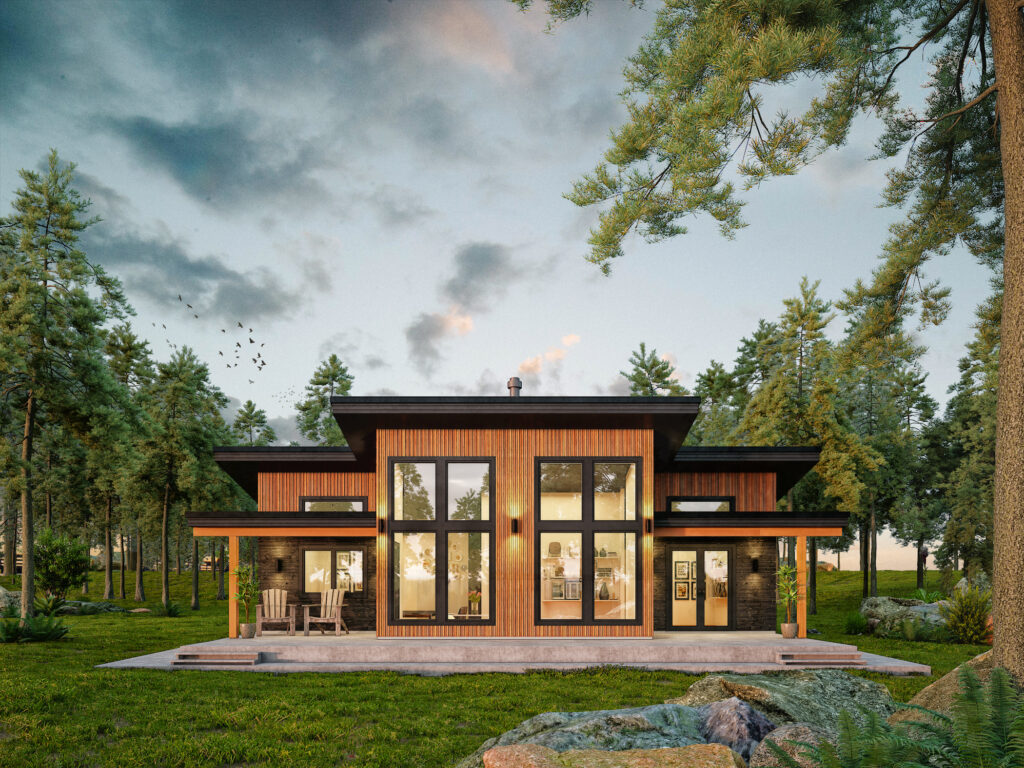
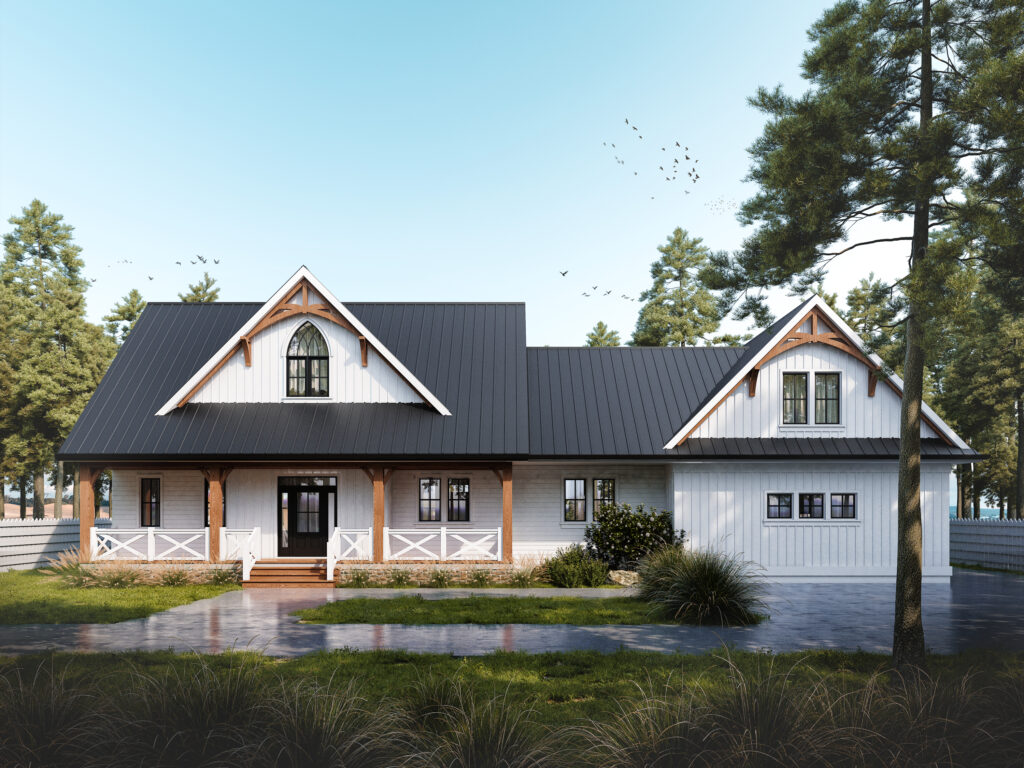
Prefab Homes and Modular Homes in Kingston for Year-Round Living (1,381–3,373 sq ft)
Larger plans intended as permanent residences rather than seasonal cottages — primary homes, multi-generational layouts, and properties occupied all year.

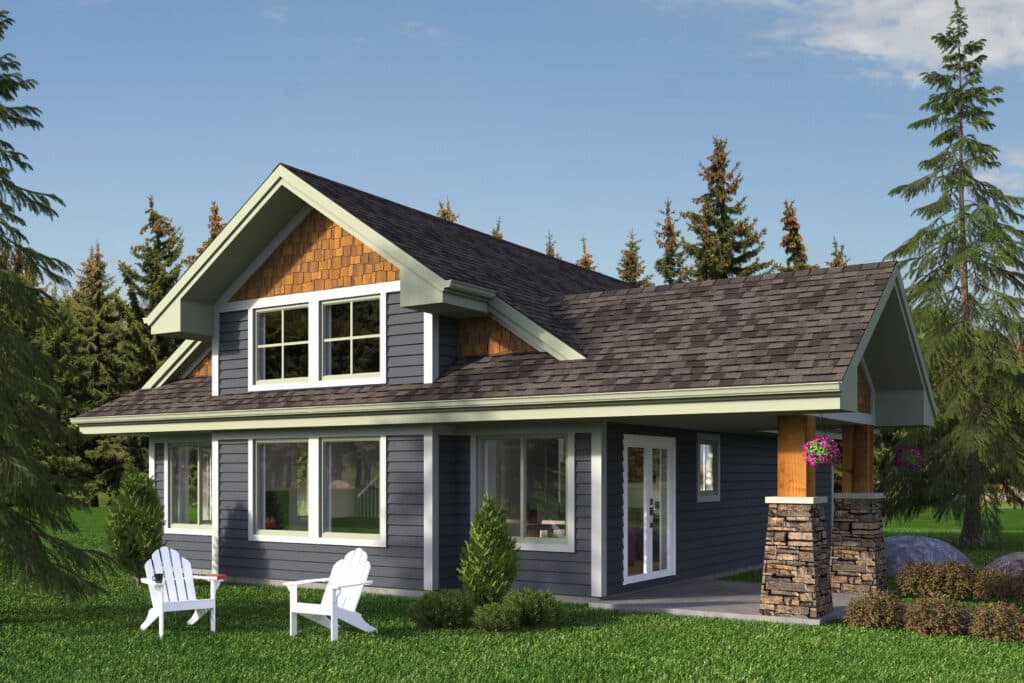
- 1381 SQ. FT
- Bedrooms: 2
- Bathrooms: 2
Preconfigured model starting at: $529,500
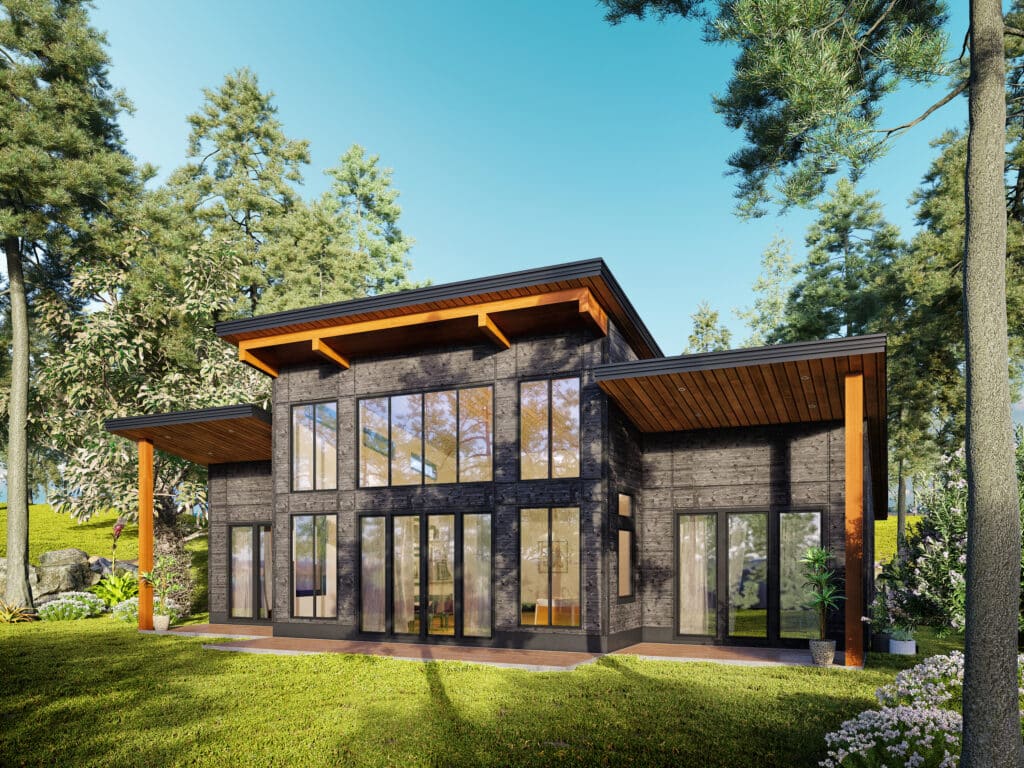
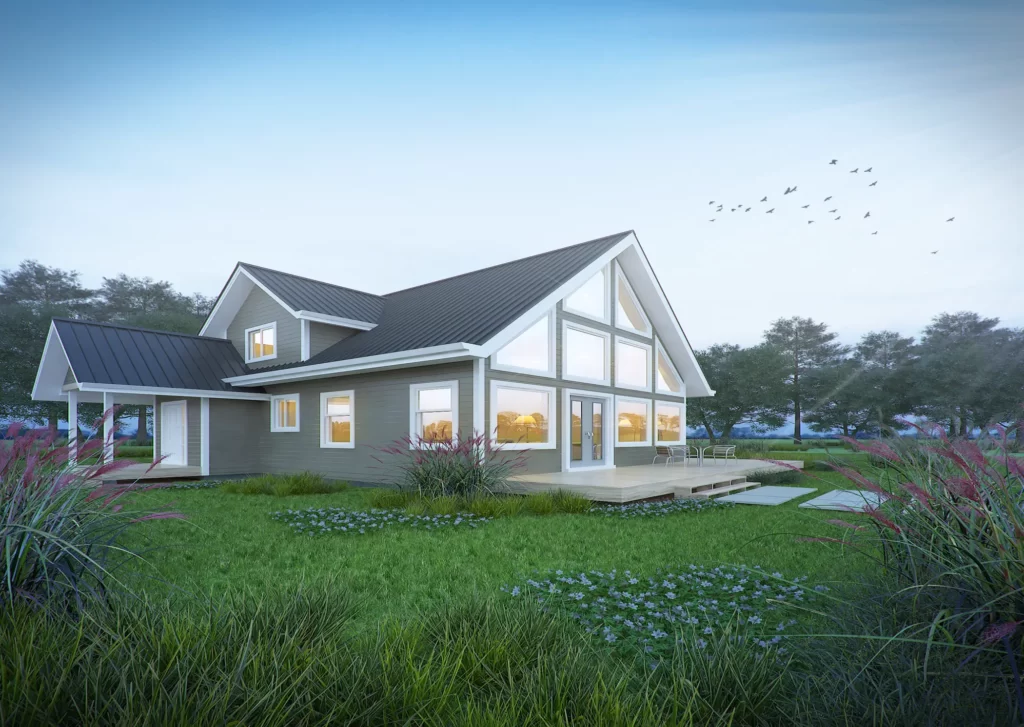
- 1752 SQ. FT
- Bedrooms: 3
- Bathrooms: 2
Preconfigured model starting at: $519,500
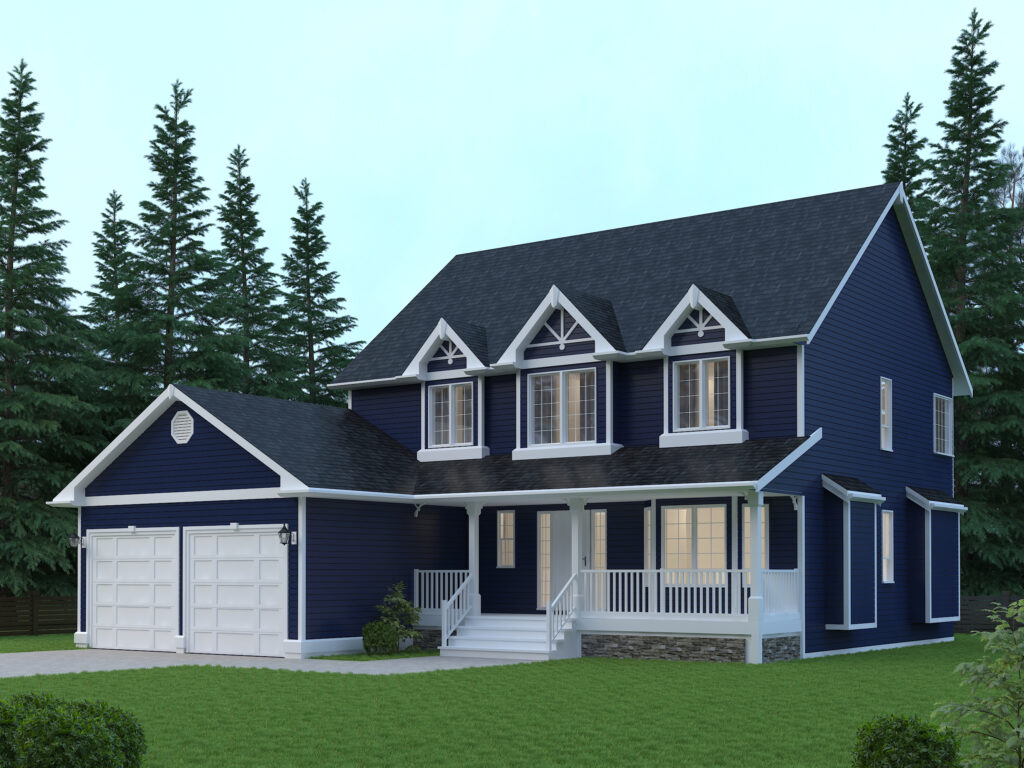

- 2307 SQ. FT
- Bedrooms: 3
- Bathrooms: 2
Preconfigured model starting at: $619,500
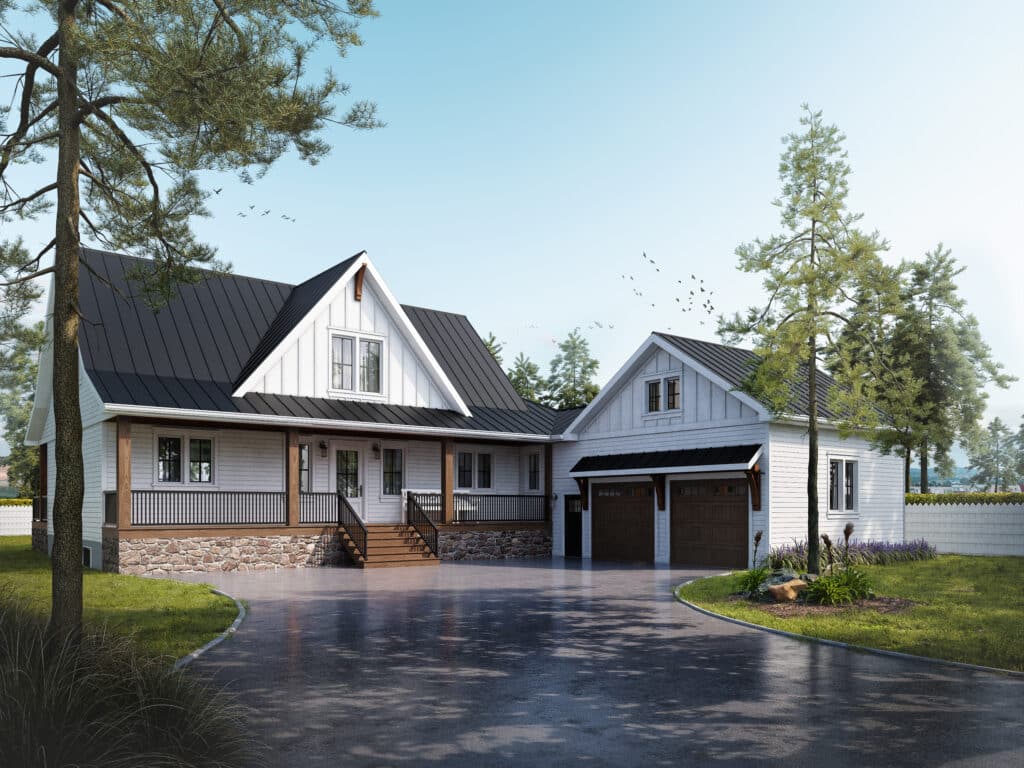
- 2513 SQ. FT
- Bedrooms: 3
- Bathrooms: 3
Preconfigured model starting at: $899,500
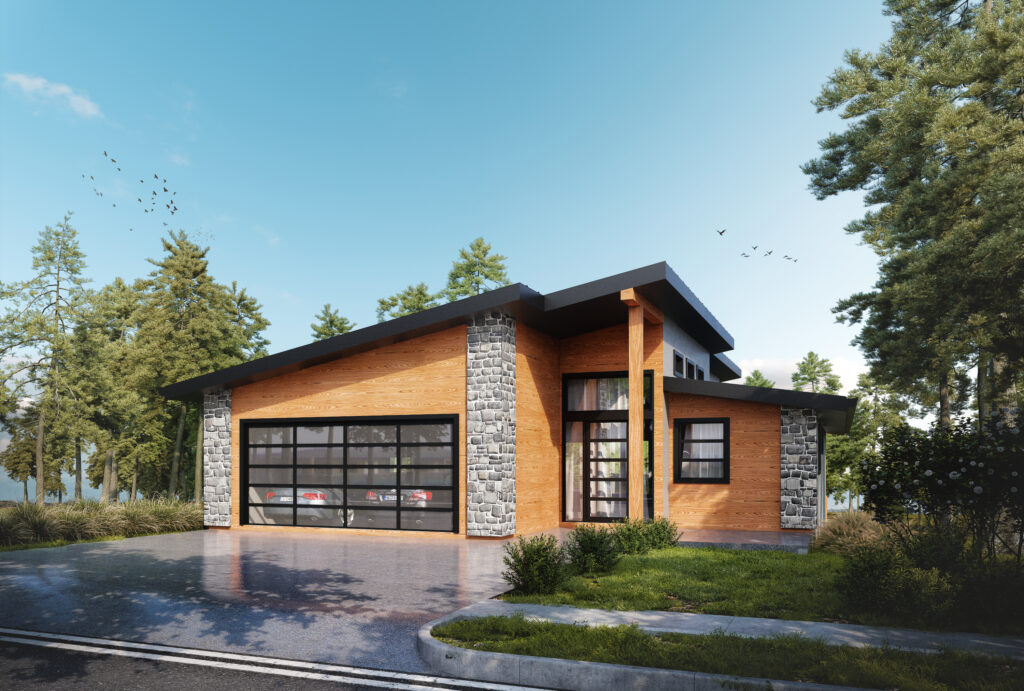
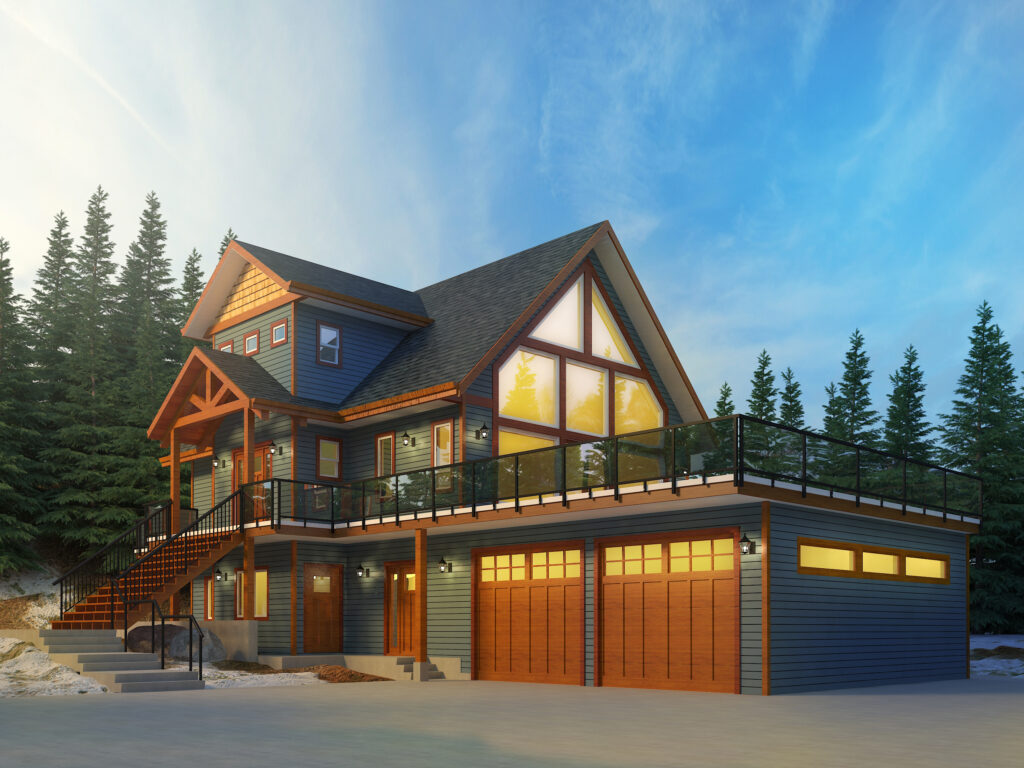
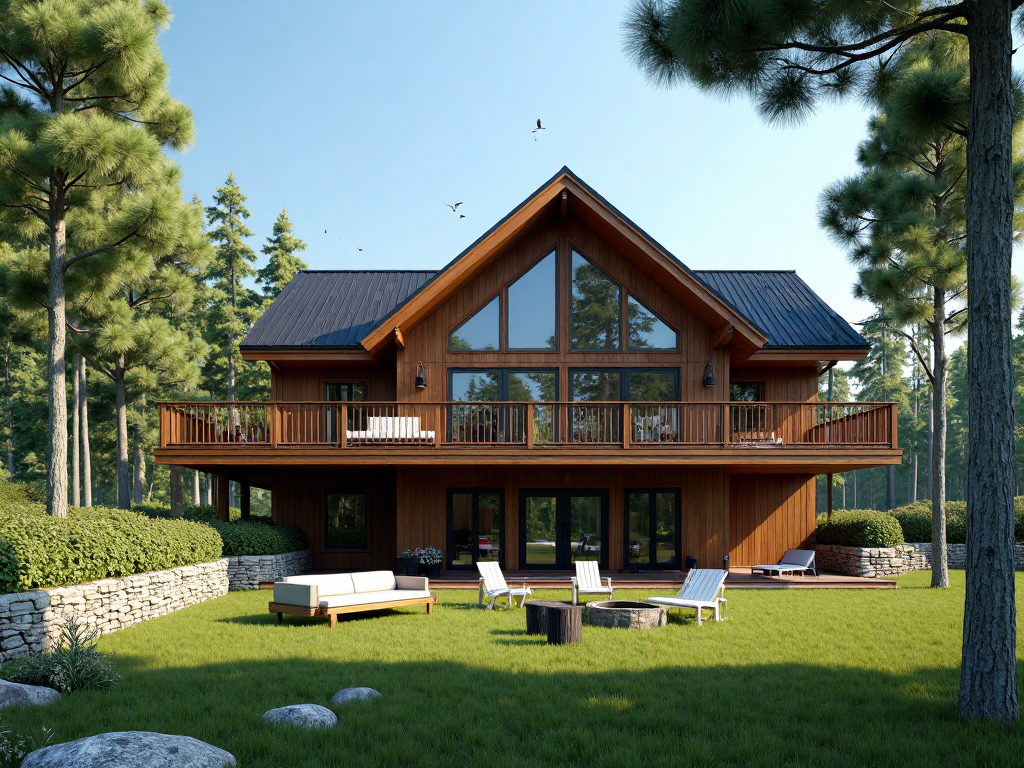
- 3008 SQ. FT
- Bedrooms: 3
- Bathrooms: 2
Preconfigured model starting at: $579,500
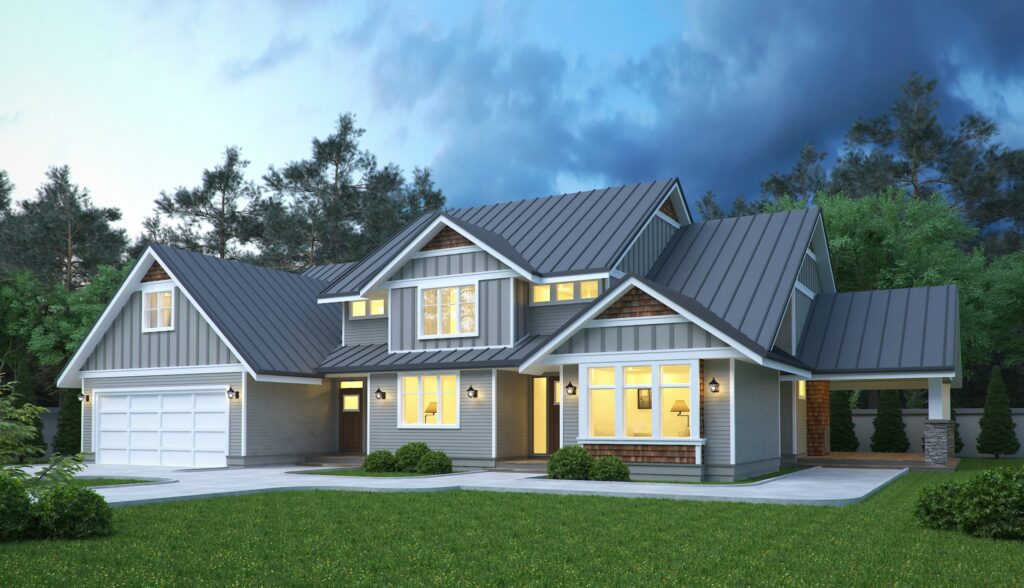
Building a permanent residence on a serviced lot inside the city rather than a cottage on rural or waterfront land? Our guide to building a year-round residence within Kingston covers the urban side of this market.
What a Prefab Cottage Actually Costs in Kingston
Budget for two things: the cottage and the site. The cottage starts at $229,500 delivered and installed. The site carries foundation, excavation and grading, water and sewage servicing, hydro, driveway access, and municipal charges. In the City of Kingston, development and education charges total $34,814 per new single-detached dwelling as of January 1, 2026.
Most disappointment in this market comes from comparing a factory price against a finished-project budget. They are not the same number, and no honest builder gives you the second one without seeing your lot.
The municipal charges you can price today
Published figures from the City of Kingston’s 2026 Building Services Fees Summary, effective January 1, 2026.
| Charge | 2026 amount (single/semi-detached) |
|---|---|
| Wastewater services | $9,306 |
| Water services | $4,615 |
| Impost charges subtotal | $13,921 |
| Development charges | $19,927 |
| Total development charges | $33,848 |
| Education development charges | $966 |
| Total | $34,814 |
Building permit fees are separate, calculated per square metre — $14.95/m² for a new single-detached, semi-detached or row dwelling, with a $152 minimum. Unfinished basement area is excluded, and building permit fees in Kingston are HST-exempt.
| Model | Floor area | Building permit fee (approx.) |
|---|---|---|
| Fox Den (505 sq ft) | 46.9 m² | $701 |
| Water’s Edge (988 sq ft) | 91.8 m² | $1,372 |
| Victoria (3,373 sq ft) | 313.4 m² | $4,685 |
These are our calculations from the City’s published rate, not quotes.
If your lot needs a septic system, add the sewage system permit: $950 for a Class 4 leaching bed handling 4,500 litres per day or less, $1,050 above that threshold. A Class 5 holding tank follows the same split. Septic tank installation alone is $750.
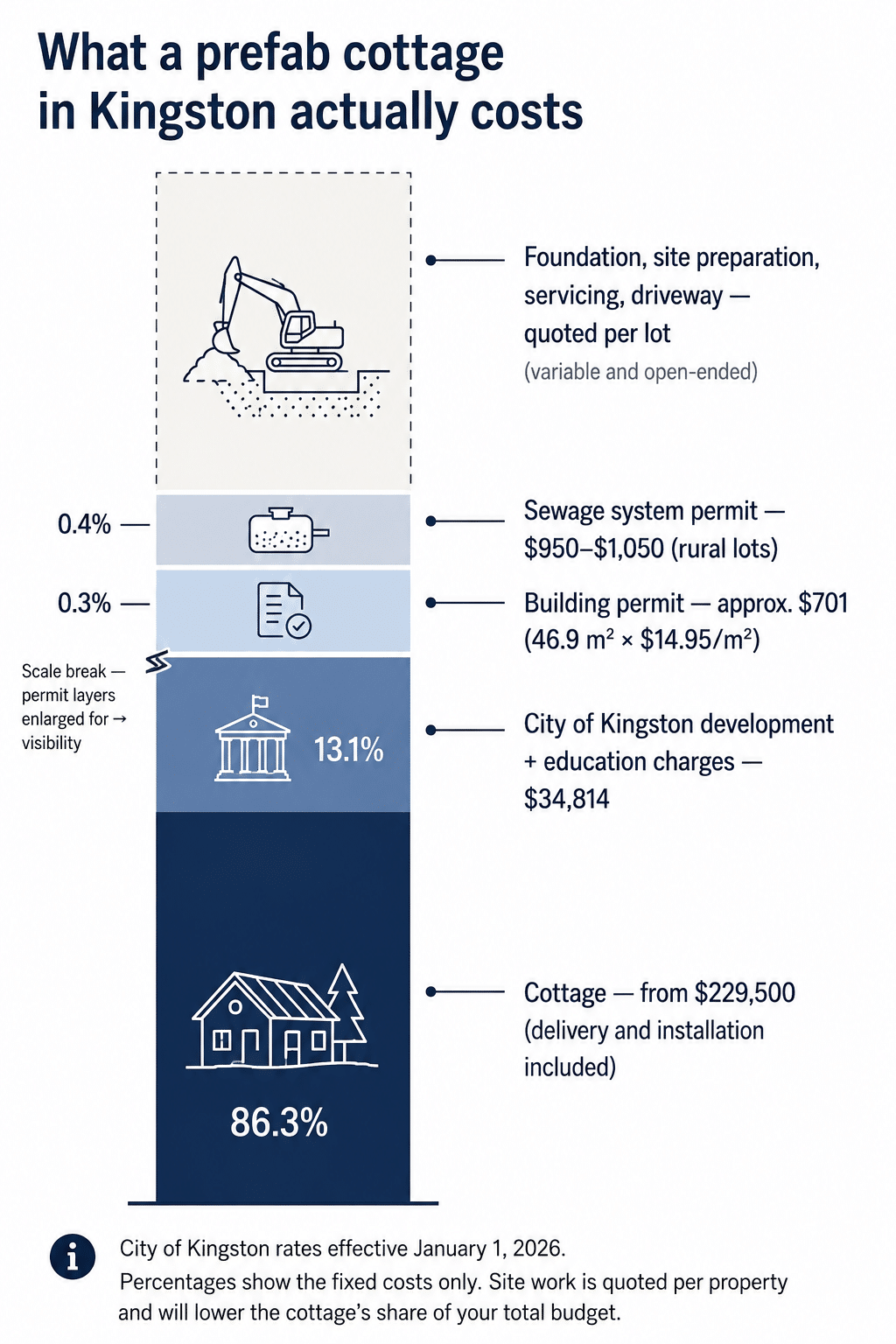
The cottage price is fixed. The site costs above it are quoted per property.
Why per-square-foot pricing doesn’t work here
You will see prefab priced per square foot across this market. It isn’t a useful comparison, and our own catalogue shows why.
Across all 33 designs:
| Across the catalogue | Price per sq ft |
|---|---|
| Lowest | ~$193 |
| Median | ~$340 |
| Highest | ~$626 |
Three examples from that range:
• Kingswood and Bay Breeze are both 646 sq ft — at $259,500 and $299,500
• Orchard is 992 sq ft at $289,500 — larger than both, priced between them
• Excelsior at 2,261 sq ft costs more than Victoria at 3,373 sq ft
Price tracks specification, not floor area. Roof form, glazing, bathroom count, module count and finish level move the number far more than square footage does.
What factory construction actually buys you
We won’t tell you prefab is cheaper than hiring a general contractor.
What factory construction genuinely changes is cost predictability. The cottage is built in a controlled environment to a fixed specification at a fixed price, with decisions locked before production begins.
Three things move a site-built budget after you’ve signed:
| Budget risk | Why it drops out in the factory |
|---|---|
| Weather delays | Production happens indoors |
| Trade availability | The build runs on a scheduled production line |
| Material waste | Components are cut to spec in a controlled environment |
Site costs still vary with the lot. But you know one of the two numbers early, and with certainty.
Why some “prefab cabins” near Kingston cost $15,000
Because they aren’t dwellings.
Delivered cabins and bunkies in the $10,000 to $30,000 range are good products for a hunting camp, a backyard office or a workshop. They’re generally sold without plumbing, permanent foundations, servicing or occupancy classification — and aren’t designed to be permitted as year-round homes.
This is the biggest source of confusion on this search. “Prefab” covers several different products:
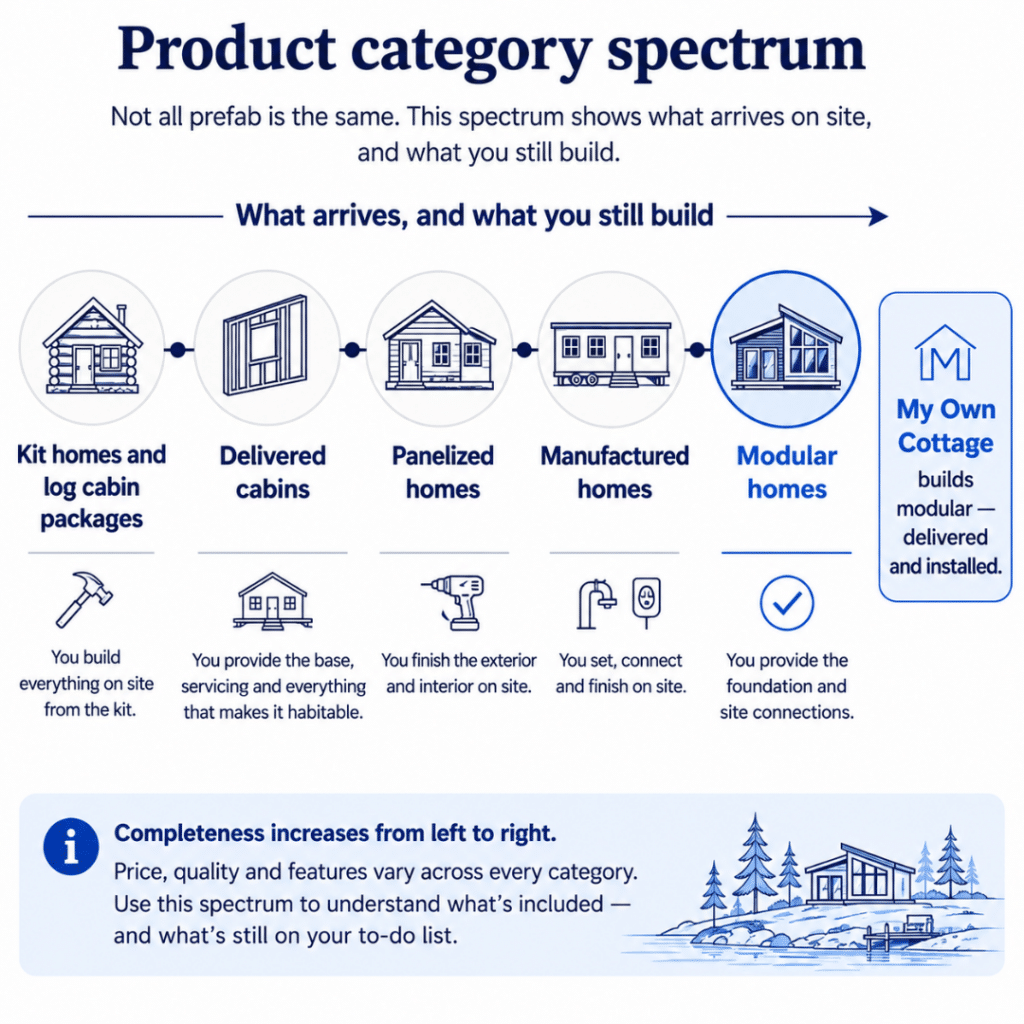
Two quotes can both say "prefab cottage" and sit at opposite ends of this line. Ask which category you're being quoted before you compare the numbers.
| Product type | What arrives | What you still do |
|---|---|---|
| Modular homes | Finished modules, set by crane | Foundation, servicing, connections, finishing |
| Panelized homes | Wall and roof panels | On-site assembly, envelope, all interior work |
| Kit homes and log cabin packages | Cut materials, shell components, drawings | Effectively the entire build |
| Manufactured homes | A complete unit on a steel chassis | Siting, skirting, connections |
| Delivered cabins | A finished small structure | Everything that makes it habitable |
They differ by an order of magnitude in price because they differ enormously in what arrives. If a kit is the route you’re weighing, it’s worth reading what a self-build package actually includes before comparing it against a finished cottage. Note too that turnkey construction means different things to different suppliers — always ask where the scope ends.
One standard worth knowing: CSA A277 governs factory certification of building modules. It covers what happens inside the plant, not transport, site erection, foundations or servicing, which stay under municipal review wherever a project is built.
Ask any builder which of its specific models carry that certification. A blanket claim across an entire product line should prompt a follow-up question. Certification is one of several things worth confirming before you sign — our guide to what to verify before committing to any cottage builder covers licence status, warranty enrolment and contract scope, and where to check each one.
Kingston’s municipal charges sit at the lower end for Ontario. If you’re comparing regions, our overview of what building a cottage costs elsewhere in the province shows how the site side of the budget shifts from one municipality to the next.
The Lot Test: Four Questions That Decide Your Build
Before choosing a model, four things determine what’s possible: which municipality your lot sits in, how it’s serviced, what’s mapped on it by the conservation authority, and whether a transport truck and crane can reach it. Answering these in order prevents the most expensive mistake in this market — designing around a cottage the lot can’t take.
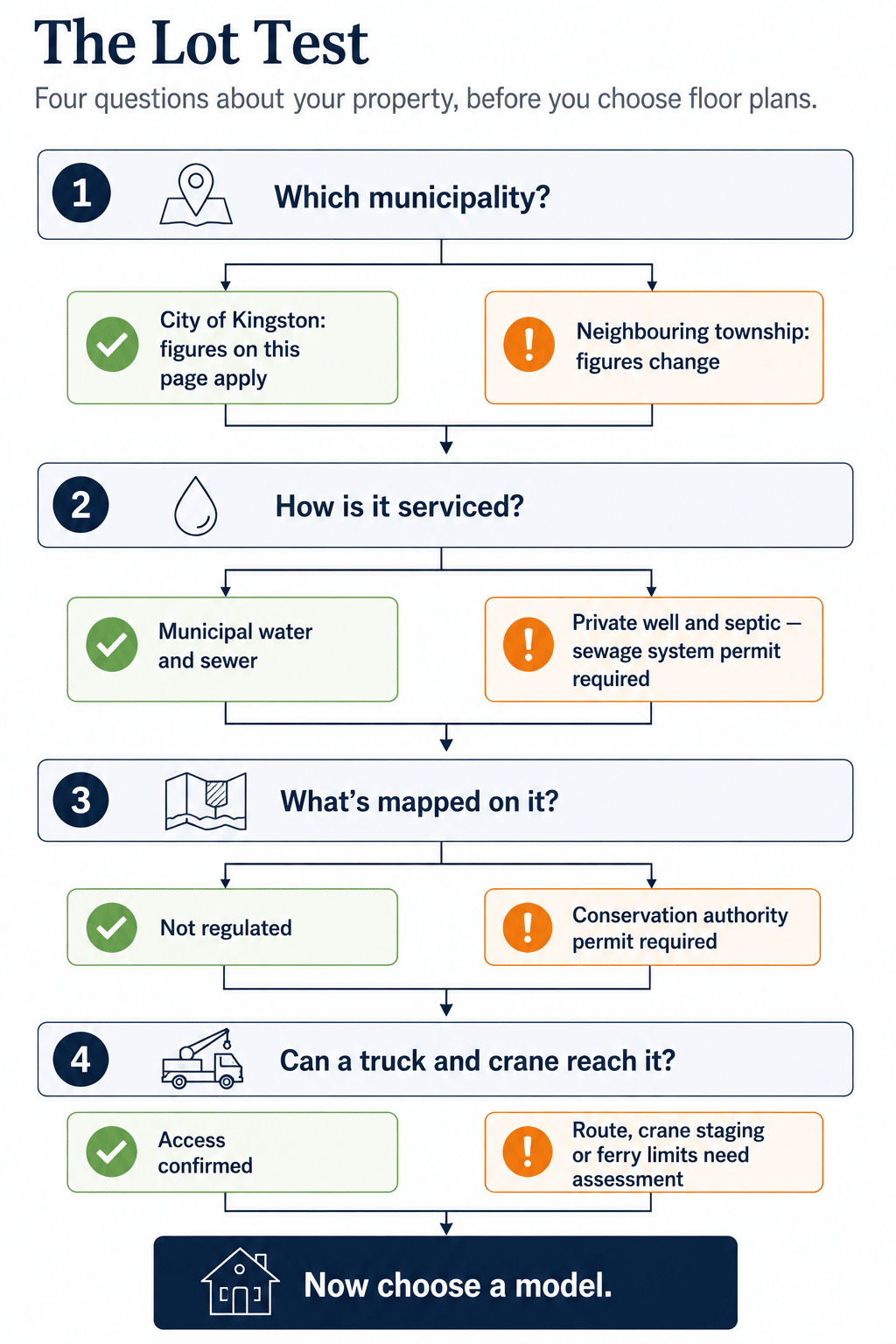
Answer these four before choosing a floor plan. Orange means an extra approval, not a dead end — both paths lead forward.
Most people start with floor plans. That’s backwards. A 1,200 sq ft plan on a shoreline lot with a 50-metre regulated setback and a narrow seasonal road may simply not be buildable — and you’ll have spent months finding out.
Question 1 — Which municipality is your lot actually in?
Searches for “prefab cottages Kingston” routinely come from people building in South Frontenac, Loyalist Township, Frontenac Islands, or out toward Gananoque and Napanee. The City of Kingston itself spans dense serviced neighbourhoods and rural land well north of the 401.
Zoning, development charges, servicing rules and approval routes are all municipal.
Everything marked “City of Kingston” on this page applies only inside the city boundary. If your lot is in a neighbouring township, the figures change.
Inside the City of Kingston: land use is governed by Kingston Zoning Bylaw 2022-62, enacted April 26, 2022. It replaced the five pre-amalgamation by-laws, which were repealed in their entirety — except for a small number of properties the new by-law shows as “Not Subject to this Bylaw.”
Rural zones under 2022-62: AG · RU · RUR · LSR · RC · HAM
→ Check your parcel: enter your address on the City of Kingston zoning map. It returns your zone and confirms which by-law applies.
Question 2 — How is the lot serviced?
A serviced lot connects to municipal water and sewer. A rural lot needs a private well and an on-site sewage system. This distinction changes your budget substantially, changes your approval sequence, and in Kingston determines whether certain options exist at all.
On a rural lot, the City of Kingston issues the sewage system permit for any on-site system with a daily capacity of 10,000 litres or less. Systems above that are permitted through the Ministry of the Environment, Conservation and Parks.
Your application needs a site evaluation covering depth to rock and soil saturation, soil permeability and flooding potential, plus a site plan showing the proposed system with dimensions to buildings, property lines, any water body and the well.
Four inspections follow: soil and percolation testing → excavation → before cover → final.
⚠️ Sequencing point. If the sewage system will sit near a water body, you must secure the conservation authority permit before the City will issue the building permit for it. This trips up more waterfront projects than any other rule.
Question 3 — What’s mapped on your property?
Cataraqui Conservation regulates development and site alteration on lands subject to natural hazards across the Kingston area, under Ontario Regulation 41/24.
A permit is generally required within:
| Distance | Feature |
|---|---|
| 30 metres | A wetland |
| 50 metres | Top of bank of a river, stream, lake or watercourse |
| 15 metres | A floodplain |
Docks, boathouses and shoreline alterations require a permit in their own right.
Two things worth knowing:
• The regulated area also covers erosion-prone areas, steep slopes and unstable bedrock — all common on Frontenac shoreline and Canadian Shield lots.
• The 30-metre wetland threshold applies to provincially significant wetlands and to any other wetland larger than 0.5 hectares.
The shoreline figure — 50 metres from top of bank — is larger than most people expect, and larger than several published sources state.
→ Check your parcel: the Cataraqui Conservation regulation screening map, before commissioning a design.
Where a permit is needed:
• 21 days to review a submitted application
• 30 or 90 days to issue, depending on permit type, once deemed complete
• Contact: 613-546-4228 ext. 221 · [email protected]
Question 4 — Can a truck and crane reach the site?
Modules arrive on flatbed transport and are set by crane. That needs adequate road width and surface, overhead clearance, load-bearing capacity on any bridge or culvert en route, and firm level ground within reach for crane outriggers. On island properties, ferry weight and dimension limits govern what can cross.
Delivery access is the constraint discovered last — and it is genuinely decisive.
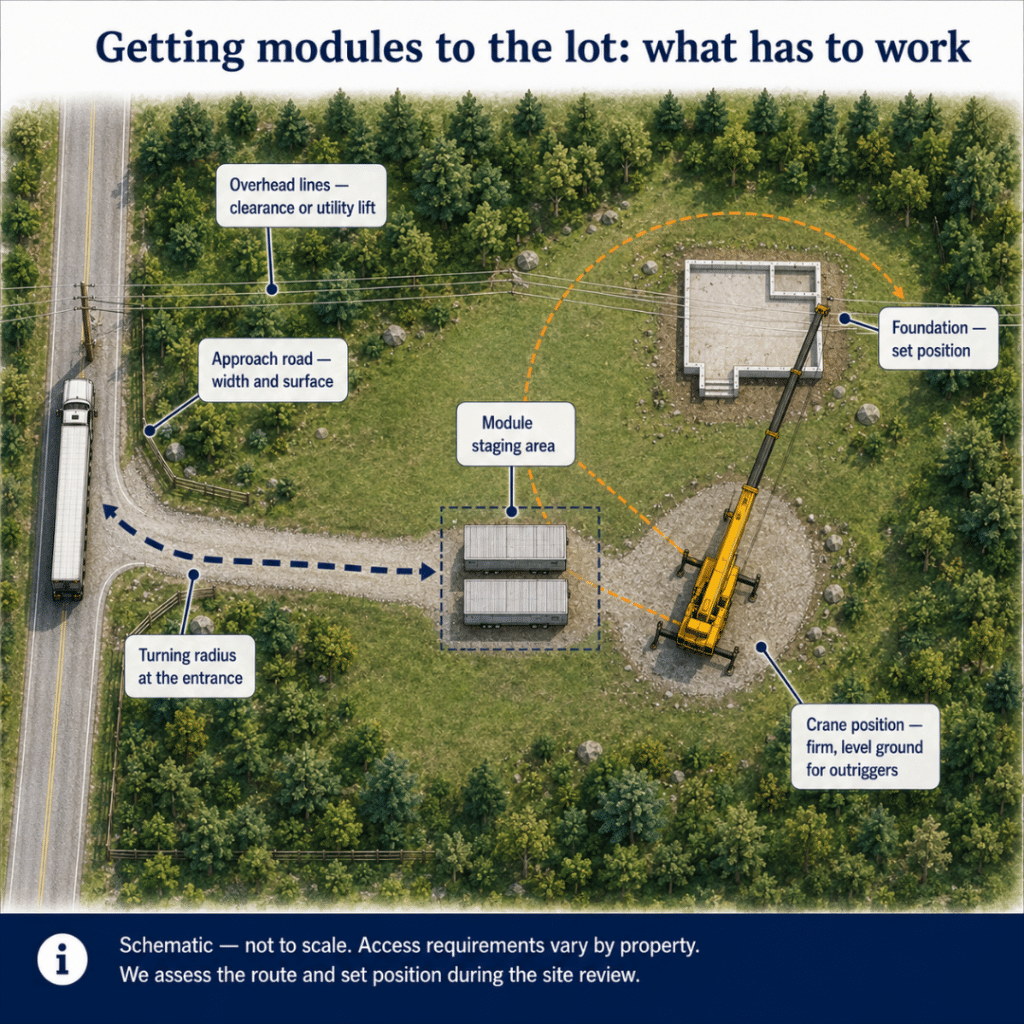
A set is four things in sequence: the truck gets in, the modules park, the crane sets up, and the lift reaches. Any one of them can fail on a lot that looks fine from the road.
Some things to check early:
• Bridge and culvert load ratings along the route, including spring half-load restrictions
• Tight bends beyond the driveway entrance, not just the entrance itself
• Seasonal road status — some Frontenac-area roads aren’t winter-maintained
• Ferry limits for Wolfe Island and Howe Island properties
Kingston sits directly on Highway 401, so the highway portion of a delivery is straightforward. The constraint is almost always the last few kilometres.
We assess that route during the site review rather than on delivery day — which is also why the installed price is confirmed after we’ve seen the property.
Waterfront Lots Near Kingston: What Changes
On a waterfront lot, the buildable envelope is usually smaller than the lot suggests. Between the conservation authority’s 50-metre top-of-bank regulated area, the zoning setback for your zone, septic separation distances from the water and the well, and any slope or erosion hazard, the area where a cottage can legally sit is often a fraction of the parcel.
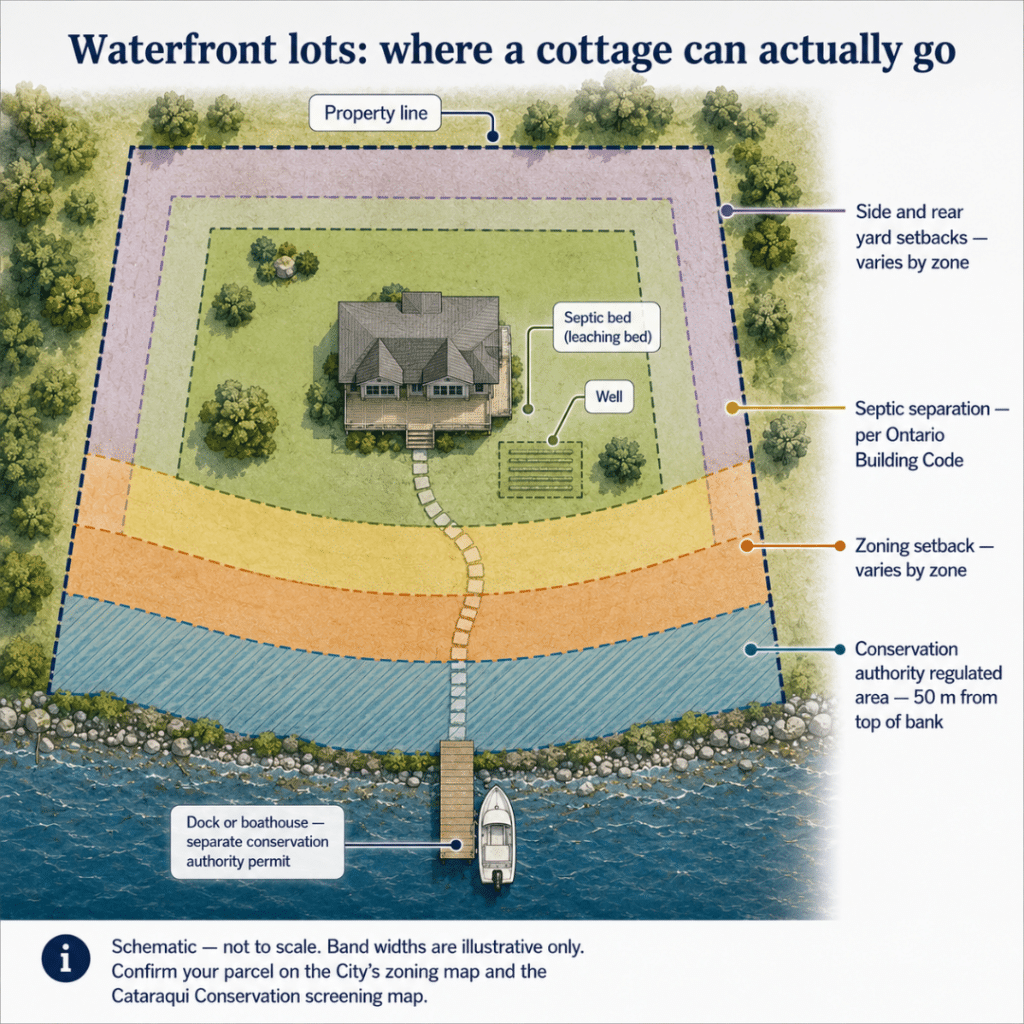
On a waterfront lot, several setbacks overlap before you get to where a cottage can sit. Check your parcel before you choose a floor plan.
Model size is decided by the lot, not by preference. This is why the small prefab cottages at the top of this page matter more on waterfront land than the floor plans people usually arrive wanting — a 505 to 788 sq ft footprint fits envelopes a 1,200 sq ft plan cannot.
Foundation choice narrows. Sloped shoreline, shallow soil over bedrock and high water tables are common on Frontenac-area waterfront, and each pushes the decision between piles, slab, crawlspace and full basement in a different direction against geotechnical reality rather than preference. Our overview of how foundation options compare on difficult sites covers the trade-offs. A dock or boathouse is a separate conservation authority permit on its own timeline.
If waterfront is the goal and you haven’t yet bought, the screening map and a zoning lookup on any candidate parcel will tell you more about what you can build than any listing description.
Working with a constrained envelope? The compact plans are built for exactly this — 505 to 788 sq ft footprints that fit where larger designs can’t.
Can a Prefab Cottage Be Used Year-Round Near Kingston?
Yes — provided two things are true: the cottage is designed and permitted as a year-round dwelling from the outset, and the lot supports year-round use.
The building envelope, heating, ventilation, plumbing protection and foundation all differ between a three-season cottage and one built for four. Specifying it correctly at design stage costs far less than converting later.
What changes for an Eastern Ontario winter
| Design area | What it covers |
|---|---|
| Envelope and energy efficiency | Insulation levels, air sealing, window performance and thermal bridging — designed to satisfy the energy requirements of the Ontario Building Code for your building type |
| Heating and ventilation | A system sized for occupied winters, plus mechanical ventilation — a well-sealed building needs deliberate air exchange |
| Plumbing protection | Service line depth, and protection of any plumbing running through unheated space beneath the floor |
| Foundation and frost | Footings below the local frost depth, which your engineer determines from the site and applicable design data |
| Roof and snow | Structure engineered to the ground snow and rain loads specified for your location in the Building Code’s climatic data |
Specification varies by model and by decisions made during design — ask for the figures on any model you’re considering. For how these choices come together across a whole build, see our guide to what makes a cottage genuinely four-season.
Year-round capability isn’t only a building question. It interacts directly with financing: the mortgage programs below test whether the property suits full-time year-round occupancy and whether it has year-round vehicular access.
A perfectly winterized cottage on an unplowed road can still fail that test.
Permits, Approvals and How the Build Works
A factory-built cottage requires a full building permit in Kingston, exactly like a site-built home. Factory construction addresses what happens inside the plant; foundation, site erection, servicing connections and final occupancy remain municipally reviewed and inspected on your property. Applications are submitted through DASH, the City’s online development and services portal.
Stage 1 — Consultation and site review
Intended use, budget range, and the property itself: servicing, access, constraints. If you don’t own the lot yet, this is the most useful conversation you can have, because it shapes what to look for.
Stage 2 — Design and customization
Start from a preconfigured plan or a custom direction, then refine layout, finishes, exterior character and performance specification. Decisions lock before production begins — the mechanism behind the cost predictability described earlier.
Stage 3 — Approvals and municipal coordination
In order:
1. Confirm zoning for your parcel — zone, setbacks, permitted uses, height
2. Confirm conservation authority status on the screening map; apply for a permit if regulated
3. Complete the site evaluation for the sewage system if the lot isn’t municipally serviced
4. Prepare drawings — site plan with setbacks and dimensions, engineered foundation drawings, lot grading and drainage, energy compliance documentation
5. Submit through DASH, including the sewage system application where applicable
6. Pay development charges and permit fees at the point the permit issues
Steps 1 through 3 should happen before you finalize a model. Permit coordination and project management across these steps is part of what we do alongside your build; applications are made in the property owner’s name.
Stage 4 — Production, delivery and installation
The cottage is built indoors while excavation, foundation and site preparation progress on your lot in parallel rather than sequentially. Modules are transported, set by crane and connected, with licensed trades completing mechanical, electrical and plumbing connections on site, followed by inspections and occupancy.
Anyone quoting a total timeline without seeing your lot is quoting the factory portion and omitting approvals — where nearly all the variability lives.
Building Services: 1211 John Counter Boulevard, Kingston · 613-546-4291 ext. 3280 · [email protected]
For the province-wide picture, see our guide to what the permit process involves for a factory-built home in Ontario.
Backyard Cottages, Garden Suites and Additional Dwelling Units in Kingston
The City of Kingston permits additional residential units on most properties — but explicitly not on rural properties.
The City notes these units are also known as secondary suites, in-law suites, carriage houses or tiny homes. Whatever the label, a backyard cottage or additional dwelling unit (ADU) behind an existing house is a different project from a cottage on its own lot, with a different rulebook.
The rules in brief
| Rule | What applies |
|---|---|
| Where they’re allowed | Most Kingston properties — not rural properties |
| Size limit | Gross floor area equal to or less than the principal dwelling |
| Parking | At least one space, tandem permitted |
| City incentive | Forgivable loan up to 50% of project cost or $40,000, whichever is less |
On size: gross floor area is measured across all storeys including finished attic space, but excludes open porches, balconies and attached garages — which matters when comparing our model sizes against your principal dwelling.
Where a detached unit is not permitted
• Cellars or basements within lands identified as “Sewer Surcharging” or “Sewer Surcharging (Combined Storm and Sewer Systems)”
• Lands identified as “Sewer Capacity Limitations”
• Lands identified as Loughborough Lake
• Any lot already containing two or more dwelling units, a garden suite, boarding house or lodging house
• Lands subject to natural hazards
The incentive
The detached grant is a forgivable loan paid after occupancy, not up front. Interior conversions carry a separate, lower amount.
Conditions:
• Five-year affordability period — rent may not exceed 90% of average market rent for a comparable unit
• Tenant income limits apply at the start of each new tenancy
• First-come, first-served while funding remains
Confirm current availability and the full conditions with the City’s Affordable Housing Department before budgeting around it.
Pre-reviewed plans: what they do and don’t cover
The City publishes pre-reviewed detached unit plans developed with local companies.
| Pre-review | What it means for your permit |
|---|---|
| ✓ Covers | Ontario Building Code compliance |
| ✗ Does not cover | Zoning compliance |
Every property is still assessed for zoning through the permit process, because lot configuration and unit placement differ on every site. Our designs aren’t currently in that catalogue and follow the standard permit route.
Development charges
Kingston’s development charges by-law provides exemptions for additional residential units, with conditions.
Because those conditions determine whether the $34,814 above applies to your project, confirm your situation directly with Building Services rather than relying on any builder’s summary — including ours.
Used this way, a compact unit can support affordable homeownership by offsetting a mortgage, house a family member, or serve as an investment property. It is not available on rural land in Kingston, and that’s the first thing to check.
Financing a Prefab Cottage in Eastern Ontario
Financing depends heavily on whether your cottage will be a year-round dwelling or a seasonal one. CMHC’s Prefab Plus program supports factory-built homes with as little as 5% down and up to four staged draws, but requires a permanent foundation, suitability for full-time year-round occupancy, and year-round vehicular access — including for homes on an island.
A four-season home on a maintained year-round road is in the strongest position. The draw schedule is built for this sequence: land acquisition and site preparation, the unit cost on delivery, then post-installation and finishing.
A seasonal cottage on an unmaintained winter road, or an island property without year-round access, faces the access test as a genuine barrier — and it’s a lot question, not a building question. Resolve it before committing to a purchase.
Separately, the First-Time Home Buyers’ GST/HST rebate applies to primary residences and explicitly excludes seasonal recreational properties. If tax treatment forms part of your budget, intended use determines it.
These are program terms, not lender decisions. Individual underwriting, appraisal treatment and insurance for a module in transit vary between lenders. Mortgage pre-qualification before you finalize a design is worth the hour — it tells you which of the two paths above you’re actually on.
More on financing a build that isn’t a conventional mortgage.
Prefab Cottages Kingston: Frequently Asked Questions
How much does a prefab cottage cost near Kingston, Ontario?
Our models start at $229,500 for a small one-bedroom design and run to $949,500, including delivery and installation on a prepared site. On top of that: foundation, site preparation, servicing, $34,814 in City of Kingston development and education charges for a new single-detached dwelling, and building permit fees at $14.95 per square metre with a $152 minimum.
What’s included in the starting price, and what isn’t?
The cottage built to your specification, plus delivery and installation on a prepared site. We confirm that installed figure after a site visit, because road access, crane positioning and site conditions affect the set.
Not included: foundation, site preparation, servicing, permits and municipal charges. Those are quoted separately against your lot, and they’re the reason a model price and a project budget are different numbers.
Who builds and delivers prefab cottages in the Kingston region?
My Own Cottage builds in Ontario and delivers across Eastern Ontario, including Kingston, Frontenac County, Gananoque, Napanee, and the surrounding townships.
Our production facility isn’t in Kingston. Most factory-built cottages in this region arrive from elsewhere in the province, and Kingston sits directly on Highway 401, so the highway portion of a delivery is straightforward — the constraint is almost always the last few kilometres. What matters more than the distance from the plant is who assesses your site, coordinates the permits and manages the installation.
Are there cheap or affordable prefab cottages in Kingston?
Not at the prices advertised on this search. Figures below roughly $100,000 almost always describe a delivered cabin, a shell or a kit rather than a permitted year-round dwelling.
Within finished modular cottages, the most affordable route is a compact plan on a serviced lot — smaller footprint, lower permit fee, no well or septic to install. The real money moves with the lot and its servicing, not the model.
Why are some prefab cabins advertised at $15,000?
Different product. Delivered cabins and bunkies in the $10,000 to $30,000 range are typically sold without plumbing, permanent foundations, servicing or dwelling classification. They suit hunting camps, workshops and backyard offices. They aren’t designed to be permitted for year-round occupancy.
What’s the difference between ready-to-move, modular, and prefab cottages?
“Prefab” is the umbrella term. A modular home arrives as finished modules set by crane and completed on site. A ready-to-move (RTM) cottage is built complete and transported whole, so it’s limited by road transport width. Panelized homes arrive as wall and roof panels for on-site assembly. Kit homes and log cabin packages arrive as cut materials, shell components and drawings. Manufactured homes are built on a permanent steel chassis — a different product class under different standards.
The distinction matters because it determines what you receive, what you still have to build, and how the unit is treated for permits and financing.
Which models suit a small or narrow lot?
The compact plans — Fox Den at 505 sq ft through Hideaway at 788 sq ft — fit buildable envelopes that larger plans cannot.
On waterfront and rural lots near Kingston, that envelope is usually set by the conservation authority’s regulated area, the zoning setback for your zone, and septic separation distances rather than by the lot’s overall size. Confirm the envelope before choosing a plan. It’s the constraint that most often forces a redesign.
How energy efficient are modern prefab cottages?
Factory construction helps in two ways that are difficult to match on site: components are built to consistent tolerances indoors, and the envelope is assembled without weather exposure, which supports better air sealing.
Actual performance depends on the specification you choose — insulation levels, window performance, air tightness, and the heating and ventilation system — not on prefab as a category. Any Ontario build must meet the energy requirements of the Ontario Building Code for its building type. Ask for the specification of the model you’re considering rather than a general efficiency claim. Ours included.
Where can I find independent reviews of a prefab cottage builder?
Start with the Ontario Builder Directory at obd.hcraontario.ca. Operated by the HCRA, it shows licensing status, years active, homes built, any regulatory actions and warranty coverage — verified information no builder’s own testimonials can give you.
Beyond that, look to third-party review platforms and homeowner communities rather than seller-published quotes, and ask any builder to connect you with recent customers directly. We’d rather you check than take our word for it.
Do I need a building permit for a factory-built cottage in Kingston?
Yes. A full building permit is required regardless of where the cottage is built. Factory construction covers the plant portion; foundation, site erection, servicing and occupancy remain municipally reviewed and inspected on your property. Applications go through DASH, the City’s online development and services portal.
Which zoning by-law applies to my Kingston property?
Kingston Zoning Bylaw 2022-62 applies across the city. A small number of properties remain under a former by-law where 2022-62 shows them as “Not Subject to this Bylaw.” Check your address on the City of Kingston zoning map — it displays both the zone and the applicable by-law.
When does Cataraqui Conservation need to be involved?
Generally within 30 metres of a wetland, 50 metres of the top of bank of a river, stream, lake or watercourse, or 15 metres of a floodplain — and for any dock, boathouse or shoreline alteration.
Check the regulation screening map before commissioning a design. Where a sewage system is going in near a water body, the conservation permit must come before the building permit.
Who issues the septic permit in Kingston?
The City of Kingston, for on-site sewage systems up to 10,000 litres per day. Above that, the Ministry of the Environment, Conservation and Parks. Class 4 leaching bed permits are $950 at 4,500 litres per day or less, $1,050 above that threshold.
Can I put a prefab cottage on rural property near Kingston?
As a principal dwelling, yes — subject to zoning, servicing and conservation approvals. As an additional dwelling unit behind an existing house, no. The City states additional residential units are available on most Kingston properties with the exception of rural properties.
What are the rules for a tiny home, garden suite or backyard cottage in Kingston?
The City treats these as additional residential units: permitted on most non-rural properties, gross floor area no greater than the principal dwelling, at least one parking space which may be tandem, and several excluded land categories including Loughborough Lake and lands subject to natural hazards. Check the restricted-areas list before assuming a backyard unit is possible on your lot.
We’ve inherited a family lot near Kingston. What should we check first?
Zoning and servicing, in that order. An inherited parcel may never have been built on, may have no septic approval or well, and may sit within a conservation authority regulated area.
Run the address through the City’s zoning map and the conservation screening map before assuming anything, and confirm it’s a legally conveyable lot of record. Those three answers determine whether the project is straightforward or needs planning approvals first.
How should the site be prepared before a modular cottage arrives?
Four things need to be ready: a completed foundation built to the engineered drawings, cleared and compacted crane access with firm level ground for outriggers, utility services stubbed to the correct locations, and lot grading and drainage per the approved plan.
Sequence matters — foundation before delivery, and the conservation authority permit before the building permit wherever the property is regulated. We coordinate the schedule against factory production.
Can I get a mortgage on a prefab home in Ontario?
Yes. CMHC’s Prefab Plus program supports factory-built homes with as little as 5% down and up to four staged draws, subject to a permanent foundation, suitability for full-time year-round occupancy, and year-round vehicular access — including for homes located on an island.
Lender-specific underwriting and appraisal treatment vary. Pre-qualify before you finalize a design, because the answer determines which models and which lots are realistic.
How long does the whole process take?
Design and approvals, factory production and site work run on three separate clocks. Approvals depend on your municipality, your property and whether conservation review applies — that’s where nearly all the variability lives. Once approvals are in hand and the site is ready, factory production and delivery run to a scheduled timeline we commit to in writing. We give whole-project timelines after the site review, not before.
Can modules reach an island property?
Sometimes. Ferry weight and dimension limits govern what can cross to Wolfe Island or Howe Island, and those limits need confirming against specific module dimensions before design. Island access also affects financing, since the year-round vehicular access requirement extends to island homes.
Plan Your Kingston Build
The cottage is the straightforward part. The lot decides everything else — which municipality, how it’s serviced, what’s mapped on it, and whether it can be reached.
If you own the property, we’ll review those four questions against your parcel and give you a scoped budget separating the cottage from the site work. If you’re still looking, that same review tells you what to check before you buy.
• Request a Free Consultation
• Call Us Directly: (705) 345-9337
• View Our Design Catalogue
Alternatively, for your convenience, you can also simply fill out the contact form below and we’ll get back to you soon!

Contact Us
We usually respond within 24 hours!
- Comprehensive Warranty
- Best Price Guarantee
- Exceptional Service
How We Verified This Page
Every municipal figure comes from a primary source, dated and linked. Fees, charges and program terms change — confirm current figures before you budget.
| Fact | Source |
|---|---|
| 2026 development charges, permit and septic fees | City of Kingston Building Services Fees Summary, effective January 1, 2026 |
| Zoning Bylaw 2022-62 status and zone map | City of Kingston — Zoning Bylaws |
| Sewage system permit authority and thresholds | City of Kingston — Plumbing and Sewage System Permits |
| Additional residential unit rules and restricted areas | City of Kingston — Additional Residential Units |
| Incentive terms | City of Kingston — ARU Incentive Programs |
| Pre-reviewed detached plans and their limits | City of Kingston — Pre-Reviewed Detached ARUs |
| Regulated area thresholds and review timelines | Cataraqui Conservation — Planning & Permitting |
| Builder licensing and warranty lookup | Ontario Builder Directory |
Verified August 8, 2026. Development charges are indexed and change on a set schedule. Incentive funding is limited and first-come, first-served. Conservation authority mapping is property-specific and may extend beyond the minimum distances stated here.
About the Author

Sean Stevenson is Chief Marketing Officer and Buyer Experience Lead at My Own Cottage Inc., an HCRA-licensed, Tarion-enrolled prefab home builder based in Orillia, Ontario.
For five years, Sean has guided Ontario buyers through the full prefab cottage process alongside the company’s build team — from lot assessment and all-in budgeting to zoning, permits, development charges and final occupancy. He focuses on the part most buyers underestimate: what a factory-built cottage actually costs once the foundation, servicing and approvals are accounted for.